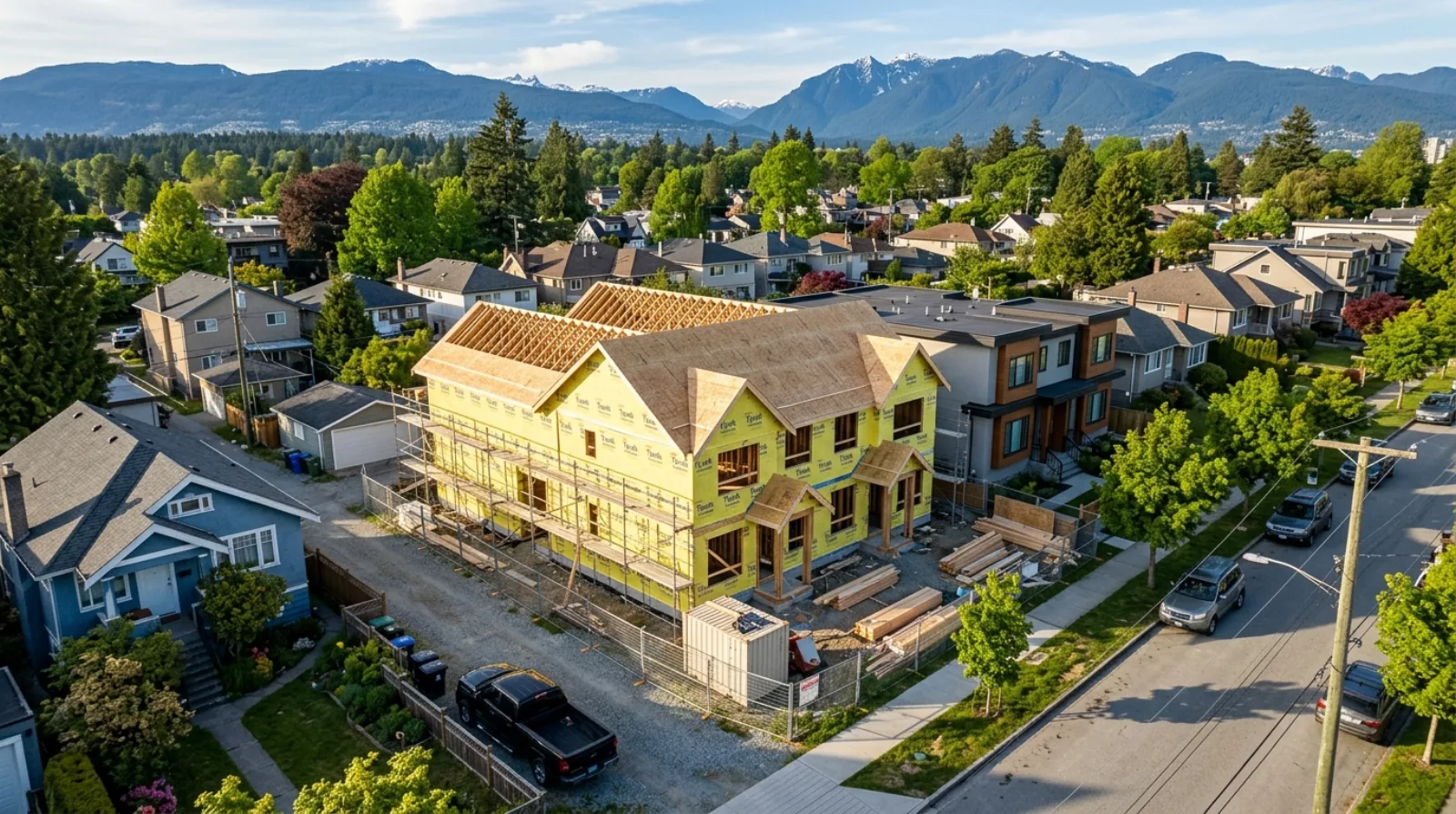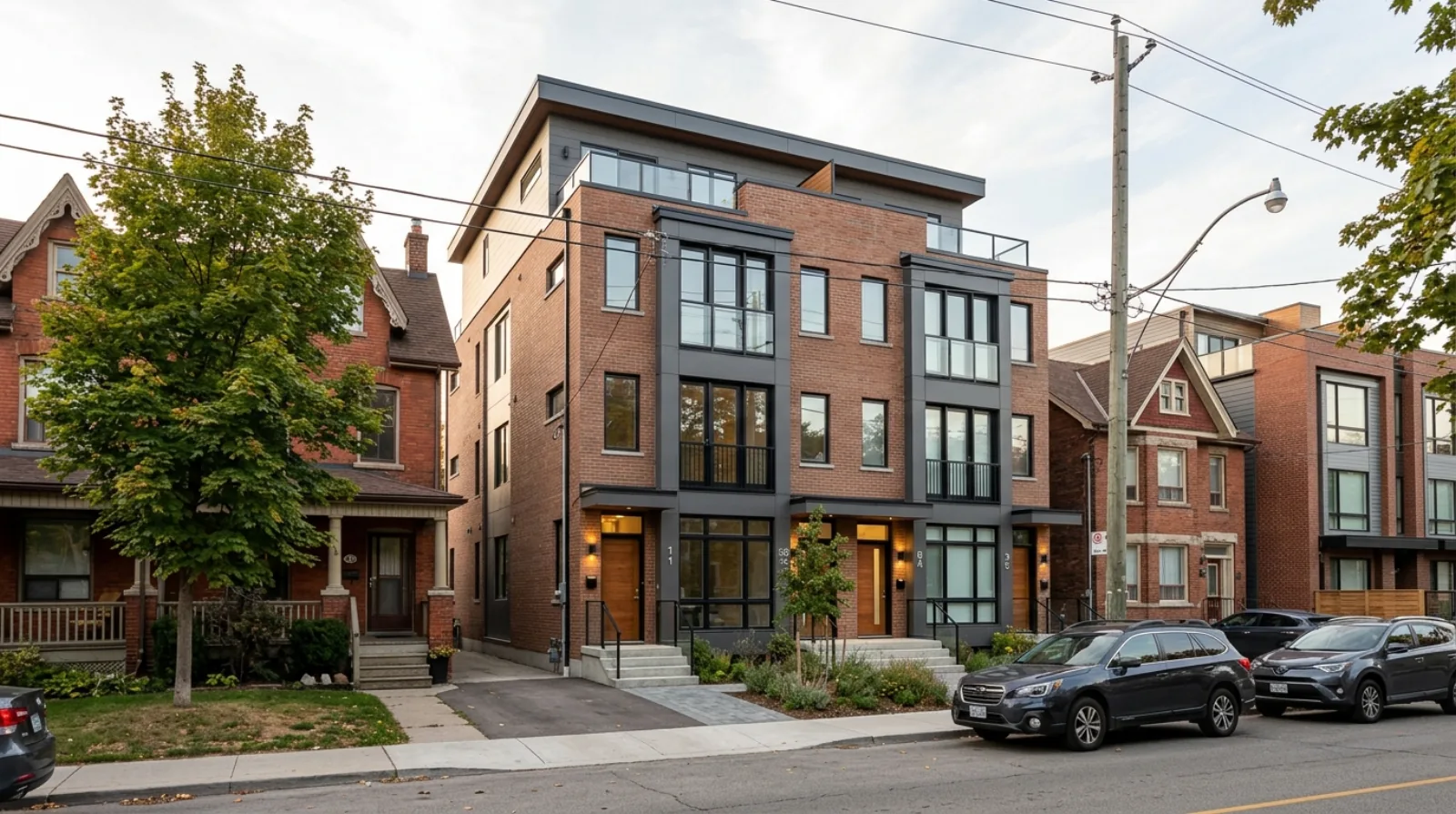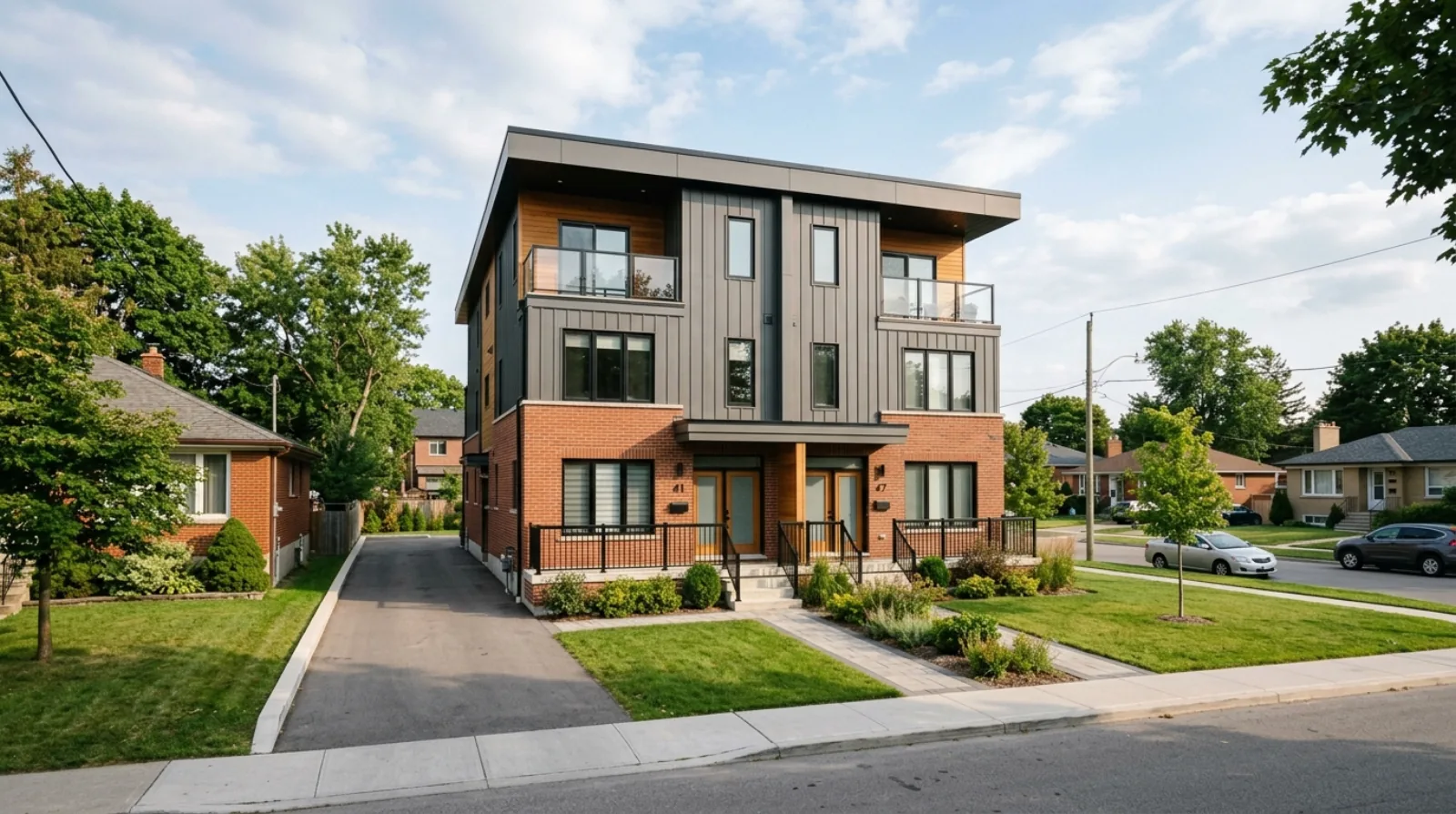
If you’ve ever tried to sketch a sixplex on a Vancouver 33-foot lot, you’ve run into the same wall: two staircases eat your floor plate. Two stairs, two corridors, two exit paths — and suddenly the rentable area per floor drops 20–25% compared to the ideal layout. That’s the difference between a project that pencils and one that doesn’t.
In late 2024, BC quietly changed this. The single-stair reform makes small multiplexes work that previously didn’t.
The rule that changed
Until 2024, the BC Building Code required two means of egress (two staircases) for any residential building over a certain occupant load and configuration. For most three-storey, six-unit walk-ups, that meant two stairs. The City of Vancouver added its own restrictions on top.
The province updated the code to allow a single point of egress — one staircase — for buildings up to a defined size and height envelope, with specific fire-safety requirements (sprinklers throughout, limited unit count per floor, capped travel distance, fire-rated stair construction). The BC Office of Housing and Construction Standards published the technical bulletins.
Vancouver’s planning and licensing department adopted compatible local provisions in 2024–2025. The exact thresholds — number of units, building height, sprinkler specifications — are technical and you should confirm them with a code consultant. What matters at a strategic level: a sixplex on a 33-foot lot can now be designed with one stair, where it previously required two.
Why two stairs broke the math
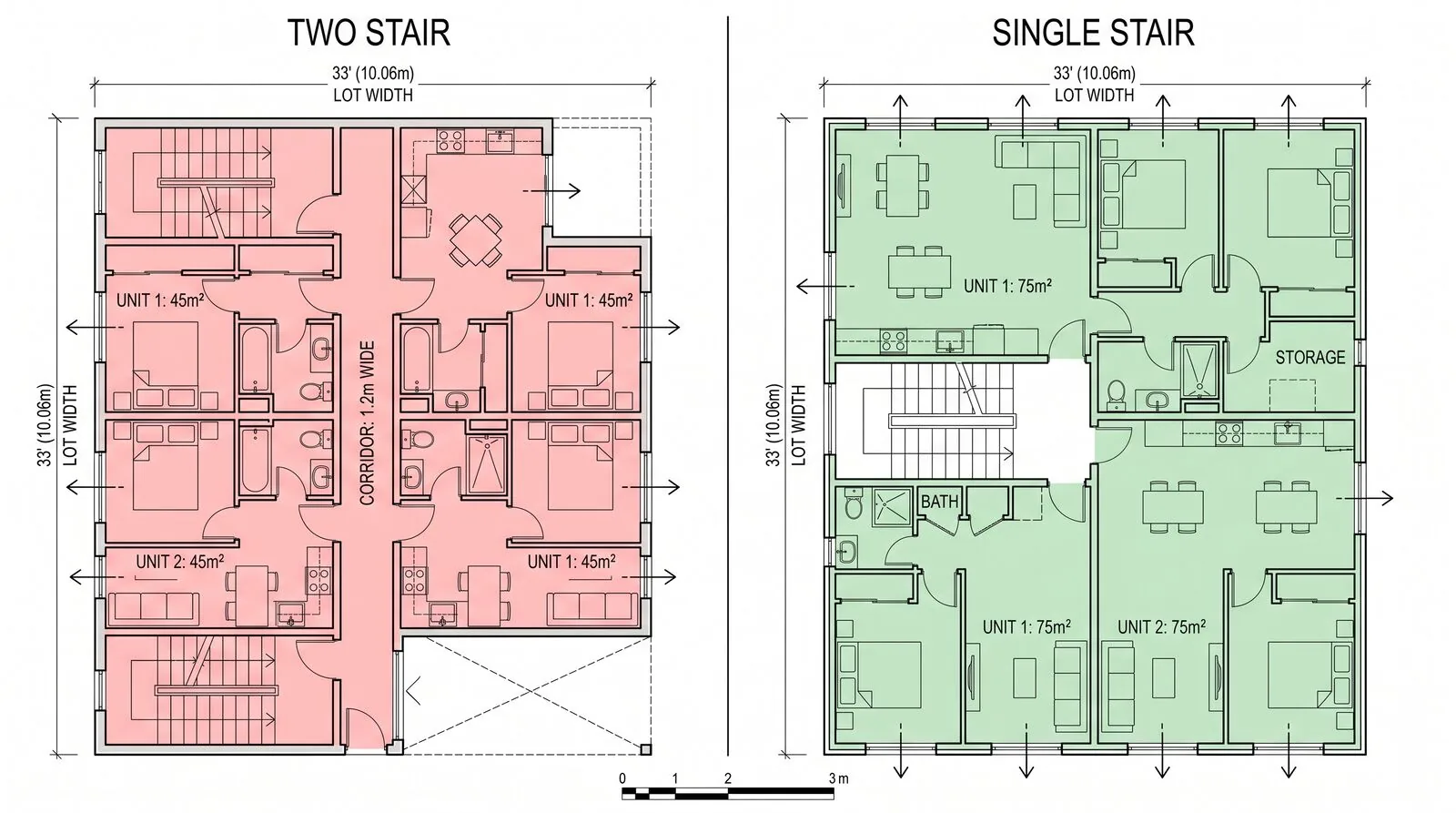
A typical 33-foot Vancouver lot is roughly 33 ft × 122 ft (≈4,026 sq ft). Building three storeys at 0.7 FSR gets you about 2,800 sq ft total — call it ~930 sq ft per floor.
With two stairs:
- Each stair takes ~80 sq ft per floor
- Add a corridor connecting them: ~120 sq ft per floor
- Total non-rentable per floor: ~280 sq ft
- Rentable per floor: ~650 sq ft, split across two units = ~325 sq ft per unit per floor
You can stack to make units larger. But two-stair layouts on narrow lots produce small, awkward units with poor cross-ventilation, no through-units, and tight kitchen layouts.
With single stair:
- One stair: ~80 sq ft per floor
- Minimal corridor or none: ~20 sq ft
- Total non-rentable per floor: ~100 sq ft
- Rentable per floor: ~830 sq ft, split across two units = ~415 sq ft per unit per floor
Same building envelope. ~25% more livable area per unit. Better light. Through-unit floor plans. Real bedroom layouts.
Why the change matters operationally
The single-stair reform doesn’t just produce nicer units. It changes which sites can host a sixplex at all.
Pre-reform, on a 33-foot lot, a six-unit project either:
- Built tiny units (sub-500 sq ft) that didn’t compete with anything else in the market
- Stacked taller — three storeys plus a roof terrace — and ate cost on framing and structural
- Defaulted to a fourplex instead, leaving density on the table
Post-reform, the same lot can host a six-unit walk-up with reasonable unit sizes (700–900 sq ft) and a clean exit path. That’s the design that already works in Tokyo, Auckland, Berlin, and most of Europe — places we’ve covered in the international missing middle comparison.
The fire-code logic behind the reform
The objection to single-stair multiplexes for decades was fire safety. The argument went: if the stair is blocked, occupants are trapped. North American codes added a redundant exit as the standard answer.
Modern fire engineering says this is over-conservative for small buildings. With:
- Full sprinkler coverage
- Fire-rated stair construction (the stair itself is the safe zone)
- Limited travel distance from any unit to the stair
- Capped unit counts per floor
…the single stair becomes a “protected exit” — equivalent to two unprotected stairs in older designs. This is how most of Europe and Japan have been building four-to-six-storey residential for a century. Their fire injury rates are not higher than ours. The National Research Council Canada has published reviews backing this.
The BC code change adopted this logic for small multiplexes specifically. It’s not a blanket allowance — there are clear limits on building size, occupant load, and travel distance. But within those limits, single stair is now permitted.
Where it applies and where it doesn’t
The single-stair allowance is limited. It generally applies to:
- Smaller residential buildings (specific floor area and storey thresholds)
- Limited unit count per floor (typically two)
- Specific sprinkler and fire-rating requirements
- A defined maximum travel distance from unit to stair
If a project exceeds any of these — adds a fourth storey, expands the floor plate, exceeds units per floor — the two-stair requirement kicks back in. So this isn’t “single stair for any multiplex.” It’s “single stair for the small-multiplex envelope, which happens to be exactly the Bill 44 product type.”
That alignment is intentional. The province built the building-code change to support the zoning change. Without single-stair, a lot of Bill 44 projects would have been theoretically legal but practically uneconomic.
What this means for owners on narrow lots
If you own a 33-foot or 40-foot lot and the math on a sixplex didn’t work in 2023, run it again now. Specifically:
- Ask your architect to model the project with a single stair and confirm code compliance
- Recompute usable floor area per unit
- Re-run rents at the new unit sizes — they’re now in the 700–900 sq ft range, which is the sweet spot for CMHC MLI Select financing
- Recheck DSCR with the new rent total
In our underwriting, the single-stair update flipped the answer on roughly 1 in 5 narrow-lot sixplex models we’d previously screened out. That’s not a small number.
For broader context on the Bill 44 framework these buildings live within, see the missing middle hub and Bill 44 explainer.
What still needs work
The single-stair reform is a step. There are still friction points:
- Some municipalities haven’t fully aligned local bylaws with the provincial code change. Check with your specific city before assuming the path is open.
- Fire department review still drives schedule. Even with the code change, individual reviewers can flag requirements that effectively erase the benefit. A code consultant pays for themselves on day one.
- Inspection familiarity is uneven. Building inspectors need to recognize the single-stair allowance. The first single-stair sixplex on any inspector’s roster gets more scrutiny than the tenth.
These are normal teething issues for a new code provision. They’ll smooth out as more projects move through the system.
Comparison with other reform jurisdictions
BC isn’t first to do this. Seattle allows single stair up to four storeys for residential. New York City permits it for buildings up to a defined occupant load. Most of Europe — Germany, Austria, Sweden — has permitted it for over a century.
The American examples are useful comparisons because their fire-safety record is documented. Seattle’s small multiplexes built under their single-stair allowance have not produced elevated fire-fatality rates compared to two-stair buildings of similar size. Several US cities are now expanding single-stair allowances based on this data. The Mercatus Center has a good summary of the policy logic.
BC’s reform is conservative compared to Seattle’s. We allow it in a smaller envelope. That’s defensible — start small, measure, expand if outcomes are good. But it does mean BC isn’t yet capturing the full economic benefit available from the code change.
What this changes about how I underwrite
When we screen a narrow-lot multiplex now, we run two layouts: the legacy two-stair version and the new single-stair version. The single-stair version is almost always the build, but the two-stair version is the fallback if any specific lot or municipality doesn’t accept the new path.
The honest summary: single-stair reform is one of the most under-discussed parts of BC’s housing reforms. Bill 44 got the headlines. This building-code change quietly made a lot of those Bill 44 projects actually buildable. They go together. You can’t talk about one without the other.
For other under-the-radar reforms in the BC housing stack, see our Bill 44 one-year-in writeup and why most R1 lots still aren’t redeveloping.
— David Babakaiff, Co-Founder, VanPlex