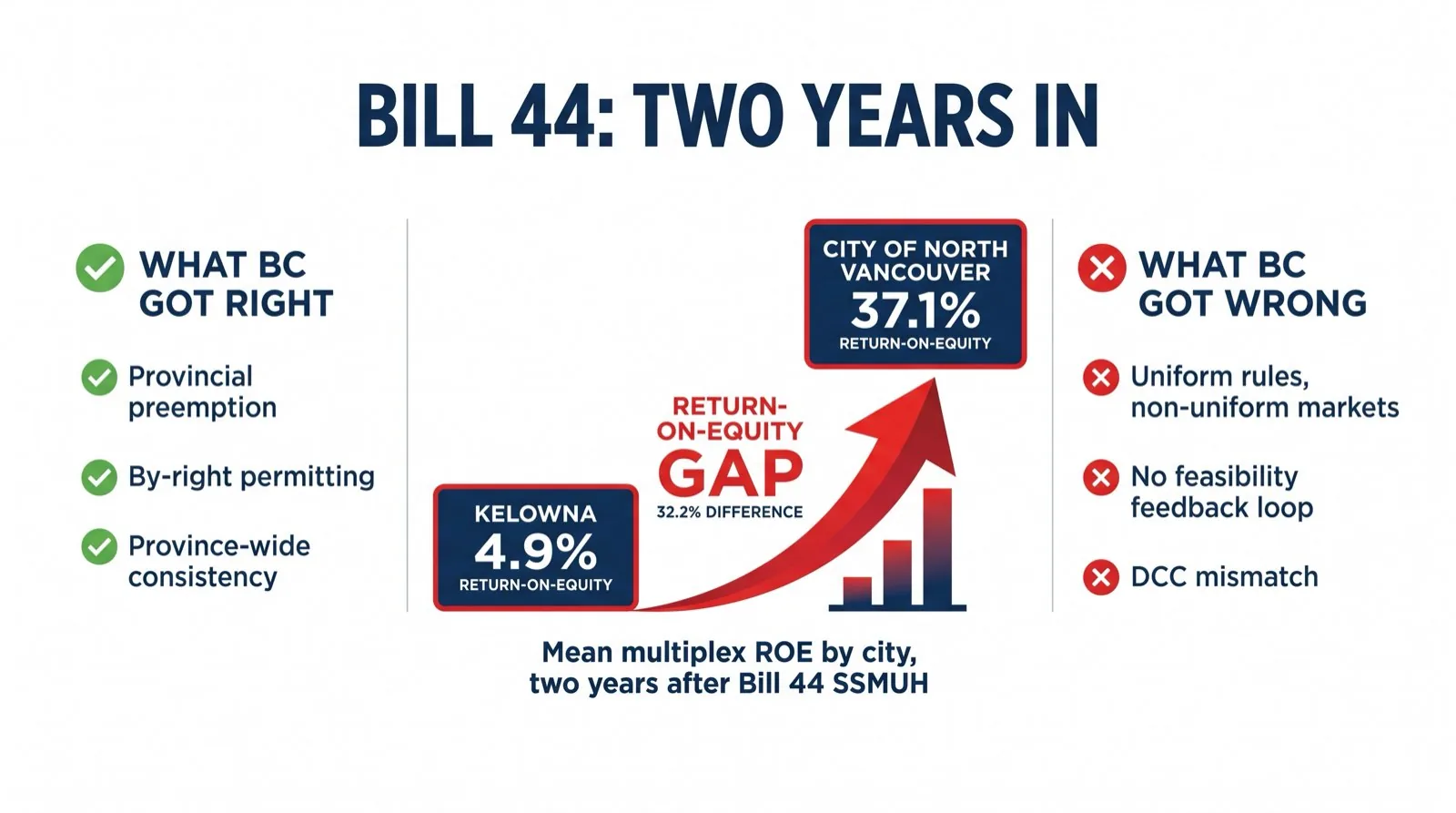
Bill 44 — the Housing Statutes (Residential Development) Amendment Act — got royal assent in November 2023 and took effect on June 30, 2024. The promise was simple: every BC municipality over 5,000 people would have to allow three to six units on most single-family lots, by right, no rezoning required.
It’s been more than a year. We can stop predicting and start counting.
This is what actually got built.
The basics, refreshed
Bill 44 didn’t legalize multiplexes everywhere. The number of units a lot can support depends on:
- Lot area — most municipalities require minimum thresholds (often around 280 m² for three units, larger for four-plus)
- Frequent transit proximity — lots within 400 m of frequent transit get up to six units; otherwise the cap is usually three to four
- Municipal bylaw conformance — every municipality had until June 30, 2024 to update zoning. Most did. A few openly resisted. We covered DNV’s refusal.
The SSMUH policy manual from the Ministry of Housing lays out the framework. Real implementation has varied widely.
What the permit data shows
Vancouver’s Issued Building Permits open dataset is the cleanest record we have. We pulled the May 2026 snapshot and ran it. Highlights:
- 2024 saw 440 new multiplex permits in the City of Vancouver. That was actually slightly down from 2023’s 443.
- 2025 saw 643 new multiplex permits — a 46% jump year-over-year and the first year multiplex permits crossed single-family permits.
- 2026 YTD (through May 9): 169 multiplex vs. 153 SFH. The trend is holding.
So the headline answer is: yes, the law worked, but with a delay. The first six to nine months after Bill 44 took effect produced almost no extra permits because owners and architects were still figuring out the rules and the application packages. The second half of 2025 was when the wave actually hit paper.
That’s a normal cycle for any zoning reform. Auckland, New Zealand saw the same lag after their 2016 Unitary Plan — almost no impact for 12 months, then a steady climb that overtook detached permits within three years. We covered the international comparisons in the Tokyo, Auckland, Minneapolis piece.
Where it worked
A few municipalities have moved faster than the rest:
- City of Vancouver. Already had R1-1 zoning in place ahead of the deadline. Has the most by-right multiplex pathway in BC and the largest density bonus stack.
- Burnaby. Updated zoning on schedule. Has been issuing multiplex permits steadily since late 2024.
- Kelowna. Adopted a permissive MF1 multiplex zone and went further than the bill required.
- New Westminster. Quietly one of the better-performing small cities — fewer headlines, more permits per capita than several larger neighbours.
What these have in common: they didn’t just rezone, they also rationalized parking, simplified application forms, and trained planning staff. Rezoning without those three is what produces a paper-only Bill 44.
Where it didn’t
Several municipalities did the legal minimum and not much else:
- District of North Vancouver publicly refused to comply with Bill 25 SSMUH amendments until forced. Permit volume stayed near pre-Bill 44 levels through 2025.
- West Vancouver resisted multiplexes throughout 2024 and 2025. The province eventually overrode them in 2026.
- Richmond complied on paper but kept restrictive parking minimums and onerous design review. Permit growth has been slow.
The pattern: where the local council was hostile or reluctant, technical compliance with the bill didn’t produce many actual permits. The legal floor isn’t the same as the practical ceiling.
Why most R1 lots still aren’t redeveloping
The bill made multiplexes legal on roughly half a million BC lots. The actual redevelopment rate so far is well under 1% per year. Why? Several reasons we’ve written about elsewhere:
- Land basis: most owners bought after 2017 at prices that don’t support new construction at current build costs. We covered this in most lots fail the BTR test.
- Construction cost inflation: BC residential construction costs ran up roughly 35–45% from 2020 to 2024 according to Statistics Canada’s residential building construction price index.
- Financing thresholds: most CMHC programs only kick in at five units. The five-unit threshold determines whether a project pencils.
- Owner inertia: most R1 owners are 60+ and not looking to develop. The reform helps people who want to develop. It doesn’t change the appetite of those who don’t.
We dug into this specifically in why most R1 lots still aren’t getting redeveloped.
What the bill did change, even where permits didn’t follow
Even on lots where nothing got built yet, Bill 44 did three things measurable from sales data:
- Land prices on under-built large lots stabilized. Lots with high redevelopment potential — corner sites, large frontages — held value through the 2024–2025 detached price softening. The optionality matters.
- Trades capacity rebalanced. Vancouver framers, electricians, and plumbers now quote multiplex jobs as a default category. Two years ago, “fourplex” was a custom request.
- Architects retooled. Most Vancouver residential architects now have a fourplex or sixplex template package. That cuts design fees and timelines for the next wave.
Those second-order effects don’t show up in permit counts. They show up in 2026 and 2027 build velocity.
Which jurisdictions actually let it work
If you’re an owner trying to figure out where Bill 44 actually translates to permitted projects, the cleanest signal is permit issuance rate per 1,000 R1 lots. Vancouver, Burnaby, New Westminster, and Kelowna are leading. North Van District, West Van, and a handful of smaller municipalities are lagging — sometimes by an order of magnitude.
The province has signalled it will keep pushing. Bill 25 amendments forced some of the laggards into compliance. The provincial multiplex map is now part of the planning toolkit. We’ll know in 2027 whether the second wave of enforcement closes the implementation gap.
What we’re seeing on the ground
In our own work, the change between fall 2024 and spring 2026 is concrete. Pre-Bill 44, most consultations started with “do I need a rezoning?” Now they start with “what tenure should I pick — strata or rental?” That’s the conversation a healthy by-right zoning system produces. The rezoning question doesn’t come up because the answer is almost always no.
Build cost is now the gating factor — not entitlement. That’s a meaningful shift. It means the next round of policy work needs to focus on cost: DCLs, city fees, parking minimums, single-stair reform, and financing. The legal supply is unlocked. The economic supply is the next bottleneck.
What to watch in 2026–2027
Three things we’re tracking:
- Permit-to-completion ratios. A permit isn’t a building. The 2025 multiplex permit boom translates to 2026–2027 completions. If completion rates lag permit rates by more than the typical 15–20%, something’s wrong with the trades pipeline.
- Strata vs rental mix. The tenure split tells us what the market is actually building. So far it’s roughly 60/40 strata-to-rental in Vancouver, more rental in Burnaby.
- Provincial enforcement pace. How aggressively will the province override holdout municipalities through 2026–2027? The West Van precedent is the test case.
The bill is real. The buildings are real. The numbers are real. Whether the next wave moves at the same speed depends on cost more than zoning at this point — and cost is the harder problem.
— David Babakaiff, Co-Founder, VanPlex