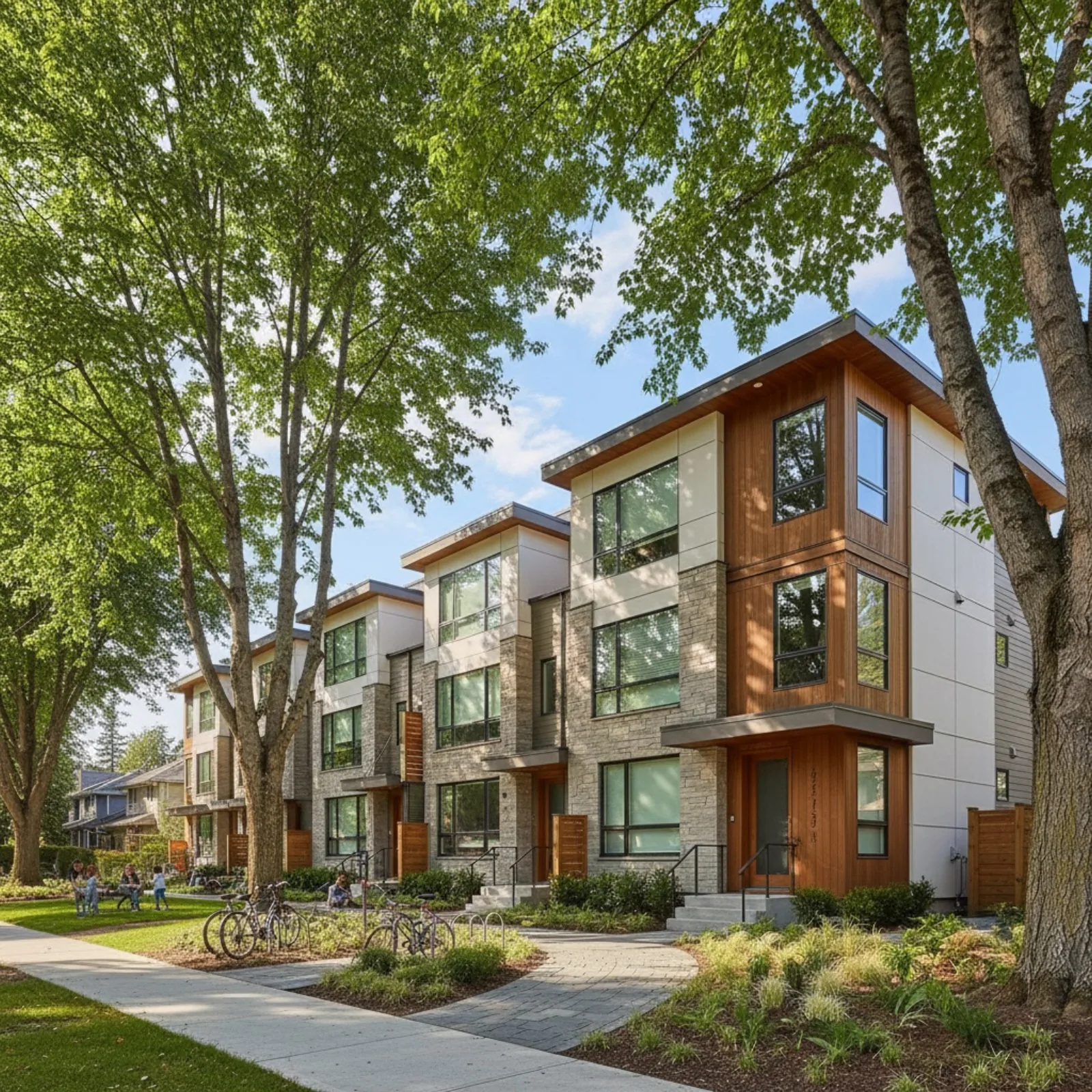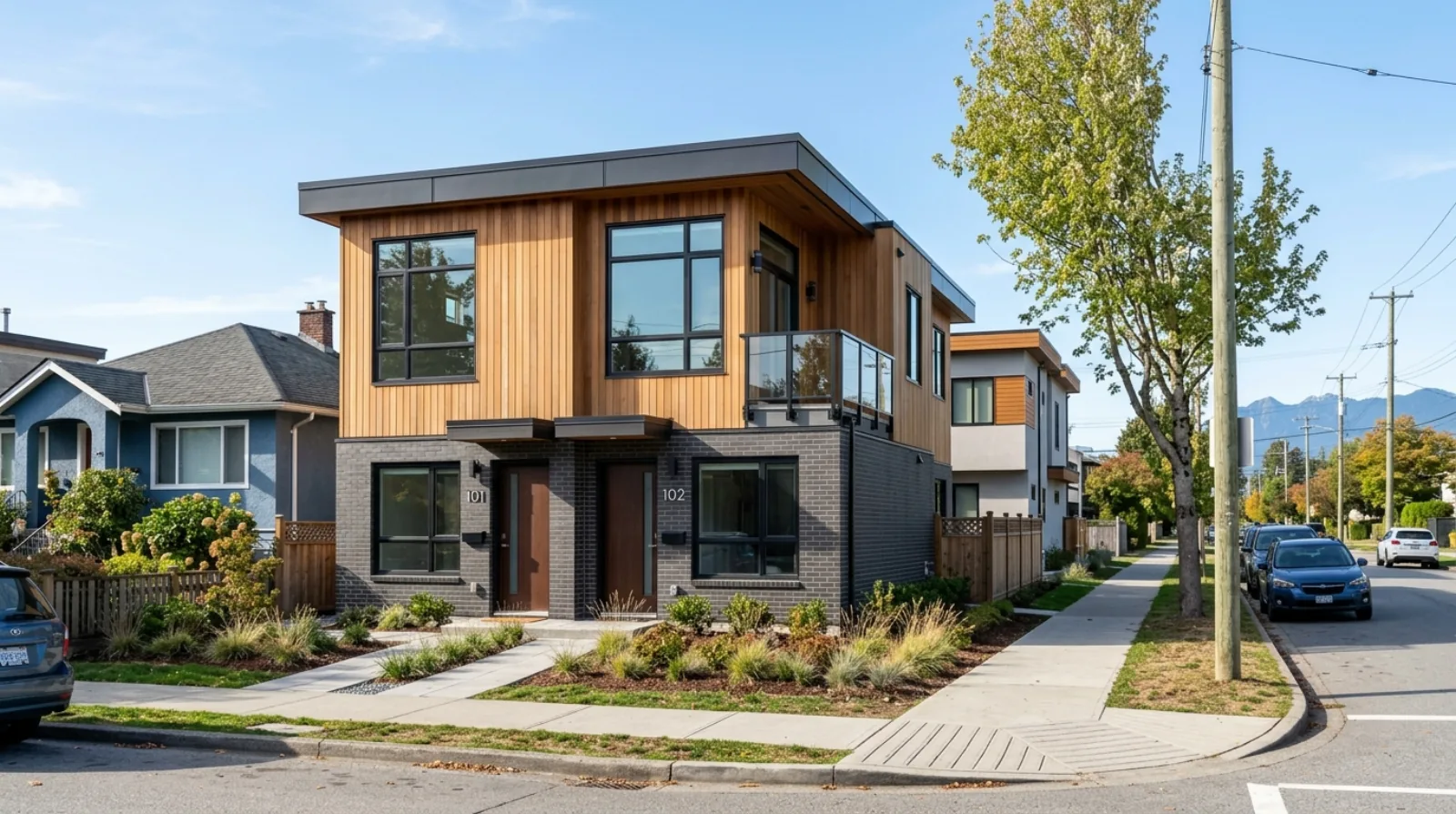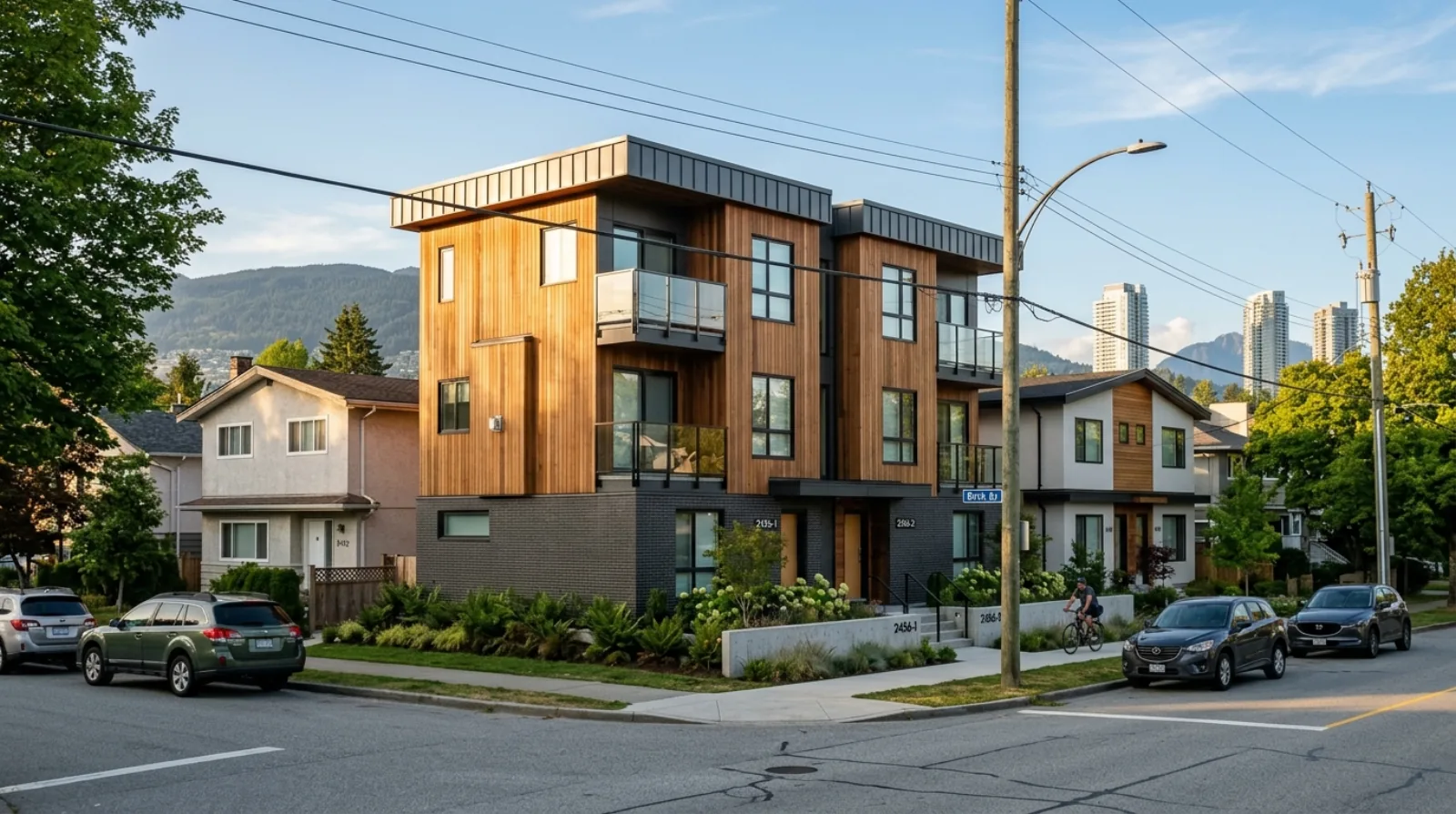
When BC was drafting Bill 44, the cities most often cited as models were Tokyo, Auckland, and Minneapolis. Three different countries, three different building cultures, three different reform paths — but each addressed the same problem: how do you legalize small-multiplex housing in neighbourhoods where it had been zoned out?
The lessons aren’t all comfortable. Some of what worked in those cities is going to be hard to replicate in BC. Some of what didn’t work tells us where to be careful.
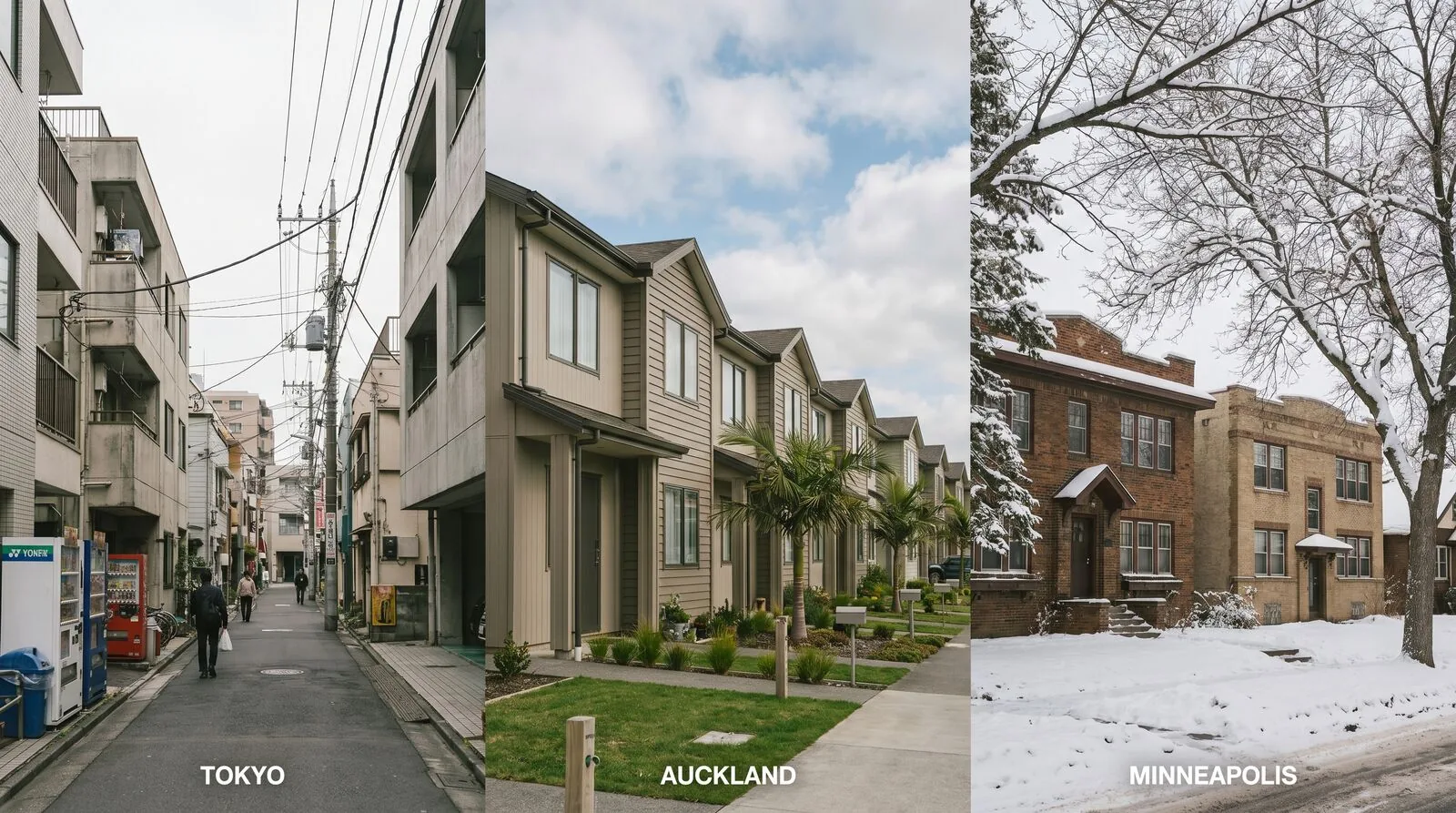
Tokyo: small lots, simple rules, many builders
Tokyo gets cited because it does something almost no North American city does: produce a steady, predictable supply of small-multiplex housing without much public drama. Population stayed roughly flat between 2000 and 2020 while prices stayed flat in real terms. That’s not magic — it’s the product of two structural choices.
Choice one: zoning is national. Japan’s land-use system is set by the Ministry of Land, Infrastructure, Transport and Tourism (MLIT), with 12 zoning categories that apply consistently across the country. Local cities tweak details but can’t add municipal-level overrides that contradict the national framework. The result: a developer in Tokyo, Osaka, or Nagoya knows the rules without re-learning them every time.
Choice two: small lots are normal. A typical residential lot in Tokyo is 60–80 m² — about 650–860 sq ft. Buildings on these lots are commonly three to four storeys with two to four units. The financing, building code, and craft tradition all assume small lots and small buildings. North American codes were written for either single-family detached or institutional-scale apartments. Tokyo has a robust middle.
What we can copy: the principle that small lots and small buildings should have a simple, predictable code path. The single-stair reform in BC is a step in this direction. Tokyo has been doing single-stair for decades.
What we probably can’t: the national zoning structure. Canada’s constitutional division puts municipal zoning under provincial jurisdiction, and BC’s Bill 44 is the closest we’ve come to a province-wide land-use framework. We can’t go higher than provincial.
The Brookings Institution and Urban Institute have published comparisons of Japanese and US/Canadian land-use systems. The takeaway is consistent: Tokyo doesn’t have one big lever. It has a hundred small ones, all pulling in the same direction.
Auckland: the closest comparison
Auckland is the most directly relevant model because the zoning reform happened recently, in a comparable Anglo-legal framework, in a comparable real-estate market with a comparable detached-house default.
In 2016, Auckland adopted the Unitary Plan, upzoning roughly three-quarters of residential land to allow more units per lot — duplex, terraced, low-rise apartment, depending on zone. The effect was studied by University of Auckland economist Ryan Greenaway-McGrevy, whose papers on the post-Unitary-Plan permit and price data are required reading for anyone working on Bill 44.
Three findings stand out:
- Permit response was fast but not immediate. Auckland saw a clear acceleration in attached-housing permits within 12–18 months of the plan taking effect. Detached permits started to decline in roughly the same period. This is the same lag we’re seeing in BC after Bill 44 — see our one-year-in writeup.
- Price growth slowed in upzoned areas. Compared to a control of similar non-upzoned NZ cities, Auckland’s price growth was meaningfully slower in the years after the reform. Greenaway-McGrevy’s papers estimate a per-year price-growth gap that compounded into a substantial cumulative effect.
- The new supply was overwhelmingly attached. Townhouses, terraces, and small apartment buildings — exactly the “missing middle” types — accounted for the bulk of post-reform permits. Detached homes shrank as a share of new supply.
What Auckland tells us: the reform works, but it takes time, and the price effect is real but modest in any single year. The cumulative effect over five to ten years is large.
What Auckland warns us about: not every neighbourhood reformed equally. Some upzoned areas saw rapid redevelopment; others barely moved. The factors that drove the difference — transit access, lot size distribution, infrastructure — are the same factors driving uneven Bill 44 implementation across BC. We see the same pattern in why most R1 lots still aren’t redeveloping.
Minneapolis: the cautionary tale on legal exposure
Minneapolis got famous in 2018 for Minneapolis 2040, the first major US city to eliminate single-family-only zoning city-wide. The plan permitted up to three units (a “triplex”) on every residential lot.
The plan also became a teaching case in how reforms can be slowed by legal challenges. Several lawsuits — primarily on environmental-review grounds — held up implementation for years. The Minnesota Environmental Policy Act required environmental analysis of the plan before it could take effect, which was litigated through state courts.
What Minneapolis tells us:
- Procedural challenges can delay reform implementation by years. The legal questions weren’t about the merits of upzoning — they were about whether the proper procedural boxes had been ticked. BC has avoided this so far because Bill 44 is a provincial statute, not a municipal plan, and provincial statutes are harder to challenge on environmental-review grounds.
- Permit response in Minneapolis was modest. Through the years the plan was active, triplex permits in single-family zones rose but not dramatically. The supply-side response was muted by high construction costs (much like BC), insufficient lot-size accommodation, and continuing parking minimum issues.
- The political fight isn’t over after the law passes. Minneapolis 2040 has faced sustained pushback from neighbourhood groups who want reversals, and the city has had to defend the policy continuously since adoption.
The BC parallel is the West Vancouver override — a municipality that resisted Bill 44 implementation, and the province had to step in. Expect more of this. Reform fights don’t end when the law passes; they migrate.
For background on Minneapolis 2040, see the Pew Research summary of the early outcomes.
Three patterns that carry over
Across all three cities, three patterns are consistent and worth noting for BC:
Pattern 1: Permit response lags reform
In all three cases, the visible permit response took 12–24 months. That’s slower than reform advocates promise and slower than critics use to declare reform a failure. BC is in the same window now. Calling Bill 44 a failure based on 2024–2025 numbers is premature; the 2026–2028 numbers are what matter.
Pattern 2: Form follows financing
Auckland’s response was townhouses because that’s what fits NZ residential mortgage financing. Minneapolis’s response was modest triplex permits because the US construction-financing market for sub-five-unit residential is weak. Tokyo’s mid-rise three-to-four-storey form exists because Japanese banks finance that scale.
In BC, the financing structure favours either single-family (residential mortgage) or five-plus units (CMHC programs). The four-unit no-man’s land is real — see the five-unit financing threshold. The form of what gets built will respond to financing reality.
Pattern 3: Parking minimums silently kill projects
Auckland and Minneapolis both struggled with parking requirements that quietly made small-multiplex math impossible. Auckland eventually reduced minimums; Minneapolis did the same. Where minimums stayed, projects didn’t get built.
BC has been moving on parking minimums but not uniformly. We covered the parking story in the parking minimum problem.
What none of these cities solved
Honest list of what stayed hard in all three:
- Land basis pressure on recent buyers: the people who bought at the peak still face hard math on redevelopment. Reforms don’t reset land basis.
- Construction cost inflation: none of these cities solved cost pressure during their reforms. Tokyo’s relative price stability is more about land/zoning supply than cost.
- Owner reluctance: most homeowners in any city aren’t interested in redeveloping. That’s normal. Reform helps the active subset.
- Quality of resulting buildings: rapid response can produce ugly or unloved buildings. Auckland faced this. Vancouver has faced its own design backlash.
These aren’t critiques of the reforms. They’re reminders that zoning reform is one lever among many, and the others — cost, capital, design — need their own work.
What I take from the three together
If I had to summarize the international evidence in one sentence: small-multiplex zoning reform reliably increases attached-housing supply over a 3–10 year horizon, in cities that pair zoning reform with parking reform and predictable permit processes. BC has done two of those three (zoning, partial parking). The third — predictable, fast permit processes — is uneven across municipalities and is the next bottleneck.
For BC owners and builders, the implication is: the trajectory is in the right direction, but the rate at which it shows up in your neighbourhood depends heavily on local implementation quality. Vancouver, Burnaby, and Kelowna are leading. Some other cities are not. That’s normal in the international examples too.
For more on the BC implementation gap, see Bill 44 one year in and the missing middle hub.
— David Babakaiff, Co-Founder, VanPlex