
July 2026 Update — Bill 25 Compliance Deadline Has Passed
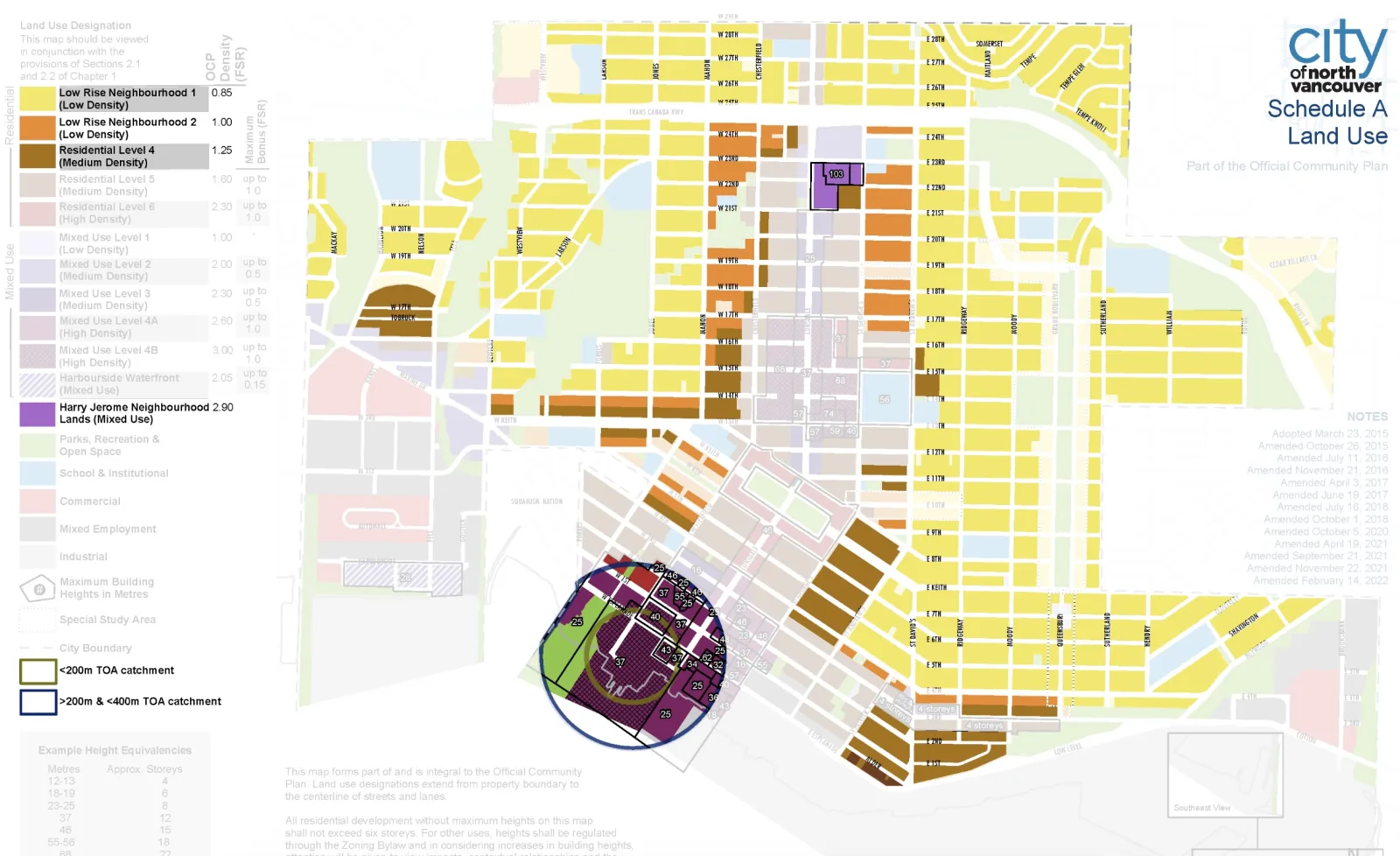
The June 30, 2026 compliance deadline is behind us. Most Metro Vancouver municipalities met it in full — Vancouver, Burnaby, Surrey, Richmond, Coquitlam, New Westminster, and others allow 3-6 units per lot including the transit-proximity 6-unit tier Bill 25 requires. City of North Vancouver is compliant only for its 3-4 unit baseline (Bylaw 9137, adopted December 2025, 4,900 lots): the separate 6-unit transit-proximity expansion covering 1,940 properties was referred back to staff on May 11, 2026 and has not returned to Council since. District of North Vancouver formally refused Bill 25 enforcement in April 2026 and is now under active provincial oversight. West Vancouver missed the deadline outright, with readings of its compliance bylaw scheduled for September 21, 2026.
What this means for developers right now: the “holdout risk” that made some markets hard to underwrite in 2025 has resolved everywhere except the North Shore. Vancouver, Burnaby, Surrey, Richmond, Coquitlam, and New Westminster have predictable rules today. City of North Vancouver’s 4-unit baseline is safe to underwrite; do not assume the 6-unit transit tier there until Council actually adopts it.
Two years after British Columbia’s groundbreaking Bill 44 ended exclusionary single-family zoning, the province closed the compliance loopholes. Bill 25 (Housing and Municipal Affairs Statutes Amendment Act, 2025) passed in November 2025 — it’s the enforcement mechanism that ensures every municipality plays by the same rules.
For developers, planners, and homeowners watching the missing middle housing movement, this changes everything.
What Bill 44 Started: The End of Exclusionary Zoning
In 2023, Bill 44 (Housing Statutes Amendment Act) fundamentally restructured BC’s residential zoning landscape. The law legalized small-scale multi-unit housing (SSMUH)—duplexes, triplexes, fourplexes, townhomes, and rowhomes—on lots previously restricted to single-family homes.
The mandate was clear: municipalities with populations over 5,000 or within urban containment boundaries must allow 3–6 units per lot (depending on lot size, transit access, and servicing capacity) without requiring rezoning applications.
Early adopters thrived:
- Vancouver pre-emptively allowed multiplexes through its R1-1 zone updates, seeing hundreds of applications for duplexes, triplexes, and laneway home combinations
- Burnaby quickly updated zoning bylaws, enabling multiplex development across former single-family neighborhoods
- New Westminster and Surrey similarly embraced the policy shift, recognizing the supply potential
By mid-2024, nearly 90% of affected municipalities had updated their bylaws. The missing middle pipeline was flowing.
But not everywhere.
The Loophole Problem: Compliance Without Results
While most cities adapted in good faith, others found creative ways to technically comply with Bill 44 while maintaining barriers to actual development:
Excessive parking requirements: Mandating 2+ parking spaces per unit in walkable neighborhoods made projects financially unfeasible on typical 33-foot lots
Restrictive site standards: Oversized setbacks, low floor-space ratios, and maximum lot coverage rules that only permitted single-family homes or small duplexes—not the triplexes and fourplexes the law intended
Process delays: Complex permitting requirements and extended review timelines that discouraged builders from pursuing multiplex projects
Height and massing restrictions: Rules that mathematically prevented achieving the allowed unit counts while meeting all other requirements
The result? In some communities, Bill 44 existed on paper but not in practice. Developers avoided these markets. Homeowners couldn’t unlock their property’s potential. The missing middle remained missing.
Bill 25: Closing the Gaps
Introduced on October 9, 2025, Bill 25 (Housing and Municipal Affairs Statutes Amendment Act, 2025) is a targeted amendment to the Local Government Act and Vancouver Charter designed to eliminate these compliance workarounds.
Key enforcement mechanisms:
Provincial override authority: If monitoring reveals persistent barriers—unviable site standards, excessive parking mandates, or exclusionary restrictions—the Province can impose minimum standards via regulation, forcing local governments to adopt them
Clear compliance standards: Municipalities cannot exclude SSMUH-permitted zones or layer restrictions that render projects economically unfeasible beyond single-family or duplex development
Limited scope with serious consequences: While expected to affect only a small number of non-compliant cities, the message is unmistakable—the Province will not tolerate backdoor resistance to housing supply goals
Consistent application: Ensures the same viable development potential across all qualifying communities, eliminating the patchwork of restrictions that previously complicated regional planning
Other provisions: The bill includes minor updates to short-term rental regulations and information-sharing protocols between government entities, but the missing middle enforcement is the centerpiece.
What This Means for Missing Middle Development
Bill 25 creates the predictability developers and builders need to scale missing middle projects across BC:
For developers and builders:
- Reduced regulatory uncertainty in previously difficult markets
- More viable infill sites for townhomes, triplexes, and fourplex conversions
- Standardized parking and site rules that allow pro formas to pencil across municipalities
- Confidence that today’s approvals won’t be undermined by future rule changes
For planners and local governments:
- Clear direction aligned with provincial housing goals
- Tools to monitor compliance and demonstrate good-faith implementation
- Support (or mandates) to update bylaws that inadvertently block viable development
- Framework for balancing neighborhood character with gentle density goals
For homeowners and property investors:
- Expanded opportunities to add legal secondary suites, laneway homes, or pursue full lot redevelopment
- Increased property values as development potential becomes more certain
- More rental income options through multiplex conversions
- Ability to age in place by adding units for family members or rental revenue
For renters and first-time buyers:
- Increased supply of ground-oriented, family-sized homes in established neighborhoods
- More attainable ownership options (strata townhomes, fee-simple multiplexes) than high-rise condos
- Downward pressure on rents as thousands of new units enter the market
- Shorter commutes as housing options expand within existing urban areas
The Numbers: How Much Missing Middle Can We Expect?
While exact projections vary, the potential is substantial:
Metro Vancouver alone: The region contains approximately 220,000 single-family lots. If even 5% pursue multiplex development over the next decade (conservative given early adoption rates in Vancouver and Burnaby), that’s 11,000 properties generating 30,000–50,000 new homes without consuming agricultural or forest land.
Province-wide impact: BC has roughly 800,000 single-family lots in communities affected by Bill 44. A similar 5% conversion rate yields 40,000 properties and 100,000+ new homes over 10 years—equivalent to building a new city the size of Nanaimo, but distributed across existing neighborhoods with infrastructure already in place.
Short-term acceleration: Bill 25’s enforcement mechanisms should unlock projects stalled by regulatory uncertainty. Expect a wave of applications in 2026–2027 as holdout municipalities update bylaws and builders return to previously avoided markets.
Caveats: Success depends on infrastructure capacity (sewers, schools, parks), construction costs, interest rates, and builder appetite. Missing middle development won’t solve affordability alone, but removing regulatory barriers is essential for any solution to scale.
Comparisons to Other Jurisdictions
BC’s approach—mandating missing middle housing province-wide, then enforcing compliance—is aggressive by North American standards:
California’s SB 9 (2021): Allows lot splits and duplexes on single-family lots statewide, but lacks robust enforcement mechanisms. Many cities have implemented restrictive standards similar to what Bill 25 addresses.
Oregon’s HB 2001 (2019): Requires middle housing in large cities, but gave municipalities flexibility in implementation. Portland thrived; smaller cities lagged.
New Zealand’s National Policy Statement on Urban Development (2020): Mandates three-story, three-unit minimum in major cities. Enforcement has been uneven but improving.
Minneapolis’s 2040 Plan (2018): Allowed triplexes citywide, inspiring similar reforms across North America. However, as a single-city initiative, it lacked the regional coordination Bill 44 + Bill 25 provides.
BC’s combination of clear mandates (Bill 44) and enforcement teeth (Bill 25) positions the province as a global leader in missing middle housing policy. The results could inform reforms across Canada, the US, and other high-cost housing markets.
Why This Matters Beyond Housing Supply
The missing middle movement isn’t just about units—it’s about sustainable urbanism:
Climate action: Gentle density reduces sprawl, preserves farmland, and enables transit/cycling infrastructure at scale. A triplex on an existing lot beats three single-family homes on greenfield sites for carbon footprint.
Fiscal sustainability: Municipalities save on infrastructure costs (roads, sewers, fire stations) when growth happens through infill rather than expansion. The tax base improves without proportional service cost increases.
Social equity: Ground-oriented missing middle homes provide family-friendly alternatives to high-rises or distant suburbs. Multigenerational living becomes easier. Renters get more housing choice without displacement pressure from mega-projects.
Economic vitality: More residents in established neighborhoods support local businesses, schools, and community centers. The “15-minute city” becomes achievable when density exists without towers.
Heritage preservation: Adaptive reuse of character homes as multiplexes preserves architectural fabric while adding housing. This approach respects neighborhood identity better than demolition for high-rises.
Bill 25 accelerates all these outcomes by ensuring the regulatory environment supports, rather than obstructs, gentle density.
What Has Happened: July 2026 Status
Bill 25 passed, took effect, and its compliance deadline has now passed. Here is where things stand as of July 2026:
Compliant municipalities (permits open, normal process):
- Vancouver — already compliant via R1-1 zoning before Bill 25 passed; permit volume strong
- Burnaby — compliant; R1 SSMUH permits growing through H1 2026
- Surrey — updated bylaws in Q4 2025; applications open, servicing reviews the main bottleneck
- Coquitlam, New Westminster, Richmond — compliant; Coquitlam has 22,131 eligible lots active
- Langley, Maple Ridge, Port Coquitlam — compliant and processing
Partially compliant:
- City of North Vancouver — Bylaw 9137 (final adoption December 2025, 6-1 vote) covers the 3-4 unit baseline on 4,900 lots and is in force. The separate 6-unit transit-proximity expansion Bill 25 also requires, covering 1,940 properties near frequent transit, was referred back to staff on May 11, 2026 and has not returned to Council as of this update. Treat the 4-unit baseline as safe to underwrite; the 6-unit transit tier is not yet law.
Under provincial oversight or past deadline:
- District of North Vancouver — formally refused Bill 25 enforcement in April 2026; now under active provincial review; Province may impose minimum site standards by regulation, overriding local bylaws
- West Vancouver — missed the June 30 deadline; readings of its compliance bylaw are scheduled for September 21, 2026
- A small number of Fraser Valley municipalities in final compliance stages
For developers as of this update: The “holdout risk” that made some markets hard to underwrite in 2025 is resolved for Vancouver, Burnaby, Surrey, Richmond, Coquitlam, New Westminster, Langley, Maple Ridge, and Port Coquitlam. City of North Vancouver’s 4-unit baseline is also safe to underwrite. DNV remains under provincial pressure, West Vancouver has not yet adopted a compliant bylaw, and CNV’s 6-unit transit tier is still pending Council action.
What Happens Next
H2 2026 (now):
- Provincial enforcement now active for District of North Vancouver; resolution expected by end of 2026
- West Vancouver’s compliance bylaw readings are scheduled for September 21, 2026
- City of North Vancouver’s 1,940-property transit-tier expansion remains with staff following the May 11, 2026 referral; no return date confirmed
- Builders who avoided holdout markets have predictable rules; application volumes expected to rise
- Pro formas across a wider set of BC communities can close with confidence
Medium-term (2026–2028):
- Wave of multiplex applications across former holdout communities now compliant
- Increased strata townhome and fee-simple fourplex projects in suburban/fringe areas
- Rental supply grows as homeowners add secondary suites and laneway homes
- Proactive municipalities (Vancouver, Burnaby, New West) see continued development momentum
Long-term (2028–2035):
- Tens of thousands of new missing middle homes across BC
- Regional housing markets rebalance as supply constraints ease
- Cultural shift toward acceptance of gentle density in established neighborhoods
- BC becomes global case study for effective missing middle policy implementation
Lessons for the Real Estate Industry
For developers: Diversify pipelines to include missing middle infill. The regulatory risk is dropping; the market opportunity is growing. Partner with landowners on joint ventures rather than outright purchases to reduce capital requirements.
For real estate agents: Educate clients on development potential. A $2M single-family lot that can become a fourplex worth $4M+ is a different investment proposition. Market to builders and investors, not just homeowners.
For planners and policymakers: Proactive bylaw updates signal friendliness to investment. Cities that lead on missing middle will attract development talent and capital. Those that resist will face provincial intervention—better to adapt on your own terms.
For homeowners: Understand your property’s multiplex potential. Even if you don’t develop, future buyers will value that optionality. Consider adding a laneway home or secondary suite to generate rental income and increase property value.
For architects and designers: Specialize in missing middle typologies. The market needs efficient, attractive designs for triplexes, fourplexes, and townhomes that fit 33-foot lots and meet market expectations. Standardized, pre-approved plans will accelerate approvals.
Addressing Common Concerns
Won’t this destroy neighborhood character? Missing middle housing has existed in BC neighborhoods for decades—most people don’t realize their street already contains duplexes and triplexes disguised as large single-family homes. Modern designs respect architectural context while adding density. Cities like Vancouver have demonstrated gentle density can coexist with heritage preservation.
What about parking and traffic? Bill 25 prevents excessive parking mandates but doesn’t eliminate parking entirely. Most multiplex projects include 1–2 spaces per unit, meeting actual demand in walkable neighborhoods. Transit-oriented areas with reduced car ownership justify lower ratios. Traffic impacts are marginal—a fourplex generates fewer trips than four single-family homes on separate lots.
Will infrastructure handle the density? Municipalities must ensure adequate servicing (water, sewer, schools) as part of Bill 44 compliance. Areas without capacity can phase in SSMUH as infrastructure upgrades occur. Infill development is far less demanding than greenfield sprawl—existing roads, utilities, and services simply serve more people.
What about affordability—will rents actually drop? More supply moderates price growth, but missing middle alone won’t solve affordability. It’s one piece alongside purpose-built rentals, social housing, and income supports. However, adding 100,000+ homes over a decade will have measurable impact on regional markets, especially for middle-income households priced out of detached homes but not interested in high-rises.
Could this lead to speculation and displacement? Some property value increases are inevitable as development potential is unlocked. However, most missing middle projects are owner-initiated or involve willing sellers. Policies like anti-flipping taxes, speculation taxes, and rental tenure protections can mitigate displacement risks. The alternative—maintaining artificial scarcity—drives far more speculation and displacement.
The Path Forward: From Policy to Pipeline
Bill 25 is the enforcement backbone that Bill 44 needed. Together, they represent BC’s most significant housing policy shift in decades—moving from exclusionary zoning that preserved single-family neighborhoods at all costs to a balanced approach that welcomes gentle density while respecting community character.
For the missing middle movement, this is the inflection point. The regulatory framework is set. The enforcement mechanisms are in place. The market is ready. What was once a progressive vision in cities like Vancouver and Burnaby is becoming the new normal across BC.
The next decade will determine whether BC’s bold experiment succeeds. If implementation goes well—if municipalities adapt, builders scale up, and communities embrace gentle density—other jurisdictions will follow. If resistance persists or infrastructure proves inadequate, the policy may falter.
But for now, the momentum is undeniable. Bill 25 just dropped the hammer on holdout cities. The missing middle housing explosion is about to begin.
Frequently Asked Questions
What is “missing middle” housing? Missing middle refers to housing types between single-family homes and high-rise apartments: duplexes, triplexes, fourplexes, townhomes, rowhomes, and low-rise apartments. These forms were common in pre-1950s neighborhoods but became rare due to exclusionary zoning. They’re “missing” because modern zoning often jumps from single-family to high-density, skipping the gentle density options in between.
How does Bill 25 differ from Bill 44? Bill 44 (2023) legalized missing middle housing across BC by mandating that municipalities allow 3–6 units per lot in most areas. Bill 25 (2025) enforces Bill 44 by closing loopholes that some municipalities used to maintain barriers (excessive parking rules, restrictive site standards) and giving the Province authority to impose minimum standards if compliance fails.
Which municipalities are affected by Bill 25? The same communities required to implement Bill 44: those with populations over 5,000 or within urban containment boundaries. Early adopters like Vancouver, Burnaby, New Westminster, and Surrey are largely compliant and unlikely to face provincial intervention. Smaller cities or those with restrictive bylaws may see provincial regulations override local rules.
Can municipalities still regulate design, height, and setbacks? Yes, but regulations must allow viable development. Municipalities retain control over design guidelines, architectural standards, and reasonable setbacks/height limits. However, rules that mathematically prevent achieving the unit counts Bill 44 allows—or make projects economically unfeasible—violate the law. Bill 25 gives the Province tools to correct overly restrictive standards.
What happens if a municipality doesn’t comply with Bill 25? Provincial monitoring will identify persistent barriers. If a municipality’s bylaws effectively block missing middle development, the Province can impose regulations setting minimum standards for parking, setbacks, lot coverage, and other site rules. These provincial rules override local bylaws until the municipality updates its regulations to enable viable development.
When will Bill 25 take effect? The bill is moving through the legislature in late 2025. Once passed, enforcement mechanisms become available immediately, though provincial intervention (imposing minimum standards) would follow a monitoring period to identify non-compliant municipalities. Expect most impacts in 2026–2027 as cities finalize bylaw updates.
How many new homes could Bill 25 unlock? Estimates vary, but if 5% of BC’s ~800,000 affected single-family lots pursue multiplex development over 10 years, that’s 40,000 properties generating 100,000+ new homes. Metro Vancouver alone could add 30,000–50,000 units from multiplex conversions on 5% of its 220,000 single-family lots. These are conservative projections—actual numbers depend on market conditions, builder capacity, and municipal cooperation.
Will this make housing more affordable? Increased supply moderates price growth, but missing middle housing alone won’t solve affordability. It’s one component of a broader strategy including purpose-built rentals, social housing, and income supports. However, adding 100,000+ homes over a decade will have measurable regional impact, especially for middle-income households seeking alternatives to high-rise condos or distant suburbs.
What about parking—won’t streets become congested? Bill 25 prevents excessive parking mandates but doesn’t eliminate parking. Most multiplex projects include 1–2 spaces per unit, meeting actual demand. Transit-oriented neighborhoods with lower car ownership can justify reduced ratios. A fourplex generates fewer vehicle trips than four single-family homes on separate lots would, so net traffic impact is often neutral or positive.
Can I convert my single-family home into a multiplex? If you’re in a community covered by Bill 44, yes—subject to meeting site requirements (setbacks, lot coverage, servicing). Most homeowners pursue this through: (1) adding a laneway home or secondary suite, (2) renovating to create multiple units within the existing structure, or (3) demolishing and building a new triplex/fourplex. Consult your municipality’s zoning bylaw and consider hiring an architect familiar with missing middle projects.
What about heritage homes—can they be demolished for multiplexes? Heritage regulations remain in effect. Protected heritage homes cannot be demolished without permits (which are rare). However, many heritage homes can be renovated to include multiple units while preserving character—in fact, adaptive reuse as multiplexes can make heritage preservation financially viable. Non-protected older homes can be redeveloped, subject to municipal design guidelines.
Will neighborhoods lose their character? Modern missing middle projects are designed to fit neighborhood context. Vancouver’s multiplex zones show that triplexes and fourplexes can be indistinguishable from large single-family homes in architectural style. Many historic neighborhoods already contain duplexes and converted homes that residents don’t recognize as multi-unit. Thoughtful design guidelines ensure gentle density respects community character.
How does Bill 25 affect short-term rentals? The bill includes minor updates to short-term rental regulations (information-sharing between municipalities and the Province) but doesn’t substantially change existing rules. Most BC municipalities already restrict short-term rentals in residential zones, requiring primary residence occupation. Missing middle units would generally be subject to the same rules—available for long-term rentals, not Airbnb-style short-term rentals.
What infrastructure upgrades are needed for missing middle density? Most existing neighborhoods can accommodate gentle density without major infrastructure changes—roads, sewers, and utilities were often built with capacity buffers. Municipalities must assess servicing adequacy as part of Bill 44 compliance and can phase in SSMUH zones as upgrades occur. Schools, parks, and transit may need incremental investment, but these are smaller-scale than greenfield sprawl requirements.
Can strata corporations restrict members from developing multiplexes? Bill 44/Bill 25 apply to lots zoned for SSMUH—typically single-family residential zones. Strata properties (condos, townhome complexes) are governed by strata bylaws and the Strata Property Act. Individual strata unit owners cannot unilaterally redevelop shared land. However, a strata corporation could collectively decide to redevelop (subject to supermajority vote requirements), though this is rare and complex.
How does this affect property taxes? Adding units to your property may increase assessed value, potentially raising property taxes. However, rental income from additional units typically exceeds the tax increase. Some municipalities offer tax incentives or exemptions for secondary suites and laneway homes. BC’s Speculation and Vacancy Tax exempts properties with long-term tenants. Consult a tax advisor for specific scenarios.
Where can I learn more about developing a multiplex project? Start with your municipality’s planning department—most have guides for SSMUH development, zoning maps, and pre-application consultations. Hire an architect experienced in missing middle housing to assess your property’s potential. Organizations like the Canadian Home Builders’ Association (CHBA) and Urban Development Institute (UDI) offer resources. For financing, discuss construction loans and rental property mortgages with your bank or a mortgage broker.
What are the typical costs to convert a single-family home to a multiplex? Costs vary widely based on project scope:
- Adding a secondary suite or laneway home: $150,000–$400,000 depending on size and finishes
- Renovating existing home to create multiple units: $200,000–$600,000 depending on layout changes, separate entrances, and systems upgrades
- Demolishing and building new triplex/fourplex: $800,000–$1.5M+ for a complete rebuild, depending on lot size, unit sizes, and finishes
Professional feasibility analysis (architect + quantity surveyor) costs $10,000–$30,000 but prevents costly mistakes. Financing through construction loans, home equity, or joint ventures with builders is common.
How long does it take to get approvals for a multiplex project? Timelines vary by municipality and project complexity:
- Simple renovations or secondary suites: 3–6 months for building permits
- New multiplex construction: 6–12 months for permits (no rezoning needed under Bill 44, which accelerates approvals)
- Complex projects or heritage areas: 12–18 months with design review and public consultation
Proactive municipalities (Vancouver, Burnaby) have streamlined processes. Cities updating bylaws under Bill 25 pressure may face backlogs initially but should improve timelines as processes mature.
Can I build a multiplex on a small lot? Bill 44 mandates SSMUH on lots meeting minimum size thresholds (typically 280–450 square meters depending on municipal bylaws). Smaller lots may qualify for duplexes or triplexes rather than fourplexes. Lot width, shape, and site constraints (setbacks, trees, slopes) also affect viability. An architect can assess whether your specific lot supports your development goals within Bill 44/Bill 25 parameters.
What’s the return on investment for converting to a multiplex? Returns depend on rental income, construction costs, and property value appreciation:
- Rental income: A fourplex might generate $8,000–$15,000/month gross rent (depending on location and unit sizes), supporting mortgage payments and providing cash flow
- Property value increase: Multiplex properties often appraise higher than single-family equivalents due to income potential—$2M single-family lot could become $3–4M+ fourplex
- Cash-on-cash return: Investors targeting 8–15% annual returns on equity invested, though first-time developers often prioritize long-term wealth building over immediate cash flow
Pro forma analysis by a real estate investment advisor is essential before committing capital.
Does Bill 25 apply to rural areas or Agricultural Land Reserve (ALR) properties? No. Bill 44/Bill 25 apply to municipalities with populations over 5,000 or within urban containment boundaries—typically cities and larger towns. Rural areas, unincorporated communities, and ALR farmland are excluded. These areas remain subject to traditional zoning, which generally preserves agricultural or low-density residential uses.
Can I operate a home business in a multiplex? Home occupation regulations (rules for running businesses from residential properties) remain in effect. Municipalities typically allow low-impact home businesses (offices, studios, consultancies) but restrict retail, manufacturing, or high-traffic operations. Each unit in a multiplex would follow the same home occupation rules as a single-family home. Check municipal bylaws for specifics.
What about environmental standards—do multiplexes need to meet energy efficiency requirements? Yes. New construction must meet BC’s Energy Step Code (minimum Step 3 as of 2024, with many municipalities requiring Step 4–5). This mandates high-performance building envelopes, efficient heating/cooling systems, and reduced greenhouse gas emissions. Renovations may trigger energy upgrades if substantial work occurs. These standards apply equally to single-family homes and multiplexes—Bill 25 doesn’t change environmental requirements.
How does Bill 25 interact with Indigenous land rights and treaties? Provincial housing legislation applies to Crown land and municipalities within BC’s jurisdiction. On reserve lands governed by federal Indian Act or under modern treaty nations’ jurisdiction, housing policy is determined by Indigenous governments—Bill 44/Bill 25 don’t override Indigenous sovereignty. However, many First Nations are pursuing similar missing middle housing strategies for their communities, and the Province has committed to consultation on housing policy impacts affecting Indigenous rights.
Will Bill 25 lead to increased property speculation? Some value increase is inevitable as development potential is unlocked, but BC’s speculation and vacancy tax, foreign buyer restrictions, and anti-flipping rules remain in place to discourage purely speculative holding. Most missing middle projects are owner-initiated or involve willing sellers pursuing development. The alternative—artificial scarcity from exclusionary zoning—has driven far more speculation historically. Increased supply typically moderates speculative pressure over time.