
August 2026 Update — Eight Months Into the New Zoning
The zoning debate covered on this page is settled. CNV’s multiplex bylaw has been in force since early 2026, and the open question now is not whether the rules would pass, but how many owners in the 4,900-property zone have actually applied. For a live count of North Vancouver permit activity by address, see the VanPlex Interactive Permit Map.
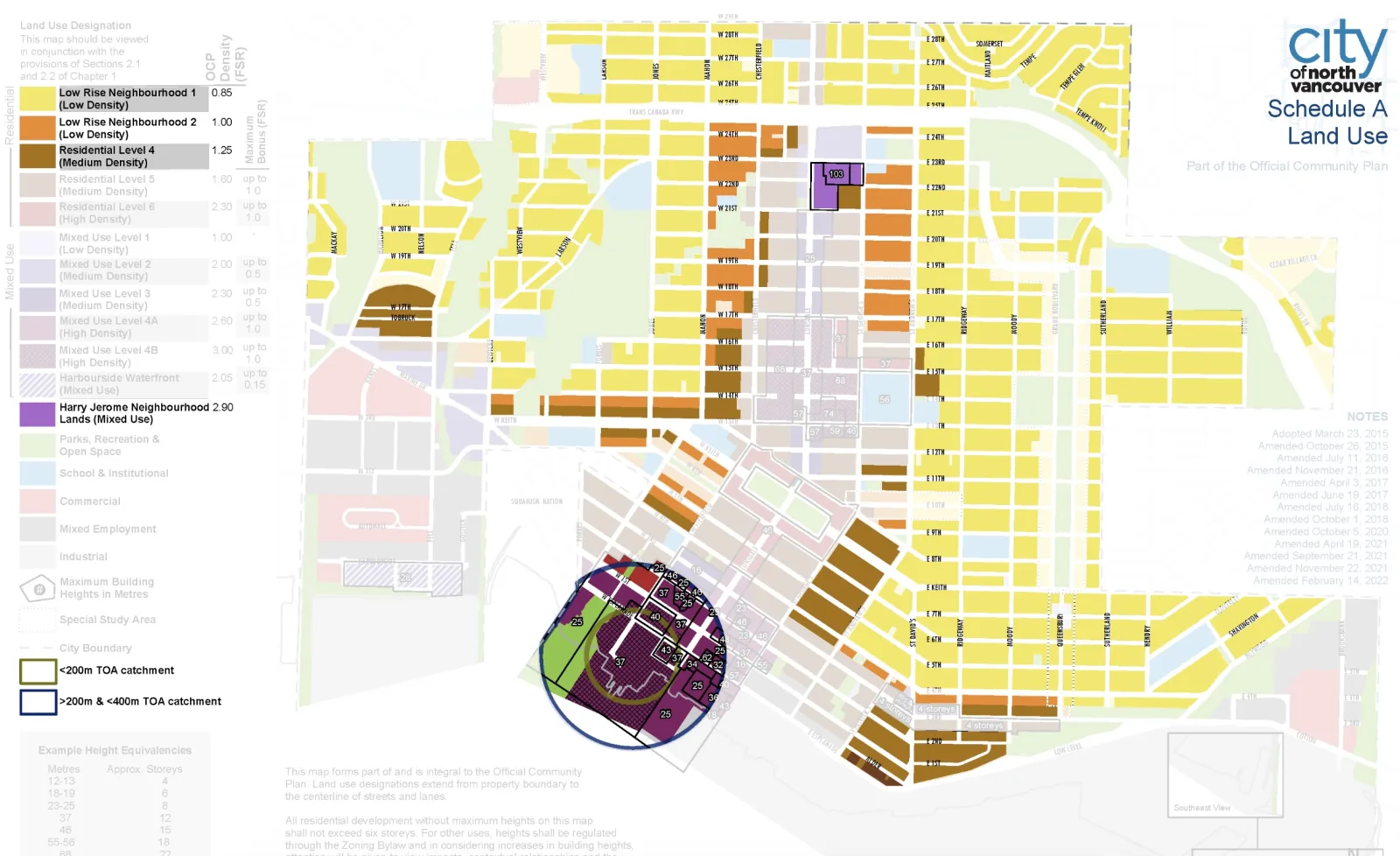
The City of North Vancouver passed its comprehensive multiplex zoning package with a decisive 6-1 council vote in December 2025, meeting the December 31, 2025 provincial deadline. Nearly 4,900 single-family properties are now zoned for 4-6 unit multiplexes, adding 6,200+ units of housing capacity. For homeowners and investors, this final adoption removed the legislative uncertainty that shaped 2025 and opened the door to project planning that is now underway.
Key Takeaways
- Final adoption passed 6-1 — legislative certainty is now complete
- ~4,900 properties now zoned for multiplexes (up from just 35 in June 2025)
- ~4,300 lots eligible for up to 4 units (east of St. Andrews, west of Mahon)
- ~600 lots eligible for up to 6 units (between St. Andrews and Mahon Avenues)
- Heritage exemptions: Grand Boulevard, East 19th, East 10th streets
- 5 city-owned sites adding 900 units capacity (Fire hall, Municipal hall, Harry Jerome Lands)
- December 31, 2025 deadline met — CNV is provincially compliant
The Final Vote: What Just Happened
After months of legislative process—including the November 17, 2025 public hearing where second and third readings passed on the same night—the City of North Vancouver has now completed final adoption of its comprehensive zoning bylaw changes.
| Legislative Milestone | Status | Date |
|---|---|---|
| First Reading | Passed | October 6, 2025 |
| Public Hearing | Conducted | November 17, 2025 |
| Second Reading | Passed | November 17, 2025 |
| Third Reading | Passed | November 17, 2025 |
| Final Adoption | Passed 6-1 | December 2025 |
Councillor Shervin Shahriari summarized the balance council aimed to achieve: “Did we land perfectly on the ideal point between neighbourhood concerns, developer feasibility feedback and provincial expectations? Only time will tell, but we were working under pressure that included deadlines and targets. I hope we have achieved the objective of helping our children, friends and families live in the same community that we are enjoying.”
Related Reading: CNV Legislative Breakthrough: November 2025 Update | City of North Vancouver Multiplex Guide
The Numbers: From 35 to Nearly 5,000 Properties
The scale of this expansion is remarkable. In June 2025, CNV adopted initial SSMUH compliance affecting just 35 properties. The December 2025 adoption expands this dramatically:
| Zone | Properties Affected | Units Allowed | Geographic Boundary |
|---|---|---|---|
| 6-Unit Corridor | ~600 | Up to 6 | Between St. Andrews Ave and Mahon Ave |
| 4-Unit Zone | ~4,300 | Up to 4 | East of St. Andrews, West of Mahon |
| Heritage Exempt | TBD | Existing | Grand Boulevard, East 19th, East 10th Streets |
Why the 6-Unit Corridor Matters: Properties between St. Andrews and Mahon Avenues represent the highest-density opportunity in North Vancouver’s new zoning framework. For investors and homeowners in this corridor, the value proposition is clear: maximum unit count translates to maximum potential equity creation.
Heritage Exemptions: What’s Protected
In a notable concession to heritage preservation advocates, council carved out exemptions for historically significant areas:
- Grand Boulevard — The city’s iconic tree-lined heritage street
- East 19th Street — Character home concentration
- East 10th Street — Additional heritage character area
These exemptions give the city time to study options that balance heritage preservation with the need for new housing. For property owners in these areas, the existing zoning remains in place while the city develops a more nuanced approach.
City-Owned Sites: 900 Additional Units
Beyond private property rezoning, CNV is leveraging its own land assets to contribute to housing capacity:
| Site | Location | Capacity Contribution |
|---|---|---|
| North Vancouver City Fire Department Hall | TBD | Included in 900 units |
| Municipal Hall Site | TBD | Included in 900 units |
| Harry Jerome Lands | East 3rd Street | Included in 900 units |
| 100 Block East First Street | Along Alder Street | Included in 900 units |
| Fifth City-Owned Site | TBD | Included in 900 units |
This public land strategy demonstrates CNV’s commitment to meeting housing targets through multiple channels—not relying solely on private development.
The Criticism: Will Builders Actually Build?
Despite the legislative milestone, critics argue the new rules may not produce the intended results.
The 10% Problem: According to industry observers, the actual floor space for multiplexes allowed under CNV’s guidelines is only 10% larger than what single-family homes are currently permitted. This narrow margin may not provide sufficient financial incentive for builders to pursue the more complex multiplex approval process.
Builder Feasibility Concerns:
- Multiplex construction is more complex than single-family
- Financing for multiplexes can be more challenging
- The marginal floor space increase may not justify the additional effort
The Implication: Some builders may continue opting for single-family renovations or rebuilds rather than multiplex development, potentially limiting the actual housing supply increase.
How Does CNV Compare to Vancouver and Burnaby?
| Municipality | Units Allowed | FSR Approach | Parking Minimums |
|---|---|---|---|
| Vancouver (R1-1) | Up to 6 | 1.0-1.25 FSR (Net Zero bonus) | Reduced near transit |
| Burnaby (R1 SSMUH) | Up to 6 | Recently reduced (3-storey max) | 0.67-1.0 per unit |
| CNV (New Zoning) | 4-6 | ~10% above single-family | Reduced near transit |
Analysis: CNV’s approach is more conservative than Vancouver’s aggressive FSR-based model. Vancouver’s 1.25 FSR Net Zero bonus strategy creates substantially more buildable area, while CNV’s 10% uplift may limit builder interest. Burnaby’s recent policy friction (height and coverage reductions) provides a cautionary tale about political volatility in multiplex regulation.
Related Reading: PlexRank Precision Guide: Why Only 2% of Lots Deliver 100%+ ROE
What This Means for Homeowners in CNV
If you own property in the City of North Vancouver, here’s what the final adoption means for you:
Immediate Equity Impact:
- Your land is now zoned for higher density (4 or 6 units depending on location)
- This increases the “highest and best use” value of your property
- Buyers evaluating your property will factor in development potential
Development Options:
- Sell to a developer at a premium reflecting multiplex potential
- Partner with a builder to develop while retaining ownership stake
- Self-develop a multiplex for rental income or sale
- Multi-generational housing — build units for family members
Key Question to Ask: Is your property in the 6-unit corridor (between St. Andrews and Mahon)? If so, your development potential is maximized.
What This Means for Investors and Developers
The Opportunity:
- ~4,900 newly zoned properties represent a significant pipeline
- First-mover advantage for those who begin planning immediately
- Heritage exemption areas may see less competition
The Challenges:
- 10% floor space uplift may limit project viability
- Need to identify properties with optimal geometry and location
- Financing for multiplex development requires specialized lenders
Strategic Approach:
- Focus on the 6-unit corridor for maximum density
- Prioritize properties with favorable lot geometry (depth, frontage)
- Model financials carefully given the limited FSR uplift
- Consider heritage-adjacent properties that may benefit from spillover demand
Frequently Asked Questions
When did the CNV multiplex zoning take effect?
Final adoption passed in December 2025 and the bylaw has been in force since early 2026. Property owners in the eligible zone can submit permit applications now. For a running count of applications and issued permits in North Vancouver and the wider region, see the VanPlex Interactive Permit Map.
How many properties in CNV are now eligible for multiplexes?
Approximately 4,900 single-family properties are now eligible for multiplex development. About 4,300 lots can build up to 4 units (east of St. Andrews, west of Mahon), while approximately 600 lots in the 6-unit corridor (between St. Andrews and Mahon) can build up to 6 units.
What areas of CNV are exempt from multiplex zoning?
Heritage character areas along Grand Boulevard, East 19th Street, and East 10th Street are exempt from the new multiplex zoning. The city is studying alternative approaches that balance heritage preservation with housing needs.
How does CNV’s multiplex zoning compare to Vancouver?
CNV’s approach is more conservative than Vancouver’s. Vancouver allows up to 1.25 FSR through Net Zero bonuses (25% more floor space than base), while CNV’s regulations provide approximately 10% more floor space than single-family. This difference significantly impacts project feasibility and builder interest.
Will builders actually build multiplexes in CNV?
Critics suggest the limited floor space uplift (only 10% above single-family) may not provide sufficient financial incentive for builders to pursue multiplex development. The complexity of multiplex construction and financing may lead some builders to continue with single-family projects instead.
Next Steps: Position Your CNV Property for 2026
The legislative uncertainty is over. CNV has acted decisively to meet provincial requirements, and the zoning framework is now locked in. For property owners and investors, the focus must shift from monitoring legislation to executing development strategy.
Immediate Actions:
- Determine your zone: Are you in the 4-unit or 6-unit eligible area?
- Assess lot geometry: Frontage, depth, and corner advantages matter
- Model financial feasibility: Given limited FSR uplift, precision is critical
- Engage design teams: Begin conceptual planning immediately
VanPlex CNV Property Assessment: We are modeling every eligible property in the City of North Vancouver to determine optimal floor plans, maximum feasibility, and projected returns under the new zoning.
Book Your CNV Feasibility Assessment | Check Your Property’s Potential