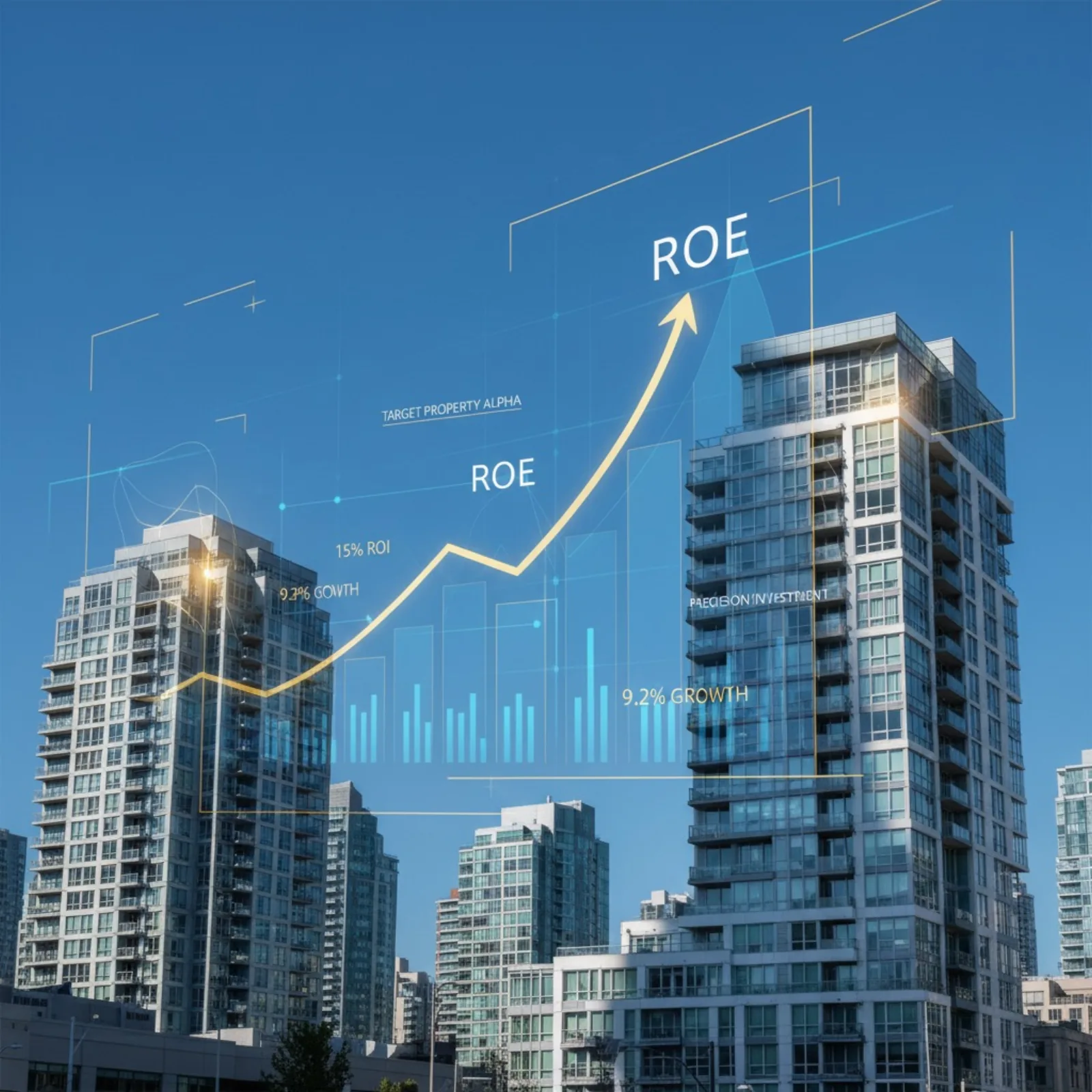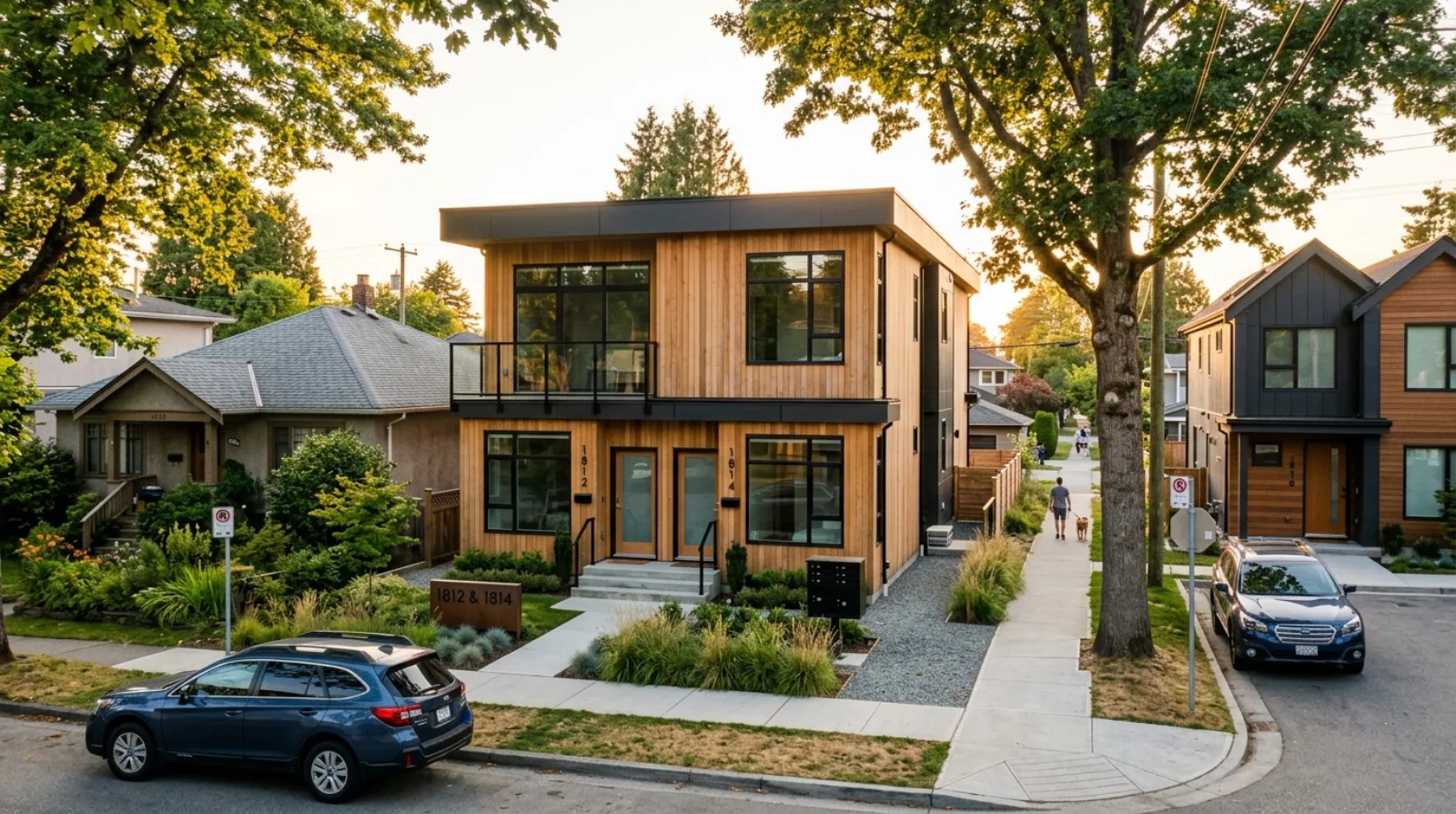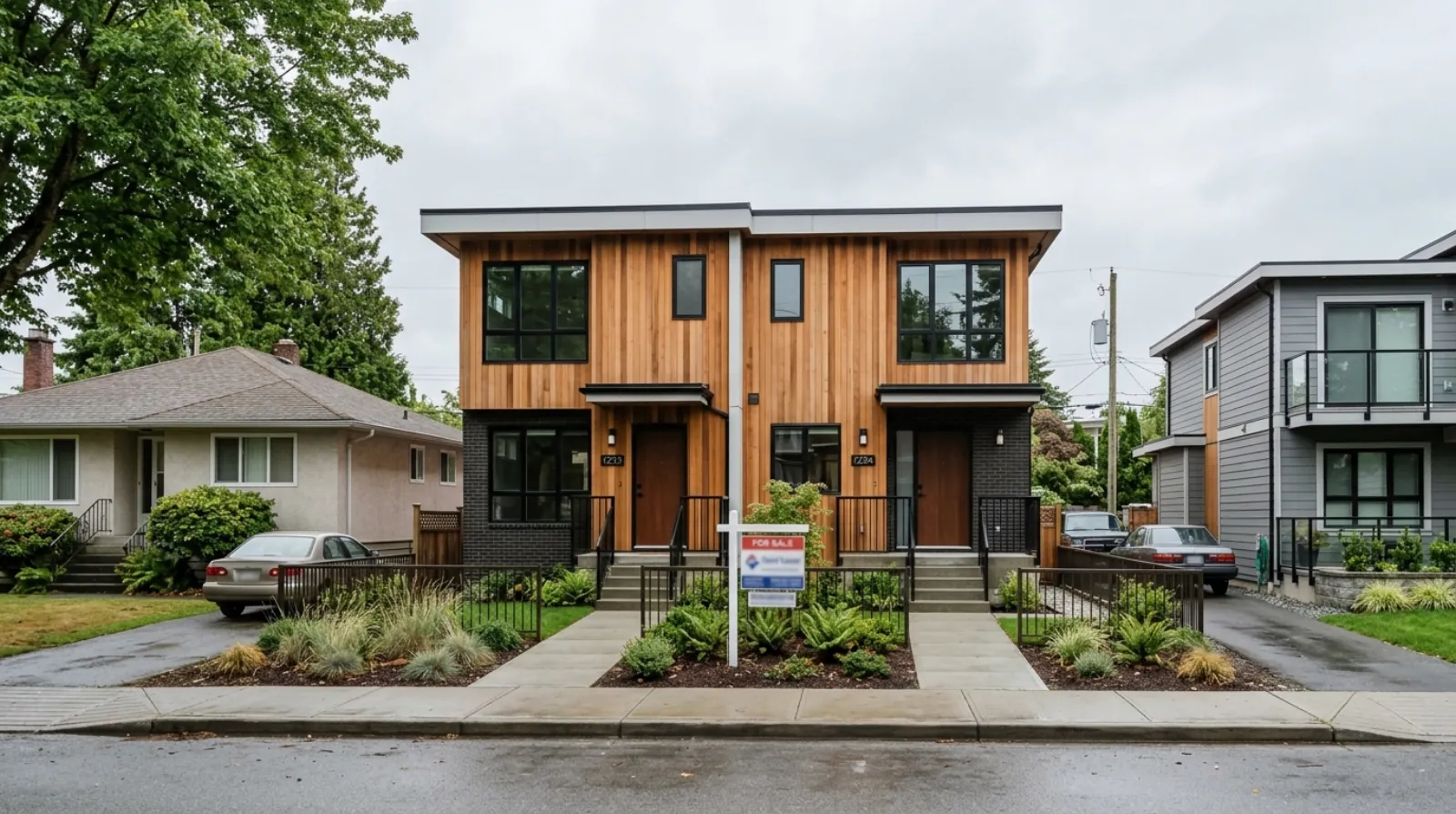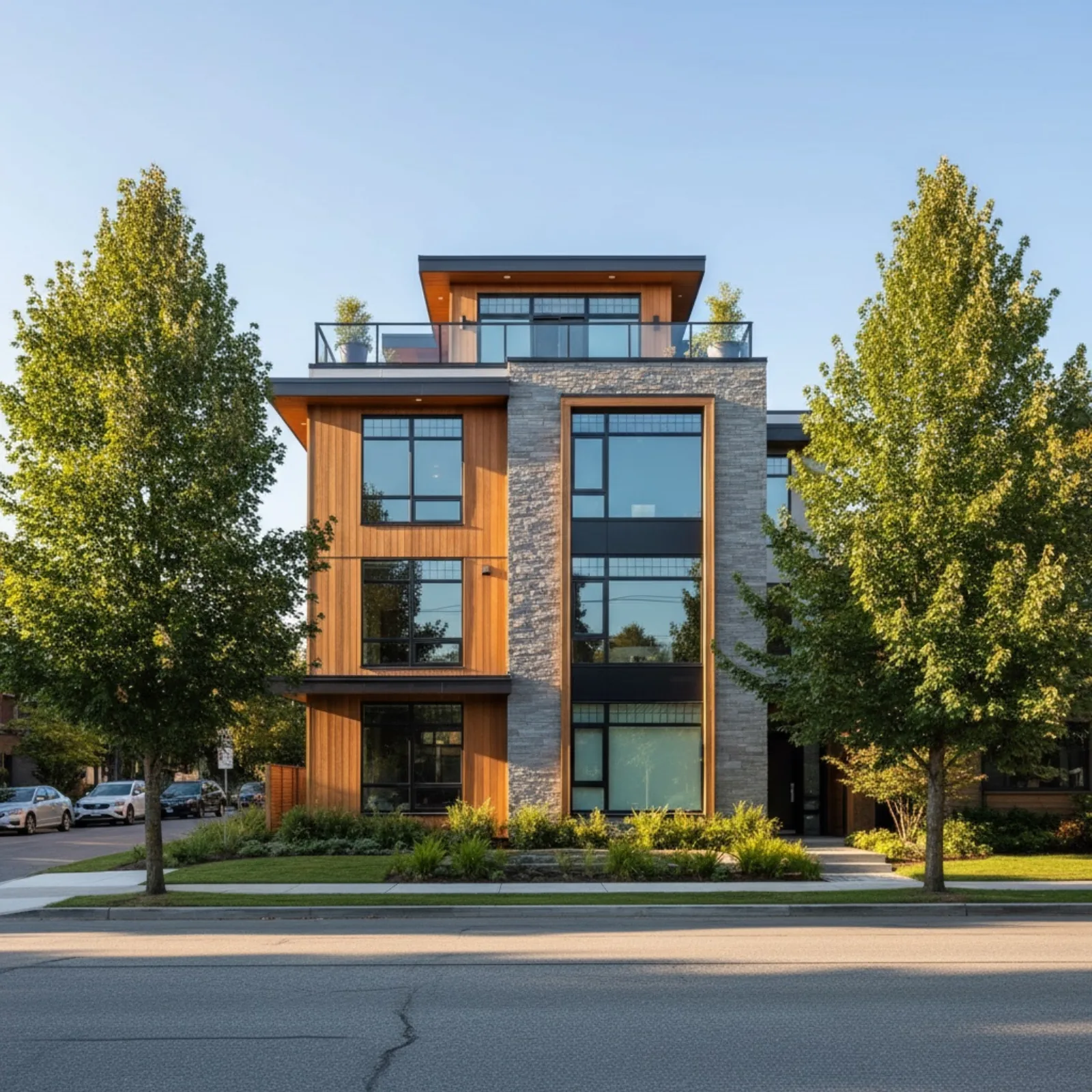

Only 2% of Vancouver’s 90,000 rezoned multiplex lots deliver 100%+ ROE—the threshold that justifies development risk. Vancouver’s median ROE is just 15%, while combined Vancouver-Burnaby achieves only 20%. The 1.25 FSR Net Zero strategy separates profitable projects from break-even. PlexRank by VanPlex identifies the exact investment-grade properties worth pursuing.
Key Takeaways
- 90,000 homes rezoned under GVRD multiplex policies (Vancouver R1-1, Burnaby R1 SSMUH)
- Vancouver median ROE: ~15% — dangerously close to minimum viability
- Vancouver-Burnaby combined median ROE: ~20%
- Only ~2% of lots deliver 100%+ ROE — the true investment-grade opportunities
- 1.25 FSR via Net Zero + CoV exclusions is the key profit multiplier
- Burnaby’s 2025 policy changes reduced GFA by 33-45% on smaller lots
- PlexRank identifies exact addresses worth pursuing
Zoning is a Volume Play — Profit is a Precision Game
The Greater Vancouver Regional District (GVRD) multiplex policies—like Vancouver’s R1-1 and Burnaby’s R1 SSMUH—have rezoned close to 90,000 homes. This is the Volume. But for investors evaluating multiplex ROI in Vancouver 2025, the only number that matters is the Return on Equity (ROE), or return on the value of the property.
The reality, proven by the data in our PlexRank Analysis, is eye opening:
| Market | Median ROE | Assessment |
|---|---|---|
| Vancouver (R1-1) | ~15.0% | Dangerously close to minimum viability |
| Vancouver + Burnaby Combined | ~20.0% | Below institutional investment threshold |
| Investment-Grade Target | 100%+ | Only ~2% of properties qualify |
Vancouver’s median ROE of ~15% is dangerously close to the minimum threshold required to justify the risk of a multi-unit project with today’s high soft costs and construction costs (often $2.3M-$3.5M for the build costs alone).
Even including Burnaby, where land coverage and construction costs are often slightly more favourable, the median ROE is only 20%.
The noise is about supply, but your focus must be on viability. Our analysis shows that only about one-quarter (25%) of rezoned properties in these two major markets are financially lucrative with standard execution.
Related Reading: How Bill 44 Created Vancouver’s Multiplex Opportunity | Complete Vancouver Multiplex Guide
Chasing the 1.25 FSR: The Vancouver Profit Multiplier
In Vancouver, the difference between a break-even project and a home run is found in the FSR mechanics—the Floor Space Ratio. Most builders stop at the 1.0 FSR maximum obtainable via the Density Bonus payment. This places them squarely in the 15%-45% ROE range.
The 2% Gold Standard:
The properties that achieve a 100%+ ROE—the true game-changers—are the ones that unlock the hidden FSR through Net Zero density bonus optimization:
| FSR Strategy | Typical ROE Range | % of Builders Using |
|---|---|---|
| Standard 1.0 FSR | 15%-45% | ~95% |
| Net Zero 1.25 FSR | 100%+ | ~5% |
- 1.25 FSR Advantage: This is achieved by pursuing Net Zero Energy standards and strategically utilizing specific density exclusions granted by the City of Vancouver (CoV) for other technical construction features.
- The Cost-to-Value Arbitrage: This specialized design expertise, which most builders are either unaware of or not equipped to handle, yields a massive increase in sellable square footage (up to 25% over 1.0 FSR). Crucially, this square footage does not attract Density Bonus charges or DCL charges, and thus decreases the proportional cost of land per saleable square footage.
Hard-Hitting Takeaway: If your pro forma doesn’t incorporate the maximum CoV exclusions and the Net Zero bonus (which has a deadline for applications), you are leaving the only significant profit on the table.
Related Reading: How to Calculate Multiplex ROI | Vancouver Multiplex Development Costs
Burnaby’s Policy Friction: The Shrinking Envelope
While Vancouver’s challenge is about maximizing FSR, Burnaby’s R1 SSMUH struggle is about defending the building envelope against policy risk.
Recently, the NIMBY-driven backlash has had a tangible effect. Admittedly oversized (even from a saleable market point of view) box-like structures appeared and triggered a public-led change to the multiplex sizing rules. The recent push to reduce height from four to three storeys (10m max) and reduce lot coverage is a direct cut to achievable floor area.
Burnaby R1 SSMUH Policy Impact on GFA (2025):
| Lot Type | Pre-Policy GFA | Post-Policy GFA | Reduction |
|---|---|---|---|
| Small Lots (under 5,000 sq ft) | 12,000 sq ft potential | 7,900 sq ft or less | 33-45% |
| Medium Lots (5,000-7,000 sq ft) | Market-optimized | Constrained | 15-25% |
| Larger Lots (7,000+ sq ft) | Market-sized units | Still viable | Minimal |
- The Land Cost Squeeze Nuance: Practically speaking, even though the new policy is across all R1 properties, it only has a significant negative effect on the smaller lots. The reason is that Burnaby’s bigger lots technically penciled out at, say, a 12,000 square foot building, but it would look too big and the unit sizes would be too large and expensive for the market, so we would cut back to say 7,900 sq feet instead. As a result, the land cost per buildable square foot (for smaller lots) has increased significantly. You must now filter for lots that inherently work within the new, tighter 3-storey envelope without relying on aggressive height or lot coverage limits that were subsequently rolled back.
- Parking Headache: The push to increase parking minimums (0.67 to 1 stall per unit) also adds significant non-revenue-generating space and cost to the pro forma, especially when not near a Frequent Transit Network (FTN) area.
Related Reading: Complete Burnaby Multiplex Guide | Bill 44 Investment Strategy
The Time for General Optimism about Multiplexes is Over
This is a market for surgical precision. As an investor looking to find profitable multiplex lots in Vancouver, your goal is to find the ~2% of lots that deliver the 100% ROE returns that truly justify the risk.
This requires proprietary data and specialized design knowledge—not just basic zoning maps and construction approaches like “a duplex with a laneway and call it good.”
What Separates the 2% from the 98%:
- Geometry: Frontage, depth, and corner lot advantages
- FSR Optimization: Net Zero certification + CoV exclusions
- Market Timing: Understanding policy windows and deadlines
- Pro Forma Precision: Full accounting of DCLs, DCCs, soft costs, and realistic sales prices
PlexRank by VanPlex changes the game from hunting for good deals to pre-knowledge of the exact address and avoiding the 85% of properties that would produce marginal results—or even losses.
How Much Does Multiplex Development Cost in Vancouver?
The total cost to develop a multiplex in Vancouver ranges from $2.3M to $3.5M for a typical fourplex to sixplex:
| Cost Category | Range | Notes |
|---|---|---|
| Construction | $1.8M-$2.8M | $400-500/sqft hard costs |
| Design & Permits | $150K-$250K | Architecture, engineering, permits |
| City Fees (DCL, DCC, Density Bonus) | $400K-$600K | Varies by unit count and FSR |
| Soft Costs & Contingency | $150K-$300K | Financing, legal, contingency |
The math only works when end value exceeds 4X development cost. This is why precision in property selection is non-negotiable.
Frequently Asked Questions
What is a good ROE for multiplex development in Vancouver?
A good ROE for multiplex development in Vancouver is 60%+ minimum, with 100%+ ROE considered investment-grade. Vancouver’s median ROE of 15% is dangerously close to the viability threshold, meaning most projects barely justify the risk. Only the top 2% of properties deliver the 100%+ returns that sophisticated investors target.
How much does it cost to build a multiplex in Vancouver in 2026?
Building a multiplex in Vancouver in 2026 costs between $2.3M and $3.5M for a typical fourplex to sixplex. This includes $1.8M-$2.8M in construction costs ($400-500/sqft), $150K-$250K in design and permits, $400K-$600K in city fees (DCL, DCC, Density Bonus), and $150K-$300K in soft costs and contingency.
What is the 1.25 FSR Net Zero bonus in Vancouver?
The 1.25 FSR Net Zero bonus allows Vancouver multiplex developers to achieve 25% more sellable square footage than the standard 1.0 FSR by meeting Net Zero Energy standards and utilizing City of Vancouver density exclusions. This additional space does not attract Density Bonus or DCL charges, creating significant cost-to-value arbitrage that can push ROE from 15-45% to 100%+.
How has Burnaby’s R1 SSMUH policy changed in 2025?
Burnaby’s R1 SSMUH policy changed in 2025 to reduce maximum height from four to three storeys (10m max) and decrease lot coverage allowances. This resulted in a 33-45% reduction in Gross Floor Area (GFA) for smaller lots, significantly increasing land cost per buildable square foot. Parking minimums also increased from 0.67 to 1 stall per unit.
How do I know if my Vancouver property is eligible for multiplex development?
To determine if your Vancouver property is eligible for profitable multiplex development, you need to analyze: lot geometry (frontage and depth), zoning designation (R1-1 for Vancouver, R1 SSMUH for Burnaby), proximity to transit (affects parking requirements), and financial viability (ROE potential). VanPlex’s PlexRank tool analyzes all 90,000 rezoned lots to identify the ~2% that deliver investment-grade returns.
Your Next 100% Profit Project
To learn more or how you can participate in VanPlex’s next 100% profit project:
- Check your property’s ROE potential: VanPlex.ca
- Explore investment opportunities: VanPlex.ca/invest
- Connect on LinkedIn: DM David Babakaiff
David Babakaiff, Co-Founder www.VanPlex.ca