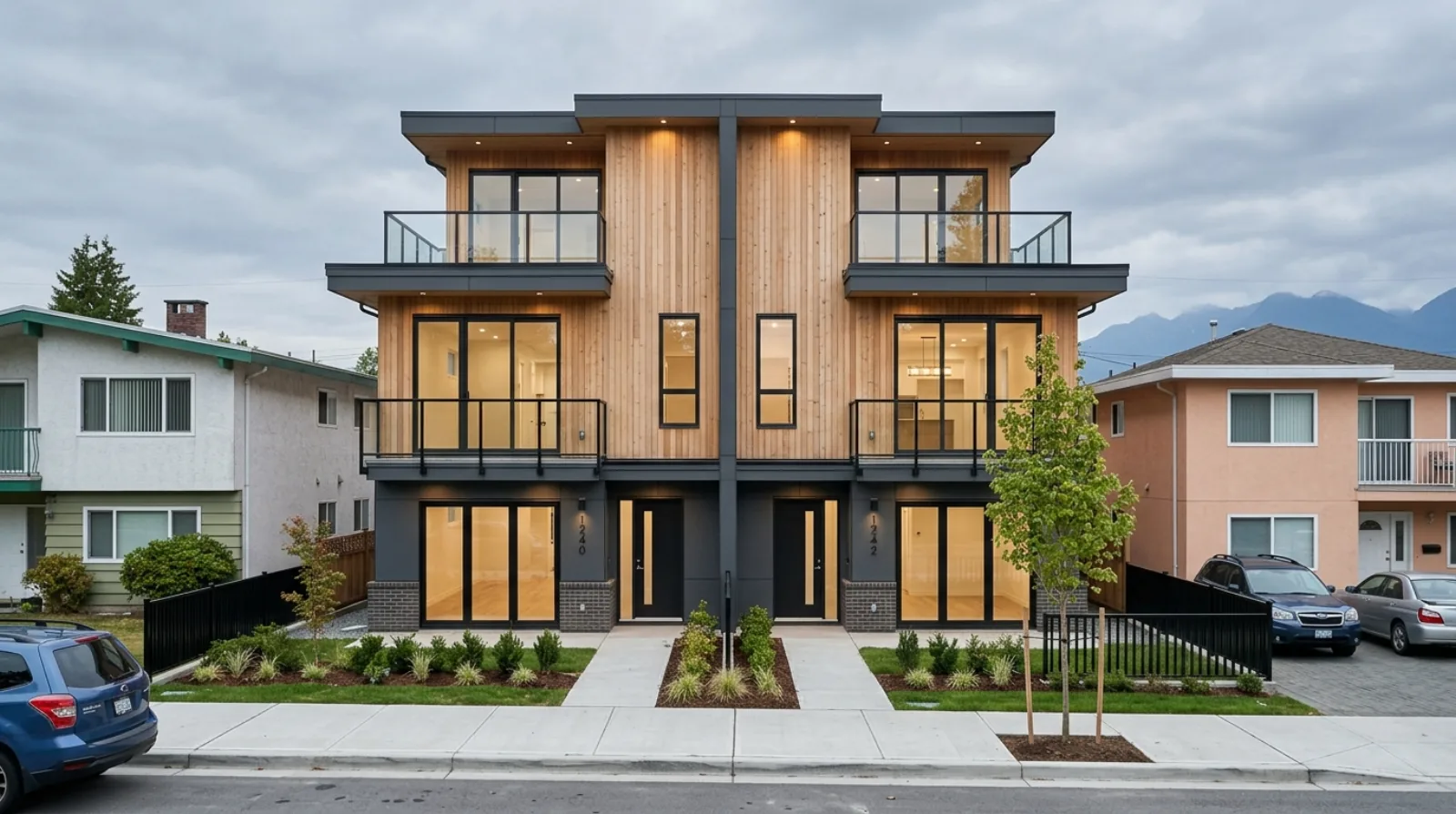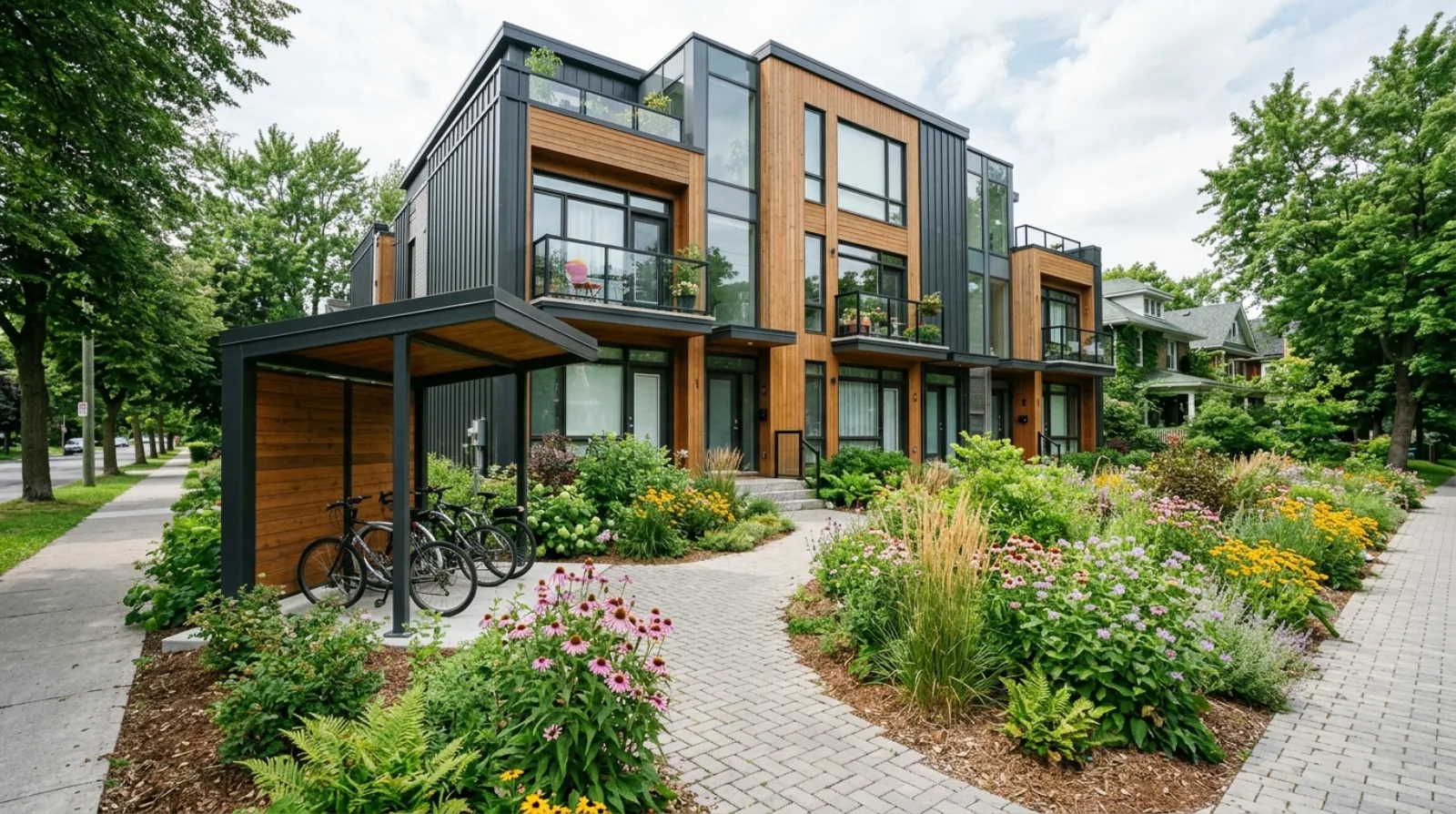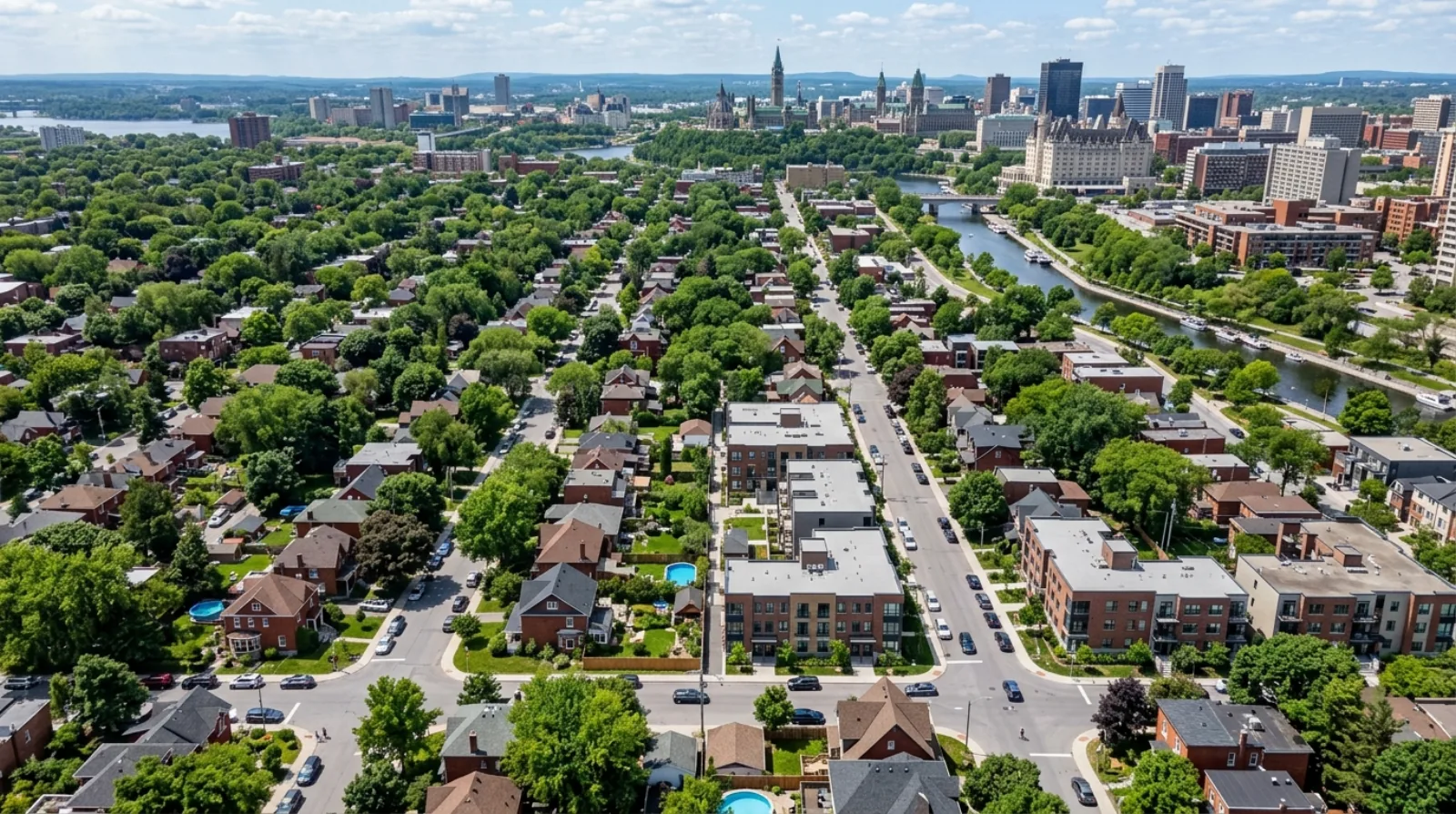
For thirty years in BC, the rule was simple: every new dwelling unit needed somewhere between 0.7 and 2.0 parking stalls. The exact ratio depended on the municipality, the unit size, and the proximity to transit. The principle was the same everywhere — every door, more parking.
That single rule is why most North American small multiplexes weren’t built between 1980 and 2020. Not zoning. Not financing. Parking.
This is the under-told story of why missing middle housing actually went missing.
Why the rule kills the building
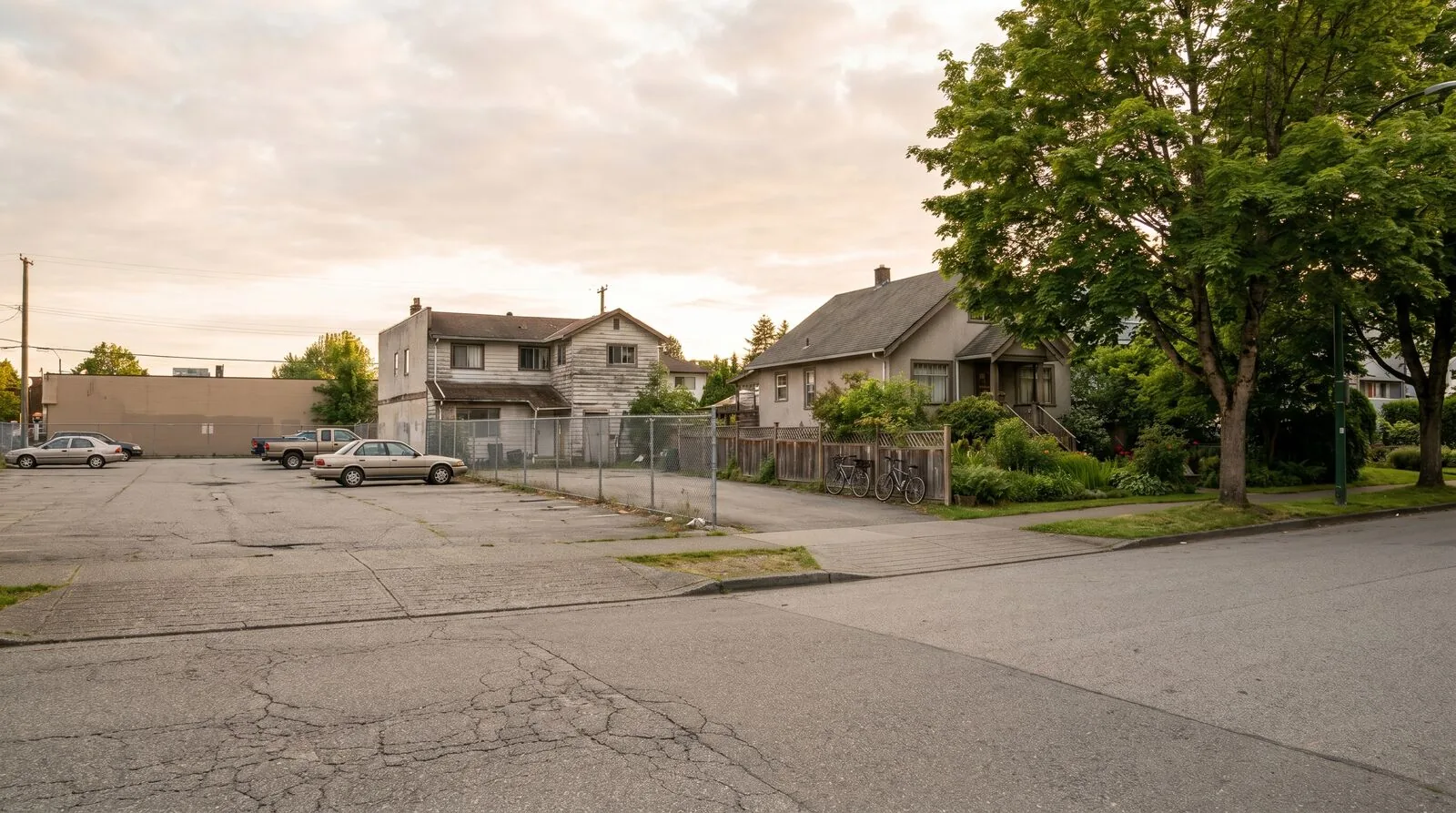
A typical Vancouver 33-foot lot is roughly 33 ft × 122 ft = ~4,026 sq ft. A standard parking stall is about 2.6 m × 5.5 m = ~155 sq ft, plus aisle space (you need ~22 ft minimum for a manoeuvring aisle). Two stalls plus aisle eats 600–700 sq ft of lot, depending on configuration.
For a fourplex requiring 1.5 stalls per unit (six stalls total), the parking requirement consumes 30–40% of the lot footprint. That space comes out of the building footprint, the yard, the trees, the bike storage — everything else.
There are three ways to fit the parking:
- Surface parking in the rear yard. Eats the back yard, often kills tree retention requirements, and produces a building that looks like a strip mall.
- Tucked under the building (slab-on-grade with a partial below-grade level). Adds expensive structural work — typically tens of dollars per sq ft of building above. Often pushes the project from break-even to negative.
- Full underground parkade. Best aesthetics, worst cost. Underground parking on a small site can cost upwards of $80,000 per stall once excavation, shoring, waterproofing, and ramp engineering are factored in. For a six-stall fourplex requirement, that’s roughly half the entire hard cost of the building.
For most small lots, option 3 is the only one that produces a quality building, and the cost makes the project not pencil. Option 2 is sometimes feasible. Option 1 produces a building nobody wants to live next to.
The historical default was therefore: don’t build the multiplex. Build a single-family home with a driveway. The parking math worked for one unit, never for four.
The rule as protectionism, not transportation policy
Parking minimums weren’t designed by traffic engineers based on actual demand. They were copied between municipalities throughout the postwar period, often based on observation in shopping malls and office parks. UCLA professor Donald Shoup’s The High Cost of Free Parking documented this. The minimums were never based on rigorous demand modelling. They were rules of thumb that became ordinances that became standards.
Once a parking minimum is in a zoning bylaw, it’s effectively a development cap. It limits how many units fit on a lot more than the FSR or setback rules do. And because it’s hidden inside a technical requirement — not the headline density — the public conversation about housing supply tends to ignore it.
Strong Towns has written extensively about how parking minimums function as exclusionary zoning by another name. Their framing matches what you see when you actually try to draw a fourplex on a 33-foot lot under 1.5-stall-per-unit minimums: the building gets impossible.
What’s changing in BC
Several BC municipalities have moved on parking minimums in the last few years:
- City of Vancouver has been progressively reducing minimums. Frequent transit areas now have low or zero requirements. R1-1 multiplex projects within 400 m of frequent transit can often be designed with one stall per unit or fewer. Confirm the specific requirements with Vancouver’s parking bylaw.
- Burnaby and New Westminster have followed similar trajectories — reduced minimums near transit, more flexibility for small multiplexes.
- Kelowna went further than required and has minimal parking requirements for its MF1 multiplex zone.
- Several smaller municipalities still have substantial minimums that effectively prevent compact multiplex forms.
The pattern: places that paired zoning reform with parking reform got more permits. Places that did one without the other got fewer.
What “no parking” actually means
A common misunderstanding: reducing minimums doesn’t mean no parking gets built. Builders provide parking when the market demands it. Vancouver projects in less-transit-rich areas typically still build parking because end-buyers and tenants want it. Vancouver projects two blocks from a SkyTrain station often skip it because the buyer pool doesn’t need a stall and would rather have a cheaper unit.
The reform isn’t “no parking.” It’s “let the market decide how much parking, instead of forcing every project to oversupply.” This matters because parking demand actually does vary. A studio renter in Mount Pleasant has different parking needs than a three-bedroom buyer in Oakridge. One-size-fits-all minimums can’t capture that.
The financial impact, in concrete terms
I won’t quote dollar figures because they move with construction costs, but the structural relationship is consistent:
- Eliminating a required underground stall typically saves a meaningful share of total project cost
- Eliminating an above-grade tucked-under stall saves less, but still meaningful
- Eliminating surface parking saves little construction cost but recovers building footprint and yard space
For a fourplex on a Vancouver 33-foot lot, the difference between “1.5 stalls per unit underground” and “0.5 stalls per unit surface” can be the difference between a viable project and a non-viable one. That’s it. That single line item.
How parking interacts with single-stair reform
Single-stair reform and parking reform are complementary. Single-stair frees up floor-plate efficiency inside the building. Parking reform frees up site footprint outside the building. Both are needed for the small-multiplex form to work on narrow lots.
If you’ve only got one of them, the project is constrained by the other. Vancouver has both for many sites; some other municipalities have one or neither. That’s why Vancouver’s multiplex permit boom is bigger than its peers.
What about traffic? What about parking on the street?
The standard objection: if multiplexes don’t provide parking, residents will use street parking, and neighbours will be angry.
The empirical answer is mixed. In dense urban areas with good transit, the parking-demand-per-unit is genuinely lower than the suburban norm. In areas without transit, demand is higher and the on-street parking pressure is real.
Most cities address this with permit parking programs. Residents register for street parking permits in their neighbourhood. New development units typically don’t get permits beyond what’s allocated, which limits the spillover. It’s not a perfect system, but it’s how most North American cities manage the transition from minimums to market parking.
The City of Vancouver has residential parking permit areas covering most denser neighbourhoods. The programs aren’t always loved, but they work.
What I tell first-time multiplex owners about parking
Three points, every consultation:
- Check the parking requirement before you fall in love with the unit count. A six-unit project at two stalls per unit on a tight lot is usually impossible. A six-unit project at zero or one stall in a transit-rich area is often viable.
- Underground parking is the project killer. If your specific lot requires underground parking to hit the unit count, model the cost carefully. Often the right answer is fewer units, no underground.
- The market will buy or rent units with less parking than you expect, if the location supports it. Don’t oversupply parking on instinct. Run actual market comps for unit sales/rents at varying parking ratios. The premium for a second stall is often smaller than the cost to build it.
The bigger frame
Parking minimums are an example of why land-use reform isn’t one law. It’s a stack of laws. The headlines focus on zoning. The actual buildable economics depend on the stack: zoning + parking + setbacks + tree protection + DCLs + fire code + financing.
If any one of those layers is hostile to small-multiplex forms, the whole stack stops working. BC has been steadily reforming the stack. Bill 44 was the most visible piece. Parking-minimum reform was just as important and got 1% of the press. Single-stair reform got 0.1% of the press. All three matter.
For owners, the practical message: when you check whether your lot can support a multiplex, don’t just check the zoning. Check the parking requirement. The two together are what determine the answer. For more on stack-level analysis, see the missing middle hub and why most R1 lots aren’t redeveloping.
— David Babakaiff, Co-Founder, VanPlex