Every BC city that adopted Bill 44 multiplex rules now has the same data point hidden in their permit records: how many of the new multiplexes are strata-titled (designed for individual unit sales) versus secured rental (held under one owner, all units rented).
The answer differs sharply by city. And the gap tells you something useful about which markets are actually producing rental supply versus which are producing condo replacements.
This is what the tenure mix looks like, city by city, and why it matters.
What strata vs rental actually means
A strata multiplex is a building where each unit has its own title. They can be sold individually. The owner builds, sells units one at a time (typically two to six buyers), and exits. The building is governed by a strata corporation under BC’s Strata Property Act.
A secured rental multiplex is a building under one title. All units are rented, often to long-term tenants. The owner holds the building, finances it long-term, and keeps it as an income property. Some BC municipalities require secured-rental commitments to be registered against the title via covenant for a specified term.
Both are legal under Bill 44. Both produce housing. They are not the same product economically, financially, or socially.
Why a city might prefer one over the other
From a municipal planning perspective:
Strata multiplexes produce ownership opportunities, more property tax per door, and individual buyer accountability. They also produce Airbnb risk (units can be sold and used for short-term rental), churn in occupancy, and harder-to-track tenant protections (each unit has different ownership).
Secured rental multiplexes produce stable long-term rental supply, predictable maintenance through one owner, and units that count toward the city’s rental housing targets. They also produce slightly less property tax revenue per door and concentration of risk (one owner can sell or default).
Most BC cities want a mix. The question is what mix actually shows up.
The actual mix, by city
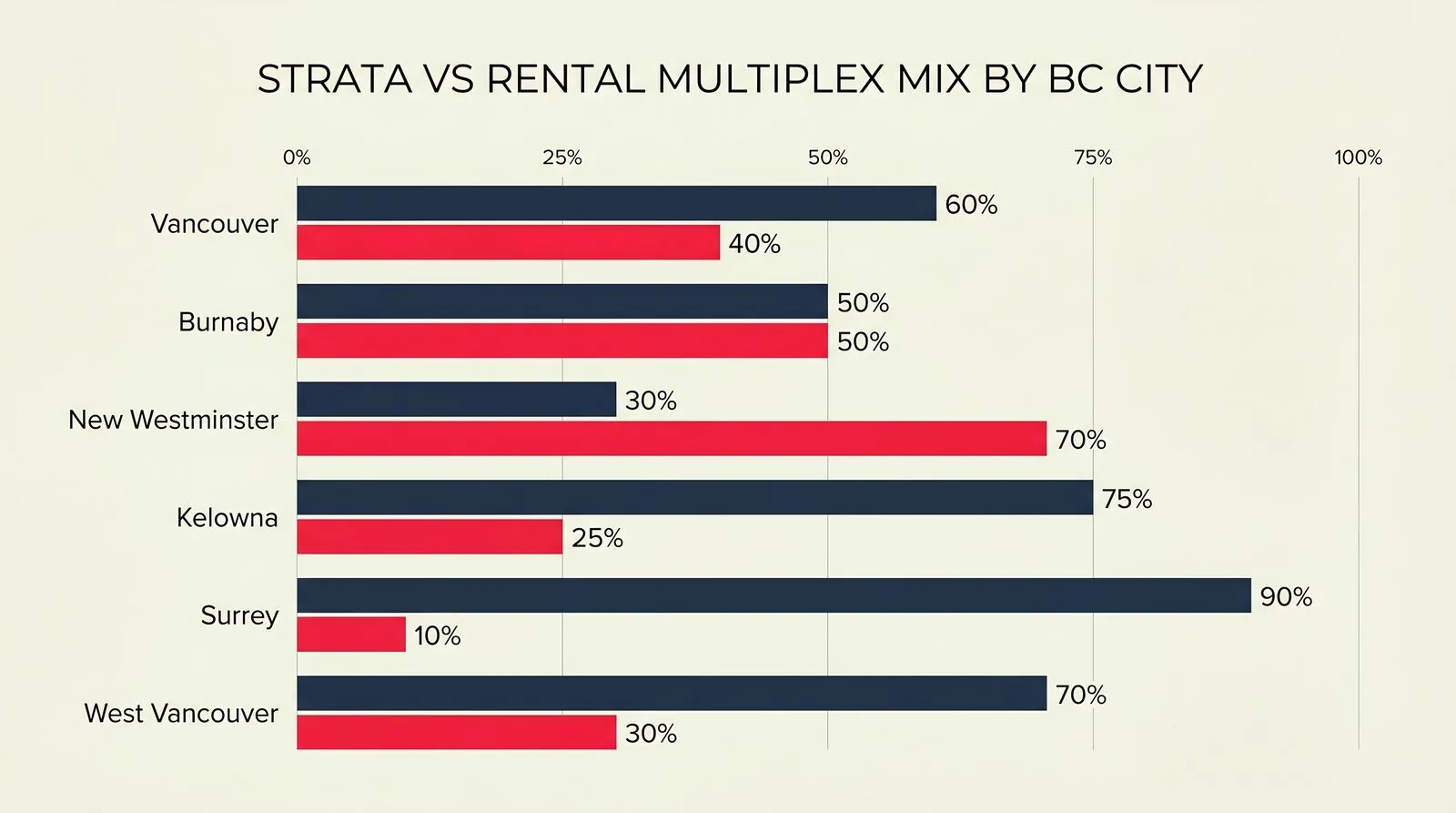
Permit datasets aren’t always perfectly clean on tenure — a strata project doesn’t always declare strata at building permit issuance, and a rental commitment may show up as a covenant or a rezoning condition rather than a permit annotation. So the numbers below are approximate based on a combination of building permits, rental tenure zoning data, and rezoning decisions through 2025.
City of Vancouver: Multiplex permit mix runs roughly 60% strata, 40% rental. Vancouver’s secured rental density bonus is the strongest in the province — owners who go rental can get up to eight units where strata is capped at six. That bonus has clearly moved the mix toward rental over time. Pre-bonus, the mix was closer to 80/20 strata.
Burnaby: Roughly 50/50 strata vs rental. Burnaby has been more rental-aggressive in policy and has its own tenure preservation rules that preserve existing rental stock and incentivize new rental.
New Westminster: Tilts heavily toward rental — roughly 30% strata, 70% rental. The city has been an outlier in actively encouraging secured rental multiplexes.
Kelowna: Tilts toward strata — roughly 75% strata, 25% rental. The Okanagan investment and second-home buyer pool produces stronger strata demand. We covered the regional dynamics in Kelowna build to rent.
Surrey: Almost entirely strata — over 90% strata, under 10% rental. Surrey’s land basis and developer mix have produced a build-to-sell default. We dug into this in Surrey rental land basis beats policy.
District of North Vancouver and West Vancouver: Sample sizes are too small to draw conclusions. These municipalities have produced few multiplex permits to date. See DNV refuses Bill 25 SSMUH.
What drives the difference
Three factors, in roughly this order of importance:
1. The financial structure of secured rental
Secured rental projects pencil when:
- The land basis is favourable (purchased pre-2018 or inherited)
- The lot supports five or more units (CMHC programs activate at five — see the five-unit threshold)
- The owner has the patience for a long-term hold (10+ years to substantial wealth realization)
- The unit mix matches CMHC affordability requirements where applicable
Strata projects pencil when:
- The land basis can be amortized over fewer high-value sales
- The end-buyer market in that neighbourhood is liquid
- The owner wants to exit at completion rather than hold
In Vancouver, both conditions can be met in different neighbourhoods. In Surrey, the strata path almost always wins because end-buyer demand is strong and CMHC underwriting is harder on suburban lots. In Kelowna, the Okanagan buyer pool keeps strata economically dominant.
2. Municipal incentives
Cities that offer real incentives for secured rental — DCL waivers, density bonuses, parking relief — get more rental. Vancouver’s density bonus stack is the most aggressive, and the rental share reflects that. New Westminster’s incentives are quietly strong. Surrey and Kelowna offer fewer rental-specific incentives, and the mix shows it.
3. Owner profile
Strata is dominantly built by professional small developers — three to six units at a time, sell, repeat. Rental is dominantly built by long-term holders, often homeowners turning their lot into income property. The local distribution of these two types affects the mix as much as policy does.
What this means for housing supply
The two tenure types produce different kinds of supply:
- Strata supply adds to ownership stock, supports first-time buyers and downsizers, and can convert to rental over time as individual owners rent out units
- Rental supply adds to long-term rental stock immediately, often at lower per-unit rents than equivalent strata-rental conversions, and stays rental for the term of any covenant
For BC’s housing affordability problem, both matter. The mix matters too. A city producing 100% strata multiplexes is not addressing rental demand. A city producing 100% rental is not addressing first-time-buyer demand. A roughly balanced mix — what Vancouver is approaching — addresses both.
The cities producing extreme mixes (Surrey’s 90%+ strata, New Westminster’s 70%+ rental) are arguably distorted in different directions. Surrey is producing condo-replacements at the small-multiplex scale rather than rental. New Westminster is doing the opposite.
What investors and owners should take from this
A few practical implications:
If you own a lot and you’re trying to figure out tenure: the answer depends mostly on your land basis and your appetite to hold. Old basis + willingness to hold = rental usually wins (and especially in Vancouver, the eight-unit rental bonus makes rental the structural winner). Recent basis + need to exit at completion = strata usually wins.
If you’re a buyer in the strata market: be aware which buildings are sold out from new strata multiplex stock and which are converted from rental. The two have different track records and different hidden risks (strata depreciation reports, original-build construction quality, etc.).
If you’re a renter in the rental market: secured-rental multiplexes are typically more stable than condo-rental units. The covenant and CMHC underwriting often produces longer-term tenure security and more predictable rent trajectories.
If you’re a city planner reading this: the tenure mix in your municipality is largely a function of your incentive stack. If you want more rental, look at what Vancouver and New Westminster did. If you want more strata, your job is mostly already being done by the market.
The strata-to-rental conversion question
A pattern we’re starting to see in 2026: some strata multiplexes are being purchased in their entirety by single buyers who then operate them as rental. This isn’t a planned policy outcome — it’s investors recognizing that a six-strata-unit building, bought from a developer at completion at slight discount, can produce competitive rental returns relative to ground-up rental construction.
This counts as rental supply but isn’t reflected in the strata-vs-rental permit data. It also creates strata governance complications (one owner controlling all units changes how strata law functions). Whether this becomes a sustained trend or a temporary arbitrage depends on price spreads between new strata sales and CMHC-financed rental construction. Watch this through 2026–2027.
Honest summary
The strata-vs-rental mix in BC small multiplexes is not a binary policy question. It’s a multi-variable function of land basis, financing structure, municipal incentives, and developer profile. Cities that want more rental need a stack of incentives, not one. Cities that get mostly strata are usually doing what their market wants, even if that’s not what the housing-affordability conversation calls for.
For owners trying to figure out which path is theirs, the most useful framing is: don’t pick tenure first. Pick land basis first. Then let the financial structure tell you which tenure pencils.
For more, see the missing middle hub, the Bill 44 explainer, and Bill 44 rental tenure rules.
— David Babakaiff, Co-Founder, VanPlex