On May 20, 2026, Vancouver Council asked staff to take a second look at the rulebook it wrote for multiplexes — three years after first writing it, and after 600-plus projects had already been submitted under it.
This is not a bombshell. It is not a moratorium. But for anyone with land under contract, drawings on a planner’s desk, or capital allocated against a Bill 44 thesis, Motion 9 is the most consequential thing Council has done to the multiplex program in a year — and it deserves to be read carefully rather than spun.
TL;DR
- Councillors Lenny Zhou and Brian Meiszner co-submitted Motion 9 to the Standing Committee on City Finance and Services on May 20, 2026. It was approved with amendments.
- The motion directs staff to run an expedited review of Vancouver’s multiplex policies and zoning, three years after the city’s 2023 rules and one year after the Province’s Bill 44 mandate stacked on top.
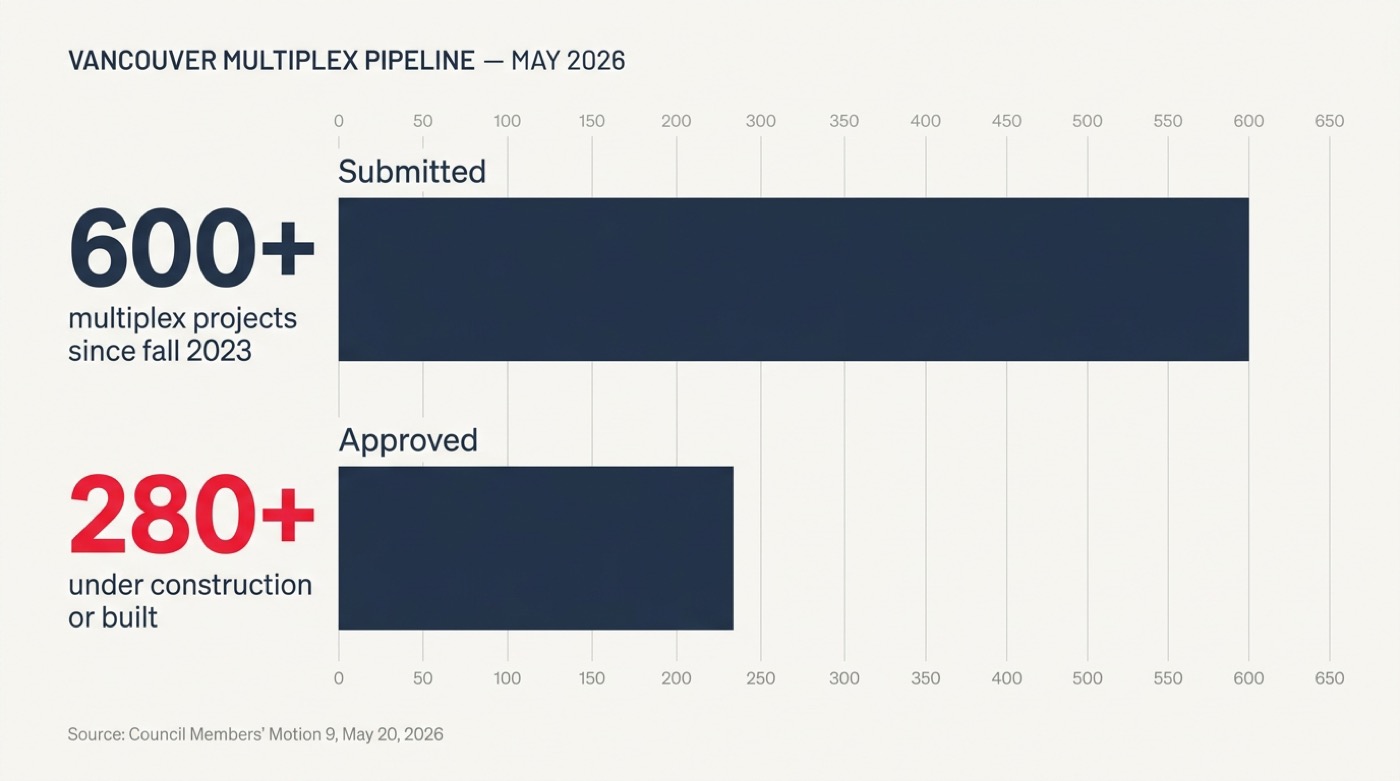
- The numbers Council cited are real: 600+ multiplex projects submitted, 280+ approved, with staff reporting “positive excitement” from the building community.
- The review must also align Vancouver’s multiplex rules with provincial Bill 25 as part of the R1-1 review.
- The motion specifically names massing, height, lot coverage, privacy, overlook, shadowing, tree retention, and views as resident concerns that triggered the review.
- The protective language matters: any refinements must “maintain certainty for applicants” and “avoid unnecessary impacts on permitting timelines or project viability.” Both directions are explicitly on the table — tightening and clarifying.
Who moved it, and what it actually says
Council Members’ Motion 9 is titled Review and Refinement of Multiplex Housing Policies Based on Early Implementation Experience. It was co-submitted by Councillors Zhou and Meiszner and heard at the Standing Committee on City Finance and Services on May 20, 2026.
The operative parts are three resolutions:
A. Staff are to run an expedited review of Vancouver’s multiplex policies and zoning, informed by the actual implementation experience to date. As part of the R1-1 review, the city’s rules must be aligned with the provincial Bill 25. The review must examine how current regulations are performing on building scale, massing, setbacks, tree canopy, and relationship to adjacent properties — and decide whether anything needs to be adjusted.
B. Staff are to consider whether additional clarity in zoning provisions or design guidance would help produce more consistent, context-sensitive outcomes. Crucially: any refinements must maintain certainty for applicants and avoid unnecessary impacts on permitting timelines or project viability.
C. Staff are to develop a best-practices guideline for multiplex development, drawing on what other North American cities have done after their own missing-middle reforms. Staff will report back to Council with findings and, where appropriate, recommended policy or zoning refinements.
That is the whole machine. No new fees, no new prohibitions, no new design rule. A direction to look, learn, and report back.
The numbers Council put on the record
The most useful data point in the motion is buried in WHEREAS clause 4. Since Vancouver’s multiplex rules came in during the fall of 2023, more than 600 multiplex projects have been submitted and more than 280 have been approved — meaning they are either under construction or already built.
That is the real story behind the review. Council is not opening this file because the program failed. It is opening it because the program worked, generated three years of on-the-ground experience, and produced enough buildings on enough streets to expose what the rules actually do versus what they were drafted to do.
The motion also quotes staff reporting “positive excitement” within the development and building community. That is unusually candid for a council document. Translated: the multiplex form is working as a housing typology. The friction is not with the existence of the rule — it is with the edges.
What residents are actually complaining about
WHEREAS clause 8 lists the concerns Council has been hearing. The list is specific, and it is the same list every councillor in every North American city has heard whenever missing-middle reform delivers actual buildings:
- Building massing
- Height
- Lot coverage
- Privacy
- Overlook
- Shadowing
- Tree retention
- Loss of green space
- Impacts on views
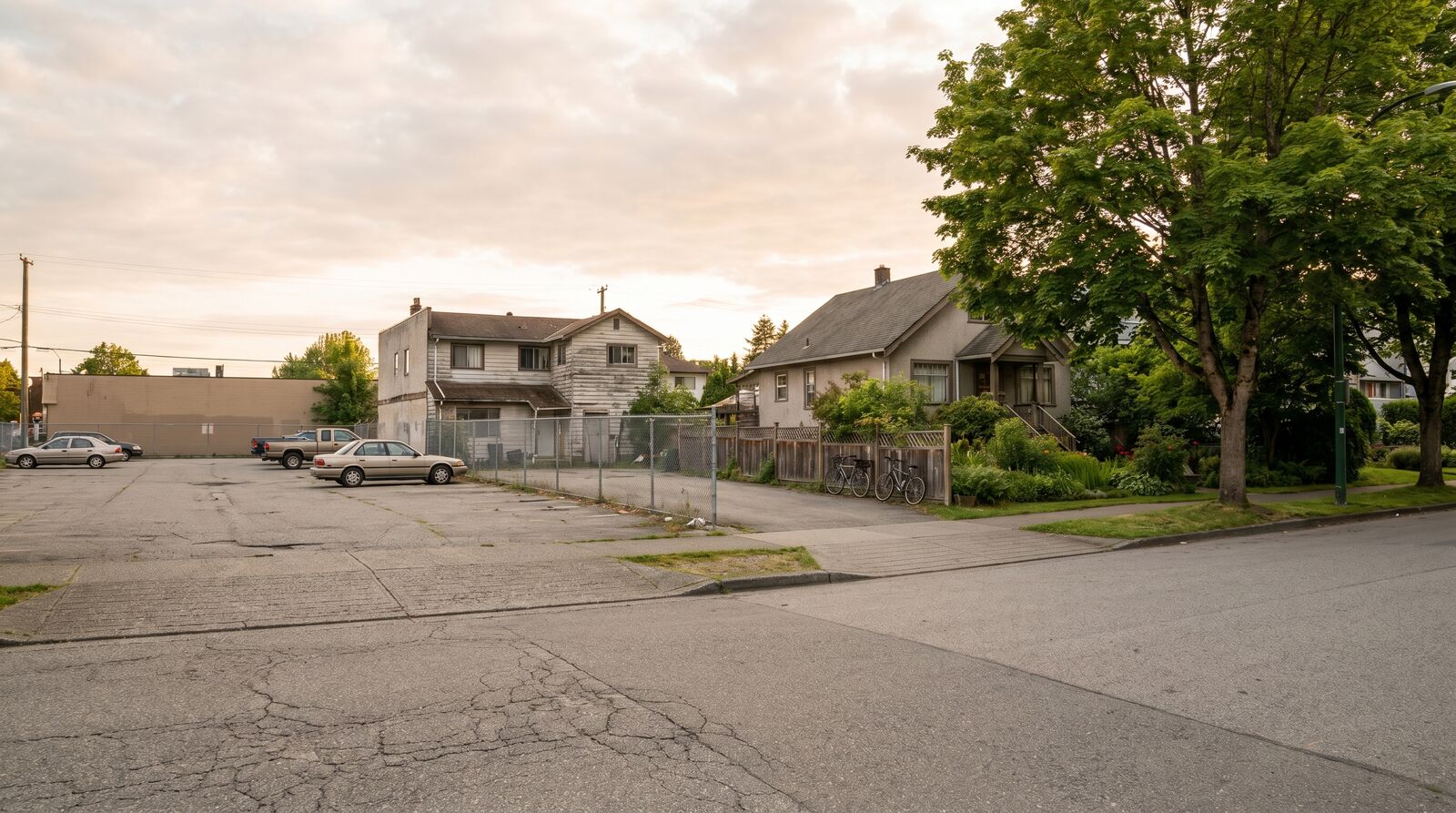
None of these are abstract. A new fourplex on a 33-foot lot puts a three-storey wall closer to the neighbour’s south-facing yard than the bungalow it replaced. A sixplex with rear lane access changes what the back of the lot looks like. Mature trees come down when foundations go in. These are real outcomes, and “the Province made us do it” is not, as a political answer, going to hold the line forever.
The honest framing is that Bill 44 forced what gets built, and Vancouver’s 2023 bylaw decided how. The “how” is what is now on the table.
What “align with Bill 25” really means
This is the part of the motion the headlines will miss. Resolution A includes a one-line direction that staff, as part of the R1-1 review, align Vancouver’s multiplex policies with the provincial Bill 25.
Bill 25 — the Housing Statutes Amendment Act, 2024 — is the provincial enforcement layer that sits behind Bill 44. It is how Victoria now compels municipalities to actually deliver on the small-scale multi-unit housing rules they were ordered to adopt. The Province has not hesitated to use it. West Vancouver was overridden by Order in Council in April 2026 when its Ambleside rules were judged non-compliant.
For Vancouver, alignment with Bill 25 is mostly a defensive move. The city wrote a Vancouver-flavoured multiplex bylaw before the Province wrote its enforcement statute, and that creates real risk that some Vancouver-specific provision — a setback rule, a parking minimum, a tree retention requirement, a privacy screen mandate — sits in conflict with what Bill 25 will treat as acceptable. Better to find that out in a staff review than in a provincial override.
In other words: this is partly Council asking staff to make sure Vancouver’s own rules will survive provincial scrutiny when they are tested.
The risk: a review that quietly tightens the screws
Here is where builders and underwriters need to be careful. Resolutions A and C give staff explicit permission to consider adjustments to built-form controls, design standards, and transition rules — and the motion’s WHEREAS clause 9 cites other North American cities that have refined their reforms to “better balance housing delivery with neighbourhood impacts.”
That sentence can go in two very different directions.
The good version: design guidelines get clearer, setbacks and tree rules become more predictable, and a real best-practices document means a designer in Marpole and a designer in Kits work to the same baseline. Less ambiguity is a builder’s friend.
The bad version: massing limits get tighter, lot coverage shrinks, height steps down in places it currently doesn’t, and the buildable area on a typical 33-foot R1-1 lot loses ten or fifteen percent. That comes straight out of unit count, which comes straight out of land value, which comes straight out of the homeowner’s cheque.
The motion does try to fence this off. Resolution B says, in so many words, that any refinements must “maintain certainty for applicants” and “avoid unnecessary impacts on permitting timelines or project viability.” The 3-3-3-1 framework — the provincial permit-processing targets — gets a specific name-check in WHEREAS clause 10. That language is the protective armour for the building community, and it is meaningful.
But council motions are easier to write than they are to enforce. What matters is what staff actually report back with, and how Council votes on whatever they recommend.
What this means if you are underwriting a Vancouver multiplex today
The honest answer is: not very much, yet. There is no new rule. There is no new fee. There is no moratorium. Permits already in the pipeline are not affected. Permits being submitted in June 2026 will be reviewed under the current rules.
What changes is the risk picture for projects whose permits will not land until late 2026 or 2027 — projects still being designed, still negotiating land, or still raising capital. For those:
- Underwrite the current rules as the base case. That is what the math has to work against today.
- Run a sensitivity for a tighter-massing scenario — say, 5–10% less buildable area — and see whether the deal still pencils. If a deal only works on the maximum building envelope, that is a deal with no margin for a refinement cycle.
- Track the staff report back. Motion 9 is open-ended on timing — the report will come “within a timeframe that aligns with upcoming housing and planning work programs.” Watch the Council agenda monthly.
- Read what Bill 25 will require carefully. If the Province’s standard is more permissive than Vancouver’s current rule on a given dimension, alignment is a tailwind. If less permissive, it is a headwind.
Top-tier lots — the ones that score well on PlexRank, the ones with clean R1-1 zoning, no infrastructure complications, and current comps that support a real exit — are not the ones at risk. Marginal lots, where the entire deal lives or dies on squeezing the maximum unit count out of the envelope, are.
The bigger story
Three years in, 600 submissions deep, 280 buildings up — Vancouver’s multiplex program is the largest live experiment in missing-middle housing in Canada. Of course Council is reviewing it. The interesting question is not whether the rules will change, but in which direction, and how fast.
If staff come back with a real best-practices guideline, clarified design guidance, and Bill 25 alignment that simplifies the rule stack, the program gets better. If they come back with tighter envelopes and harder transition rules dressed up as “neighbourhood fit,” the program gets harder.
Both are possible. What is no longer possible is treating the 2023 rules as settled law.
If you own a Bill 44–eligible lot in Vancouver, the PlexRank score on your address tells you which side of that line you sit on. Top-tier lots can absorb a tighter envelope and still pencil. Marginal lots cannot. The two-minute lookup is at VanPlex.ca — and it is free.
— David Babakaiff, Co-Founder, VanPlex | PlexRank™ | Profit with Multiplex