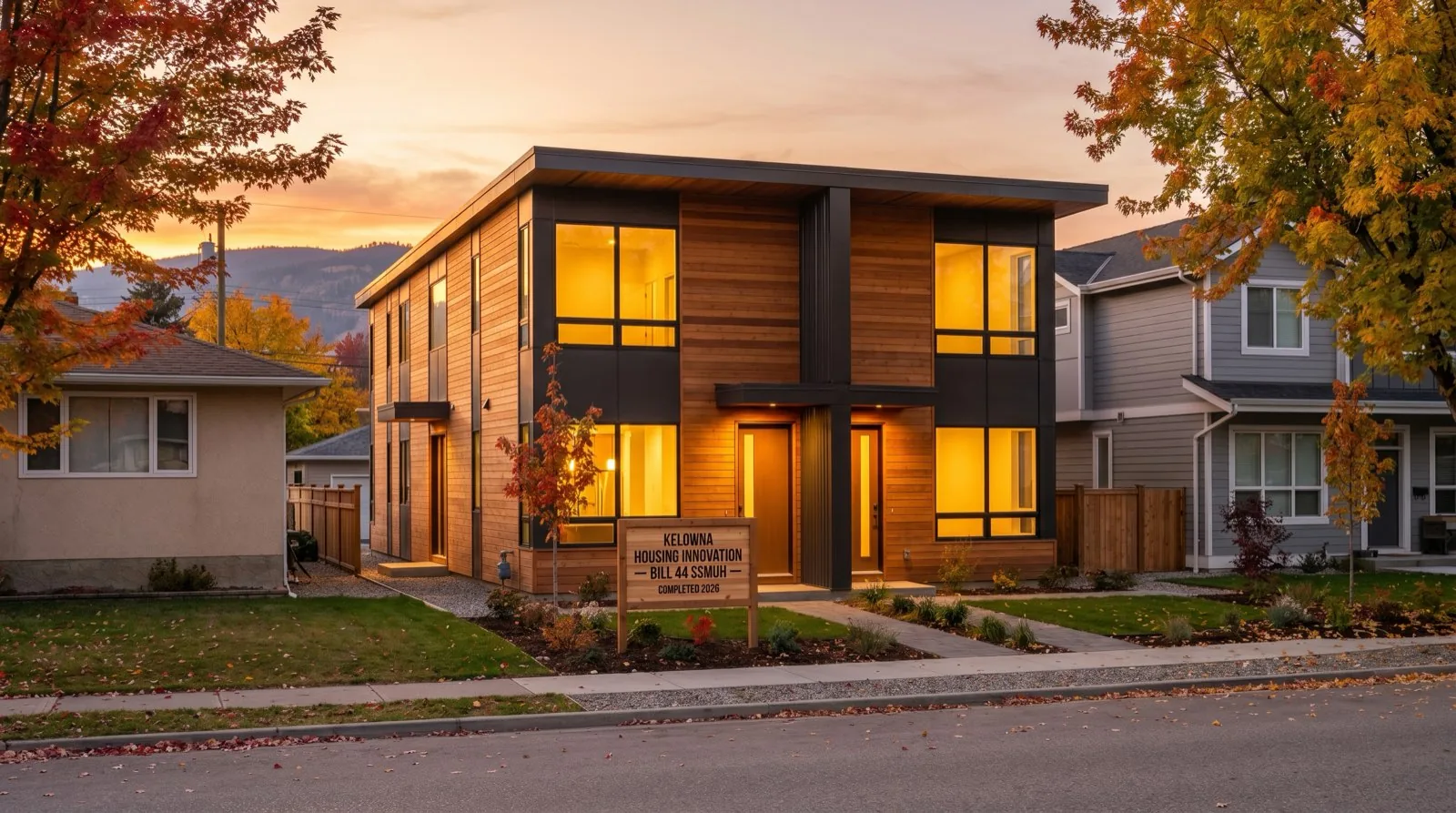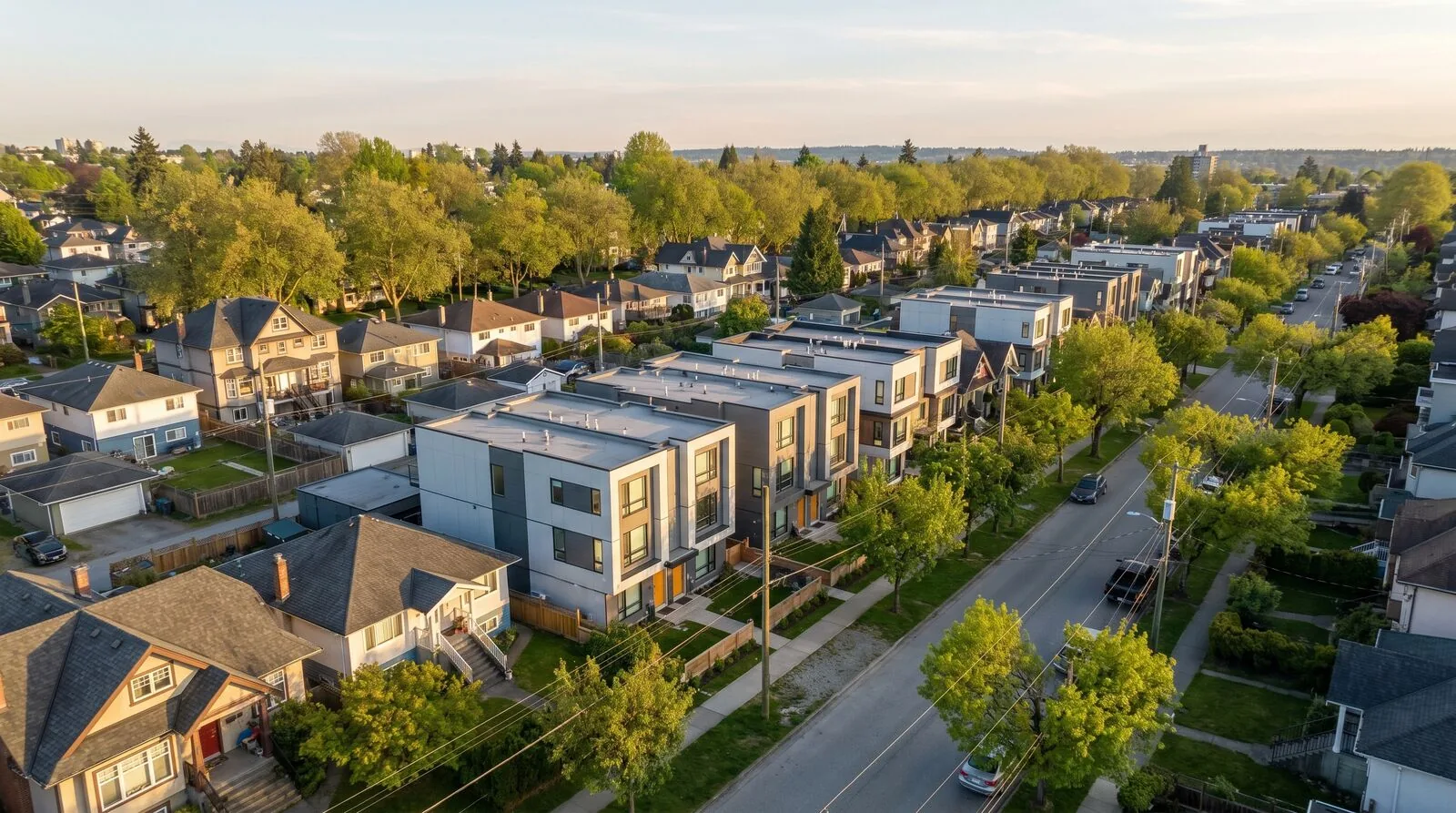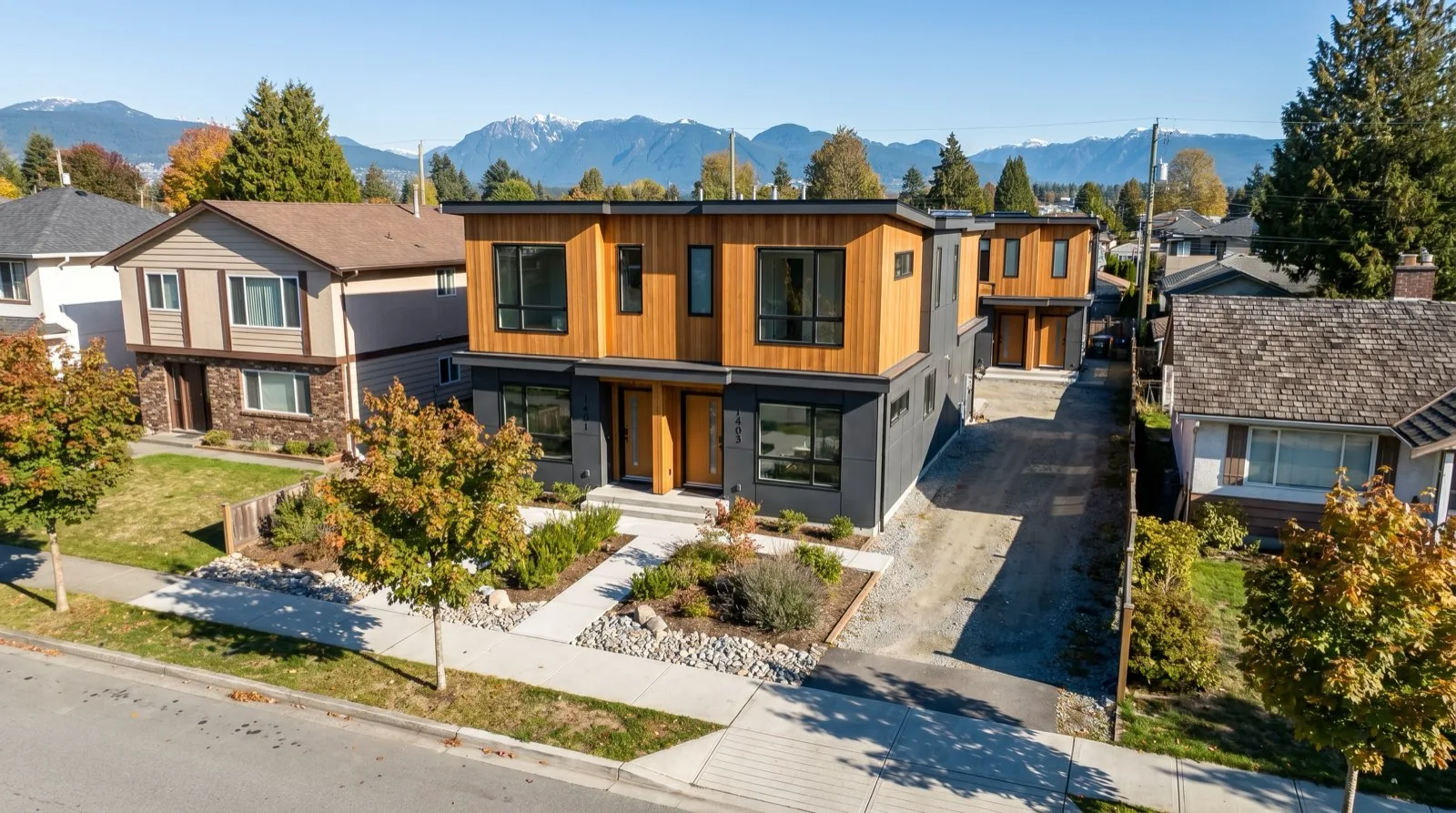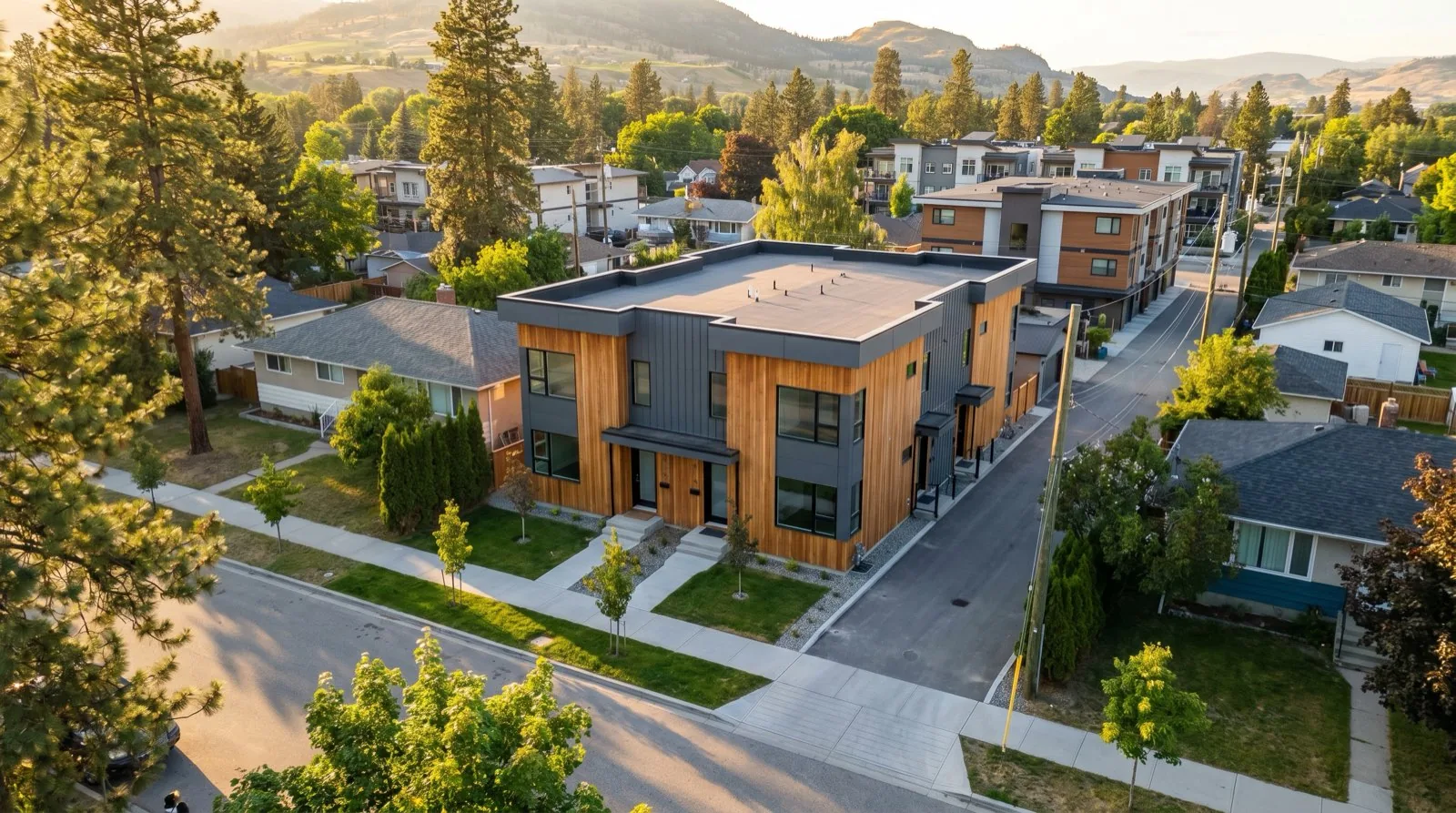

Bill 44 changed Kelowna overnight. Most owners still haven’t caught up.
On March 18, 2024, the City of Kelowna pre-zoned every eligible residential lot in the city to comply with the Province’s Small-Scale Multi-Unit Housing (SSMUH) legislation. No rezoning application. No public hearing. No Council vote on your street. The zoning map just shifted under 50,000-plus single-family parcels overnight, according to the City’s planning legislation page.
If you own a house in Kelowna South, Rutland, North Glenmore, Capri, or Pandosy, the rules that applied to your lot in 2023 are not the rules that apply in 2026. This primer walks through what actually changed — the Zoning Bylaw families you need to know, how SSMUH layered on top, and a worked example so you can see what a 650 m² lot can actually become.
The Zoning Bylaw 12375 families that matter
Kelowna replaced its old zoning bylaw in 2022 with Zoning Bylaw No. 12375, and that bylaw is still the legal backbone for every residential application in the city. Everything Bill 44 did layers on top of 12375 — it didn’t replace it.
There are two families of residential zones that do the heavy lifting for multiplex work.
The RU family: Residential Urban
The RU zones (RU1, RU2, RU3, RU5) are what most Kelowna homeowners are sitting on. These are the detached-house zones, but each one carries different allowances for duplexes, carriage houses, and secondary suites. Before Bill 44, the unit count was tightly controlled by which RU designation your lot carried. After Bill 44, the RU zones still exist, but the SSMUH minimums override the old unit caps on any lot that qualifies.
The City’s zoning bylaw overview is the authoritative source for which RU designation applies to a specific parcel. Don’t guess from the street name.
The MF family: Multiple Family
The MF zones (MF1, MF2, MF3, MF4) are the purpose-built multi-unit zones. Section 13 of the Zoning Bylaw governs them.
MF1 is the one most relevant to multiplex builders. It’s designated for infill housing in the Core Area, ground-oriented, up to two storeys. If you’re planning a 4-plex or 6-plex on a typical 550-700 m² lot in Kelowna South or Pandosy, MF1 — or an RU lot operating under SSMUH floors — is where the math lives.
MF2, MF3, and MF4 step up from there into townhouses, low-rise apartment buildings, and higher-density forms that generally require site consolidation and full rezoning. They’re outside the scope of a typical single-lot multiplex build.
How SSMUH layered on top on March 18, 2024
Bill 44 — the Housing Statutes (Residential Development) Amendment Act — required every municipality in BC with a population over 5,000 to adopt SSMUH-compliant zoning by June 30, 2024. Kelowna met the deadline three and a half months early on March 18, 2024.
The Province’s SSMUH policy page sets the minimum floors that every BC city must honour on eligible lots:
- 3 units on lots of 280 m² or smaller
- 4 units on lots larger than 280 m²
- 6 units on lots larger than 280 m² that sit within 400 m of a qualifying frequent-transit stop
Kelowna can allow more than these floors. It cannot allow less.
No public hearing. That’s the real shift.
The operational change most owners underestimate is the removal of the public hearing requirement for SSMUH-consistent applications. If your design fits within the pre-zoned envelope — setbacks, height, site coverage, parking — you don’t get dragged into a Council meeting where a neighbour three blocks over objects to shadow on their tomato garden. You deal with Planning staff, you meet the bylaw, you move.
That change alone compresses the timeline on a typical Kelowna multiplex from a 12-18 month rezoning slog to a permit-speed review. It’s the single biggest economic shift Bill 44 delivered.
Parking: the quiet win
The Province’s SSMUH rules also eliminated minimum parking requirements on eligible lots within 400 m of frequent transit. Kelowna’s main frequent-transit spine is Route 97 Okanagan RapidBus, running 15-30 minute headways along Harvey Avenue from UBC Okanagan to West Kelowna.
Lots within 400 m of Route 97 stops can build 6-unit SSMUH projects with zero required parking. You can still provide parking — most operators do, because tenants want it — but you’re not forced to bury a stall under every suite. For a 6-unit build on a 650 m² lot, that’s the difference between viable and underwater.
Key takeaway: Bill 44 didn’t just raise the unit count. It killed the public hearing, compressed the timeline, and removed mandatory parking near transit. Those three changes compound.
A worked example: 650 m² RU2 lot in Kelowna South
Let’s walk a realistic lot. A 650 m² (roughly 7,000 ft²) RU2-zoned property on a side street off Pandosy, four blocks from a Route 97 stop.
Pre-Bill 44 (before March 18, 2024)
Under the pre-SSMUH RU2 rules, the owner could build:
- Single-family house, plus
- Secondary suite, plus
- Carriage house (if the lot met rear-yard dimensions)
Three units maximum, with two of them (the suite and carriage house) tightly restricted in size and design. Any denser form required a full rezoning to MF1 or higher — a 12-18 month process with a public hearing and no guaranteed outcome.
Post-Bill 44 (after March 18, 2024)
Same lot, same zoning, same owner. The SSMUH floors now apply:
- Lot is 650 m² (over the 280 m² threshold), so the minimum floor is 4 units
- Lot is within 400 m of a Route 97 RapidBus stop, so the floor rises to 6 units
- No public hearing required if the design fits the envelope
- No minimum parking required under the transit exemption
The owner’s realistic options are:
- Build 4 units with surface parking, conservative design, MF1-style ground-oriented form
- Build 6 units leaning on the transit exemption, reduced parking (often 2-3 stalls instead of 6), tighter unit layouts
- Keep the existing house and do nothing — the upzone doesn’t force anyone to build
The 2040 OCP directs 48% of new units to the five Urban Centres (Downtown, Pandosy, Capri-Landmark, Midtown, Rutland) and 25% to the Core Area. A Kelowna South lot near Pandosy is squarely in the Core Area allocation zone — which means Planning staff are actively trying to approve infill here, not slow-walk it.
The six-unit move isn’t for everyone
Going from 4 to 6 units on the same footprint means:
- Smaller units (often two-bed instead of three-bed)
- Thinner margins per unit
- Higher debt service if you’re not taking out via CMHC MLI Select
- More tenant turnover risk in a 6.4% vacancy market (see CMHC’s 2025 Kelowna rental data)
The 6-unit floor unlocks an option. It doesn’t make the option correct for every owner.
What Bylaw 12375 still controls
SSMUH didn’t override height, setback, site coverage, or building envelope rules. Those still come from Bylaw 12375 and the specific zone that applies to your lot. The Province set unit-count floors; Kelowna sets the three-dimensional envelope. The distinction matters because two lots with the same SSMUH allowance — say, 6 units — can produce materially different buildings depending on the underlying zone’s height and setback rules.
That’s why two lots on the same street can produce very different projects. An RU5 corner lot with 10 m street frontage on two sides reads differently from an RU2 interior lot with a 15 m front setback requirement. Same SSMUH floor, different buildable form.
The practical workflow for any owner:
- Confirm zone via the City’s zoning bylaw page
- Measure lot area against the 280 m² threshold
- Check distance to the nearest Route 97 RapidBus stop (400 m rule)
- Pull the building envelope for your specific zone from Bylaw 12375
- Design to the envelope, then apply through Planning with no public hearing
The Province’s housing target layered on top
Alongside the SSMUH framework, the Province set Kelowna a housing target of 8,774 new homes over five years covering 2024-2029. That target isn’t a zoning bylaw, but it shapes how Planning staff prioritize files and how Council communicates about development to the public. SSMUH applications on eligible lots contribute directly to the target. So do larger MF rezonings, TOA densifications, and purpose-built rental projects.
An owner whose lot sits in an Urban Centre or the Core Area is working with the wind at their back from a policy-alignment perspective. An owner on a peripheral single-family lot — especially one with no frequent-transit access — is still allowed to build under SSMUH, but the proforma has to carry more of its own weight because the location isn’t doing the same density-target work.
The 2021 Census baseline
Kelowna’s 2021 Census population was 144,576 for the city and 222,162 for the CMA. Growth has continued since 2021 — Kelowna remains one of the fastest-growing CMAs in BC — which is the underlying demand rationale for the Province’s 8,774-unit target and the OCP’s Urban Centre allocations. SSMUH is one of the policy levers the Province bet on to absorb that growth without requiring every parcel to go through individual rezoning.
What the primer doesn’t cover
Three things this primer deliberately skips, because they deserve their own treatment:
- Development Cost Charges under DCC Bylaw 12420 — four residential brackets, depending on units per hectare
- Wildfire interface design under FireSmart Kelowna — mandatory Priority Zone 1 rules within 10 m of structures
- Step Code / overheating compliance — Kelowna HDD 3,715 and the 26°C overheating rule shape mechanical system design
Each of those compounds on top of SSMUH. Get the zoning right first, then stack the rest.
Related reading
What’s next for your Kelowna lot
Start with the Kelowna Multiplex hub for a full map of zones, neighbourhoods, and economics. If you know your address and want a plain-English answer on what SSMUH allows on your specific lot, we’ll run it.