
Texas, US | Multiplex Guide
The Texas Multiplex Guide: What You Can Build on a Single-Family Lot in 2026
If you own a lot zoned for one house in Texas, two things decide how many homes it can hold: your city's own code and the deed restrictions recorded on your lot. Texas cities write their zoning rules under Local Government Code chapter 211, so the answer in Austin is different from the answer in Dallas. In 2025 the Legislature passed three laws that changed how the largest cities treat new lots, commercial land and neighbor protests: SB 15, SB 840 and HB 24. This guide explains each one, the rules in four large cities, and the code, tax and loan rules that decide whether a duplex, triplex or fourplex works on your land.
VanPlex is a multiplex company in Vancouver, British Columbia. We do not build, lend or sell property in the United States. We wrote this guide as a reference for Texas owners, and every rule on it is linked to the statute, the state agency or the city that wrote it.
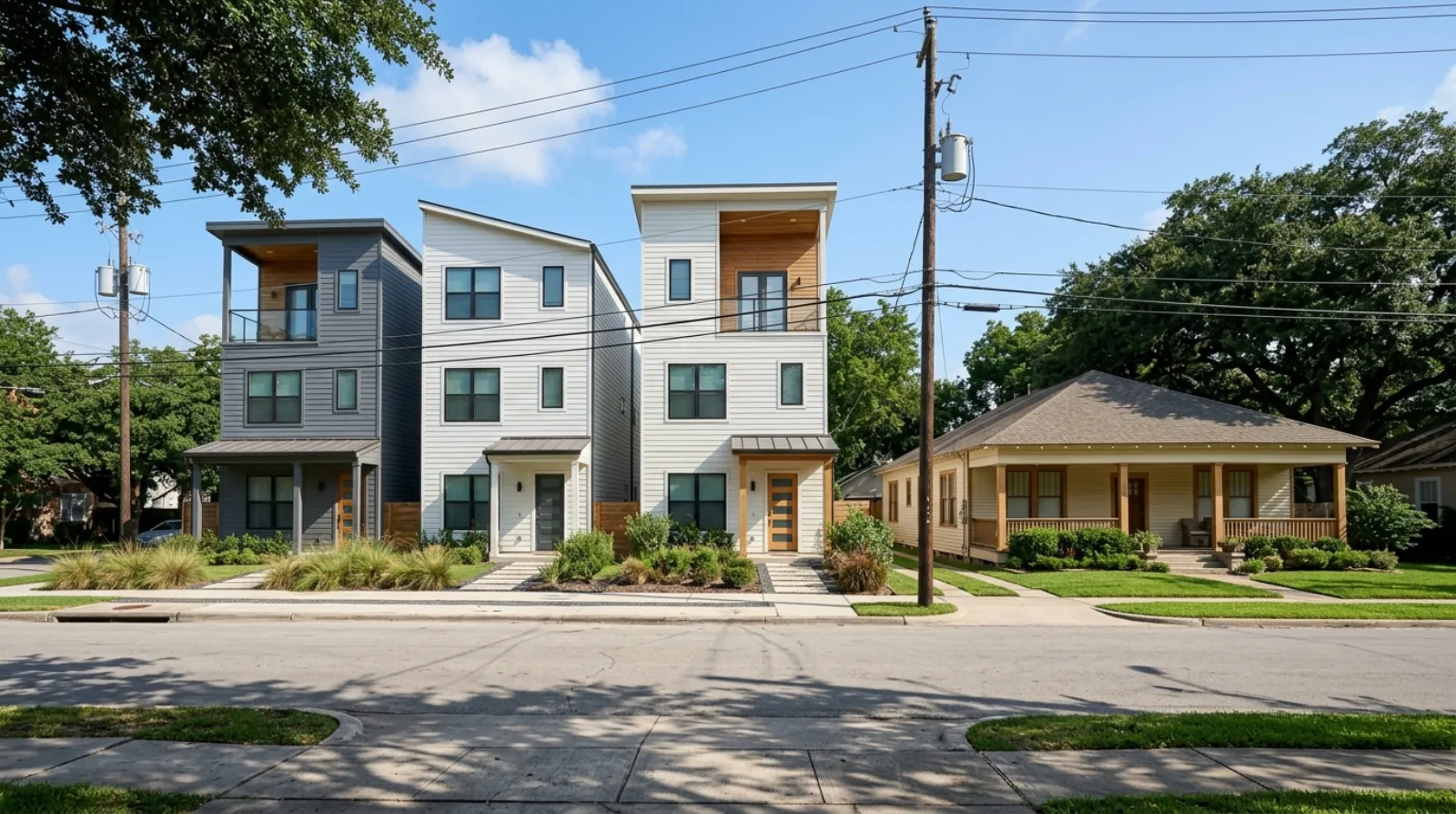
Texas multiplex law in six facts
- Each Texas city decides whether a single-family lot can hold two, three or four homes. Cities get that power from Local Government Code chapter 211, which lets them regulate building size, lot coverage, density and land use. Source: Local Gov. Code 211.003
- Since September 1, 2025, SB 15 bars large Texas cities from requiring lots over 3,000 square feet on new single-family tracts of five acres or more that have no recorded plat. Source: SB 15 (2025), enrolled text
- SB 840 (2025) requires the same large cities to allow housing of three or more units on land zoned for office, commercial, retail or warehouse use, with no rezoning, at 36 units per acre or more. Source: Local Gov. Code chapter 218
- Under HB 24 (2025), a neighbor protest against a rezoning that adds housing needs owners of 60 percent of the land within 200 feet, and a majority of the council can still approve the change. Source: Local Gov. Code 211.0061
- Houston's Chapter 42 allows lots inside the city below 3,500 square feet, down to an average of 1,400 square feet, when the plat meets its performance standards. Source: Houston Code, Chapter 42 lot rules
- The City of Houston says it does not allow a duplex if deed restrictions prohibit more than one dwelling unit on a lot. Source: Houston Livable Places FAQ
City count is VanPlex's own count from 2020 Census figures. Lot size from SB 15. Density from Local Gov. Code chapter 218. Permits from the Census Building Permits Survey.
Why the Answer Depends on Your City
Texas gives zoning power to cities. Under Local Government Code 211.003, a city council may regulate the height and size of buildings, the share of a lot a building covers, the size of yards, population density, and the use of land for homes, shops or industry. The number of homes allowed on one lot is part of that power, so each city sets it.
Counties are different. Texas counties can zone only in the specific areas listed in Local Government Code chapter 231, such as Padre Island and the land around certain named lakes. Just outside city limits sits the city's extraterritorial jurisdiction (ETJ): unincorporated land where the city controls how land is divided into lots. For a city of 100,000 people or more, the ETJ reaches five miles past its boundary. In the ETJ a city may apply its plat rules (the rules for recorded maps that divide land into lots), but Local Government Code 212.003 bars it from regulating building use, building size or units per acre unless another law allows it.
Houston is the large city that writes its land rules without a zoning code. It controls lot size, lot width and building lines through Chapter 42 of its city code. Its definition of single-family residential includes one building with up to two units, and a house with a detached second dwelling unit of up to 1,500 square feet. The how Texas zoning works page explains cities, counties, the ETJ and plats in full.
The 2025 State Laws in One Table
The 89th Legislature met in regular session in 2025. Three of its bills change what an owner or small builder can do in the largest Texas cities. All three were signed on June 20, 2025 and took effect on September 1, 2025. Two of them apply only in a city of more than 150,000 people that sits wholly or partly in a county of more than 300,000. This guide calls those the "covered cities."
| Law | What it does | Where it applies | In force | Code section |
|---|---|---|---|---|
| SB 15 (2025) | A covered city cannot require a lot larger than 3,000 sq ft, wider than 30 feet or deeper than 75 feet. On lots of 4,000 sq ft or less it cannot require more than 1 parking space per unit or fewer than 3 stories. | New single-family tracts of 5 acres or more with no recorded plat, in cities over 150,000 people in counties over 300,000 | September 1, 2025 | Local Gov. Code 211.051 to 211.058, added by SB 15 |
| SB 840 (2025) | Housing with 3 or more units, or mixed use that is at least 65% housing, on land zoned for office, commercial, retail, warehouse or mixed use, with no rezoning. At least 36 units per acre and 45 feet. At most 1 parking space per unit. | The same large cities as SB 15. Heavy industrial zones and land near airports and military bases are left out. | September 1, 2025 | Local Gov. Code chapter 218, added by SB 840 |
| HB 24 (2025) | A neighbor protest against a rezoning that adds housing needs owners of 60% of the land within 200 feet. A majority of the council can then approve it. | Every Texas city with zoning, for zoning proposals made on or after September 1, 2025 | September 1, 2025 | Local Gov. Code 211.0061, amended by HB 24 |
Sources: SB 15, SB 840 and HB 24 bill histories, and the code sections listed.
Read the table with care. SB 15 governs the size and shape of single-family lots on large new tracts. The number of homes on each lot is still set by the city. SB 840 is the 2025 law that reaches small multifamily buildings: on commercial land in a covered city, a building of three or four units counts as "multifamily residential" and falls under the same rules as a large apartment project. HB 24 applies whenever you ask a city to rezone land for more housing.
Several 2025 bills added sections with the same number. SB 840 and HB 24 each added a "Section 211.0011," and SB 15 and SB 1567 each added a Subchapter D to chapter 211. This guide always names the bill next to the section. The other 2025 laws page lists every bill we checked, including SB 673, the statewide accessory dwelling unit (ADU) bill, which stopped on the House calendar on May 26, 2025. Texas has no statewide ADU law.
The 19 Cities the 2025 Laws Reach
SB 15 and SB 840 use a population test, and no state agency publishes a list of the cities that pass it. Texas statutes read "population" as the count in the most recent federal census, under Government Code 311.005, unless a law says otherwise. VanPlex applied the test to the 2020 Census counts for every Texas city and county in the Census Bureau's 2020 redistricting file. This is a VanPlex count from 2020 Census figures, and 19 cities pass:
- Houston
- San Antonio
- Dallas
- Austin
- Fort Worth
- El Paso
- Arlington
- Corpus Christi
- Plano
- Lubbock
- Irving
- Garland
- Frisco
- Grand Prairie
- McKinney
- Brownsville
- Killeen
- Pasadena
- Mesquite
Laredo had 255,205 people in 2020 but sits in Webb County, which had 267,114 in 2020, so it fails the county test. Amarillo fails for the same reason. Pasadena and Mesquite pass by fewer than 2,000 people. The SB 15 page shows every close case with its numbers.
How Many Homes Fit on One Lot
No state law sets the number of homes on a Texas single-family lot, so every row below is a city rule or the SB 840 rule for commercial land. Your lot can hold fewer if its deed restrictions say so.
| Homes | Where | Rule |
|---|---|---|
| 2 | Houston, any lot the code treats as single-family | One building with up to two units, or a house plus a detached second dwelling unit of up to 1,500 sq ft (Chapter 42, Sec. 42-1). Deed restrictions can still forbid it. |
| 2 | San Antonio, R-1 to R-6 and RM districts | A house plus one accessory dwelling of up to 800 sq ft or 50% of the house, to a 1,600 sq ft maximum. The owner must live in one of the two (UDC 35-371). |
| 2 | Dallas, single-family districts | One home per lot. A second needs an ADU overlay requested by owners in the area, or a Board of Adjustment special exception. |
| 3 | Austin, SF-1, SF-2 and SF-3 lots of 5,750 sq ft or more | Up to three units under HOME Phase 1 (Ordinance No. 20231207-001), for applications filed on or after February 5, 2024. |
| 2 to 4 | San Antonio, RM-6, RM-5 and RM-4 | Two units in RM-6, three in RM-5 and four in RM-4 (minimum lot 4,000 sq ft). On lots of one-third acre or less, the units must be in one building. |
| 3 to 8 | Houston, multi-unit residential sites inside the city | A site of at least 3,500 sq ft with 3 to 8 units. No more than 4 units on a site along a local street. Height up to 30 feet (Sec. 42-237). |
| 3 or more | Land zoned office, commercial, retail, warehouse or mixed use in the 19 covered cities | SB 840 (2025) requires the city to allow multifamily housing with no rezoning, at 36 units per acre or more. |
Sources: Houston Chapter 42, Austin Ordinance No. 20231207-001, San Antonio UDC 35-310.06, San Antonio UDC 35-371, City of Dallas ADU page.
Austin's HOME Phase 1 ordinance made duplex, two-unit and three-unit uses permitted in its SF-1, SF-2 and SF-3 zones, for applications filed on or after February 5, 2024. Houston allows two units on a lot the code treats as single-family, and 3 to 8 units on a multi-unit residential site. San Antonio's RM-4 district allows four units on a 4,000 square foot lot. Dallas allows one home per single-family lot unless a neighborhood overlay (an extra set of zoning rules for one area) or a special exception (permission for one property) adds a second. The Austin, Houston, Dallas and San Antonio pages give the full rules.
Deed Restrictions Come First
A deed restriction is a private rule recorded against a lot, and enforced by the other owners or a homeowners association (HOA). Texas law tells courts to read these rules broadly: Property Code 202.003 says a restrictive covenant "shall be liberally construed to give effect to its purposes and intent." Under Property Code 202.004, a court may award damages of up to $200 for each day a violation lasts.
The 2025 laws leave these private rules in place. SB 15 states that it does not prohibit owners from enforcing HOA rules or deed restrictions. Houston's own Livable Places FAQ says the City "does not allow construction of a duplex if deed restrictions prohibit more than one dwelling unit on a lot." Austin's HOME page puts the duty on you: "It is the applicant's responsibility to verify property-specific information such as deed restrictions or restrictive covenants on the property." Get a copy of the deed restrictions for your lot before you pay for plans.
What the Numbers Show
Texas had 31,709,821 people on July 1, 2025, by the Census Bureau's Vintage 2025 estimate, up from 29,145,505 in the 2020 Census. Most of its permits are for one-unit buildings. In 2025 the state issued permits for 140,579 one-unit buildings and 3,178 two-unit buildings. Homes in buildings of two to four units made up 9,133 of the 210,217 homes permitted, or 4.3 percent, by VanPlex's calculation from the Building Permits Survey.
| 2025 permits | 1-unit buildings | 2-unit buildings (homes) | 3 to 4 unit buildings (homes) | 5+ unit buildings (homes) |
|---|---|---|---|---|
| Texas (statewide) | 140,579 | 3,178 (6,356) | 727 (2,777) | 1,970 (60,505) |
| Houston | 4,774 | 1,054 (2,108) | 2 (8) | 123 (4,988) |
| Austin | 2,079 | 176 (352) | 1 (3) | 113 (6,459) |
| Dallas | 2,026 | 36 (72) | 4 (12) | 346 (4,883) |
| San Antonio | 3,888 | 0 (0) | 8 (31) | 102 (1,401) |
| Fort Worth | 5,887 | 59 (118) | 23 (84) | 105 (3,348) |
| Arlington | 532 | 14 (28) | 51 (204) | 9 (812) |
| El PasoEl Paso reported 0 months; Census filled in every figure | 1,466 | 35 (70) | 14 (44) | 15 (142) |
Sources: Census Bureau Building Permits Survey, state file and South Region places file, 2025 annual, estimates with imputation.
Houston permitted 1,054 two-unit buildings in 2025, more than every other city in the table together. Austin permitted 176. Three- and four-unit buildings stayed rare in the big cities: Houston permitted 2, Austin 1 and Dallas 4. Arlington permitted 51 and Fort Worth 23. The Census counts each permitted building by the number of homes it holds, and cities classify attached townhouses in their own ways, so compare the rows with that in mind.
Five Steps to Your Answer
-
Step 1
Find out who controls your land
Is your lot inside a city, in a city's ETJ, or in the county beyond it? Inside a city, the city's zoning or development code applies. In the ETJ, only the city's plat rules apply. The zoning page explains each case.
-
Step 2
Read the deed restrictions and the plat
Get a copy of the recorded deed restrictions and the subdivision plat (the recorded map of the lots). If a recorded rule limits the lot to one home, you cannot build more unless that rule is changed, whatever the city allows.
-
Step 3
Read your city's rule for the number of homes
Start with the Austin, Houston, Dallas or San Antonio pages, or the more Texas cities page.
-
Step 4
Check whether a 2025 state law applies
A tract of five acres or more with no recorded plat may fall under SB 15. Commercial land in a covered city may fall under SB 840. A rezoning request follows HB 24.
-
Step 5
Check the code, the taxes and the loan
Texas law treats one- and two-family homes, and townhouses of up to three stories with separate exits, as residential. The state minimum for those is the International Residential Code as it existed on May 1, 2012. Other multifamily buildings follow the commercial code, so a third attached unit can change the code your design must meet. See building codes, property tax, insurance and flood and financing 2 to 4 units.
Who This Guide Is For
Homeowners
You own a house in a Texas city and want to know if you can add a second home, a garage apartment or a duplex.
How zoning works →Small builders and investors
You look for land that can hold three or more homes without a rezoning vote.
SB 840 commercial land →Architects and permit consultants
You need the state code minimums, the energy codes and the permit deadlines in one place.
Building codes →Best For
- ✓ A lot in a city whose code already allows two or more homes, such as Austin SF-3 or Houston.
- ✓ Commercial land in one of the 19 covered cities, where SB 840 allows three or more homes with no rezoning.
- ✓ Large unplatted tracts in covered cities, where SB 15 caps the lot size the city can require.
Usually Fails When
- ✕ Recorded deed restrictions limit the lot to one home.
- ✕ The city zone allows one home and the owner has not checked whether an overlay, special exception or rezoning is possible.
- ✕ The design adds a third attached unit and the budget assumed the residential building code.
What To Verify Before Spending Money
- → Whether the lot is inside the city, in the ETJ or in the county.
- → The recorded deed restrictions and plat for the lot.
- → The city's current code section for the number of homes per lot, read on the city's own site.
Explore the Hub
Where to Go Next
Related VanPlex Pages
Frequently Asked Questions
Can I build a duplex on my lot in Texas?
Does Texas have a statewide middle housing law?
Which Texas cities allow three homes on one lot?
Do deed restrictions override city zoning in Texas?
What did the Texas Legislature pass on housing in 2025?
Does SB 15 let me split my existing lot in Texas?
How many duplexes are built in Texas each year?
Is a fourplex residential or commercial under Texas building codes?
Does Houston have zoning?
Can a Texas city control what I build just outside its limits?
How many Texas cities does SB 15 cover?
Official sources (checked October 2026)
Planning a multiplex in Texas?
VanPlex builds multiplexes and models lots in British Columbia, Canada. We do not build, lend, or broker in Texas yet. Join the Texas list and we will tell you when that changes.