
California, US | Multiplex Guide
The California Multiplex Guide: What You Can Build on a Single-Family Lot in 2026
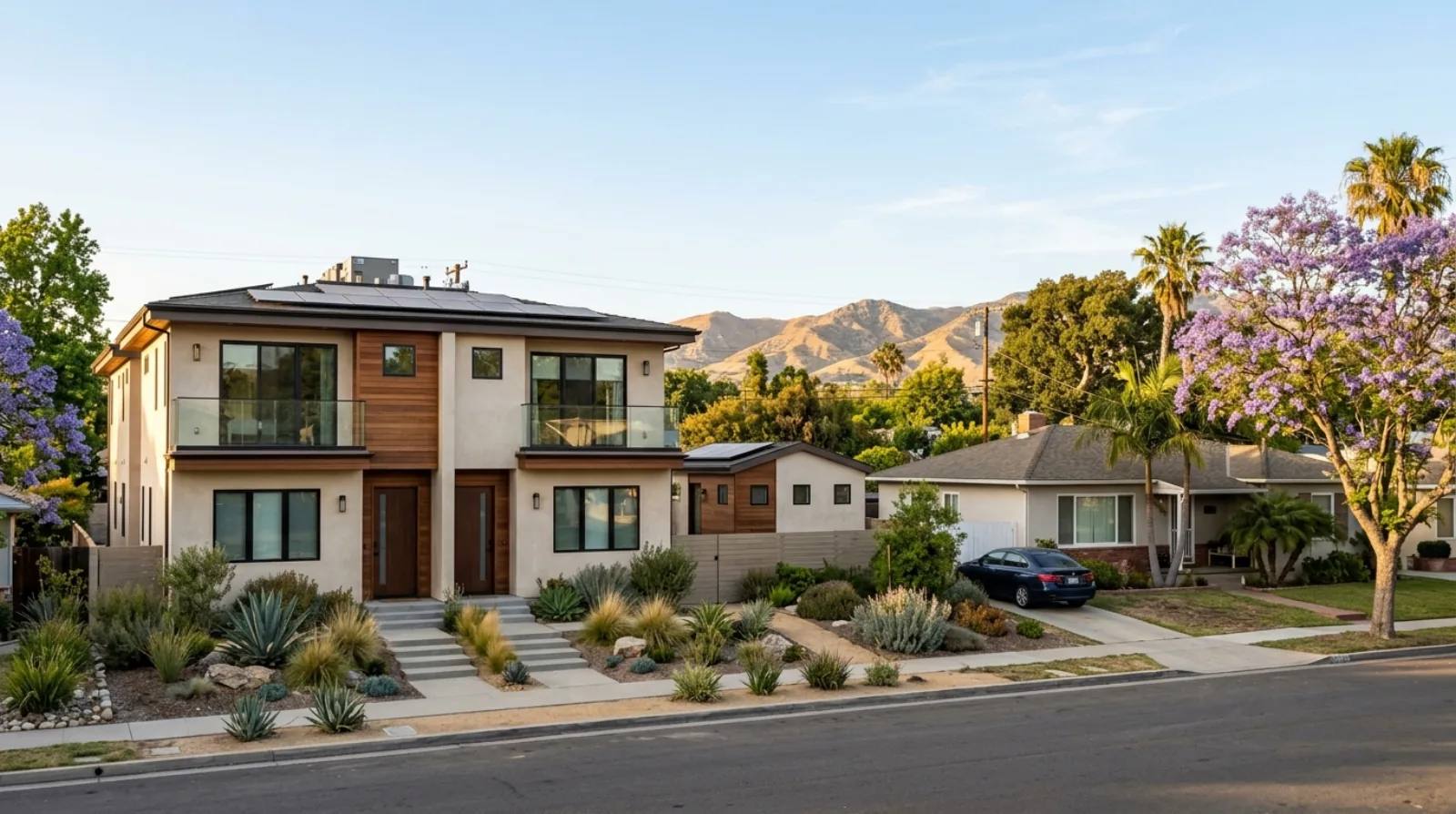
If you own a house on a single-family lot in a California city, state law already lets you add homes to it. Two sets of rules apply. SB 9 (2021) lets you build two primary homes, split the lot in two, or both. State ADU law lets you add accessory dwelling units (ADUs), which are smaller extra homes on the same lot. Used on their own or together, they can put up to four homes where one stood. This guide explains each law, what changes on January 1, 2027, and how six large cities apply the rules.
VanPlex is a multiplex company in Vancouver, British Columbia. We do not build, lend or sell property in the United States. We wrote this guide as a reference for California owners, and every rule on it is linked to the statute, the state agency or the city that wrote it.
California multiplex law in six facts
- SB 9 (2021) requires California cities to approve up to two homes on a lot in a single-family zone, a split of that lot into two, or both, through staff review with no public hearing. Source: HCD SB 9 Fact Sheet
- The California Department of Housing and Community Development (HCD) says SB 9 allows up to four homes on the land that usually holds one single-family house. Source: HCD SB 9 Fact Sheet
- ADU law alone lets a single-family lot hold the house, one ADU converted from existing space, one junior ADU and one new detached ADU. Source: Gov. Code 66323
- From January 1, 2027, AB 956 requires cities to approve two new detached ADUs on a single-family lot instead of one. Source: AB 956 (2026)
- Since July 1, 2026, SB 79 allows buildings of five or more homes near qualifying rail and bus stops in seven counties. Source: HCD SB 79 Advisory
- California had 15,064,131 homes on January 1, 2026. 1,157,166 of them were in buildings of two to four units. Source: California Department of Finance E-5
Four homes from the HCD SB 9 Fact Sheet. Ten homes from Gov. Code 66499.41. Sixty days from Gov. Code 65852.21. ADU count from the Department of Finance E-1 release.
The State Laws in Force Today
California housing law is written mostly at the state level, and cities must follow it. The table below lists the laws a single-family lot owner can use as of October 2026. Most of them use ministerial approval, which means city staff check your plans against fixed written rules and must approve them if they comply. There is no public hearing and no vote by a planning board.
| Law | What it allows | In force since | Code section |
|---|---|---|---|
| SB 9 (2021), two units | Up to 2 primary homes on a lot in a single-family zone. Local rules cannot keep either home under 800 sq ft. Side and rear setbacks of 4 feet at most. Decision within 60 days. | January 1, 2022. The 60-day deadline applies from January 1, 2025 (SB 450). | Gov. Code 65852.21 |
| SB 9 (2021), lot split | Split one lot into 2. Each new lot at least 1,200 sq ft and at least 40% of the original. Up to 2 homes per new lot. Owner signs a 3-year residence affidavit. | January 1, 2022 | Gov. Code 66411.7 |
| ADU and junior ADU law | 1 ADU converted from existing space, 1 junior ADU inside the house, and 1 new detached ADU the city may cap at 800 sq ft. All approved by staff review. | In force now. AB 956 allows 2 detached ADUs from January 1, 2027. | Gov. Code 66310 to 66342 |
| SB 684 and SB 1123 | Up to 10 lots with up to 10 homes. Multifamily-zoned lots up to 5 acres, or vacant single-family lots up to 1.5 acres. | July 1, 2024 (SB 684). July 1, 2025 (SB 1123). | Gov. Code 65852.28, 66499.41 |
| SB 79 (2025) | Buildings of 5 or more homes at 30 or more units per acre on residential, mixed or commercial lots within a half mile of qualifying rail and bus stops. | July 1, 2026 in cities of 7 counties | Gov. Code 65912.155 to 65912.162 |
| Builder's remedy | Where the city's housing plan is out of compliance, a project of 10 or fewer homes on under 1 acre at 10 or more units per acre can exceed local zoning with no affordable units required. | In force now | Gov. Code 65589.5(h) |
SB 9 start date from the Los Angeles Department of Building and Safety. All other rows from the code sections listed.
SB 9 (2021) applies only to lots in a single-family zone inside a city that includes part of a US Census Bureau urban area. ADU law applies on any lot zoned for homes, including multifamily lots. The other laws apply to narrower groups of land: SB 684 and SB 1123 cover multifamily-zoned lots and vacant single-family lots, and SB 79 covers land within a half mile of qualifying transit stops in Alameda, Los Angeles, Sacramento, San Francisco, San Mateo, Santa Clara and San Diego counties.
The builder's remedy applies when a city's housing element (the housing plan the state requires every city to keep current) is out of compliance on the day your application is complete. In that case, Government Code 65589.5 lets a qualifying project exceed local zoning. A project of 10 or fewer homes on a site under one acre, at 10 or more units per acre, qualifies with no affordable units required. The permit deadlines page covers it in full.
What Starts January 1, 2027
California passed the housing laws below in 2026, and each one takes effect on January 1, 2027. Until then, the current rules apply. Plan an application filed in 2026 under today's law, and plan one filed in 2027 under the new one. For SB 1116, the new rules cover applications a city receives on or after January 1, 2027.
| Bill | Chapter | What changes on January 1, 2027 |
|---|---|---|
| AB 956 | Chapter 791, Statutes of 2026 | A city must approve 2 detached new ADUs on a single-family lot instead of 1. No junior ADU is required on a lot that has 2 new detached ADUs. Details |
| SB 1117 | Chapter 809, Statutes of 2026 | On a lot with up to 2 ADUs, impact fees on an ADU over 750 sq ft apply only to the floor area above 750 sq ft. Details |
| SB 1116 | Chapter 808, Statutes of 2026 | SB 684 projects get a floor area ratio of at least 1.25, smaller lots (480 or 960 sq ft), a new site test, and limits on private deed rules (CC&Rs) that block them. Details |
| AB 2601 | Chapter 955, Statutes of 2026 | An SB 9 two-unit application can be processed at the same time as the lot split, and the parcel map may include a condominium plan. Details |
| AB 1751 | Chapter 781, Statutes of 2026 | Missing Middle Townhome Ownership Act: staff approval for for-sale townhome projects of up to 150 homes, 3 stories or less. Does not apply in San Francisco. Details |
| SB 1036 | Chapter 54, Statutes of 2026 | A development fee on a project that demolishes or changes an existing use must be reduced so it covers only the added impact. Details |
Two of these bills change what most owners can build. AB 956 raises the number of new detached ADUs a city must approve on a single-family lot from one to two. SB 1117 changes how impact fees (one-time charges a city or district collects to pay for public facilities) apply to an ADU larger than 750 square feet: on a lot with up to two ADUs, the fee will apply only to the floor area above 750 square feet. The ADU Handbook of the California Department of Housing and Community Development (HCD), updated in March 2026, does not yet describe either bill, so expect new state guidance before they start.
Two follow-up bills to SB 79 also start on January 1, 2027. AB 2576 removes some historic sites from SB 79, and SB 1361 bars a city that has a station from taking certain actions against transit agencies and their projects. The SB 79 page explains both.
How Many Homes Fit on One Lot
The table shows the common ways a single-family lot reaches two, three or four homes under state law in 2026, and the state option for more than four. Your city may allow more by its own rules. It cannot allow less than state law requires.
| Homes | Combination | How it works |
|---|---|---|
| 2 | House plus 1 ADU or junior ADU | ADU law. Staff approval, no owner-occupancy rule for an ADU. |
| 2 | Duplex or 2 houses under SB 9 (2021) | Two primary homes in a single-family zone. Local rules cannot keep either home under 800 sq ft. |
| 3 | House plus ADU plus junior ADU | ADU law. The junior ADU must be inside the house and the owner lives on site if it shares a bathroom. |
| 4 | House, converted ADU, junior ADU and detached ADU | ADU law alone, under Gov. Code 66323(a). From January 1, 2027 a second detached ADU can replace the junior ADU. |
| 4 | SB 9 duplex plus ADUs | Two SB 9 homes plus ADUs. HCD says SB 9 never requires a city to allow more than 4 units on one lot. |
| 4 | SB 9 lot split, 2 homes on each lot | Two new lots, up to 2 units each, with ADUs and junior ADUs counted in the 2. |
| 5 to 10 | SB 684 or SB 1123 small-lot subdivision | Multifamily-zoned lot, or a vacant single-family lot up to 1.5 acres. Up to 10 lots and 10 homes. |
The four-home limit comes from HCD's own reading of the law. Its SB 9 Fact Sheet says that "in no case does SB 9 require a local agency to allow more than four units on a single lot, in any combination of primary units, ADUs, and Junior ADUs." After an SB 9 lot split, the city has to allow only two units on each new lot, and ADUs count toward those two. The duplex to fourplex page walks through each combination, including what an existing duplex can add under ADU law.
Some cities already allow more on their own. Sacramento's Missing Middle Housing ordinance sets no maximum density in its R-1 zones. Berkeley's Middle Housing rules allow up to 70 units per acre in R-1. San Francisco allows four units on RH lots and six on corner lots, and Oakland's RD zone allows four homes on a lot of 4,000 square feet. Read your city's page before you assume the state limit is the only one.
Two Different Bills Named SB 9
Two unrelated California laws share the name SB 9. The lot split law is SB 9 of 2021 (Chapter 162, Statutes of 2021). A separate SB 9 of 2025 (Chapter 510, Statutes of 2025) deals with local ADU ordinances: HCD's ADU Handbook explains that a city ADU ordinance not sent to HCD within 60 days is "null and void," and the city must then apply state ADU law alone. This guide always writes "SB 9 (2021)" for the lot split law so the two are never confused.
How the State Enforces These Laws
The state has given these laws deadlines and an enforcer. HCD has had power to enforce SB 9 since January 1, 2024, under AB 434 (Chapter 740, Statutes of 2023), according to its SB 9 Fact Sheet. Since January 1, 2025, a city must approve or deny a complete SB 9 application within 60 days, or the law treats it as approved. ADU law sets its own deadlines: the city has 15 business days to say whether your ADU application is complete and 60 days to decide it when a house already stands on the lot.
Charter cities, which run under their own local charter, have tested how far state law reaches. Five of them (Redondo Beach, Carson, Torrance, Whittier and Del Mar) won a trial court judgment against SB 9 in 2024. On November 12, 2025, the Court of Appeal reversed it and sent the case back to the trial court. ADU law and SB 79 both say in their own text that they apply to charter cities. The SB 9 page has the full case history.
What the Numbers Show
California had 15,064,131 housing units on January 1, 2026, according to the Department of Finance. Single detached houses were 8,565,186 of them, or 56.9 percent. Buildings of two to four units held 1,157,166 homes, or 7.7 percent.
The Department of Finance reported 29,710 ADUs added in 2025, an 11.42 percent increase over 2024, and said the state passed 15 million housing units for the first time. In their annual progress reports to HCD, cities and counties reported 41,846 ADU permits for 2025, against 5,336 permits for homes in two- to four-unit buildings. Those totals are VanPlex's own sum of HCD's published Table A2 data, from 503 reporting cities and counties.
SB 9 has been used far less. The Terner Center at UC Berkeley surveyed 13 cities after its first year and found Los Angeles received 211 applications for new SB 9 units in 2022, while San Diego received seven. The Center concluded that "the impact of SB 9 has been limited so far." HCD does not publish a statewide SB 9 count in its open data.
Five Steps to Your Answer
-
Step 1
Find your zone and your city
Look up the zoning of your parcel on the city or county zoning map. SB 9 (2021) needs a single-family zone. SB 684 needs a multifamily zone or a vacant single-family lot. ADU law works in any zone that allows homes.
-
Step 2
Run the exclusion checks
Fire hazard zones, flood zones, historic listings, tenant history and past lot splits can each block SB 9 or SB 684. The eligibility page lists all eleven checks.
-
Step 3
Pick the law that fits your goal
To keep one lot and rent the homes, ADU law fits: a city cannot require you to live on a lot with an ADU. To sell homes on separate lots, you need an SB 9 lot split or SB 684, or a city that has opted in to selling ADUs as condominiums.
-
Step 4
Read your city's own rules
Cities add written standards on top of state law and sometimes allow more homes. Start with the Los Angeles, San Diego, San Jose, San Francisco, Sacramento or Oakland and Berkeley pages.
-
Step 5
Check fees, tenants and the loan
Impact fees, the statewide rent cap and lender rules decide whether the homes pay for themselves. See impact fees, rent and tenant rules and financing 2 to 4 units.
Who This Guide Is For
Homeowners
You own a house in a California city and want to know if you can add a second home, an ADU or a lot split.
Check your lot →Small builders and investors
You look for lots that can hold 4 to 10 homes and need the state rules that skip a public hearing.
SB 684 and SB 1123 →Architects and permit consultants
You need the deadlines, the hearing limits and the environmental review rules in one place.
Permit deadlines →Best For
- ✓ A lot in a single-family zone inside a California city that includes part of a Census urban area.
- ✓ Owners who want two to four homes with staff approval and no public hearing.
- ✓ Vacant single-family lots up to 1.5 acres, where SB 1123 allows up to 10 homes.
Usually Fails When
- ✕ The lot is in a very high fire hazard severity zone, a flood zone or a historic listing that SB 9 excludes.
- ✕ A tenant lived in a home you plan to demolish or alter within the last three years.
- ✕ The plan counts on more than four homes on one lot under SB 9, which HCD says no city must allow.
What To Verify Before Spending Money
- → The zone of your parcel on the city or county zoning map.
- → Fire, flood and historic status on the official maps and lists.
- → Whether your application will be filed before or after January 1, 2027.
Explore the Hub
Where to Go Next
Related VanPlex Pages
Frequently Asked Questions
Can I build a fourplex on a single-family lot in California?
How many homes can I build on my lot in California in 2026?
Is single-family zoning banned in California?
What changes in California housing law on January 1, 2027?
Do I need a public hearing to build a duplex in California?
How many ADUs were added in California in 2025?
How many homes does California have?
Can I split my lot and sell part of it in California?
What is the difference between SB 9 and an ADU in California?
Do California housing laws apply in charter cities like Los Angeles?
Can I build more than four homes on a single-family lot in California?
Official sources (checked October 2026)
Planning a multiplex in California?
VanPlex builds multiplexes and models lots in British Columbia, Canada. We do not build, lend, or broker in California yet. Join the California list and we will tell you when that changes.