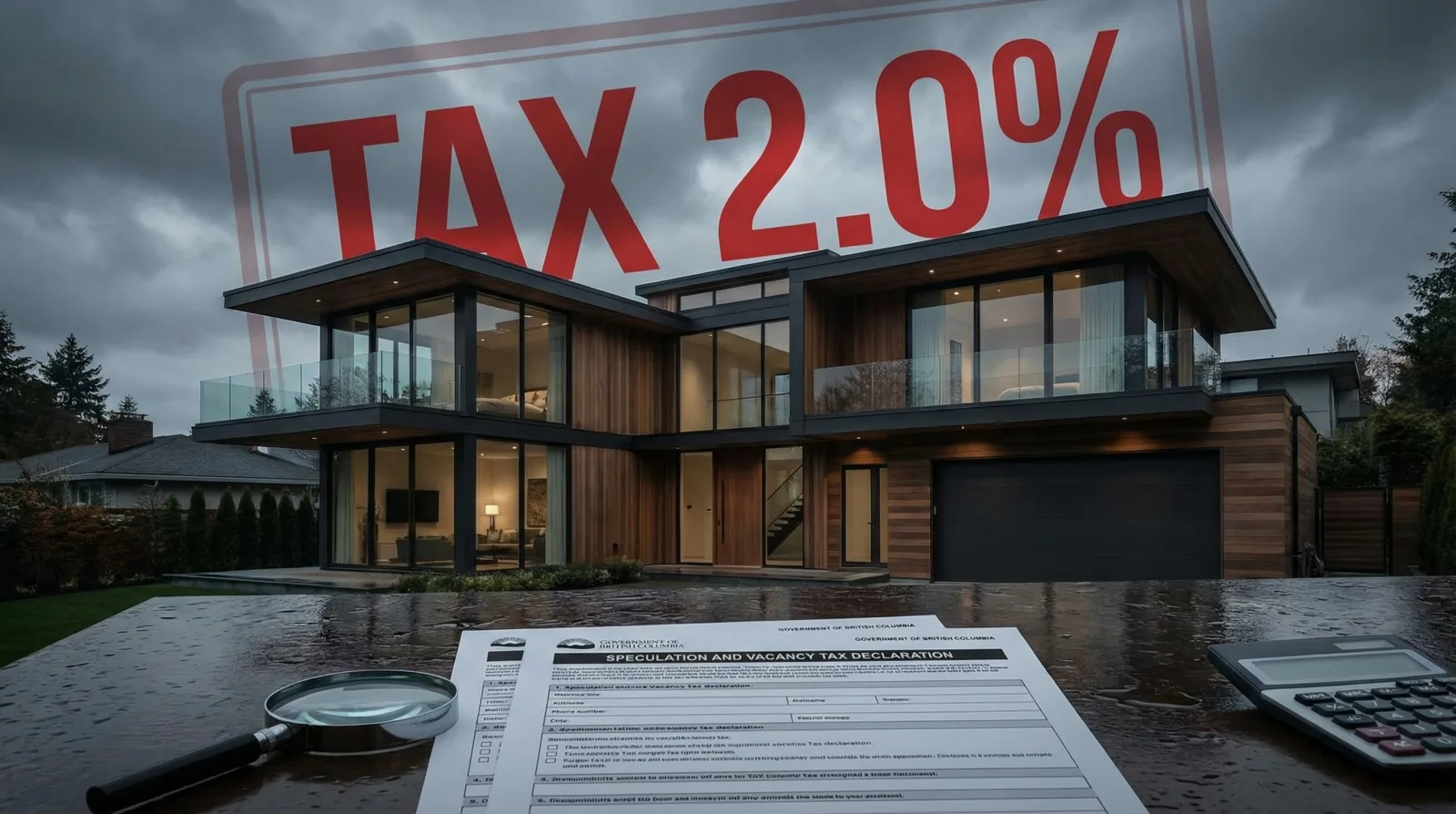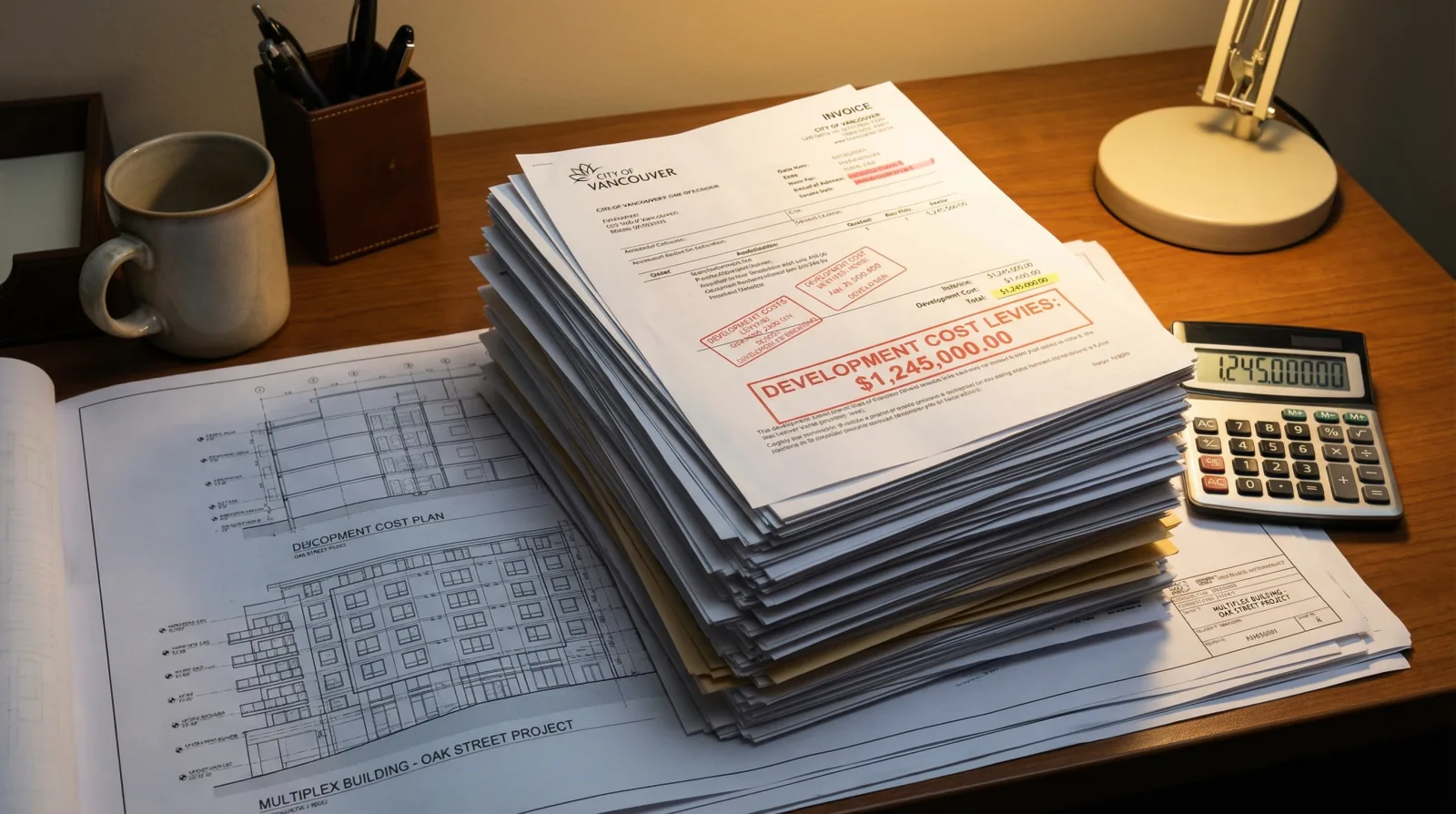

New Westminster council came back from its summer break on August 31, 2026 and changed how builders hand money to the city. A new pilot lets a surety bond stand in for cash on development cost charges and on the security a project posts for works and services. On a New Westminster fourplex that security is 120 percent of the estimated works cost, sitting on top of city charges of $105.04 per square metre of floor area.
That is a cash-timing change, and cash timing is what kills small projects.
What council actually did on August 31
The item was Subdivision and Development Control Bylaw No. 7142, 2007, Amendment Bylaw No. 8602, 2026. Bylaw 7142 is the rulebook for how New Westminster handles subdivision and development, including what a builder has to build and what a builder has to post before the city hands over a permit.
According to Mayor Patrick Johnstone’s published account of the meeting, the amendment sets up a pilot program that permits surety bonds in place of cash. His summary of the reasoning is the clearest statement of the problem. The city has traditionally required cash up front for things like development cost charges and works and service agreements, and for a smaller builder, in his words, “the moment that cash is required by the city is the very moment they are most cash-poor.”
The item moved on the consent agenda, which is where routine matters go when no councillor pulls them for debate. As of September 5, 2026 the city’s own development cost charges page had not been updated to describe the pilot, so the operating details, including how long the pilot runs and which bond issuers qualify, are worth confirming with the city before you plan around them.
The cash a New Westminster fourplex has to find at building permit
Here is the part builders feel. New Westminster’s DCC bylaw charges a ground-oriented multiplex at the townhouse rate. The bylaw defines townhouse residential as a building divided into two or more dwelling units where each unit has direct ground level access and each unit is attached to another. That is a fourplex.
The city’s rate table, consolidated to January 12, 2026, sets the total city DCC for townhouse residential at $105.04 per square metre of gross floor area in the Mainland area, and $137.49 per square metre in Queensborough. It is payable at building permit approval.
Metro Vancouver charges its own regional DCC on top, per unit rather than per square metre. For building permits issued on or after July 24, 2026, the total regional DCC for a townhouse dwelling unit runs from $15,208 to $20,296 depending on which of the four sewerage areas the lot sits in. The Metro Vancouver board rolled its 2026 increases back to 2025 rates on July 24, 2026, and there is no mechanism for rebates on permits issued before that date.
| What is due at building permit | Basis | Amount |
|---|---|---|
| City of New Westminster DCC, Mainland | Gross floor area | $105.04 per sq m |
| City of New Westminster DCC, Queensborough | Gross floor area | $137.49 per sq m |
| Metro Vancouver regional DCC, townhouse unit | Per dwelling unit | $15,208 to $20,296 |
| Works and services security under s. 4.4 | Estimated works cost | 120 percent |
Sources: City of New Westminster DCC Bylaw No. 8327, 2022, consolidated January 12, 2026; Metro Vancouver regional DCC rates effective July 24, 2026; New Westminster Bylaw No. 7142, 2007, consolidated March 24, 2025.
Run the arithmetic on the city rate alone. A square metre is 10.7639 square feet, so 1,000 square feet of gross floor area is 92.90 square metres, which is $9,758.54 at the Mainland rate. A 4,000 square foot fourplex is 371.61 square metres, or $39,034.14. Add four regional units at the townhouse rate and you are between $60,832 and $81,184 more. None of that includes the works and services security, which is a separate 120 percent of whatever the engineering estimate says the servicing costs.
The floor areas above are an example so you can see the math. Your number depends on your design, so run your own.
Why the works and services security is the sharper problem
Section 4.2 of Bylaw 7142 says the required works and services have to be built, to the satisfaction of the Director of Engineering, before a building permit is issued. Section 4.3 gives an alternative: at the owner’s request, the city can issue the permit before the works are done, if the owner signs a works and services agreement and deposits security.
Section 4.4 sets that security at 120 percent of the total cost of the required works and services. Section 4.5 lists the acceptable forms, and until this pilot the list read: cash, a certified cheque payable to the city, a letter of assurance from provincial and federal public bodies considered case by case by the Director of Finance and the Director of Engineering, or a clean irrevocable letter of credit.
| Security a builder can post | Before the pilot | Under the pilot |
|---|---|---|
| Cash | Yes | Yes |
| Certified cheque | Yes | Yes |
| Irrevocable letter of credit | Yes | Yes |
| Letter of assurance from a public body | Case by case | Case by case |
| Surety bond | No | Yes, per Bylaw 8602, 2026 |
Source: New Westminster Bylaw No. 7142, 2007, s. 4.4 and s. 4.5, consolidated March 24, 2025, and Amendment Bylaw No. 8602, 2026.
A letter of credit looks free on paper, and it costs you anyway, because your bank counts it against your borrowing room. For a builder with one project and one credit facility, a letter of credit for 120 percent of the servicing cost eats capacity they wanted for construction draws. A surety bond is underwritten by an insurer against the company’s balance sheet and track record instead, which leaves the bank line where the builder needs it.
The provincial rules sitting underneath the pilot
New Westminster is moving inside a framework the Province has already built.
On development cost charges, the Province’s rules allow instalment payment where the charge is $50,000 or more, or where council authorizes instalments for a smaller amount. The first instalment is one quarter of the charge, due at subdivision approval or when the building permit is granted. The balance is due at whichever comes first: four years later, or 15 business days after all occupancy permits are issued and the local government gives notice.
The security for that deferred balance can be a letter of credit, an on-demand surety bond, or other assigned security. The Province is direct about the bond: a financial officer may decline a surety deposit if it is unsatisfactory, but may not decline an on-demand surety bond if the developer qualifies with an acceptable surety bond issuer.
Note the $50,000 threshold against the numbers above. A small New Westminster fourplex can land under it on the city DCC alone and above it once the regional DCC is counted, so whether you get instalments at all is a question worth asking before you set your budget rather than after.
What the pilot does not change
It does not reduce a fee. The city DCC rate, the regional DCC rate, and the 120 percent security level are all the same the day after as the day before.
It does not change your zoning. New Westminster pre-zoned residential lots for infill housing and adopted its Infill Housing Program in June 2026, which is a separate matter with its own unit counts by lot size and transit distance. If that is the question you actually have, start with what New Westminster’s pre-zoning allows on your lot and the New Westminster city page.
It also does not make a bond free. A surety bond carries a premium, and an insurer underwrites the company before issuing one, so a first-time builder with no completed projects may find the bank line easier to get than the bond. Get a quote before you assume this helps you.
What to do if you are building in New Westminster this year
Three steps, in order.
First, price your gross floor area against the published rate so your city DCC number is exact to the dollar. Second, ask engineering for the works and services scope early, because 120 percent of an estimate you have not seen is not something you can plan around. Third, call your broker about a surety bond quote and compare it against what a letter of credit costs you in lost borrowing room, since that second number is the one builders usually forget to count.
Then ask the city where the pilot stands. It was moved on August 31 and the public-facing pages had not caught up a week later, so the intake process, the qualifying issuers, and the end date are all worth a direct question.
Thinking about a multiplex on a New Westminster lot? Run your address through VanPlex to see the unit count and the return math before you commit to a design.
David Babakaiff, Co-Founder, VanPlex | PlexRank™ | Profit with Multiplex