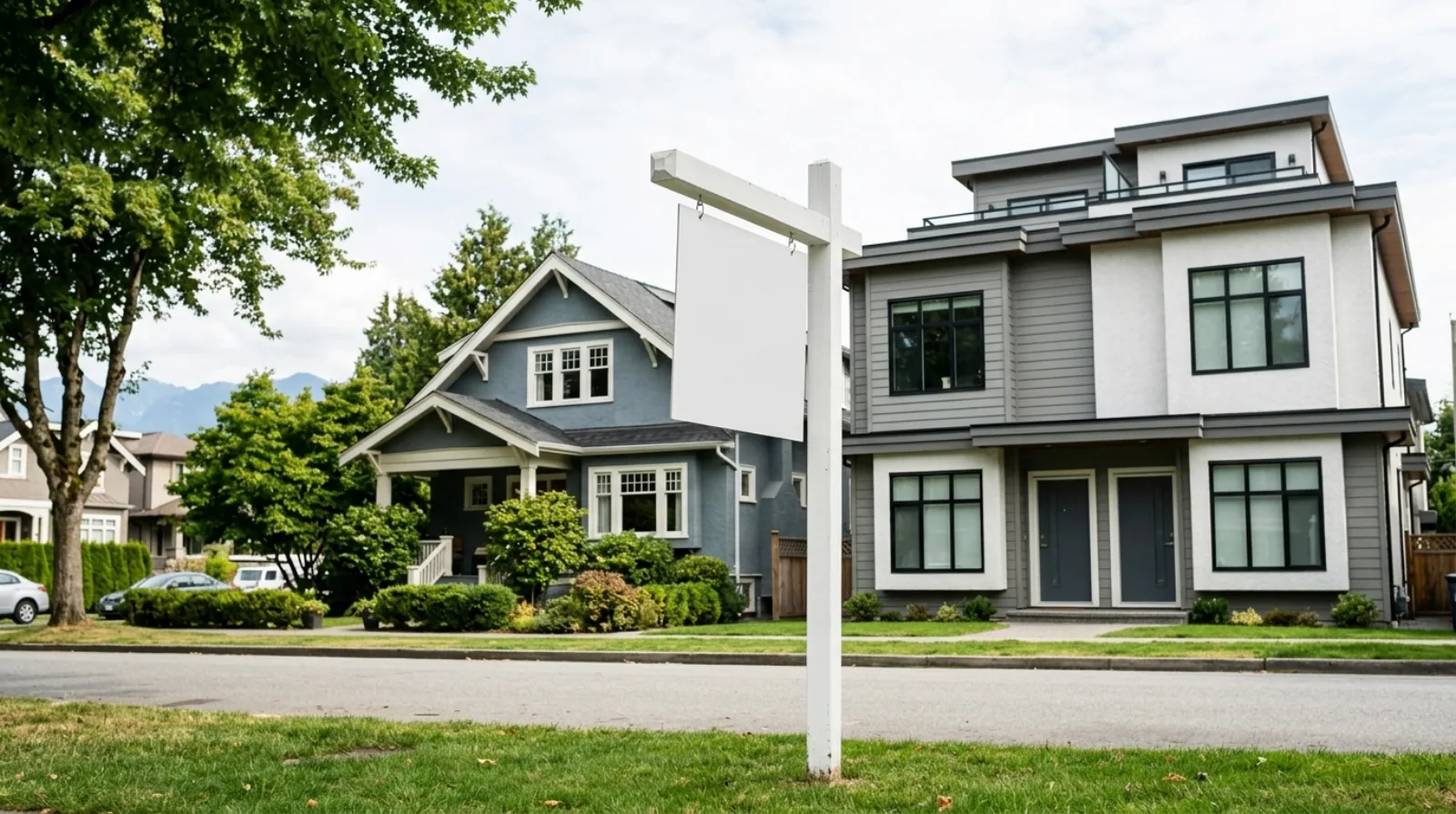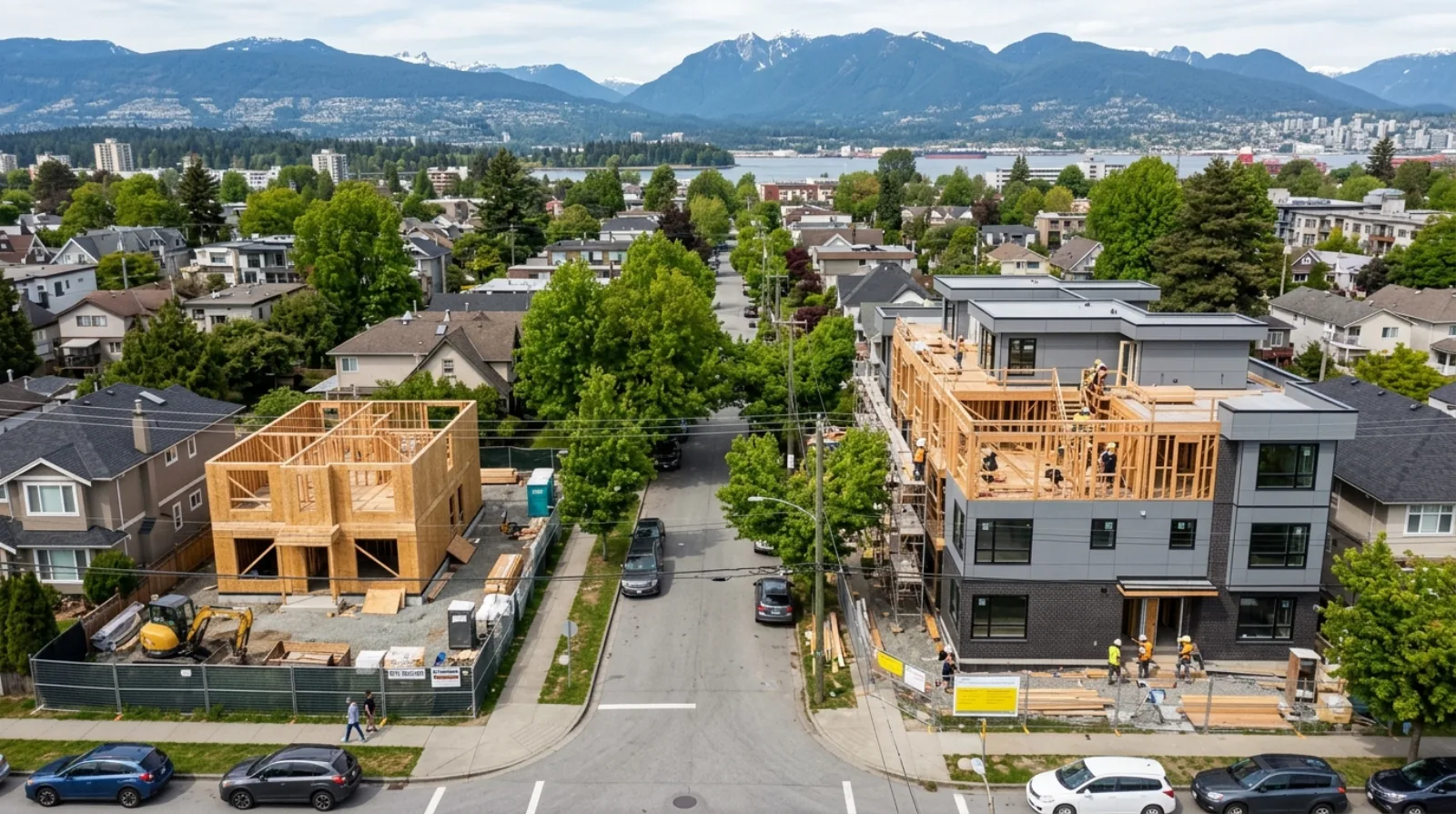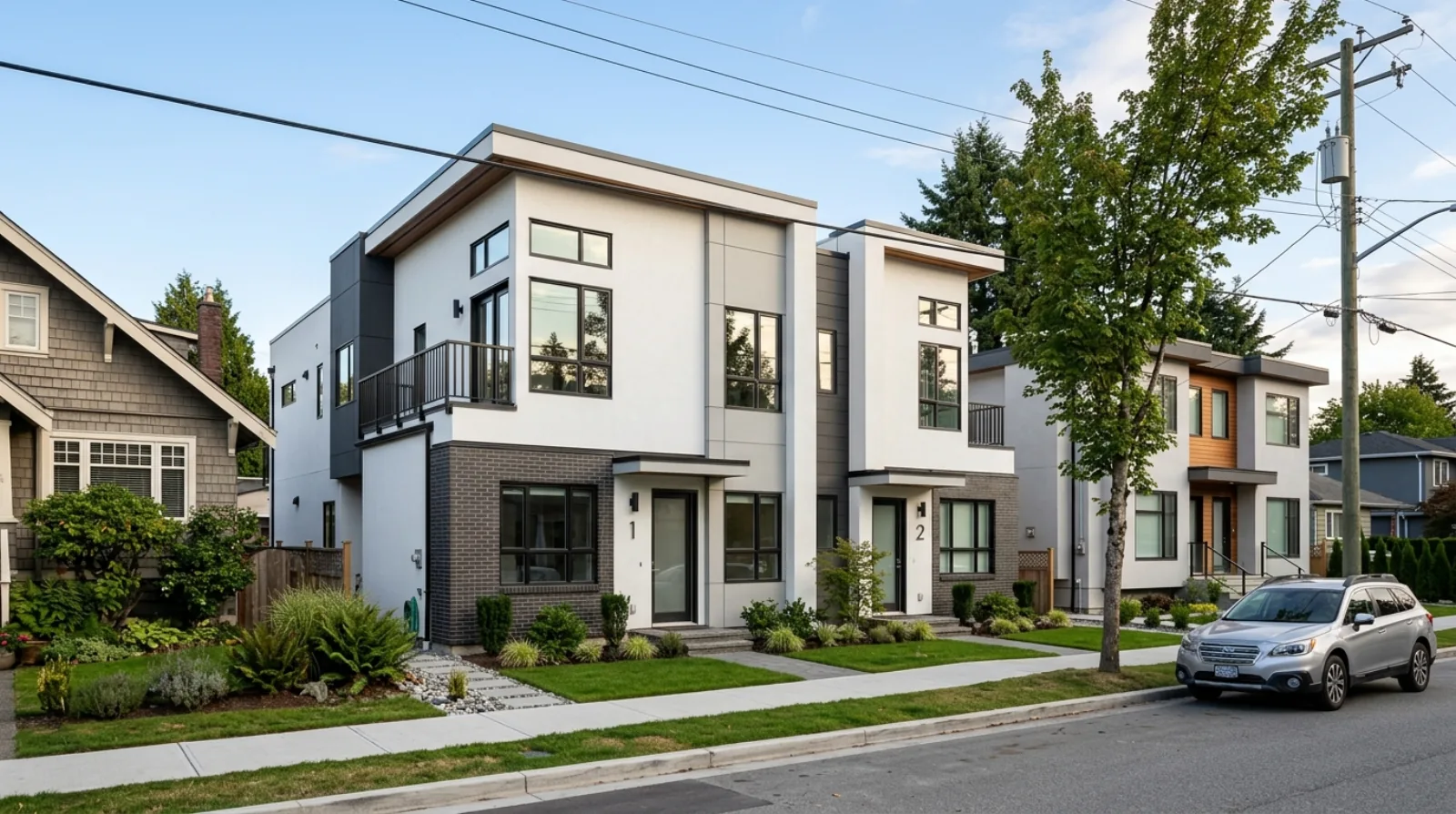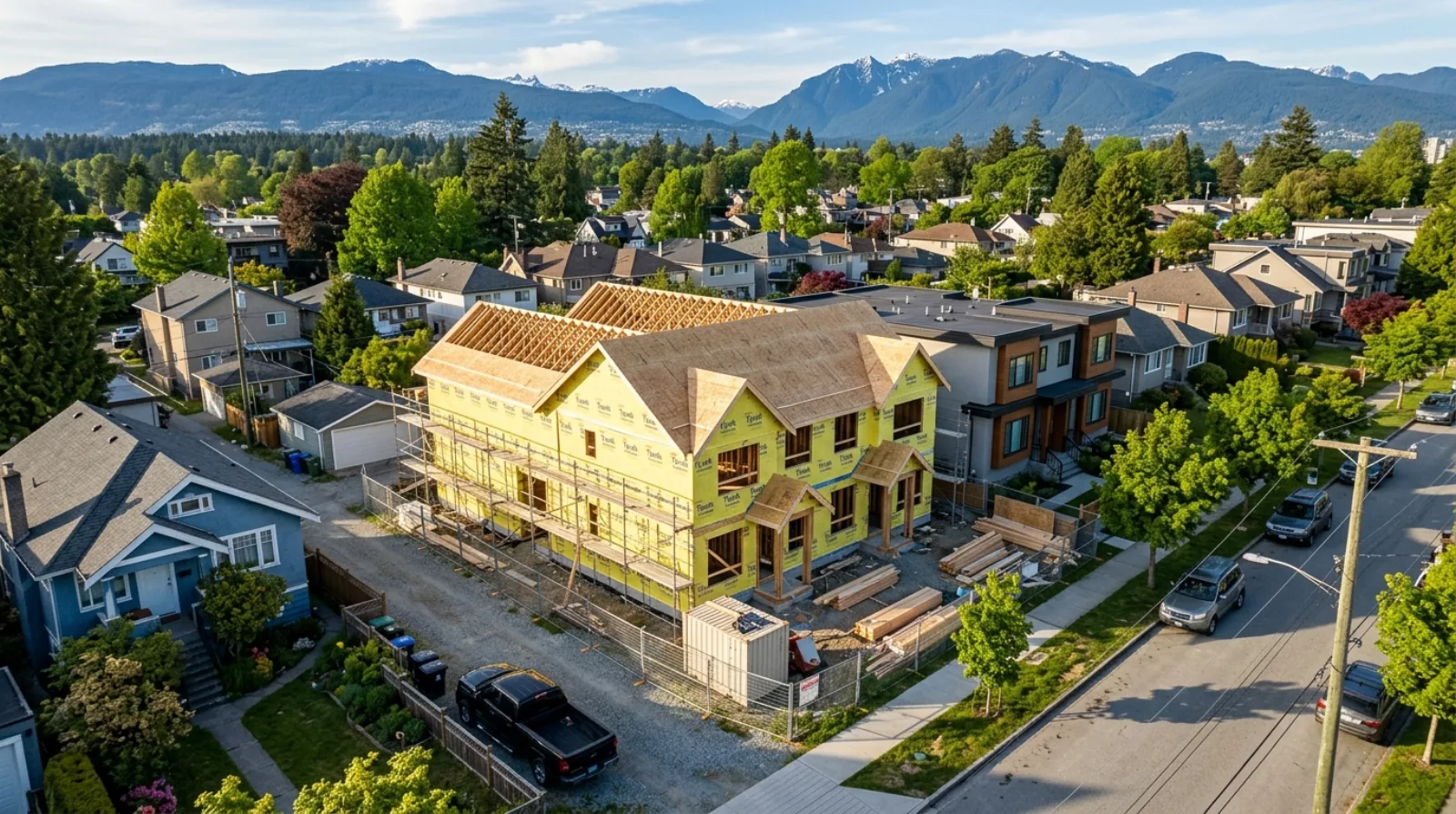

- That is the number of Vancouver multiplex permit records displayed on the VanPlex Interactive Permit Map when we accessed it on August 11, 2026. These are not 591 lots that zoning says could theoretically support more homes. They are actual permit records tied to actual addresses, where someone moved from asking “what could we build?” to putting a proposal into the municipal process. One of those addresses may be yours. Another may be next door, across the lane, or on a lot remarkably similar to yours a few blocks away.
The zoning now has addresses
When Vancouver introduced multiplex zoning, most of the discussion was theoretical. How many new homes could be created? Would homeowners build? Would developers participate? Where would fourplexes, fiveplexes and sixplexes begin to appear?
The permit map provides the beginning of an answer. Each point represents a property where an owner, builder or development team decided the opportunity was worth investigating seriously enough to prepare plans and submit an application.
The motivations will be different. Some owners may be trying to create homes for children or aging parents. Some may plan to keep one home and sell the others. Some properties were likely purchased specifically for redevelopment. Others may involve a partnership between the property owner and a builder or investor.
The map cannot tell us every story behind the application. But it can show us where those stories are beginning, and how far some of them have progressed.
Multiplex Vancouver is not developing evenly
The applications are distributed across Vancouver, but not evenly.
Hastings-Sunrise leads by a wide margin. It is followed by Kensington-Cedar Cottage and Renfrew-Collingwood, with substantial activity also appearing in Dunbar-Southlands and Victoria-Fraserview. Other neighbourhoods show considerably less activity.
The ranking does not tell us precisely why one neighbourhood is attracting more applications than another. It may be a combination of lot dimensions, land values, finished-home demand, existing building conditions, and where builders and designers have found opportunities they believe can be repeated.
The concentration raises useful questions. Are standard lots in these neighbourhoods producing more efficient designs? Is the land basis leaving more room for the project to work? Are builders becoming more confident because they have already taken similar applications through the process nearby?
The answers will vary from one property to another. For a homeowner, however, the immediate question is simpler: what is already happening around your property?
A citywide total tells us that multiplex development is underway. The neighbourhood view tells you whether it is already arriving on your street.
The more important number may be 320
The map shows the volume of permit activity. The status breakdown gives us a better sense of how far some of those proposals have advanced.
Of the 567 permit records included in the dashboard’s three displayed status categories:
| Status | Records | Share of 567 |
|---|---|---|
| Issued | 320 | 56% |
| Submitted | 241 | 43% |
| Pending | 6 | 1% |
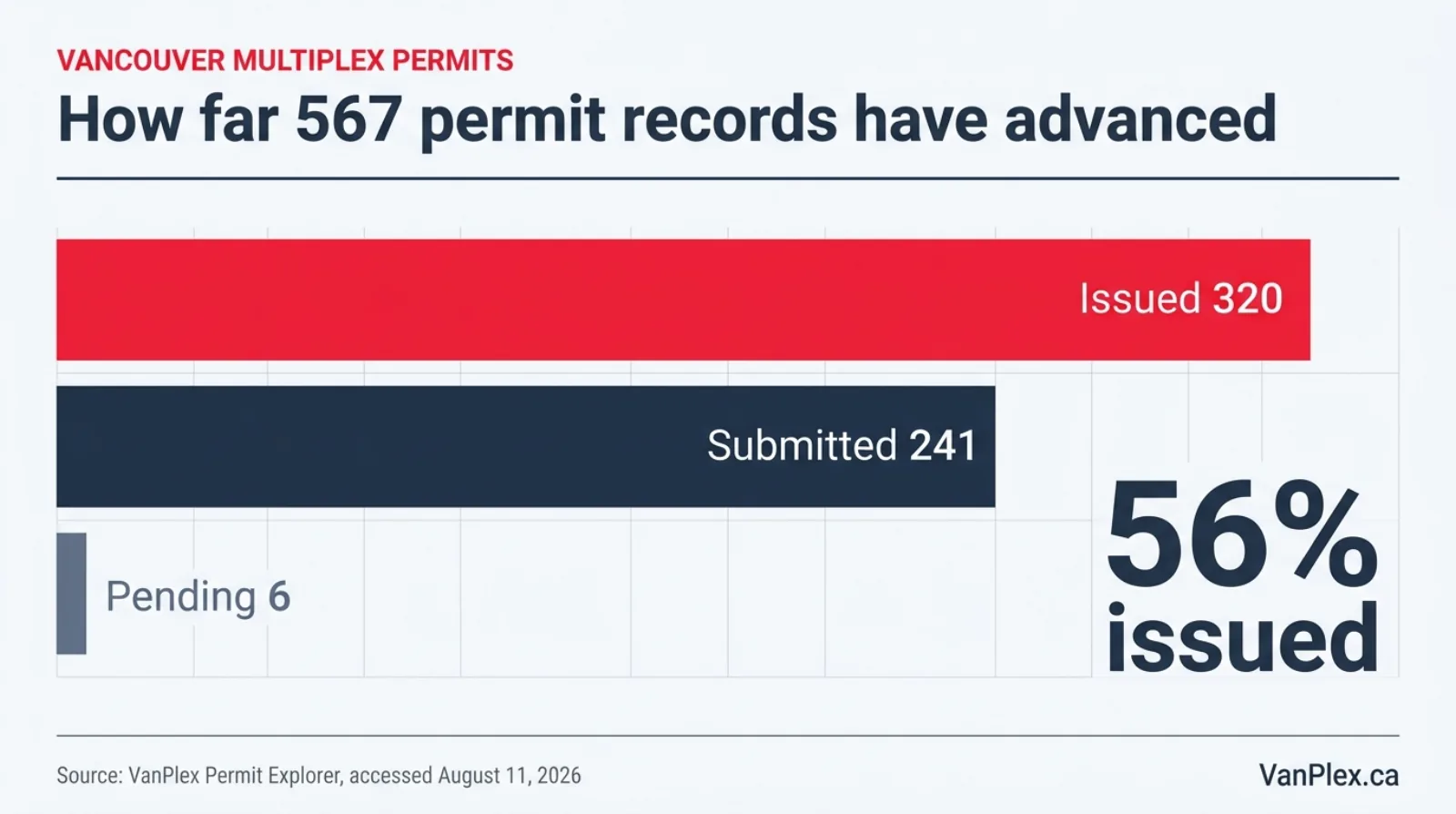
That 56% figure is a meaningful threshold. It tells us this is no longer simply a collection of homeowners and builders testing the new zoning. Hundreds of proposed multiplex developments have progressed beyond the initial application stage.
But the distinction is important:
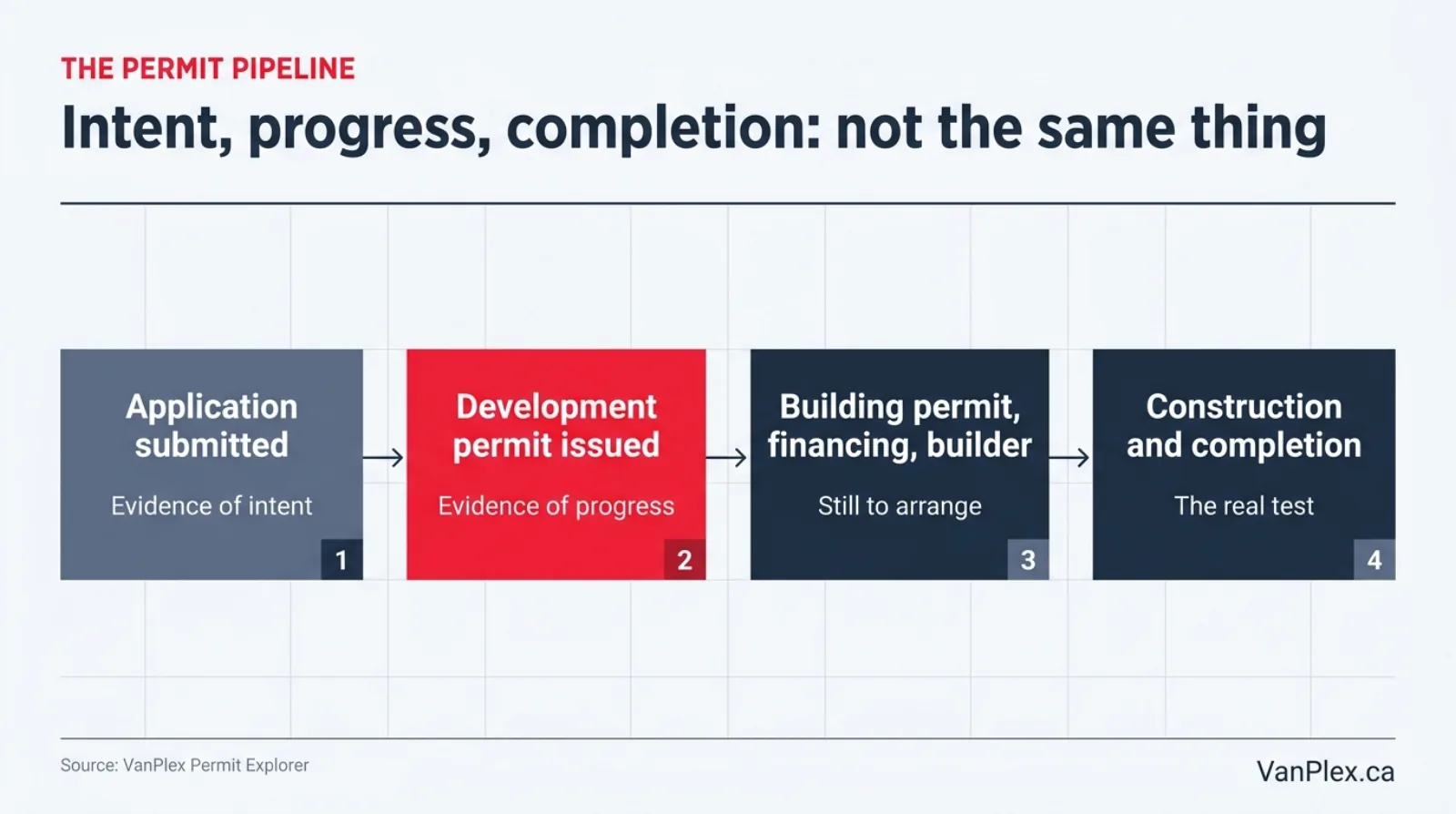
An application is evidence of intent. An issued development permit is evidence of progress. Neither is evidence of completion.
An issued development permit does not necessarily mean the owner has obtained a building permit, arranged construction financing, selected a builder or started construction. If the difference between those two permits is fuzzy, our plain-language guide to development permits vs building permits in BC walks through it.
Some issued projects will proceed. Others may wait for financing, construction costs, market conditions or the owner’s personal circumstances to align. That gap between application, issuance and completion is where much of the real multiplex story will be written.
What can you learn before spending money?
If your property is one of the permit records, you can find it on the map and see how it fits into the broader Vancouver pipeline.
If it is not, begin by searching your street. Then look for properties with a similar lot width, depth, lane condition and zoning.
| Question to ask | Why it matters |
|---|---|
| What unit count did they propose? | Shows what owners of lots like yours believe the site supports |
| When was the application submitted? | Older applications reveal how long the process is taking in practice |
| What stage has it reached? | Issued nearby permits mean the City has approved designs on comparable lots |
| Are similar properties advancing, or stalled at submitted? | A pattern of stalls is something to investigate before you spend on plans |
A nearby application that progressed can provide a real-world starting point for what may be possible. An older application that has not advanced may be equally valuable, because it gives you something specific to investigate before committing substantial money to plans and consultants.
Another property’s application does not prove that the same project will work on yours. Site conditions, design, financing and the owner’s goals may be different. We covered how professionals evaluate a specific lot in how multiplex buyers read your lot.
But you no longer have to start with a blank sheet of paper.
Even if you have no intention of building
The map is useful well beyond homeowners preparing a development.
If you plan to remain in your home, it can show whether multiplex change in your neighbourhood is still theoretical or already moving through the permit system.
If you are considering selling, it can show whether builders and developers are actively pursuing properties in your area.
If someone approaches you with an offer, it gives you a way to investigate nearby activity before deciding whether that offer reflects only the value of your existing home or also recognizes its development potential. That question matters more than ever after Council’s July 28 vote, which we broke down in what the Villages Plan rejection means for land value.
And if your family may consider building, partnering or selling several years from now, today’s applications provide an early view of what other owners are attempting and what the City is issuing.
Was one of them yours?
Open the map and search your address.
If you find your property, see how your application compares with the others. If you do not, search your block, your neighbourhood and lots that resemble yours.
Vancouver’s multiplex transition is no longer represented only by zoning maps and estimates of theoretical housing capacity. It now has hundreds of addresses, hundreds of proposals and hundreds of owners who have already taken the first step.
Explore the VanPlex Interactive Permit Map.
Source note: VanPlex analysis of City of Vancouver permit records, displayed in the VanPlex Permit Explorer and accessed August 11, 2026. Underlying City records may reflect earlier reporting dates. Dashboard totals may vary between views where records do not contain the same status or neighbourhood classifications.
Multiplex Intelligence Principle: Before becoming the next point on the permit map, study what has already been attempted on properties like yours, and how far those applications progressed.
David Babakaiff, Co-Founder, VanPlex | PlexRank™ | Profit with Multiplex