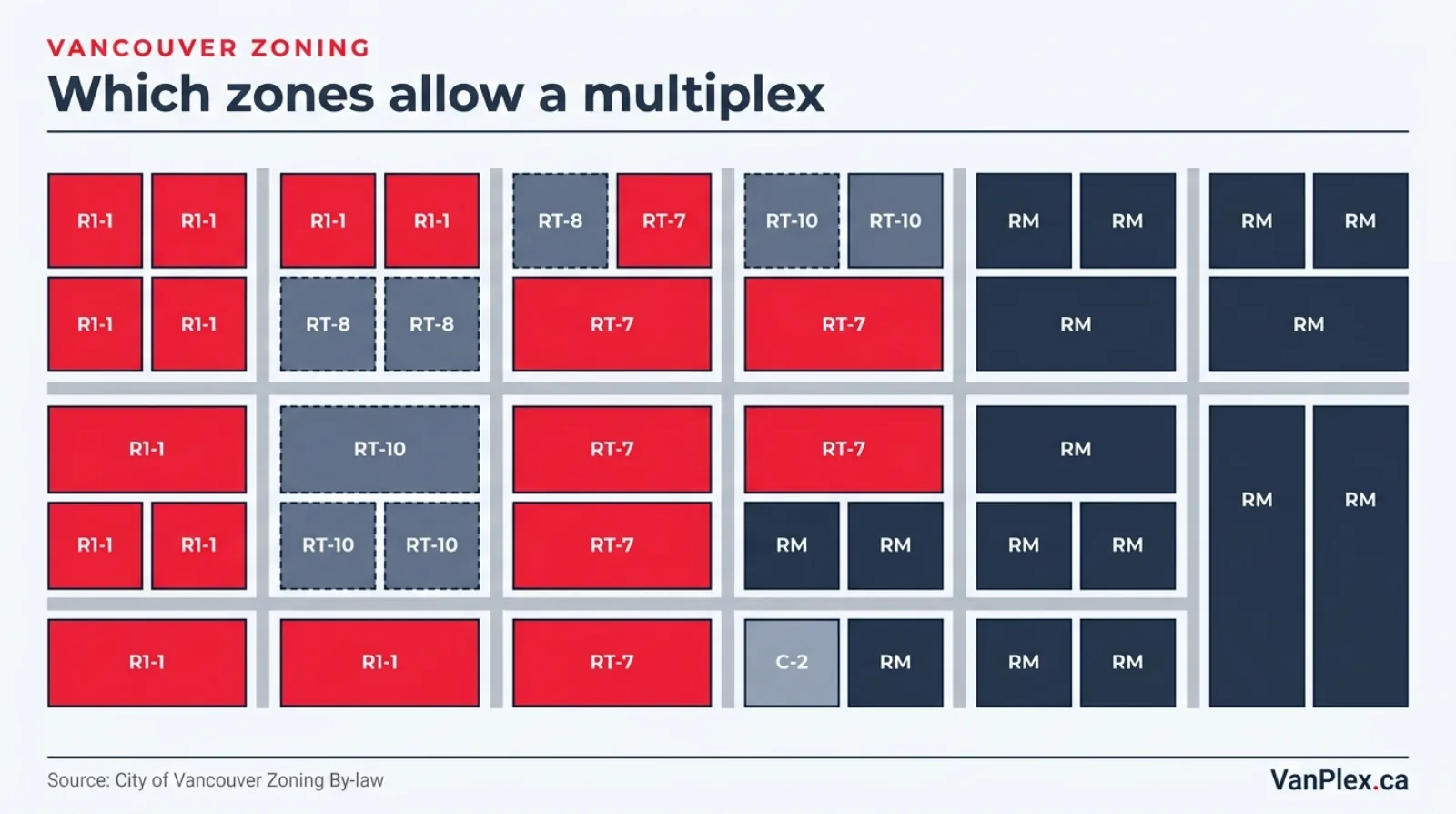

A flat editorial map of Vancouver city blocks color-coded by zoning designation, showing which zones such as R1-1 and RT-7 allow a multiplex outright versus RT-8, RT-10, RM, and C-2 which do not
Zoning & Regulation

Vancouver Zoning: R1-1, RT, RM, C-2, Multiplex Guide

9 min read

R1-1 and RT-7/RT-9 allow a multiplex outright, at 1.0 FSR. RT-8 and RT-10 still do not, even after a provincial bill forced a June 30, 2026 deadline. RM zones already allow apartments. C-2 needs city sign-off case by case. Here is what each letter on your lot actually lets you build.

Key takeaway

A zone-by-zone comparison of Vancouver's residential and commercial-adjacent zoning designations, framed around which zones let an owner build a multiplex today under Bill 44's small-scale multi-unit housing rules.

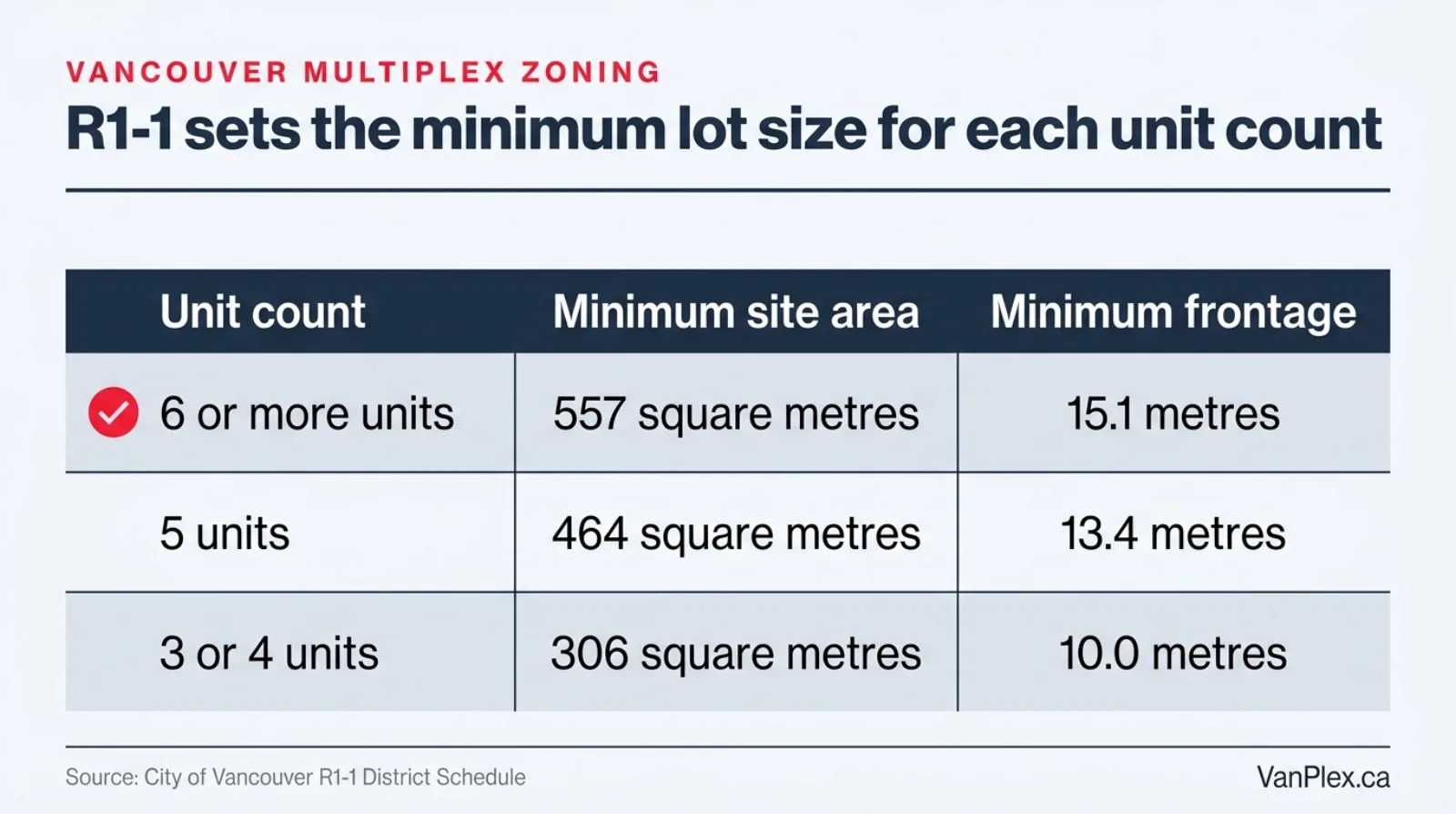
R1-1, in effect since October 17, 2023, allows a multiplex outright on a qualifying lot at 1.0 floor space ratio (1.25 with Net Zero construction), with three unit bands set by minimum site area and frontage: 306 square metres and 10.0 metres for three or four units, 464 square metres and 13.4 metres for five units, and 557 square metres and 15.1 metres for six or more units, plus a minimum site depth of 30.4 metres. Multiple dwelling is a conditional approval use under section 2.2.7, reviewing design rather than eligibility. RT-7 and RT-9 were amended to the same 1.0 FSR standard effective June 30, 2024. RT-8 and RT-10 were excluded from the original 2023 bylaw on a staff interpretation that neither met the provincial 'Restricted Zone' definition; as of the June 30, 2026 SSMUH compliance deadline forced by Bill 25 (Royal Assent November 27, 2025), no City of Vancouver council report had named a specific replacement FSR for either zone, so both remained at their pre-amendment figures, RT-8 at 0.50 FSR and RT-10 at 0.80 FSR, with multiple dwelling available only through conditional approval or rezoning.

RM zones already permit apartment buildings outside the SSMUH framework, ranging from RM-1's 0.40 FSR to RM-4's 1.45 FSR (3.00 for full social housing). C-2 is a commercial district-shopping zone where multiple dwelling is a discretionary, case-by-case Director of Planning approval, not a guaranteed use. The article cites VanPlex's own PlexRank analysis of 56,088 R1-1 lots, which found only 2% (about 1,500 properties) clear a 100%+ return-on-equity threshold, to distinguish zoning eligibility from financial viability.

What this covers

  • R1-1 outright multiplex at 1.0 FSR
  • R1-1 unit bands by site area and frontage
  • RT-7 and RT-9 matched to R1-1 in June 2024
  • RT-8 and RT-10 excluded, still pending as of June 30, 2026
  • Bill 25 Restricted Zone definition closes the staff loophole
  • RM zones outside the SSMUH framework
  • C-2 multiple dwelling is discretionary, not guaranteed
  • zoning eligibility versus financial viability
zoning R1-1 RT-7 RT-8 RT-10 RM

A lot’s zoning letters decide whether you can build a multiplex, not the price, not the neighbourhood, not what your neighbour just built. R1-1 allows a multiplex outright, no rezoning. RT-8 and RT-10 do not, even after two rounds of provincial pressure to change that. RM zones already permit apartments at densities most R1-1 owners will never reach. C-2 is a commercial strip zone where a home above a shop needs city sign-off case by case. Here is what each letter actually lets you build, and where the line sits between a lot that qualifies today and one that does not.

R1-1: the zone that carries Vancouver’s multiplex program

R1-1 replaced the old RS-1 single-family schedule on September 14, 2023, in effect October 17, 2023, and it now covers most of Vancouver’s former single-detached blocks. It is the zone doing the work: VanPlex’s own analysis of 56,088 R1-1 lots found that only 2%, roughly 1,500 properties, clear the 100%+ return on equity threshold that makes a ground-up multiplex worth the risk. Half the lots come back at a negative or near-zero return. A quarter land in the 15% to 30% range, barely worth the work. Another quarter land in the 30% to 90% range, which is builder-grade but not exceptional. That 2% figure is VanPlex’s own PlexRank modelling, built from real construction costs, financing terms, city fees, and resale comparables, not a City of Vancouver statistic. The zoning lets almost every R1-1 lot build. The math says almost none of them should.

R1-1 sets three unit bands, and a lot has to clear both the minimum site area and the minimum frontage for its band, under the District Schedule’s June 2026 consolidation:

Unit countMinimum site areaMinimum frontageSection
6 or more units557 m² (5,995 sq ft)15.1 m (49.54 ft)3.1.2.1
5 units464 m² (4,994 sq ft)13.4 m (43.96 ft)3.1.2.2
3 or 4 units306 m² (3,294 sq ft)10.0 m (32.81 ft)3.1.2.3

Table showing Vancouver R1-1 minimum site area and frontage by unit count: 557 square metres and 15.1 metres for six or more units, 464 square metres and 13.4 metres for five units, 306 square metres and 10.0 metres for three or four units

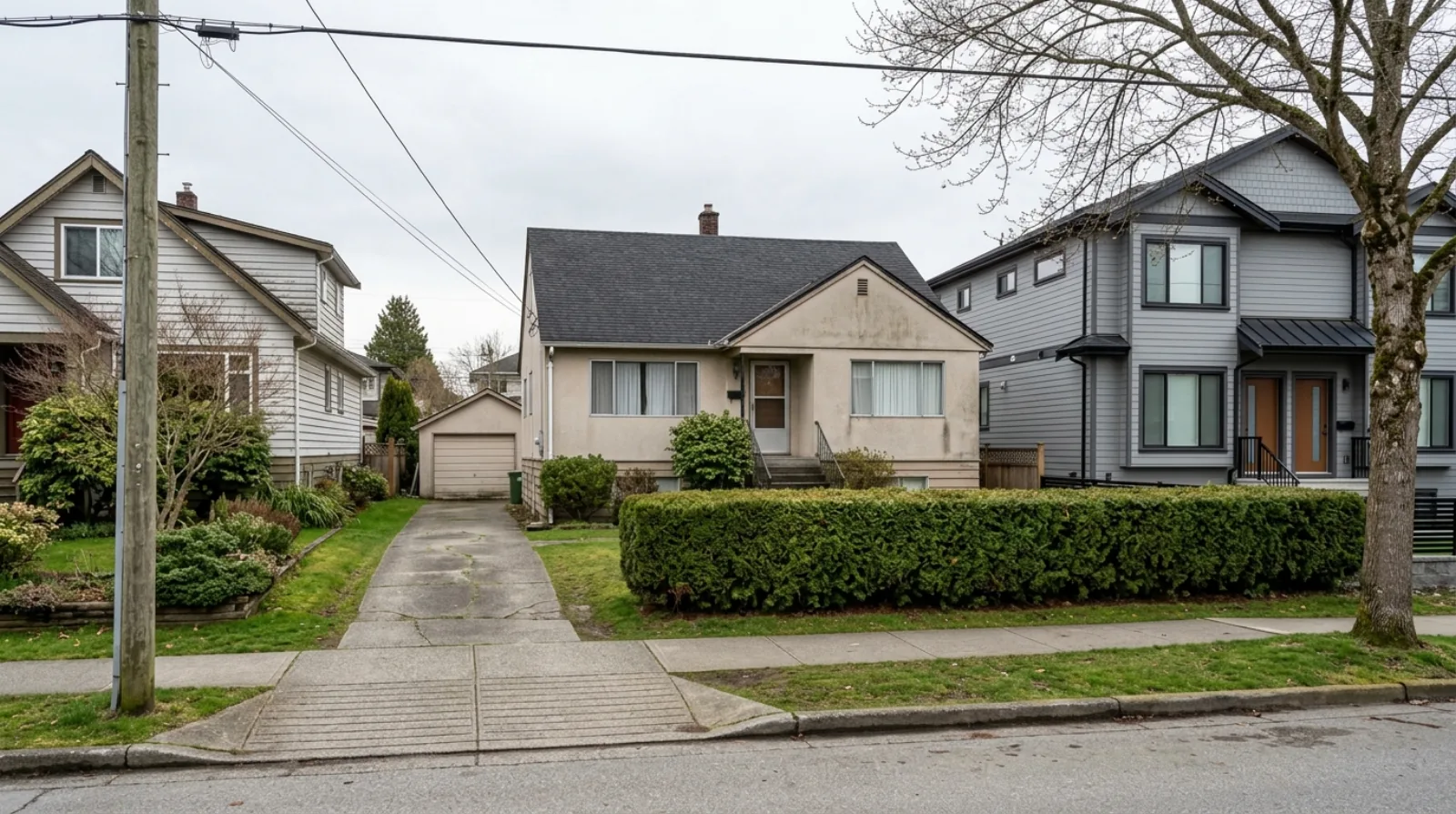
A standard 33 by 122 foot Vancouver lot measures 10.06 m of frontage, clearing the three-or-four-unit band by 2.3 inches. A standard 50 by 122 foot lot measures 15.24 m, clearing the six-unit band by 5.5 inches. The margins are thin enough that a survey discrepancy of half a foot can drop a lot a full tier. There is also a minimum site depth of 30.4 m (99.7 feet) under section 3.1.2.4, so a shallow lot fails regardless of how wide it is.

Floor space ratio (FSR), the ratio of total building floor area to lot size, is 1.0 as of right, rising to 1.25 with Net Zero energy construction. Multiple dwelling is a conditional approval use decided by the Director of Planning under section 2.2.7, which means every application still goes through design review, even though the use itself is guaranteed on a qualifying lot. On the secured-rental path, where every unit is committed to long-term rental rather than sold as strata, a qualifying lot can reach 8 units instead of 6.

RT-7 and RT-9: brought up to the R1-1 standard in 2024

RT-7 (north Kitsilano) and RT-9 (near Commercial Drive and Victoria) started as character-retention, two-family districts, but Vancouver Council amended both to match the R1-1 program. The amendment went to public hearing June 13, 2024 and took effect June 30, 2024: outright FSR raised to 1.0, and multiplex added as a use on qualifying lots on the same site-area and frontage terms as R1-1. If your lot sits in RT-7 or RT-9, you are working from the same numbers in the table above, not a separate, lower-density schedule.

RT-8 and RT-10: the two zones the province had to force

RT-8 (parts of West Kitsilano) and RT-10 (Kensington-Cedar Cottage) were left out of the original 2023 multiplex bylaw. City staff argued both zones already permitted “multiple dwelling” as a conditional use, so neither one met the provincial definition of a “restricted zone” that Bill 44’s small-scale multi-unit housing (SSMUH) rules were written to fix.

As of April 2026, the two zones sat well below the R1-1 standard. RT-8’s outright maximum density was 0.50 FSR, with a rule that at least half the units in a building have to contain two or more bedrooms. RT-10’s outright maximum was 0.80 FSR with 45% maximum site coverage. In both zones, a multiplex needed conditional approval or a rezoning application. Neither zone gave an owner the as-of-right building permit process that R1-1 owners have used since October 2023.

That loophole closed on paper. Bill 25, the province’s Housing and Municipal Affairs Statutes Amendment Act, received Royal Assent on November 27, 2025, and it broadened the SSMUH “restricted zone” definition to cover any zone where a single detached dwelling, a secondary suite, or a detached accessory dwelling is the primary allowed use, which brings RT-8 and RT-10 inside the mandate. Vancouver’s deadline to comply was June 30, 2026. At the time of writing, no City of Vancouver council report naming a specific new FSR or unit count for RT-8 or RT-10 has been published, so this article states the two zones’ figures as they stood before that deadline and flags the change as pending rather than guessing at a number nobody has confirmed yet. If you own in either zone, check the number on your property directly against the City’s current district schedule before pricing a project, because the outright figure above is the one most likely to move.

RM zones: apartment density, not the multiplex program

RM stands for multiple dwelling, and RM zones already allow purpose-built apartment buildings at densities most R1-1 lots cannot reach on their own. RM-1, a duplex-adjacent East Vancouver schedule, caps outright FSR at 0.40, rising to 0.65 where a residential building built before January 1, 1940 is retained. RM-4, the medium-density apartment schedule across Mount Pleasant and Fairview, allows 4-storey apartments and 6-storey social housing apartments at up to 1.45 FSR, rising to 3.00 where the entire residential floor area is social housing.
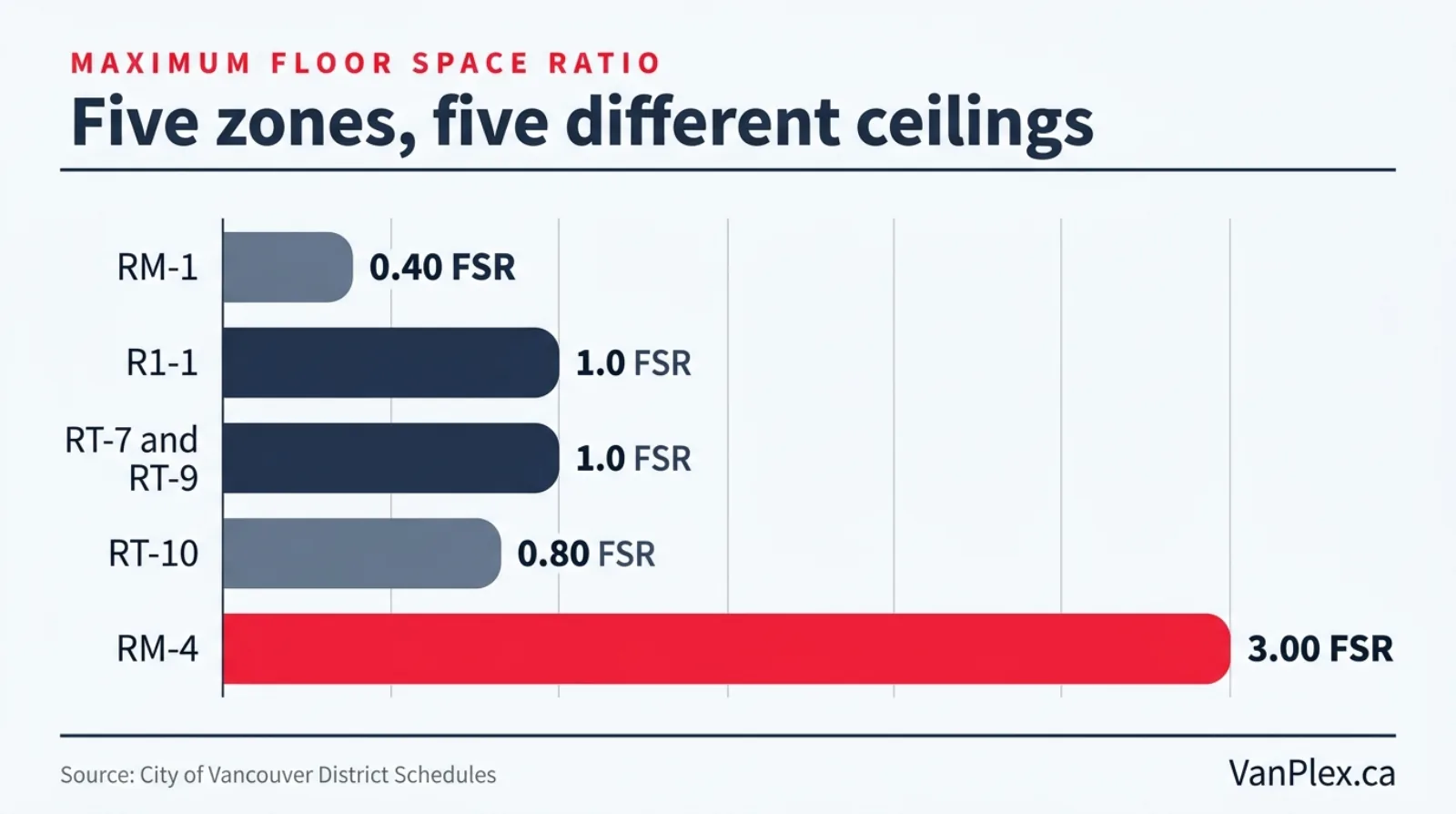
Horizontal bar chart comparing maximum floor space ratio by Vancouver zone: RM-1 at 0.40, R1-1 at 1.0, RT-7 and RT-9 at 1.0, RT-10 at 0.80, and RM-4 at 3.00

RM zones are not part of the SSMUH multiplex conversation because they were never restricted to single-family use in the first place. Bill 44’s small-scale multi-unit housing rules exist to open up zones that only allowed one house per lot. An RM zone already allows an apartment building, so the province had no reason to touch it. If your lot is zoned RM, the relevant question is not whether Bill 44 unlocks a multiplex. It is what apartment form your specific RM sub-district already permits, and RM sub-districts vary by roughly a factor of seven in maximum density, from RM-1’s 0.40 FSR to RM-4’s 3.00 FSR ceiling for social housing.

C-2: a commercial strip, not a multiplex zone

C-2 is Vancouver’s district-shopping commercial schedule, covering strips like parts of Commercial Drive, Dunbar Street, and Kingsway. Its intent is to keep ground-floor retail serving the neighbourhood while allowing residential floors above. In the current C-2 sub-district schedules, a multiple dwelling is a use the Director of Planning approves case by case if the specific site is judged suitable for residential use, not a use every C-2 lot gets automatically. That is the opposite of what R1-1 does: R1-1 guarantees a qualifying lot the use outright, with the Director of Planning reviewing design, not eligibility. C-2 makes the use itself discretionary.

A single-family house does not sit on C-2 land. C-2 shows up in a multiplex feasibility check only when a lot backs onto or sits within a C-2 strip and an owner is asking whether a mixed residential-commercial building is possible, which is a rezoning-scale question, not a Bill 44 as-of-right question.

The zoning sets the ceiling, the lot sets the price

The letter on a lot sets a ceiling on what it can build, not the price that lot is worth. A 33 foot R1-1 lot and a 50 foot R1-1 lot both clear a multiplex band, but one produces four units and the other can produce six, and the site-specific costs of servicing, trees, slope, and lane access decide how much of that ceiling is worth building to. VanPlex’s 56,088-lot analysis found 98% of technically eligible R1-1 lots do not clear the return threshold that justifies development risk, even though every one of them is zoned to build.

Which zone are you in, and does it clear the bar

ZoneMultiplex allowed todayOutright FSRPath
R1-1Yes, outright on a qualifying lot1.0, up to 1.25 Net ZeroAs-of-right building permit
RT-7 / RT-9Yes, outright, matched to R1-1 in June 20241.0As-of-right building permit
RT-8Not outright as of the June 30, 2026 deadline; change pending0.50 (pre-amendment)Conditional approval or rezoning
RT-10Not outright as of the June 30, 2026 deadline; change pending0.80 (pre-amendment)Conditional approval or rezoning
RM (all sub-districts)Not applicable, apartment use already permitted0.40 to 3.00 depending on sub-districtGoverned by RM schedule, not SSMUH
C-2No, residential use is discretionaryNot standardized across sub-districtsDirector of Planning approval, case by case

If your address is R1-1, RT-7, or RT-9, the next question is whether your lot’s actual frontage and site area clear the band you are aiming for, not whether the zoning allows it in principle. If it is RT-8 or RT-10, treat the current figures as the ones in force until the City publishes a specific replacement, and do not price a sale or a refinance against a number that has not been enacted yet. If it is RM or C-2, the multiplex program does not apply to your lot at all, and the real question is what your specific sub-district’s own apartment or mixed-use rules allow.

Run your own address through PlexRank to see the zone, the unit band, and the return before you commit to a design.


David Babakaiff PlexRank™ | Profit with Multiplex
Frequently asked questions

Does R1-1 zoning allow a multiplex in Vancouver?

Yes. R1-1 replaced the single-family RS-1 zone on September 14, 2023, in effect October 17, 2023, and it allows a multiplex outright on a qualifying lot, no rezoning needed. The outright floor space ratio is 1.0, rising to 1.25 with Net Zero energy construction. A lot needs 306 square metres and 10.0 metres of frontage for three or four units, up to 557 square metres and 15.1 metres of frontage for six or more units, under the District Schedule's June 2026 consolidation.

Does RT-8 or RT-10 zoning allow a multiplex today?

Not outright, as of the province's June 30, 2026 compliance deadline. RT-8 (parts of West Kitsilano) and RT-10 (Kensington-Cedar Cottage) were excluded from Vancouver's 2023 multiplex bylaw because city staff judged that both zones already allowed multiple dwelling as a conditional use. Bill 25 closed that reasoning on November 27, 2025, but no City of Vancouver council report naming a specific replacement FSR or unit count for either zone had been published as of this article, so a multiplex on either zone still needs conditional approval or a rezoning application.

What is the difference between RT-7 and RT-8 zoning in Vancouver?

RT-7 covers heritage streets in north Kitsilano and was amended by Vancouver Council on June 30, 2024 to match the R1-1 multiplex program: outright 1.0 floor space ratio and a multiplex use on a qualifying lot. RT-8 covers select West Kitsilano blocks and, as of the June 30, 2026 SSMUH deadline, was still capped at 0.50 outright floor space ratio with multiple dwelling only available through conditional approval. The two zones sit a few blocks apart in the same neighbourhood but run on different rules.

Can I build a multiplex on RM-zoned land in Vancouver?

RM zoning already permits purpose-built apartment buildings, so the province's small-scale multi-unit housing rules under Bill 44 do not apply to it the way they apply to former single-family zones. RM-1 caps outright floor space ratio at 0.40. RM-4 allows 4-storey apartments and 6-storey social housing apartments at up to 1.45 floor space ratio, rising to 3.00 where the entire residential floor area is social housing. What an RM lot can build depends on its specific sub-district's own apartment rules, not the multiplex program.

Does C-2 zoning allow a house or a multiplex in Vancouver?

No lot zoned C-2 carries a single-family house, because C-2 is a commercial district-shopping schedule covering strips such as parts of Commercial Drive, Dunbar Street, and Kingsway. Multiple dwelling in a C-2 sub-district is a use the Director of Planning approves case by case if the specific site is judged suitable for residential use, not a use every C-2 lot receives automatically the way R1-1 guarantees a qualifying lot.

What percentage of Vancouver's R1-1 lots actually make sense to redevelop?

VanPlex modelled all 56,088 R1-1 lots in Vancouver with full construction, financing, and city-fee assumptions and found that only 2 percent, about 1,500 properties, clear a 100 percent or higher return on equity, the threshold that makes a ground-up multiplex worth the development risk. Half of the lots came back negative or near zero, a quarter landed at 15 to 30 percent return, and another quarter landed at 30 to 90 percent. This is VanPlex's own PlexRank modelling, not a City of Vancouver statistic, and it means zoning eligibility and financial viability are two separate questions.

What happened to the Restricted Zone loophole that excluded RT-8 and RT-10?

When Vancouver enacted R1-1 in 2023, city staff argued RT-8 and RT-10 did not meet the provincial definition of a Restricted Zone under Bill 44's small-scale multi-unit housing rules, because both zones already allowed multiple dwelling conditionally. Bill 25, which received Royal Assent on November 27, 2025, broadened that definition to cover any zone where a single detached dwelling, a secondary suite, or a detached accessory dwelling is the primary allowed use, which brings both RT-8 and RT-10 inside the mandate.

What is the minimum lot depth for a multiplex under Vancouver's R1-1 zoning?

R1-1 requires a minimum site depth of 30.4 metres, which is 99.7 feet, under section 3.1.2.4 of the District Schedule. A lot shallower than that cannot host a multiplex at any unit count regardless of its frontage width, which is a separate check from the site-area and frontage minimums that set the unit-count bands.

Is multiple dwelling an outright use or a conditional use under R1-1?

It is a conditional approval use decided by the Director of Planning, under section 2.2.7 of the R1-1 District Schedule. That approval covers design review on a qualifying lot, not eligibility. Once a lot clears the minimum site area and frontage for its unit-count band, the multiplex use itself is guaranteed; the conditional step reviews the specific building design rather than whether a multiplex can go there at all.

Free 12-page guide for Vancouver-area homeowners. Build, sell, hold, or partner — side-by-side comparison of the numbers, timeline, and risk on each path.

Verified phone required. We'll text you the link in 60 seconds.

David Babakaiff

David Babakaiff

Co-Founder, VanPlex | 25+ Years BC Construction

David Babakaiff is Co-Founder of VanPlex with 25+ years scaling BC construction. He led Alair Homes Vancouver to the 2024 HAVAN Award for Best Multiplex Unit in the GVRD. VanPlex’s PlexRank™ algorithm scores residential parcels across BC for multiplex conversion potential under Bill 44.

Want insights like this delivered weekly?

Join 2,500+ property owners getting ROI case studies, market data, and exclusive opportunities.

No spam. Unsubscribe anytime.

Detailed black and white architectural site plan drawing of a Vancouver multiplex lot showing property lines, setbacks marked in red dashed lines, building footprint shaded grey, and lot dimensions in metres, illustrating how floor space ratio and site coverage together shape a buildable envelope
8 min read

FSR and Site Coverage: The Two Numbers on Your Lot

Floor space ratio caps how much you can build. Site coverage caps how much ground the building can cover. Vancouver's R1-1 multiplex FSR starts at 0.70 and rises to 1.00 under three specific conditions, but a narrow lot often hits its footprint limit before it uses that full allowance. Here is how the two numbers interact, and why your lot's shape decides which one binds first.

Zoning & Regulations
FSRsite-coverage+7
By David Babakaiff • Co-Founder, VanPlex | 25+ Years BC Construction
Vancouver City Hall seen past a residential street of new multiplex buildings, the setting for the October 17, 2026 mayoral election
9 min read

Vancouver Mayor 2026: Every Candidate Ranked on Multiplexes

Eight candidates are running for Vancouver mayor on October 17, 2026. The voche.me editorial team read every platform and ranked them on one question: who makes it easier to build a multiplex? Pete Fry has the most detailed plan, Ken Sim has the strongest record, and Colleen Hardwick would ask the Province to revisit Bill 44.

Policy Analysis
vancouver-election-2026mayor+9
By Voche.me editorial • Vancouver election guide (voche.me)
A standard 50 foot wide Vancouver residential lot with an older detached house, the frontage width that clears the R1-1 six-unit multiplex minimum by about five inches
8 min read

How to Find a Multiplex Lot: Start With Frontage

A standard 50 by 122 foot Vancouver lot clears the six-unit frontage minimum by 5.5 inches. A 33 foot lot clears the four-unit minimum by 2.3 inches. Both margins sit inside normal rounding error on a listing, which is why frontage, not price, is the first filter when hunting for a site.

Investment Analysis
multiplexvancouver+6
By David Babakaiff • Co-Founder, VanPlex | 25+ Years BC Construction