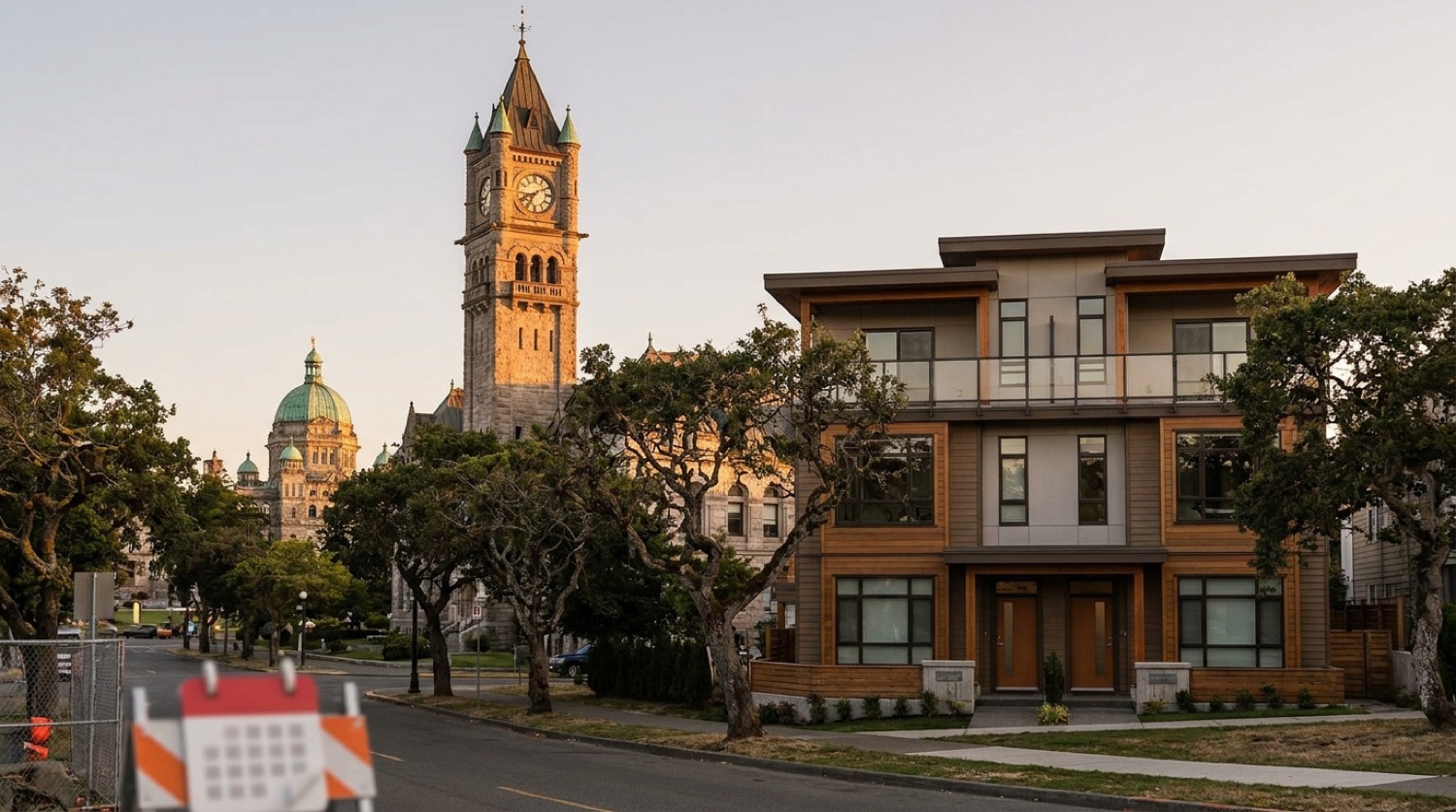
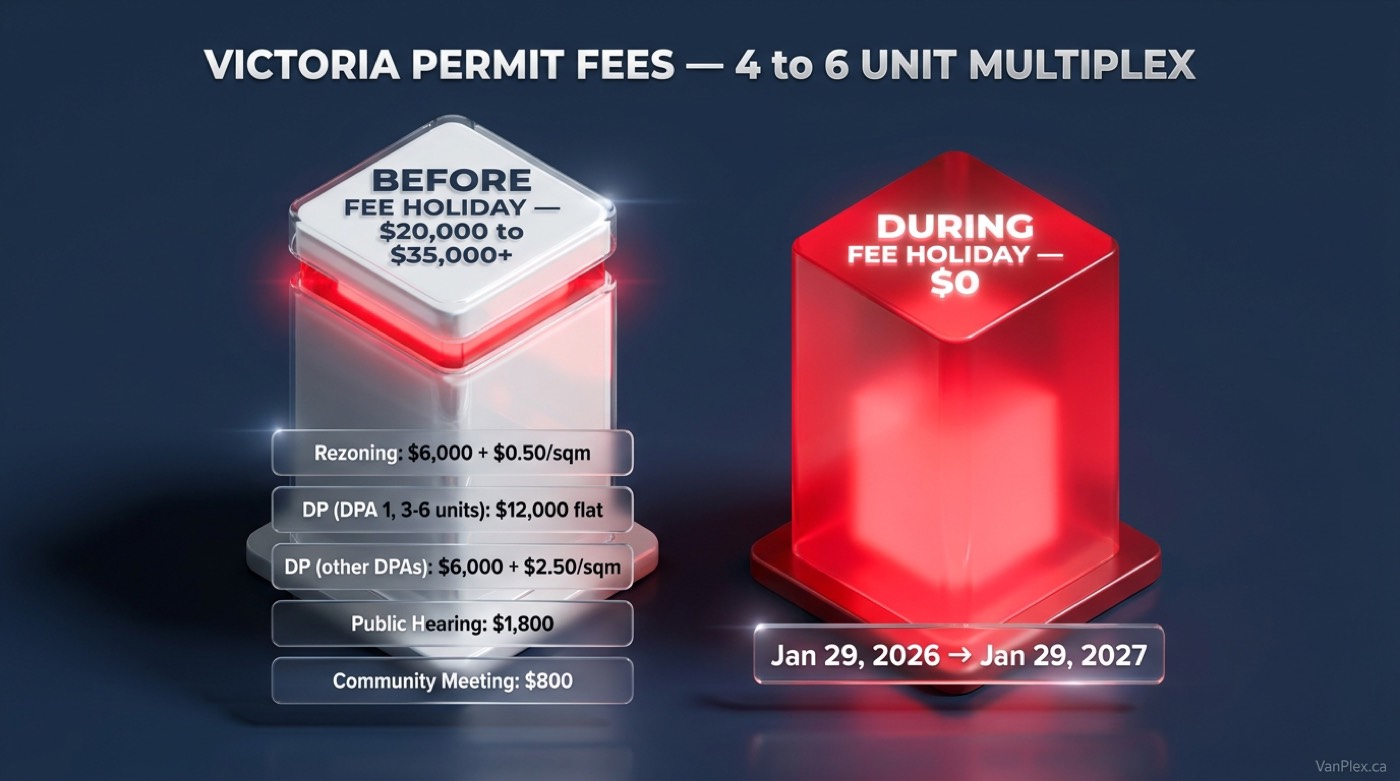
From January 29, 2026 to January 29, 2027, the City of Victoria is waiving municipal permit fees for planning and development activities. For a typical 4–6 unit missing middle multiplex, that’s a saving of roughly $20,000–$35,000 in rezoning, development permit, and related fees — money you don’t spend if your project files inside the one-year window.
Mayor Marianne Alto pushed the fee holiday through Council. The bylaw is the Development Fee Waiver Bylaw. The math is simple: file before January 29, 2027, or pay full freight.
TL;DR (Key Takeaways)
- Victoria’s Development Fee Waiver Bylaw waives municipal permit fees from January 29, 2026 to January 29, 2027
- The waiver covers planning and development activity permits: rezoning, development permits, related applications
- Pre-holiday cost for a typical 4–6 unit multiplex project: $20,000–$35,000+ in municipal fees alone
- Specific savings include rezoning fees ($6,000 + $0.50/sq m floor area), development permits in DPA 1 ($12,000 flat), and public hearing / community meeting / landscape security fees
- Mayor Marianne Alto moved the bylaw through; Victoria was already a missing-middle-friendly city before Bill 44 forced provincial alignment
- Building permit fees and provincial/regional charges (DCCs, school site acquisition, etc.) are not part of the waiver — only municipal planning fees
- The clock is twelve months — projects in pre-design today can realistically file inside the window
What Victoria’s fee holiday actually waives
The Development Fee Waiver Bylaw covers municipal permit fees the city itself charges. For a typical 4–6 unit multiplex on a Victoria lot, the line items normally look like this:
| Fee | Pre-Holiday Cost | Notes |
|---|---|---|
| Rezoning (4–6 units) | $6,000 + $0.50/sq m | Plus floor area component |
| Development Permit (DPA 1, 3–6 units) | $12,000 flat | Most central neighbourhoods |
| Development Permit (other DPAs, 4–6 units) | $6,000 + $2.50/sq m | Higher per-area rate |
| Public Hearing | $1,800 | If rezoning triggers a hearing |
| Community Meeting (rezoning pre-app) | $800 | Required for many rezoning files |
| Landscape Security Deposit | 120% of landscaping cost (min $2,000) | Refundable, but ties up cash |
Add the floor-area components and you’re routinely in the $20,000–$35,000 range before you pour any concrete. On a small multiplex, that’s 0.5%–1% of total project cost in fees the city is now waiving.
The waiver is broad — it applies to anyone requiring a city permit or rezoning for planning and development activities. There’s no missing-middle-only carve-out. Anything from a small commercial tenant fit-out to a six-unit purpose-built rental can benefit, as long as the application is filed inside the window.
What it doesn’t waive
Three things still cost money during the holiday:
- Building permit fees. Building permits go through a separate fee structure tied to construction value and aren’t part of the planning fee waiver.
- Provincial and regional charges. BC’s Development Cost Charges (DCCs), the Capital Regional District’s regional infrastructure charges, school site acquisition charges, and BC Hydro service connections all sit outside the City of Victoria’s fee schedule.
- Refundable deposits. Landscape security and similar deposits are returned at completion, but they still tie up cash during the project. The waiver doesn’t eliminate the deposit requirement.
So the headline saving — $20K–$35K — is real, but it’s not the only fee in the project. Build the proforma against actual line items, not a percentage estimate.
Why Victoria, why now
Victoria was already ahead of most BC municipalities on missing middle. Mayor Marianne Alto was one of the rare BC mayors who moved on missing middle policy before Bill 44 forced provincial alignment in June 2024. The fee holiday is a continuation of that posture — using the city’s discretionary fee tools to actively pull development applications forward, not just legalize them.
The political logic for Council:
- Permit applications had slowed across BC in 2024–2025 as construction costs and interest rates squeezed proformas
- Fee waivers cost the city the lost revenue but cost less than the slowdown costs in housing supply terms
- A one-year window creates urgency — applications already in the queue get a discount, but the policy isn’t permanent revenue erosion
For Victoria homeowners and small developers, the practical effect is straightforward: the cheapest year to apply for a permit in Victoria has already started. It ends January 29, 2027.
What this means if you own a Victoria lot
If you’ve been considering a missing middle project on a Victoria property — duplex, triplex, fourplex, or larger — three things to do this week:
1. Calculate your actual fee saving
Don’t model a placeholder. Pull your floor area number, identify which Development Permit Area your lot is in (DPA 1 vs. others), and check whether your project is likely to need a rezoning. The $20K–$35K range is real but project-specific.
2. Compress the application timeline
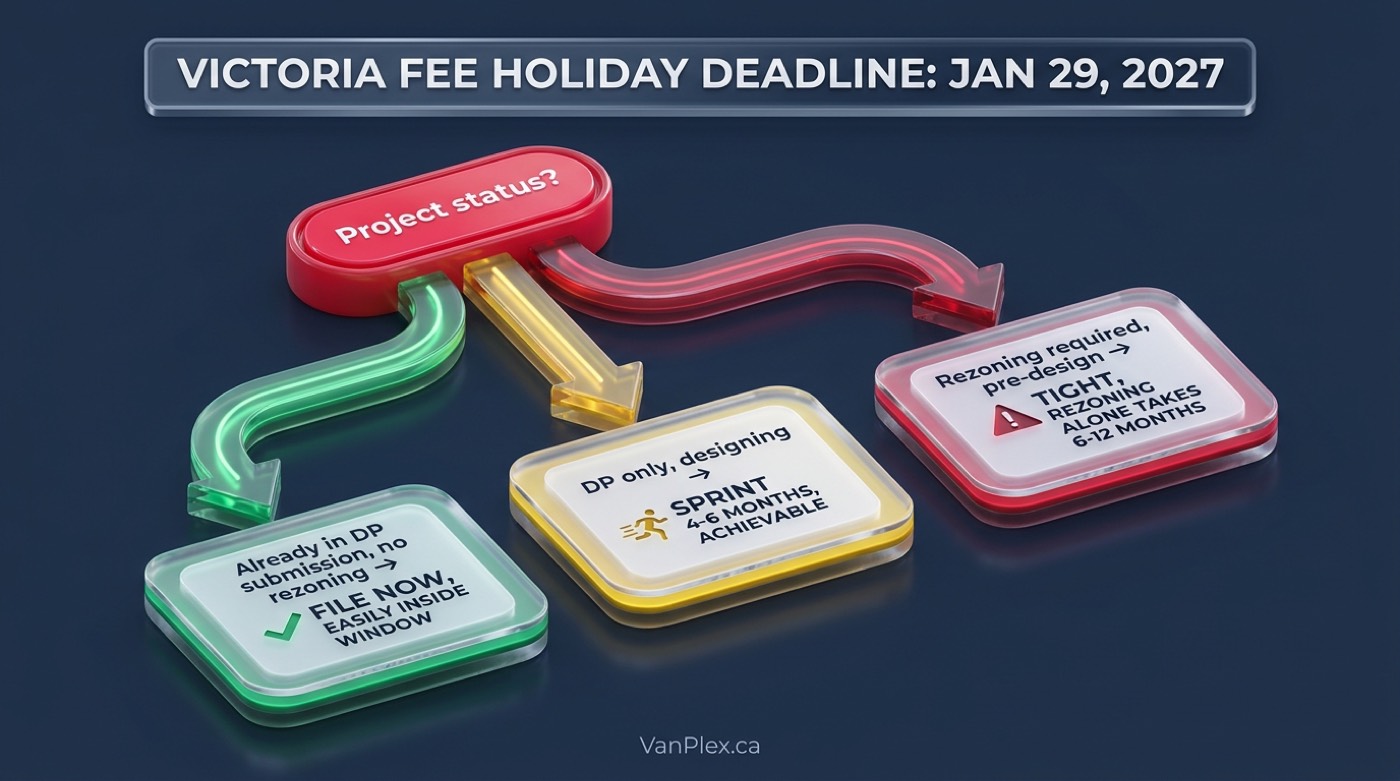
The fee holiday rewards filing inside a 12-month window. If your designer’s normal pace is 8–10 months from initial brief to development permit submission, you’re cutting it close. Sprint or you miss it.
For typical Victoria missing middle projects:
- Pre-application meeting → schematic design: 4–8 weeks
- Schematic to development permit submission: 8–16 weeks
- Rezoning (if needed): adds 6–12 months on top
If you’re starting a rezoning today (May 2026), the realistic submission window is closing fast. If you’re a development-permit-only project on a lot already zoned for multiplex, you have time.
3. Check whether your project really benefits
The fee holiday matters most for projects with rezoning or large floor area. A small 3-unit infill on a lot already zoned for multiplex with a modest building permit might save $8K–$12K. A 6-unit project requiring rezoning, a public hearing, and a large floor area assessment could save closer to $35K. The bigger your application, the bigger the win.
How this fits with BC’s other policy moves
The Victoria fee holiday is part of a broader pattern across BC:
- Vancouver is removing density bonus contributions from 90%+ of multiplex lots on June 30, 2026 (see our Vancouver Density Bonus Removal post)
- CMHC is shifting MLI Select energy attestation to 2020 codes on September 30, 2026 (see our CMHC MLI Select September 30, 2026 Energy Deadline post)
- Vancity has financed 45 multiplex projects ($60.4M) in six months since launching its construction mortgage program (see our Lenders Pivot to Missing Middle post)
Each one is a different kind of pressure on the timeline. Vancouver’s June 30 deadline lowers fees for projects that issue permits after the date. Victoria’s January 29, 2027 deadline waives fees for projects that file before the date. CMHC’s September 30 transition makes energy scoring tougher after the date. The pattern: 2026 has multiple compounding deadlines that materially change the multiplex math.
If you have a Victoria lot, the Victoria deadline is the closest one — and the most actionable.
What to do this month
For a quick check on whether your specific Victoria lot pencils for a missing middle multiplex — and what filing inside the fee holiday window saves you in dollar terms — drop the address into the VanPlex proforma. The fee structure is updated to reflect the holiday, so you can see both pre- and post-holiday economics side by side.
The holiday is twelve months. Twelve months goes faster than it sounds.
Author: David Babakaiff, Co-Founder of VanPlex PlexRank™ | Profit with Multiplex
Sources: