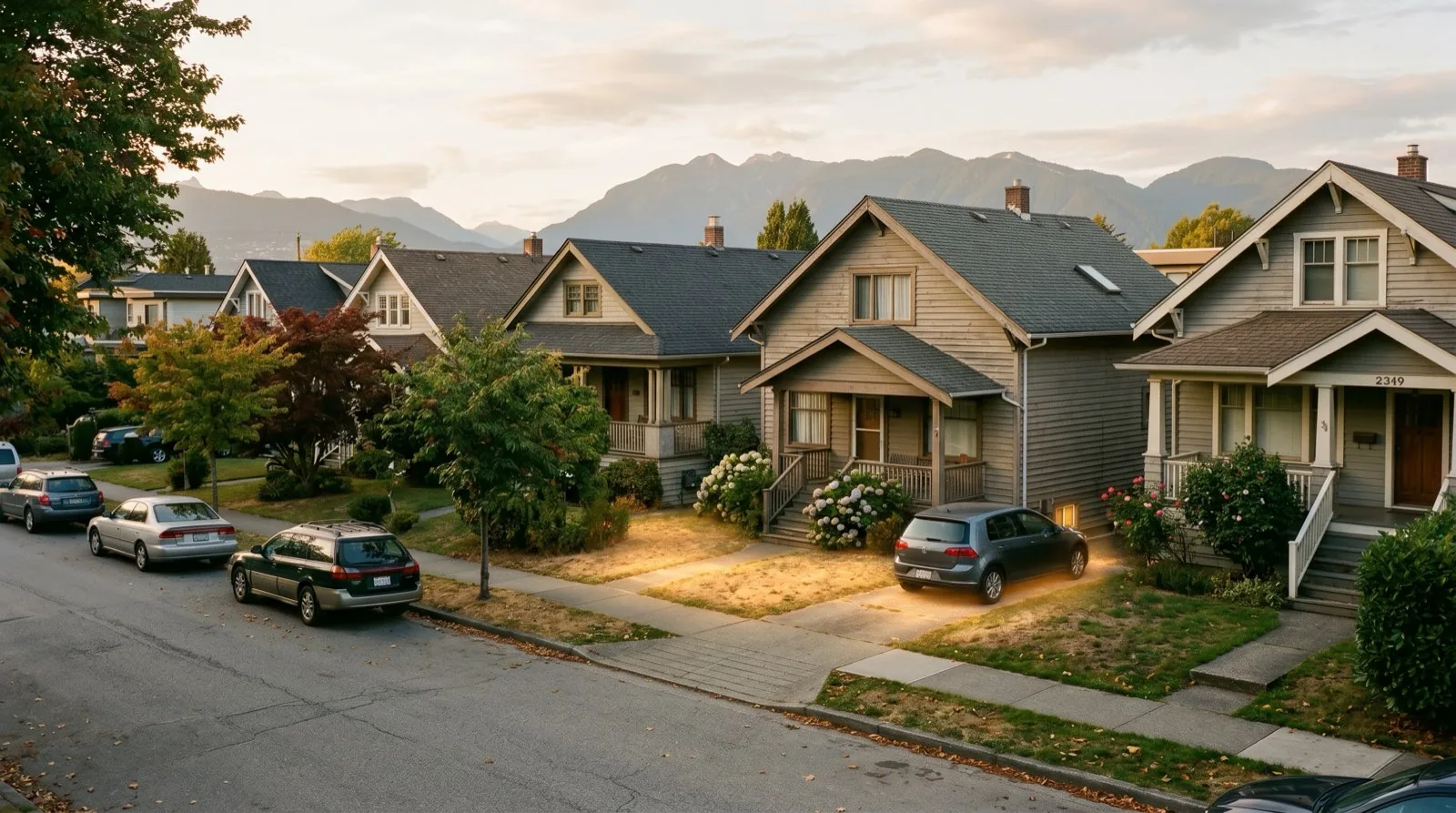

Targeted multiplex conversions on the top 2% of lots—filtered by VanPlex’s PlexRank(TM) for 100%+ ROE—remain the lowest-risk entry point in new ground-oriented housing, even as Vancouver prices slide 6.8% year-over-year (REBGV, February 2026), AI disrupts 21,000-40,000 white-collar jobs by 2027, and 5,000+ unsold condos flood the market. Here’s why selective data-driven development still works when everything else looks bleak.
Vancouver Home Prices: 11 Straight Months of Decline
The Vancouver market is cooling fast. February 2026 sales were 28% below the 10-year average, with inventory at record highs leading to sellers losing hundreds of thousands on average (REBGV, February 2026). The composite benchmark price sits at $1.1 million—a 6.8% year-over-year drop marking 11 straight months of declines.
Detached homes are hit hardest, down 8.8% to $1.84 million, while condos fell 6.8% to $782,000. Royal LePage forecasts a 3.5% aggregate drop by Q4 2026—the second-largest among major Canadian cities. This follows 2025’s 20-year low in sales (23,800 transactions), with high interest rates and buyer caution fueling the slump.
| Metric | Current Value | YoY Change |
|---|---|---|
| Composite Benchmark | $1.1M | -6.8% |
| Detached Homes | $1.84M | -8.8% |
| Condos | $782K | -6.8% |
| Feb 2026 Sales vs 10yr Avg | — | -28% |
| BC Assessment Avg SFH | $2.09M | -5% |
The pattern is clear: declining prices, weak sales, and structural shifts are removing buying power from the market. But within this environment, selective opportunities backed by data stand out as lower-risk plays.
AI’s Quiet Squeeze on Vancouver’s White-Collar Workforce
Adding downward pressure: AI-driven job disruptions in Vancouver’s key economic sectors. Metro Vancouver’s tech sector employs 125,000-150,000 workers (roughly 1 in 10 jobs), with broader white-collar roles in finance, professional services, and administration totaling 350,000-400,000.
TD Economics notes Canada’s resilience compared to the US, with moderate disruption expected. Still, 6-10% of these jobs (21,000-40,000) could face net displacement by 2027—mostly through attrition, unfilled roles, and flat growth rather than mass layoffs.
High-risk roles include:
- Junior developers and QA testers
- Marketing coordinators and content producers
- Financial analysts and bookkeepers
- Administrative and data-entry positions
BC’s tech sector already shed 249 jobs in 2024 amid national growth. This “quiet hollowing” means softer demand for high-end homes as entry-level and mid-level workers—normally prime first-time buyers—face hiring freezes and stagnant wages.
The Grey Market: 5,000+ Unsold Condos Suppressing Prices
Compounding the issue is a glut of unsold units. Over 5,000 new and resale condos sit empty as of early 2026—a 24-year high—with sales ratios at 9.1%, firmly in buyer’s market territory (REBGV, March 2026).
CMHC reports 2,500 developer-held unsold condos, doubling from last year and potentially rising to 3,500 by year-end. Many are concentrated in the $800K-$1.2M range, exactly where affordability crunches hit hardest.
| Condo Inventory Metric | Value | Trend |
|---|---|---|
| Unsold New + Resale Condos | 5,000+ | 24-year high |
| Sales-to-Active Ratio | 9.1% | Buyer’s market |
| Developer-Held Unsold (CMHC) | 2,500 units | 2x from 2025 |
| Projected Year-End Developer Inventory | 3,500 units | Rising |
| Price Range Most Affected | $800K-$1.2M | Affordability crunch |
This “grey market”—unlisted but available inventory—suppresses prices and signals overbuild in segments that don’t match demand for attainable, ground-oriented housing. The mismatch is the opportunity.
Global Unrest and Short-Term Cost Spikes
Looking beyond local market dynamics, the balance of this decade brings heightened instability. Analysts predict escalating unrest, polarization, and economic disruption, with civil protests more frequent than 2025. Key drivers: great-power rivalries, climate stress, inequality, and institutional breakdowns. The World Bank warns of the weakest global growth since the 1960s.
Short-term pain is already hitting Metro Vancouver:
The US-Israel-Iran conflict is driving up costs across Canada. Metro Vancouver gas prices have surged to averages around $1.83-$1.90 per litre in early March 2026 (some stations at $1.90+), up sharply from recent lows due to disrupted oil supply through the Strait of Hormuz and a weak Canadian dollar. National averages jumped over 20 cents in a single week in some reports, with further increases possible.
Food prices could follow as higher energy costs ripple through supply chains and farming operations, adding pressure to already elevated grocery bills. Various projections estimate family food cost increases of nearly $1,000 in 2026.
The Silver Lining: AI-Driven Deflation and Abundance
Not all doom. AI could usher in “positive deflation.” Expert investors during change disruptions like Vinod Khosla forecast AI and robotics slashing production costs, creating abundance where goods halve in price every two years. Sam Altman predicts massive deflationary pressure, making money more valuable and essentials—housing, food, education—radically cheaper.
By 2030-2035, this could deflate trillions in GDP equivalents while boosting real purchasing power significantly. In housing specifically, AI efficiencies in design, permitting, and construction could lower build costs, aligning with broader abundance trends.
The implication for multiplex investors: those who build now at current costs may find their completed units appreciating in a deflationary environment where new construction becomes even cheaper but demand for existing ground-oriented housing persists.
Why Targeted Multiplex Conversions Still Work
Vancouver’s downturn + job softness + grey market oversupply + global unrest = less upward buying pressure and more downward price risks. Add war-driven fuel and food cost hikes, and affordability worsens short-term.
Important caveat: Rental yields from multiplexes in Vancouver are often not realistic hedges. Rents lag far behind land and development costs, so pure rental plays face challenges. This isn’t a rental story.
The pivot is selectivity. Multiplex conversions—fourplexes to sixplexes—can still work when you filter ruthlessly. VanPlex’s PlexRank(TM) regularly analyzes city-wide single-family properties rezoned for multiplex across Vancouver, Burnaby, North Vancouver, and more, identifying the top 2% that deliver 100%+ ROE (return on equity).
These high-viability lots stand out with:
- Favorable frontage and lot dimensions
- Optimal zoning potential under Bill 44/SSMUH
- Cost structures that absorb current market softness
- Significantly reduced risk compared to broader market plays
| Factor | Broad Market Play | PlexRank(TM) Top 2% |
|---|---|---|
| Target ROE | 20-40% | 100%+ |
| Risk Level | High (market-dependent) | Lower (data-filtered) |
| Lot Selection | General | Optimized frontage/zoning |
| Market Sensitivity | High | Buffered by margins |
The Supply Cliff Nobody’s Watching
Meanwhile, new ground-oriented housing construction is grinding to a halt. CMHC notes fading momentum with Vancouver starts moderating amid weaker sales, stalled projects (over 100,000 approved condo units delayed), and overall provincial slowdowns in 2026-2028 forecasts.
Permits and builds are cautious, with single-family and missing-middle activity cooling sharply. A supply cliff is coming—one that will result in a frenzied build phase in a couple of years, dealing with overpriced materials and labour as a consequence.
Faster permitting and build times for multiplex conversions (target 10-12 months versus longer traditional timelines) boost annual ROI, compressing returns to hit or exceed thresholds within the selective top 2%.
The Strategic Takeaway for Multiplex Investors
In a decade of restructuring, targeted multiplexes offer the lowest-risk stability: potential for quicker cash flows or sales amid deflationary forces, while scaling attainable supply where demand persists. But the low-risk play starts with the 100%+ return properties identified by PlexRank(TM).
The question isn’t whether to build—it’s whether your lot makes the cut.
Visit VanPlex.ca to check if your property ranks in the top 2% of multiplex-viable lots. Use the PlexRank(TM) tool to see your personalized ROE projection and connect with verified development partners who specialize in high-viability conversions.
David Babakaiff, CEO and Co-Founder of VanPlex PlexRank(TM) | Profit with Multiplex