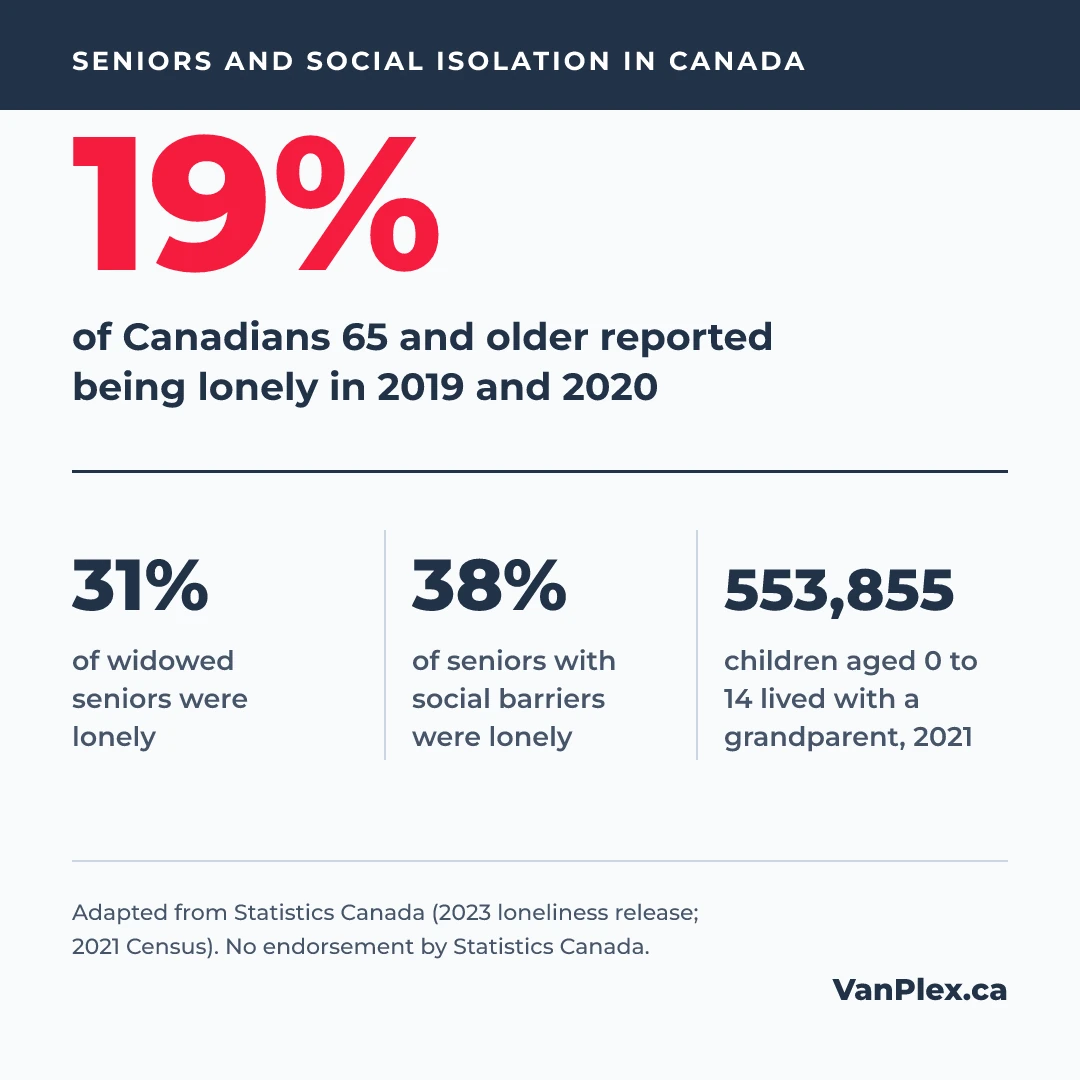
Almost one in five Canadian seniors (19%) aged 65 and older reported experiencing loneliness in 2019 and 2020, according to Statistics Canada. In any given year, 1 in 5 people in Canada will personally experience a mental health problem or illness, according to the Canadian Mental Health Association (CMHA).
My name is Louis Nguyen, and I’m the Director of Sales at Costar Construction, a family construction company in Vancouver. I build homes. When I read why older Canadians end up alone, the first causes on the list are about housing and family. That part is something builders can change.
How many older Canadians are lonely?
Statistics Canada published A look at loneliness among seniors on November 6, 2023. Its numbers show that loneliness depends on who a senior lives with and how easily they can get out.
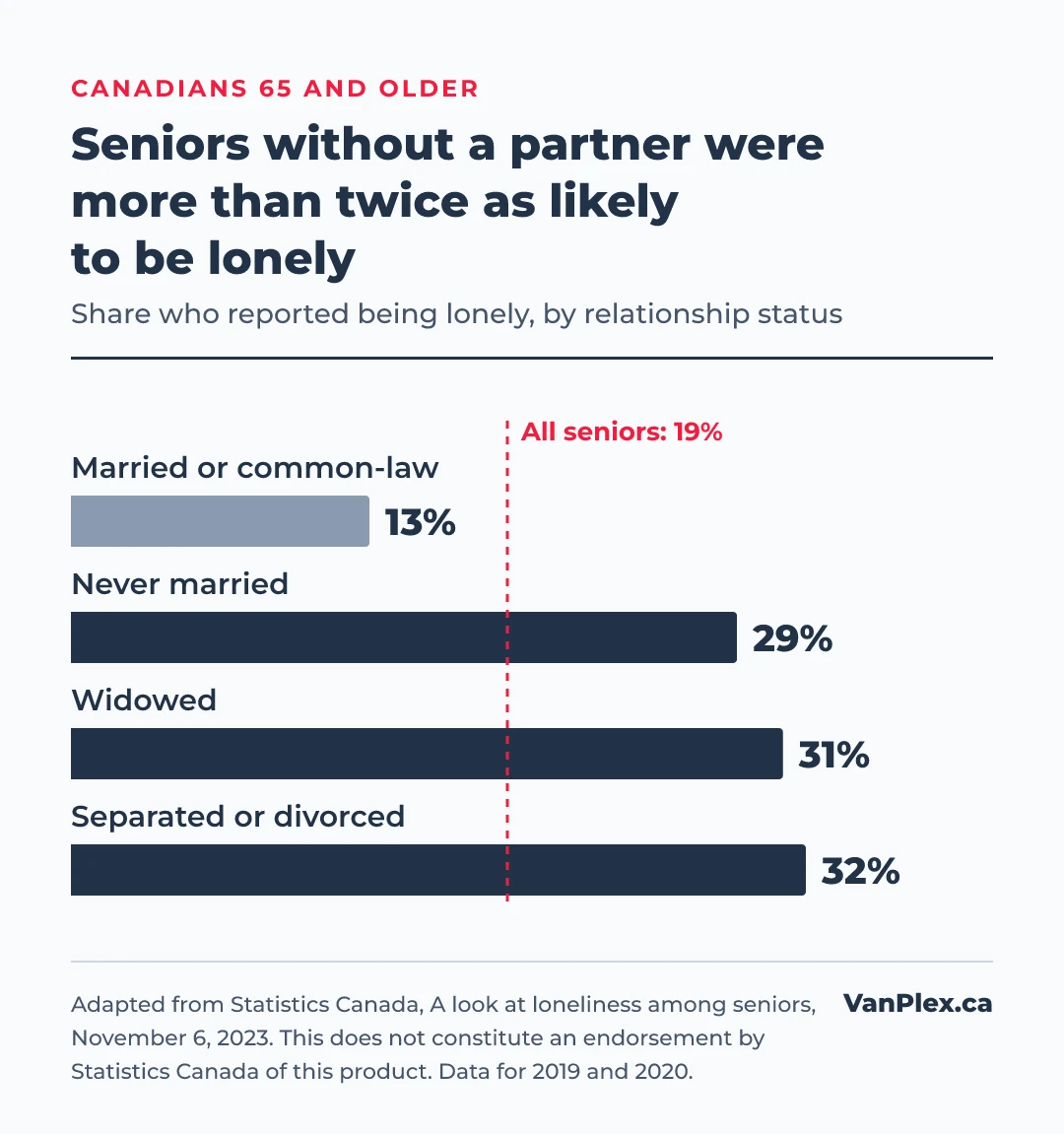
Adapted from Statistics Canada, A look at loneliness among seniors, November 6, 2023. This does not constitute an endorsement by Statistics Canada of this product.
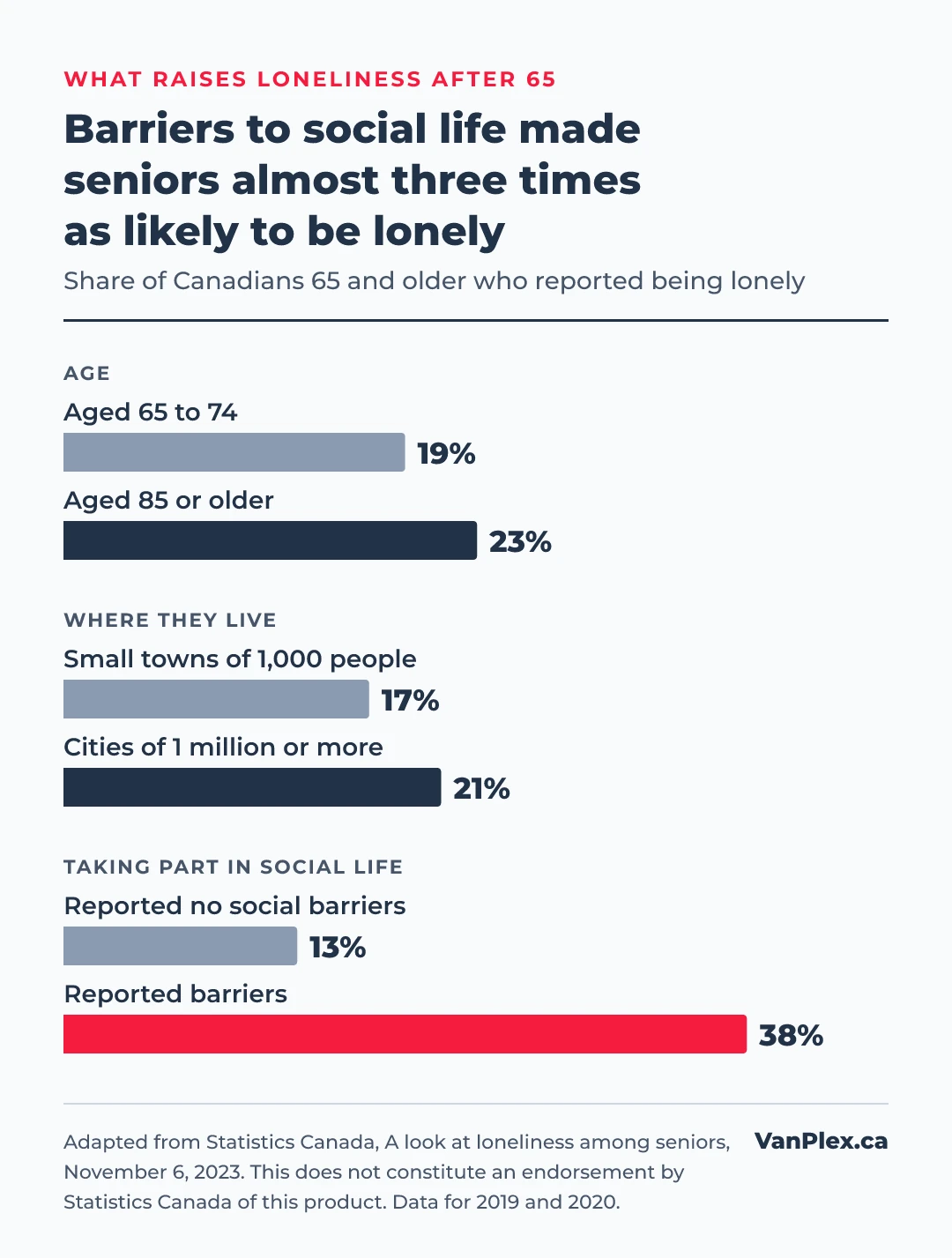
Adapted from Statistics Canada, A look at loneliness among seniors, November 6, 2023. This does not constitute an endorsement by Statistics Canada of this product.
Here are all the figures in one table:
| Group of Canadians 65 and older | Share who reported being lonely (2019 and 2020) |
|---|---|
| All seniors | 19% |
| Aged 65 to 74 | 19% |
| Aged 85 or older | 23% |
| Married or common-law | 13% |
| Never married | 29% |
| Widowed | 31% |
| Separated or divorced | 32% |
| Living in cities of 1 million or more people | 21% |
| Living in small towns of 1,000 people | 17% |
| Reported barriers to social participation | 38% |
| Reported no social barriers | 13% |
Source: Statistics Canada, “A look at loneliness among seniors”, November 6, 2023.
I noticed two lines in that table. Seniors who were widowed, separated, divorced or never married were more than twice as likely to be lonely as seniors living with a partner. And seniors who reported barriers to taking part in social life were almost three times as likely to be lonely as those with no barriers. Both of those depend on who is close by.
A second source points the same way. The BC Association of Community Response Networks (BC CRN) cites the Canadian Coalition for Seniors’ Mental Health (CCSMH) in its October 2023 article, Social Isolation and Loneliness in Seniors: A Growing Challenge: nearly one in five Canadians 65 or older say they lack companionship, and one-third are at risk of social isolation.
Social isolation and loneliness, defined
BC CRN, citing CCSMH, separates the two ideas. Social isolation can be measured, for example by how often a person sees other people. Loneliness is how a person feels, and that is harder to count. A person can be isolated and feel fine, or have people around and still feel lonely.
For anyone who designs homes, the measurable part is the useful one: a building can make it easy for family to see each other every day.
What isolation does to health
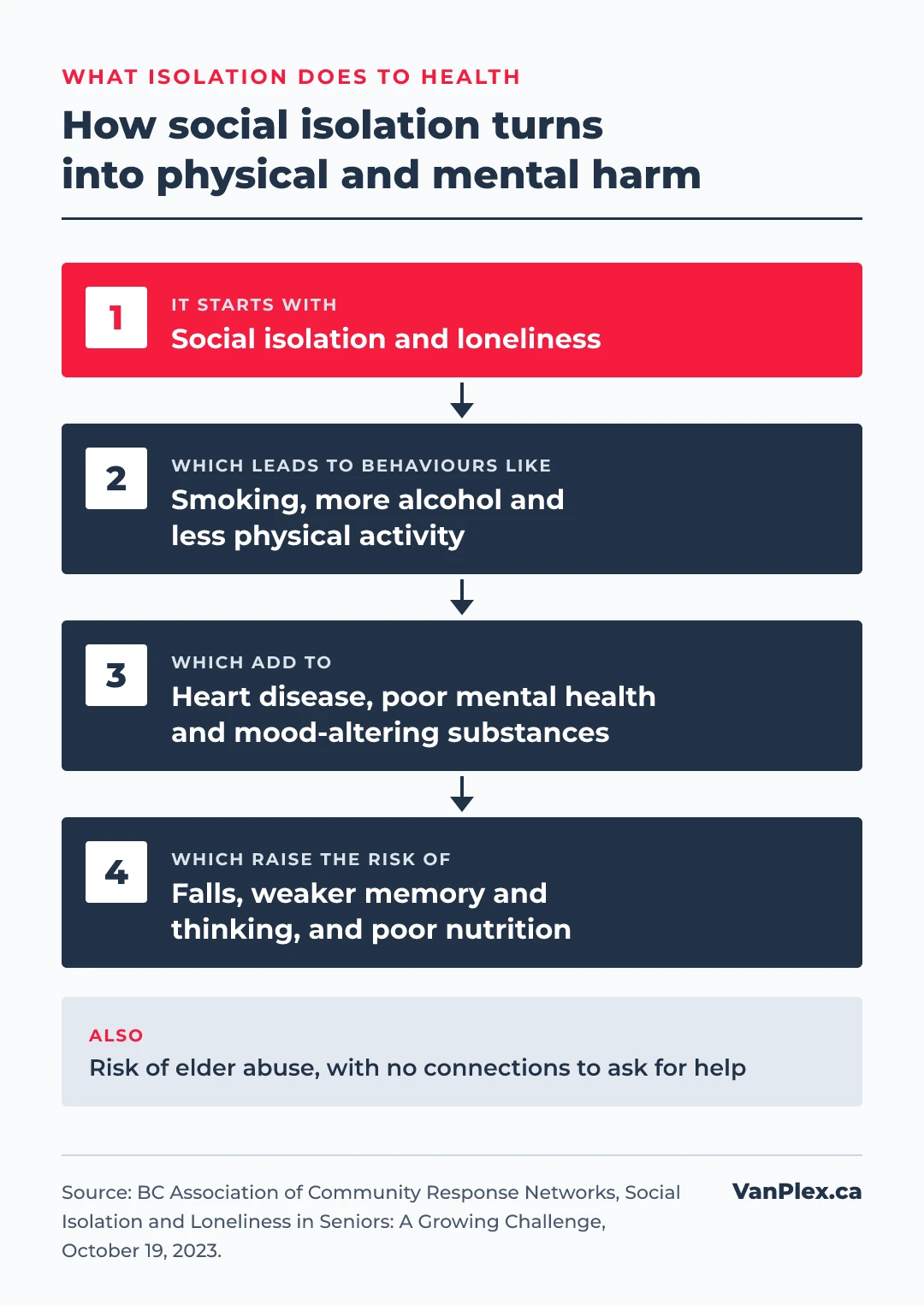
BC CRN writes that social isolation and loneliness “can result in both physical and mental harm.” It lists the chain this way: less physical activity, more smoking and more alcohol use add to heart disease, poor mental health and the use of mood-altering substances. Those in turn raise the risk of falls, weaker memory and thinking, and poor nutrition. BC CRN adds that isolation puts vulnerable people at risk of elder abuse “with no connections to ask for help.”
The CMHA figure at the top of this post covers people of every age in Canada, so it counts a different group from the Statistics Canada and CCSMH figures. BC CRN is the source that links isolation to mental health: it lists poor mental health among the results. For a family company like ours, that link is reason enough to design homes differently.
Why so many older people end up alone
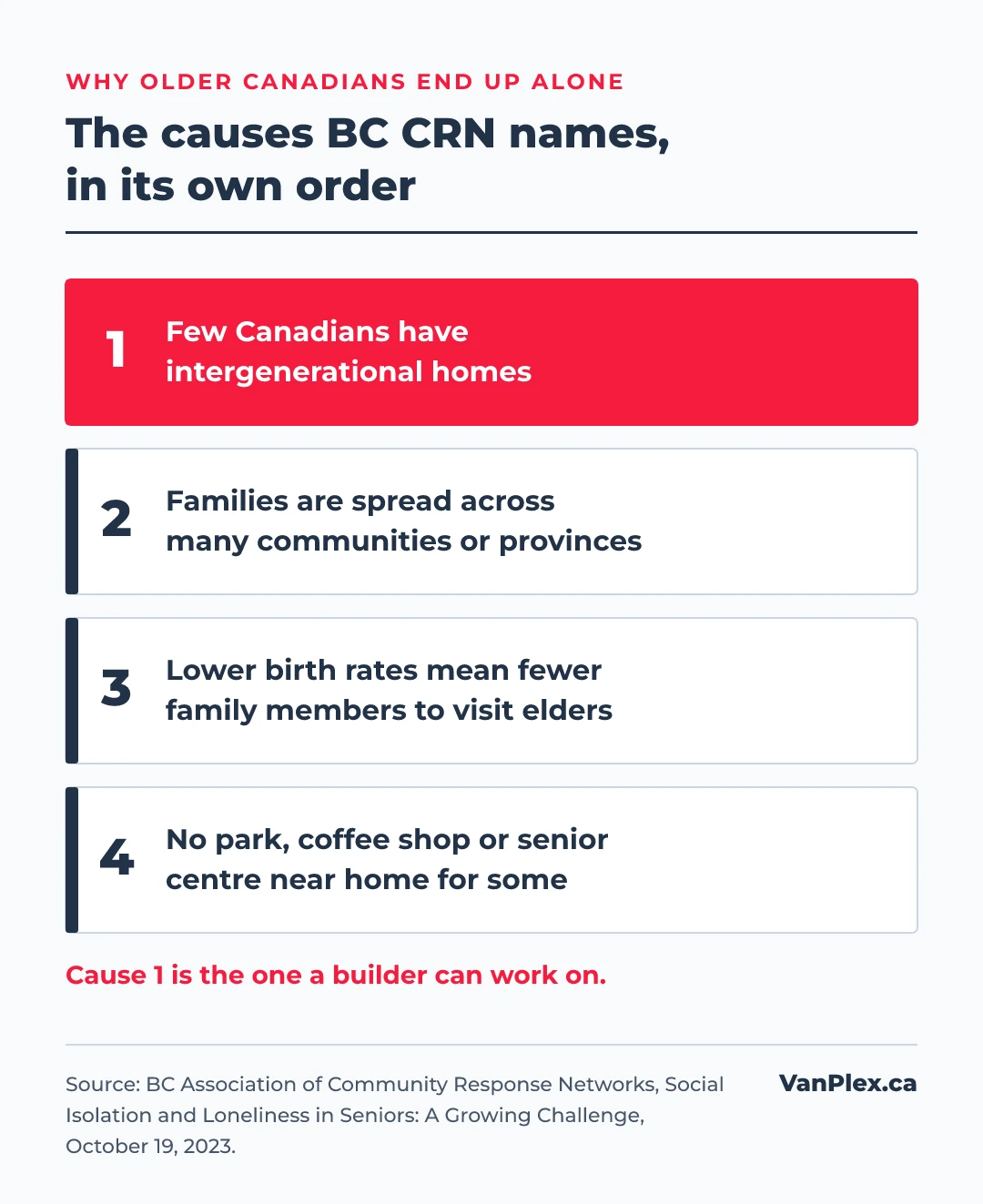
BC CRN names the causes in this order: “Few Canadians have intergenerational homes, families are often dispersed in many communities or provinces, and lower birth rates result in fewer family members to visit elders.”
It also names daily access. Some older people have trouble getting around. Others have no park, coffee shop or senior centre near their home. Poor health, low income and rural living make all of this harder, according to Canada’s National Institute on Ageing, as BC CRN reports it.
Big cities show higher rates. In the Statistics Canada data, seniors in cities of 1 million or more people were more likely to be lonely (21%) than seniors in small towns of 1,000 people (17%). Metro Vancouver is in the first group.
A builder can work on the first cause on that list: homes where three generations want to live side by side.
Many families already live with grandparents
In the 2021 Census, Statistics Canada counted 553,855 children aged 0 to 14 (9% of children in census families) living in the same household as at least one grandparent. Of those children, 93% lived with at least one parent and at least one grandparent under the same roof. Statistics Canada’s own chart breaks that group down:
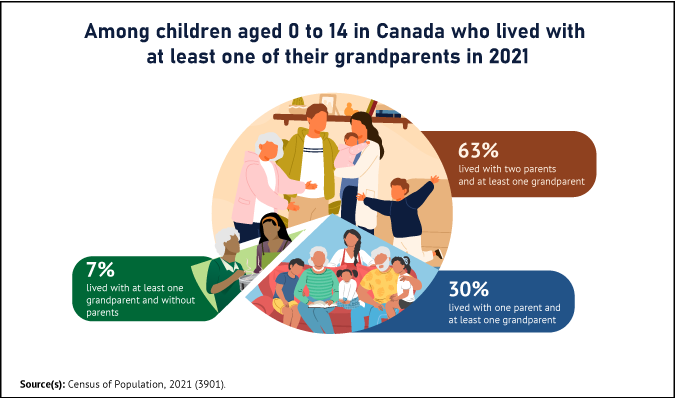
Source: Statistics Canada, Home alone: More persons living solo than ever before, but roomies the fastest growing household type, July 13, 2022. Reproduced and distributed on an “as is” basis with the permission of Statistics Canada.
The same release shows the other side. 4.4 million people in Canada lived alone in 2021, up from 1.7 million in 1981, and one-person households made up 29.3% of all households. Those counts cover adults of every age. The chart below is Statistics Canada’s own.
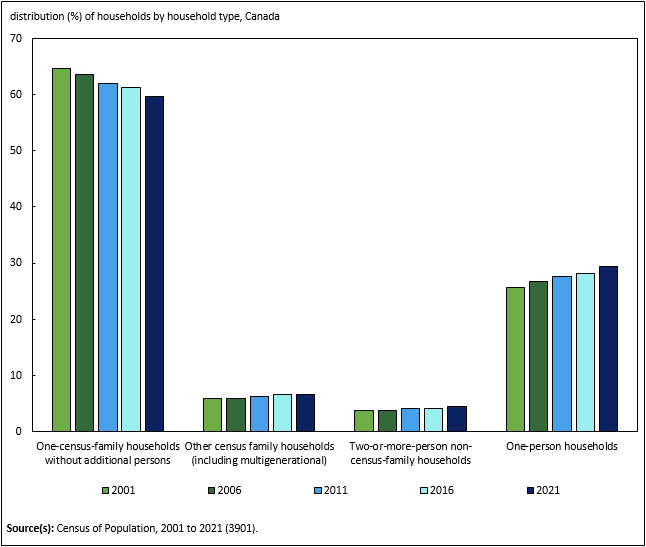
Source: Statistics Canada, Home alone: More persons living solo than ever before, but roomies the fastest growing household type, July 13, 2022. Reproduced and distributed on an “as is” basis with the permission of Statistics Canada.
Our view at Costar is that a home designed for three generations from the first drawing works better for everyone in it than a house changed later to fit them.
What makes three generations under one roof work
These are the design choices we come back to on every project. They come from building homes for families, so take them as one builder’s view.
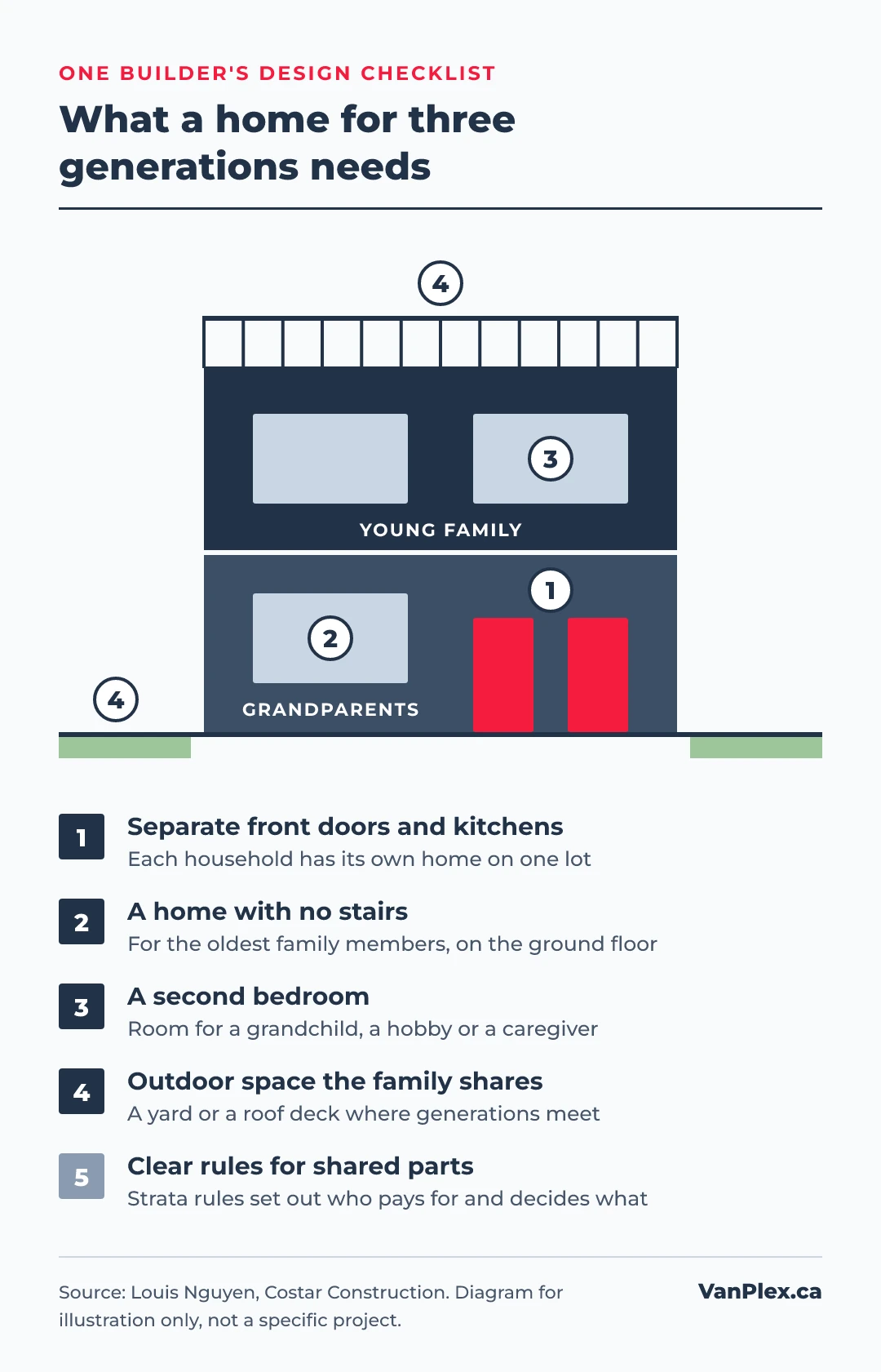
- Separate front doors and separate kitchens. In a multiplex, each household has its own home on the same lot. Grandparents can see the grandchildren every day and still close their own door at night.
- A home with no stairs for the oldest family members. In We Killarney, the six-plex we showed in a video tour with REW, the ground floor home has no stairs, so parents or grandparents can live there while a young family lives above.
- A second bedroom. A grandparent’s home with two bedrooms has space for a grandchild who sleeps over, a hobby, or a caregiver later on.
- Outdoor space the generations share. A yard or a roof deck is where a grandparent watches the kids play without anyone planning a visit.
- Clear rules for the shared parts of the building. When the homes in a multiplex are owned separately under strata, the owners share the rules and costs for the building and the land. As I told REW in its guide for single-family homeowners: “I feel like if stratification and strata management are done right, it would relieve a lot of the headache and a lot of the conflicts between homeowners who are living on the same property together.” That is true for family members too.
Vancouver has built for big families before
When REW interviewed me for its July 2026 profile, Costar Construction: a family building family homes, I said: “Multiplexes are an opportunity very similar to what we had with the old Vancouver Special back in 1965 and 1985, where they were trying to solve multi-generational living needs and a housing crisis at that time. So very similarly right now, we are also experiencing that and we have a shortage in multi-generational family options.”
BC’s small-scale housing rules now allow several homes on lots that used to hold one house. Those homes can be designed for any buyer, or they can be designed from the first sketch for a family that wants to stay close. We’re choosing the second.
How we’re putting this into our next projects
We’re working on two design themes for upcoming Costar multiplex projects.
The Sunset Project has generous two-bedroom layouts, designed for co-living across generations: grandparents, parents and kids on one lot.
Condo 2.0 gives a household generous living space on a single floor, the way a condo does, so daily life doesn’t depend on stairs. It adds a front yard, a back yard and a roof deck, and the design has two levels. We see it as a fit for grandparents and for young families.
Our core values are the same as when we started. We will keep going until intergenerational family living is something families want again, and until fewer older people in our city spend their days without company.
If your family is thinking about living together
- Talk as a family first. Decide who would live in which home, and who needs a home without stairs.
- Find out what your lot allows. Look up your address on VanPlex and read the multigenerational living guide. The design guide covers layouts for older family members.
- Ask the city early. My advice to REW is the same today: “I think the first step that you can take is email the city and just ask about what we can do on this property.”
- Walk through a building under construction. A builder who invites you onto a site partway through is showing you how they work.
- Compare the options. VanPlex has a side-by-side look at a laneway house, a suite and a multiplex for family living.
If your family is planning to live together, I would like to hear from you at costarconstruction.com.
Louis Nguyen | Director of Sales, Costar Construction. Costar Construction is a family construction company in Vancouver. Its multiplex It Takes Two won Best Multiplex Home at the CHBA BC 2024 Georgie Awards, and the company is a member of the Homebuilders Association Vancouver. Figures in this article come from Statistics Canada, the Canadian Mental Health Association and BC CRN, as read on October 2, 2026.