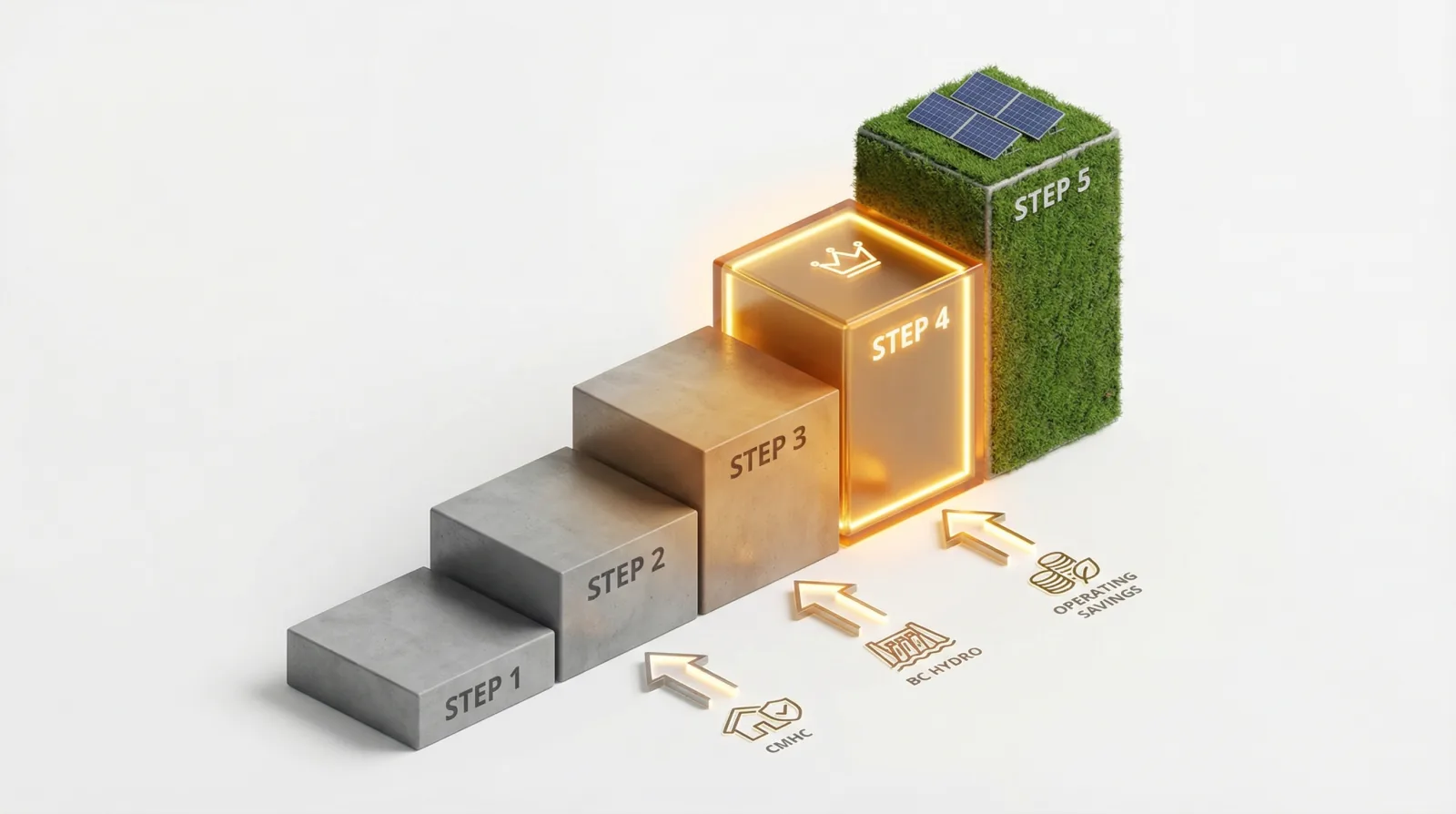

BC’s Energy Step Code has five tiers. Step 1 is paperwork. Step 5 is near-Passive House performance. Most multiplex developers default to Step 3 because it is the minimum requirement. That is a mistake. Step 4 is where the incentives, rebates, and operating savings converge to create the best risk-adjusted return.
The Step Code Ladder: A Quick Summary
BC’s Energy Step Code establishes progressive tiers of building energy performance. Each step tightens two metrics: thermal energy demand intensity (TEDI, how much heating energy the building needs) and mechanical energy use intensity (MEUI, total mechanical energy including heating, cooling, and hot water).
Step 1-2: Energy modeling required, minimal performance improvement. Essentially baseline code compliance with documentation.
Step 3: The current minimum requirement for new Part 3 buildings in most BC municipalities. Requires improved insulation, better windows, and reasonable airtightness. Achievable with standard construction practices and modest upgrades.
Step 4: Significant performance improvement. Requires heat pumps, enhanced envelope, and airtightness below 2.0 ACH@50Pa. This is where the building starts performing meaningfully better than code minimum.
Step 5: Near-zero emission performance. Requires triple-pane windows, R-24+ walls, airtightness below 1.5 ACH@50Pa, and all-electric mechanical systems. Approaches Passive House performance levels.
Why Step 3 Leaves Money on the Table
Step 3 is the path of least resistance. Your architect and builder know how to hit it. The cost premium over non-Step-Code construction is modest, roughly 3-5%. But Step 3 buildings do not qualify for the most valuable green building incentives.
CMHC MLI Select green discount: CMHC offers reduced mortgage insurance premiums for buildings that achieve meaningful energy efficiency improvements. The green building pathway requires performance exceeding Step 3 by a significant margin. Step 4 is the practical entry point. The discount translates to 25-50 basis points off your insurance premium, saving $15,000-$40,000 over the life of a CMHC-insured mortgage.
BC Hydro New Construction Program: Rebates scale with performance. Step 3 buildings receive baseline incentives. Step 4 buildings qualify for enhanced rebates of $10,000-$20,000 per project, depending on unit count and specific measures installed.
CleanBC incentives: Additional provincial rebates for heat pump installation and building envelope improvements are accessible at Step 4 levels, often stacking with BC Hydro rebates.
At Step 3, you are paying the compliance cost without capturing the financial upside. It is the worst position on the cost-benefit curve.
Why Step 5 Is Overkill for Most Projects
Step 5 delivers excellent energy performance. Buildings at this level use 60-70% less energy than code minimum. But the incremental cost from Step 4 to Step 5 is steep, and the incremental financial benefit is modest.
Cost premium: Step 5 adds 15-25% to base construction costs, compared to 10-18% for Step 4. On a $3M base build, that is $450,000-$750,000 for Step 5 versus $300,000-$540,000 for Step 4. The additional $150,000-$210,000 buys better windows, more insulation, and tighter air sealing.
Diminishing energy returns: Moving from Step 3 to Step 4 reduces energy consumption by 30-40%. Moving from Step 4 to Step 5 reduces it by an additional 15-20%. The first jump is larger and cheaper. The second jump is smaller and more expensive.
Construction complexity: Step 5 requires specialized trades, continuous exterior insulation, and meticulous air sealing details. Not every builder can reliably deliver it. Step 4 is achievable by competent mid-market builders without specialized Passive House experience.
The exception is Vancouver, where Step 5 qualifies for the 19% FSR exclusion. If you are building in Vancouver specifically, the extra floor area makes Step 5 pencil. Everywhere else in BC, Step 4 is the rational choice.
Step 4 Economics: Real Numbers on a 6-Unit Multiplex
Let us run the numbers on a concrete example. Consider a 6-unit multiplex in a Metro Vancouver suburb, 4,800 sq ft of floor area, wood-frame construction.
Base construction cost (Step 3 minimum): $3,000,000
Step 4 premium: 10-18%, or $300,000-$540,000 additional
What the premium buys:
- Air-source heat pumps for space heating/cooling: $48,000-$90,000
- Heat pump hot water heaters: $18,000-$30,000
- Enhanced insulation (R-22 walls, R-40 roof): $36,000-$60,000
- High-performance windows (U-1.4 or better): $24,000-$48,000
- Improved air sealing and HRV systems: $30,000-$54,000
- Energy modeling and commissioning: $12,000-$18,000
Financial recovery:
| Incentive Source | Value |
|---|---|
| CMHC MLI Select green discount (25-yr mortgage) | $25,000-$40,000 |
| BC Hydro New Construction rebates | $10,000-$20,000 |
| CleanBC heat pump rebates ($3-6K x 6 units) | $18,000-$36,000 |
| Municipal green building incentives (where available) | $5,000-$18,000 |
| Total incentives | $58,000-$114,000 |
Operating savings over 20 years:
Step 4 buildings consume 30-40% less energy than Step 3 buildings. On a 6-unit multiplex, that translates to roughly $6,000-$8,000 per year in reduced utility costs. Over 20 years, accounting for energy price inflation at 3% annually, cumulative savings reach $120,000-$160,000.
The full picture:
- Step 4 premium: $300,000-$540,000
- Incentive recovery: $58,000-$114,000
- 20-year operating savings: $120,000-$160,000
- Net cost after recovery: $26,000-$266,000
The worst case is a $266,000 net premium. The best case is a $26,000 net premium on a $3M+ building. And that net premium buys you a more durable, more comfortable building that commands higher rents and attracts better tenants.
The Rental Premium Factor
Buildings with demonstrably lower operating costs command rental premiums. Tenants increasingly factor utility costs into their housing decisions, particularly for electric heating where the tenant pays the bill.
Market data from Metro Vancouver suggests energy-efficient units command 3-7% rental premiums over comparable standard-efficiency units. On a $2,800/month two-bedroom, that is $84-$196/month, or $1,008-$2,352 per year per unit. Across six units over 20 years, the cumulative rental premium reaches $120,000-$282,000.
This rental premium alone can close the gap on the Step 4 construction premium.
Making the Decision
The Step Code decision should be made during feasibility, not during construction documents. The choice affects your architect’s design, your mechanical engineer’s specifications, and your construction budget.
For a detailed breakdown of Step Code requirements by tier, see our Step Code guide. For a full cost-benefit analysis including financing scenarios, visit our cost-benefit calculator.
Step 4 is not the cheapest option. It is not the greenest option. It is the option where the math works best for the largest number of multiplex projects across BC. That is why the smartest developers are targeting it.