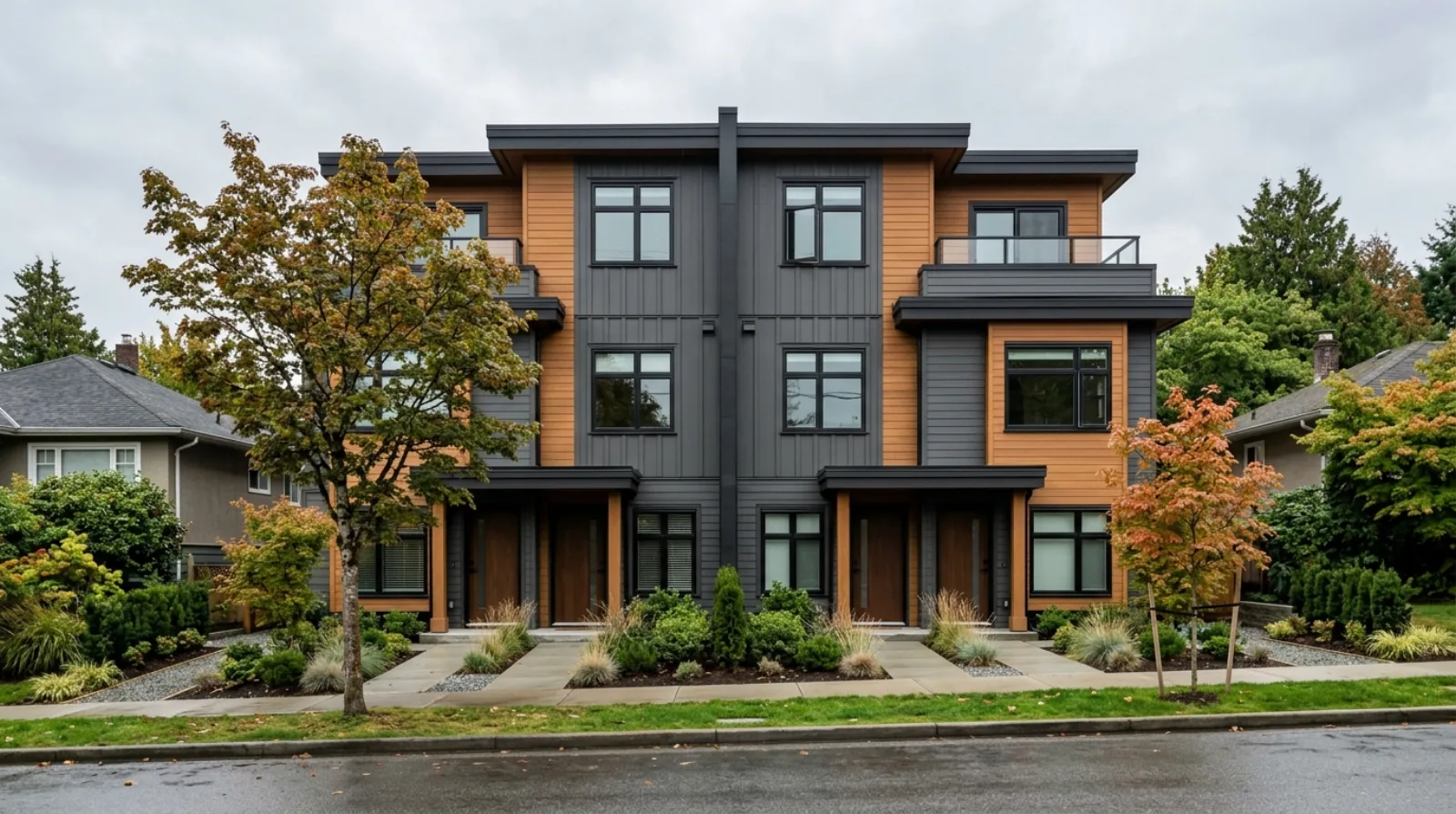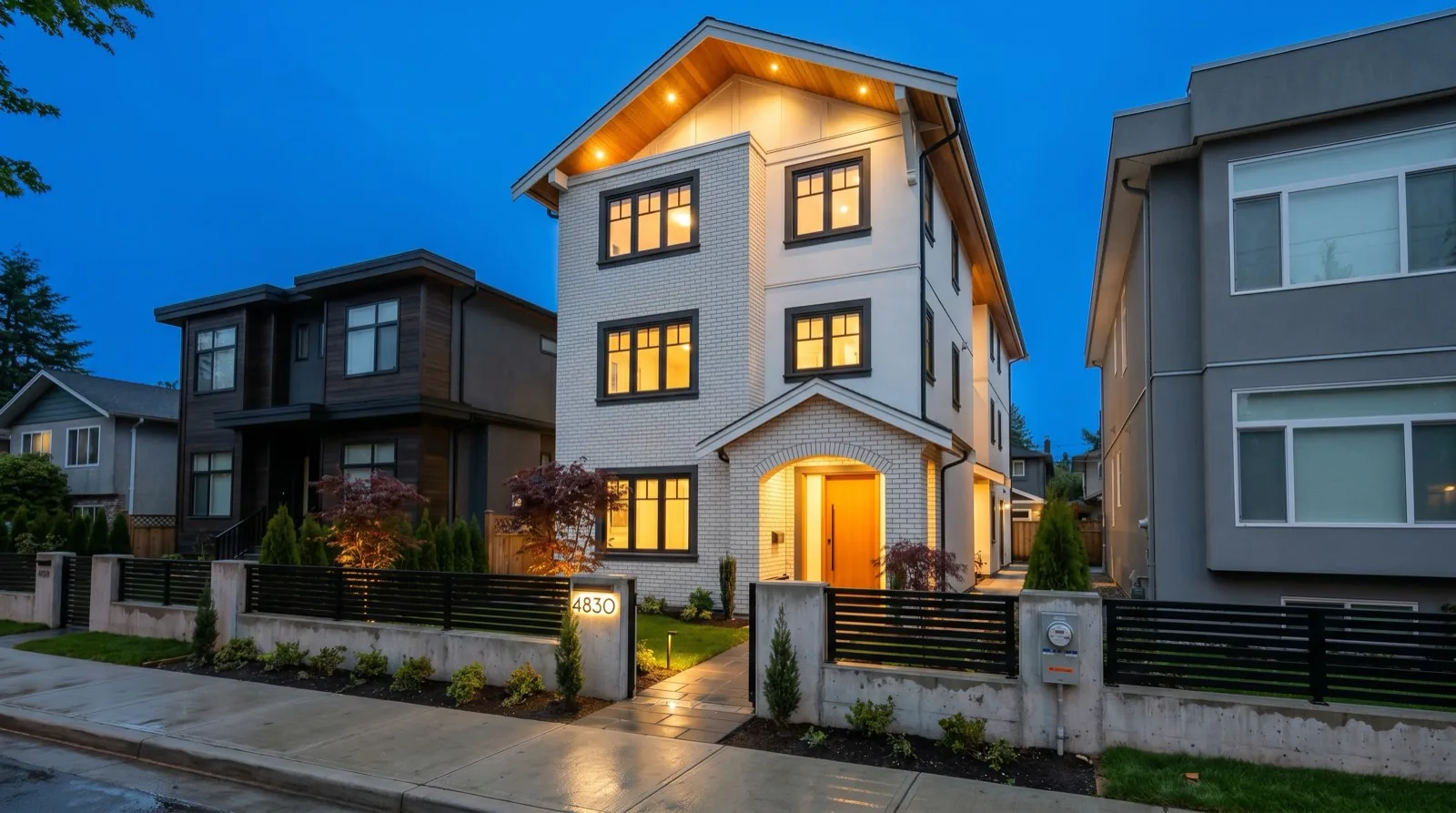

To sell one half of a duplex you own on a single title, you first turn the duplex into two strata lots, each with its own title. Because you live in the building, it counts as “previously occupied” under the BC Strata Property Regulation (s.14.1), so your city or regional district must approve the strata plan under section 242 of the Strata Property Act before the Land Title Office will accept it. The city must refuse unless the building “substantially complies” with its bylaws and the building regulations.
This post walks through the approval, the 2026 city fees we confirmed, the documents, the taxes to check, and what you own together once the half is sold. Our strata conversion guide covers conversions of larger buildings too.
Why living there changes the route
The Regulation defines “previously occupied” as “occupied at any time in its past for any purpose”, with one exception: a developer using a unit only as a display suite for sales (s.14.1). Your own household living in one half meets that definition.
A building that was never occupied takes a shorter route. A BC land surveyor certifies on Form S that it has not been occupied (s.241), and the Act names no city sign-off. Once anyone has lived there, section 242 applies instead:
- The “approving authority” (council, or the regional board outside a municipality) may approve, approve with terms and conditions, or refuse. Its decision is final and cannot be appealed (s.242(3), (4)).
- It must not approve unless the building “substantially complies” with local bylaws and the building regulations (s.242(5)).
- It must consider the priority of rental housing in the area, plans to relocate occupants, the building’s life expectancy, and projected major maintenance cost increases (s.242(6)).
- Council may hand the decision for a type of building to an approving officer (s.242(10)), and many cities do this for small buildings.
- Its endorsement on the plan (Form T) must be dated no more than 180 days before the plan is filed (s.242(9)).
The city step, by city
| City | Who decides a duplex | 2026 fee we confirmed | Rules to know |
|---|---|---|---|
| Vancouver | Approving Officer (fewer than 6 units) | $7,640 proposed from January 1, 2026 ($7,310 in 2025), plus inspections ($850.50 in 2025) | Number of strata lots must equal the number of principal units; building report of “reasonable quality for its age”; “a minimum of eight to ten weeks” |
| Burnaby | Council | $2,000 for up to 4 units, plus $265 inspection | Must fully comply with the current Zoning Bylaw and BC Building Code; the 2022 duplex example added a covenant that each unit is a single-family home |
| Surrey | Council issues a Certificate of Approval | $1,113 | 2014 duplex example: engineer certified the building and the fire separation wall was upgraded to the current Code |
| Richmond | Not confirmed | $2,689 for a two-family dwelling | Proof the building is used as a two-family dwelling only |
| Coquitlam | Approving Officer and Council, after committee review | $4,856.70 for two units or less (standard zones) | Covenant against further subdivision; no street servicing upgrade for a duplex conversion |
| City of North Vancouver | Director of Planning for fewer than 3 units (the policy also refers to Council) | $520.70 application, $520.70 legal, $208.28 duplex inspection | Substantial compliance with the Building Code and zoning; on-site inspections |
| Victoria | Approving Officer (3 or fewer units, vacant or owner-occupied, good condition) | $150 review (under 3 units) + $50 final | Common and bearing walls must meet current Code fire separation and sound ratings; “up to three months” |
| Saanich | Not confirmed | $500 | Engineer and architect report on compliance with BCBC 2024; approval lapses after 18 months |
Sources: each city’s guideline, policy or fees bylaw, listed with dates on our city pages. Vancouver’s figures come from its April 2025 guideline and an October 2025 council report proposing the 2026 fee. Our Vancouver strata rules page has the full Vancouver detail.
The table shows the city’s part only. Upgrades the inspection asks for, such as a fire separation wall between the halves, are on top. Surveyor and lawyer fees have no published figure; each is quoted per job. Our cost to stratify guide lists every item.
The documents that go to the Land Title Office
- The strata plan, drawn by a BC land surveyor, showing the land, the building, each lot’s boundaries and area in square metres (s.244).
- The city’s endorsement on Form T, dated within 180 days.
- Signatures of the owner and of every holder of a registered charge, such as your mortgage lender (s.244(1)(g)). Talk to your lender early: the lender has to agree to the plan.
- A Schedule of Unit Entitlement (Form V). For two homes, either each lot’s habitable area in square metres, set by a BC land surveyor, or the same whole number for both lots (s.246(3)). This number sets each half’s share of strata fees and costs from then on.
- Form X with the strata corporation’s mailing address, and Form Y only if you want bylaws different from the Standard Bylaws (s.245).
The Land Title and Survey Authority (LTSA) fee to deposit a plan is $105.30, plus $3.55 per electronic transaction (fee listing of April 1, 2026). We could not confirm whether a separate title fee applies for each new strata lot.
Taxes to check before you list
BC home flipping tax. In force since January 1, 2025. It is 20% of net taxable income on residential property sold within 365 days of buying it, falling to nil at 730 days. The Province’s page lists “Subdividing property” among transactions that generally are not taxable. It does not say whether a new strata lot starts a new 730-day count. If you bought the duplex less than 730 days before your sale, ask the Province before you sell.
Property transfer tax. Your buyer pays it. The Province’s newly built home exemption is full at a fair market value of $1,100,000 or less and partial up to $1,150,000, for a buyer who moves in as a principal residence within 92 days and stays the first year. It applies to newly built homes only, so ask your lawyer whether your half qualifies before you advertise it to buyers as exempt.
Home warranty. If the duplex is new, the Homeowner Protection Act says a new home may not be sold within 10 years of the first occupancy permit unless it has home warranty insurance or is exempt (s.22). A building that used BC Housing’s rental exemption carries a covenant barring the sale of any unit for 10 years from first occupancy. Check both before you plan a sale.
Selling the half
A two-lot strata is outside the Real Estate Development Marketing Act’s disclosure rules, which start at 5 strata lots. Your buyer gets the 3-business-day Home Buyer Rescission Period instead, and pays 0.25% of the price if they cancel within it.
You also become the “owner developer” under the Act, the person who files the plan and sells the first lots. That brings duties of its own (Part 3 of the Act):
- An interim budget covering the 12 months after the first sale, given to your buyer before they sign (s.13, s.14).
- A reserve fund deposit at the first sale of at least 10% of the interim budget’s operating expenses, if the sale is within a year of filing the plan (s.12; Regulation s.3.01).
- All strata expenses paid by you up to the end of the month in which the first lot is sold (s.7).
- Strata insurance on the whole building at full replacement value, with $2,000,000 of liability cover, running until at least 4 weeks after the first annual general meeting (s.149, s.15).
- A first annual general meeting within the 6 weeks that start on the earlier of 50% plus one of the lots being sold or 9 months after the first sale (s.16). If you keep your half, only one of two lots is sold, so the 9-month date applies.
The buyer will also ask for a Form B Information Certificate, with the budget, the reserve fund balance and the insurance summary, so set up a bank account in the name “The Owners, Strata Plan [number]” before you list.
Living next to your buyer
After the sale you and your buyer are the strata council, both of you (Standard Bylaw 9(2)). A 3/4 vote needs both of you, and there is no tie-breaking vote at council or at general meetings (Standard Bylaws 18(2), 27(6)). Before you sell, write down who repairs what and how costs split. Our duplex strata guide covers the rules for two owners, and our strata conversion guide covers the city process in more cities.
We are building the StraPlex app for owners of 2 to 6 unit stratas, with the steps from city application to filed plan in order, and the budget, insurance and records ready for your first buyer. The waitlist is below.
David Babakaiff, Co-Founder, VanPlex | PlexRank™ | Profit with Multiplex