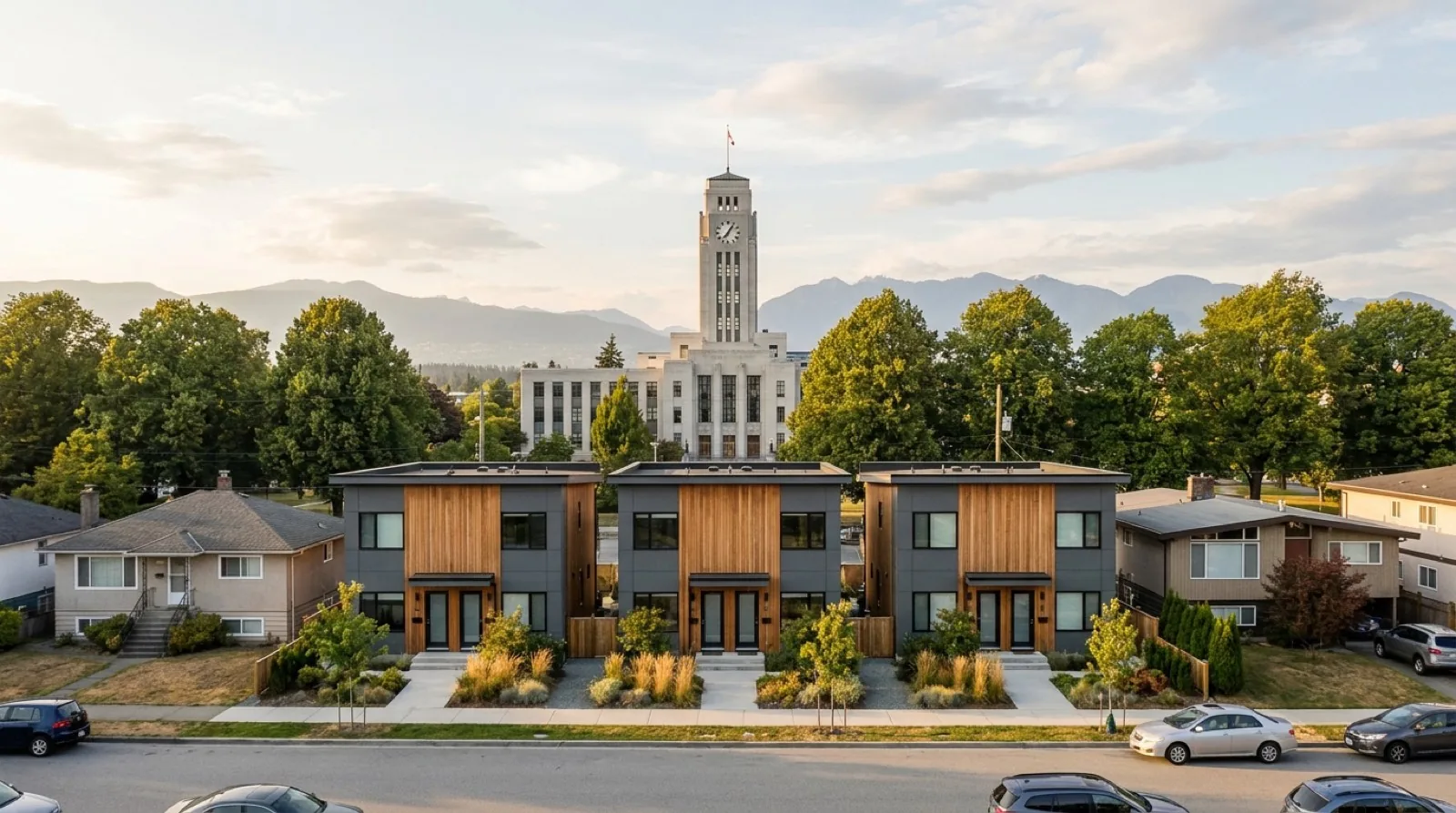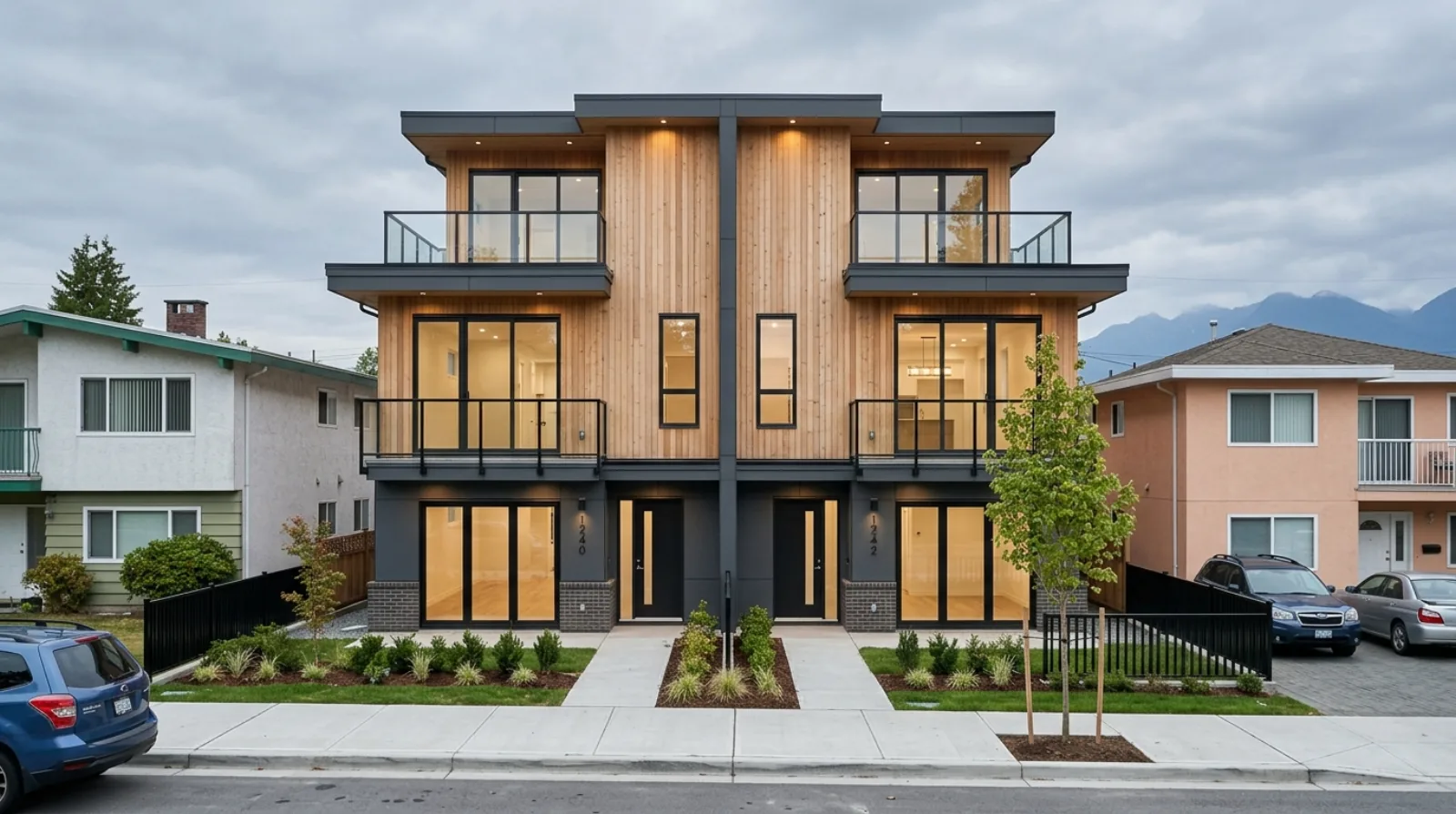

Vancouver wants to stop taxing empty new multiplexes. On June 9, 2026, council will vote on whether to extend the Empty Homes Tax “vacant new inventory” exemption down to projects of just two units, instead of the five-unit floor that’s quietly been hitting small multiplex and duplex builders since 2023. For anyone holding a finished-but-unsold fourplex, this is the difference between owing the city 3% of assessed value and owing nothing.
TL;DR
- Vancouver council votes June 9, 2026 on extending the Empty Homes Tax (EHT) “vacant new inventory” exemption from developments of 5 or more units down to 2 or more units.
- The EHT is 3% of a property’s assessed value per year. New multiplexes and duplexes that sat unsold were getting taxed because they fell under the five-unit cutoff.
- City staff found about 10 cases in 2023–2024 where small-project owners were denied the exemption and taxed.
- Unsold new-inventory declarations jumped from 261 in 2024 to 597 in 2025, roughly a 130% increase, as higher rates slowed sales.
- The catch: the province’s Speculation and Vacancy Tax still uses the five-unit rule. Even if the city fixes its side, you could still owe the provincial tax until Victoria matches.
What’s actually on the table June 9
Right now, to skip the EHT on a newly built home that hasn’t sold yet, the home has to be part of a development of five or more units. That carve-out is called the vacant new inventory exemption, and council approved it in May 2023 to avoid taxing brand-new supply that just hadn’t been absorbed by the market yet.
The problem: a fourplex is four units. A duplex is two. None of them clear the five-unit bar. So the exemption that was meant to protect new housing supply skipped over exactly the “missing middle” buildings the city spent 2023 trying to encourage.
The June 9 amendment drops the threshold to two or more units. If it passes, a finished but unsold duplex, triplex, or fourplex would no longer get hit with the Empty Homes Tax while it waits for a buyer. Here’s the before-and-after.
| Current rule | Proposed (June 9) | |
|---|---|---|
| Units needed to qualify | 5 or more | 2 or more |
| Duplex covered? | No | Yes |
| Fourplex covered? | No | Yes |
| Tax if vacant and not exempt | 3% of assessed value/year | Exempt |
Source: City of Vancouver staff report, reported by Mike Howell / Lodestar Media for Castanet (June 5, 2026).
Why the five-unit floor was a real problem
A 3% annual tax on assessed value is not a rounding error. On a finished multiplex unit assessed at, say, the price of a typical new Vancouver home, 3% a year stacks up fast while you’re already carrying construction financing and waiting for the market to move.
City staff put it plainly in their report: without the change, small multi-unit projects “face a disproportionate risk of vacancy tax during slower absorption periods, which increases financial risk of such projects and may discourage development of duplex and multiplex housing, undermining recent municipal and provincial policy changes intended to expand ‘missing middle’ supply.”
That’s the city admitting its own tax was working against its own zoning. In October 2023, council introduced multiplex as an as-of-right option in low-density areas. A month later, the province’s Small-Scale Multi-Unit Housing (SSMUH) legislation, Bill 44, opened up density across B.C. Then the Empty Homes Tax quietly taxed the people who actually built the result.
The numbers tell the absorption story
This change isn’t happening in a vacuum. Unsold new inventory in Vancouver has been climbing as higher interest rates slowed buyers down.
- Vacant new inventory declarations rose from 261 in 2024 to 597 in 2025, about a 130% jump.
- Staff identified roughly 10 cases in 2023–2024 where small-project owners were denied the exemption and taxed.
- The fiscal hit to the city is small: about 12 cases would no longer owe the tax, totalling roughly $0.7 million out of about $194.5 million in EHT levied over those periods.
So the city gives up a fraction of a percent of EHT revenue, and small builders stop eating a tax that made marginal projects look worse. For a program that has collected $169.8 million net since 2017 (all of it earmarked for affordable housing), $0.7 million is noise. For a builder holding one unsold fourplex, it’s the whole margin.
The catch nobody’s talking about: the province hasn’t moved
Here’s the part that matters most if you’re underwriting a project right now. Vancouver’s Empty Homes Tax is only one of two vacancy taxes. The province runs a separate one, the Speculation and Vacancy Tax, and its new-inventory exemption still uses the five-unit threshold.
So even if council passes this June 9, a vacant new duplex or fourplex could still be exposed to the provincial tax. The staff report says as much: owners “could continue to be subject to the provincial policy.”
That’s why council is also asking Mayor Ken Sim to write the province and request a matching update to the Speculation and Vacancy Tax Act. Until Victoria agrees, you’ve got a half-fix: city relief, provincial risk. If you’re modelling holding costs on a small build, assume the provincial tax can still apply and confirm your specific situation. We broke down how the provincial tax treats new multiplex inventory in our BC Speculation Tax and build-to-rent guide.
What this means if you’re building or holding a multiplex
If you have a finished multiplex or duplex sitting unsold in Vancouver, watch the June 9 result. If it passes, the city’s EHT should come off the table for two-plus-unit projects, but file your declaration correctly and keep the province’s tax on your radar.
If you’re underwriting a new project, the holding-cost picture just got a little less ugly on the city side. The vacancy-tax risk during a slow sales period was a real line item that made tight deals tighter. Removing it on the municipal side improves the downside case.
And if you’re deciding whether the missing middle still pencils, this is one more sign the policy stack is being tuned in builders’ favour: zoning in 2023, single-stair reform, fee changes, and now the vacancy-tax fix. None of it makes a bad lot good. But it keeps chipping away at the friction on the good ones. Run your address through our feasibility tools before you assume anything; the tax treatment is only one input.
Not everyone’s buying it
The public reaction was mostly cold. When the story hit r/vancouvercanada, the top comments were blunt, and a lot of them were just “No.” A few arguments kept coming up, and they’re worth taking seriously even if you build for a living.
The renter-protection argument: the Empty Homes Tax is one of the few real levers the city has, and prices are still nowhere near what people who work in Vancouver can pay. Weaken the tax and you weaken one of the only tools pushing empty supply into use.
The “just lower the price” argument: if your new fourplex has sat unsold for months, that’s a price problem, not a tax problem. The tax is supposed to make holding empty inventory uncomfortable. Exempt it and you remove the pressure to cut the price.
A few people went the other way entirely and argued the city should raise the Empty Homes Tax and add an empty-commercial-lease version, not hand out more exemptions. And a recurring suspicion: that small-project owners are getting special treatment the average renter never will.
The fairness argument is the one that actually matches what’s on the table. As one commenter pointed out, the tax already exempts unsold units in developments of five or more. This change just extends the same treatment to smaller projects. If the big multi-unit builders are exempt, it’s hard to justify taxing the fourplex next door.
Our read: the renter-protection instinct is reasonable, but it’s aimed at the wrong target here. This isn’t a break for speculators sitting on empty condos, who still pay. It’s a narrow fix for brand-new missing-middle inventory during a slow market, worth about $0.7 million, that lines small builders up with the big ones. The “lower your price” crowd has a point too, but a 3% annual tax stacked on construction debt doesn’t make a fourplex cheaper. It makes the marginal ones not get built at all. Fewer fourplexes isn’t the outcome the renters in that thread actually want.
Frequently asked questions
What is Vancouver’s Empty Homes Tax? It’s a municipal tax of 3% of a property’s assessed value, charged each year on homes left empty or under-used. Vancouver introduced it in 2017 to push vacant properties back into use as long-term housing. Net revenue, which can only fund affordable housing, reached $169.8 million as of November 2024.
Does the June 9 change mean my multiplex is automatically exempt? No. If council approves it, developments of two or more units would qualify for the vacant new inventory exemption, but you still have to file the correct declaration each year. And the separate provincial Speculation and Vacancy Tax may still apply until the province updates its own rule.
Why were small multiplexes taxed in the first place? The exemption that protects new, unsold housing only applied to developments of five or more units. Duplexes, triplexes, and fourplexes fell below that line, so they were denied the exemption and taxed even though they were brand-new supply waiting to sell.
How much revenue does the city lose by fixing this? Very little. Staff estimate about 12 cases and roughly $0.7 million out of about $194.5 million in EHT levied over the relevant periods.
The bottom line
Vancouver spent 2023 making it legal to build multiplexes, then taxed the builders who did it and couldn’t sell fast enough in a high-rate market. June 9 is the city cleaning up after itself. It’s a small dollar figure for the city and a real one for small builders, but the job is only half done until the province matches it.
Watch the vote, file your declarations carefully, and don’t assume the provincial tax disappeared. If you’re weighing a multiplex and want to see how holding costs and absorption risk hit your specific lot, check your property with VanPlex before you commit.
Source: Mike Howell, “Vancouver council looks to exempt small-scale multiplex, duplex projects from empty homes tax”, Castanet / Lodestar Media, June 5, 2026.
— David Babakaiff, VanPlex | PlexRank™ — Profit with Multiplex