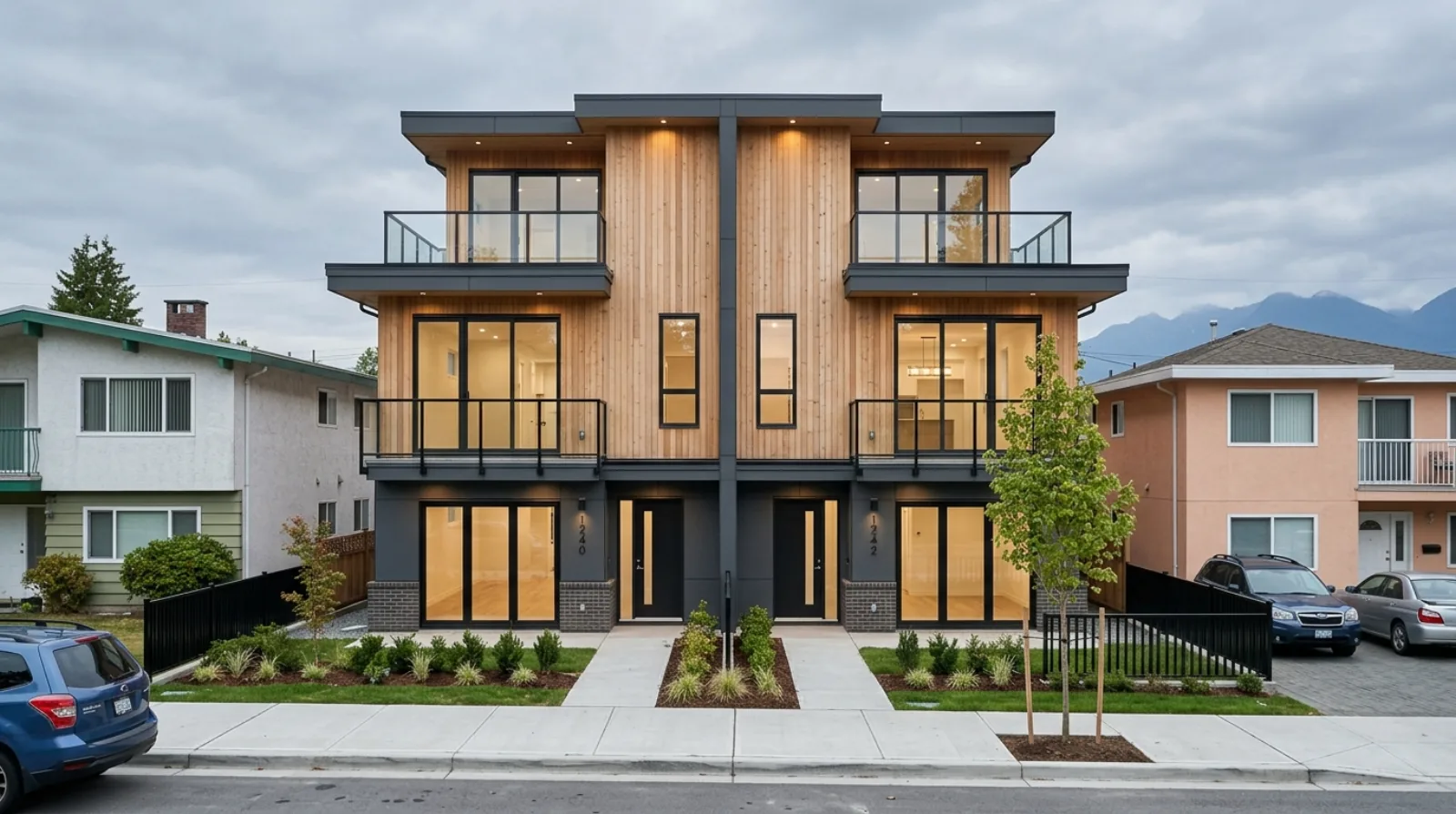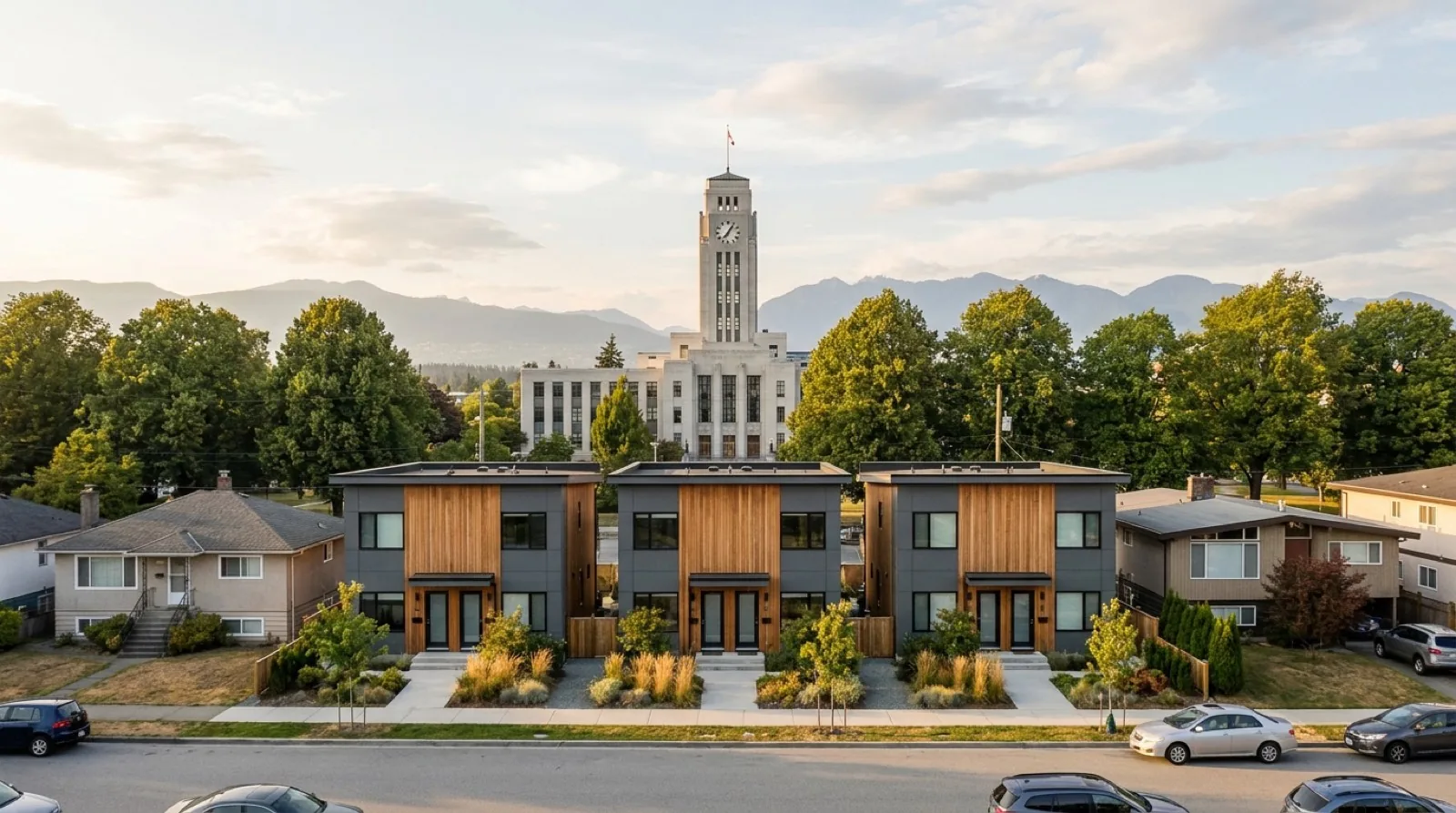
On May 27, 2026, Vancouver City Council voted 7–4 to allow natural gas heating in new homes again, reversing a four-year-old climate rule that required all-electric systems. Mayor Ken Sim’s ABC majority said yes; the opposition said no. What does that actually change? More than you might think, but less than the headline suggests.
The decision rattled the city’s building and development world because it seemed like vindication for builders who had argued the all-electric rule was adding cost, complexity, and time. But the real story is more nuanced. Gas heating is back as an option — not a requirement. That distinction matters enormously. And below the surface, the vote reveals something harder to measure: a shift in political will around housing speed versus climate perfection.
What Council actually voted on
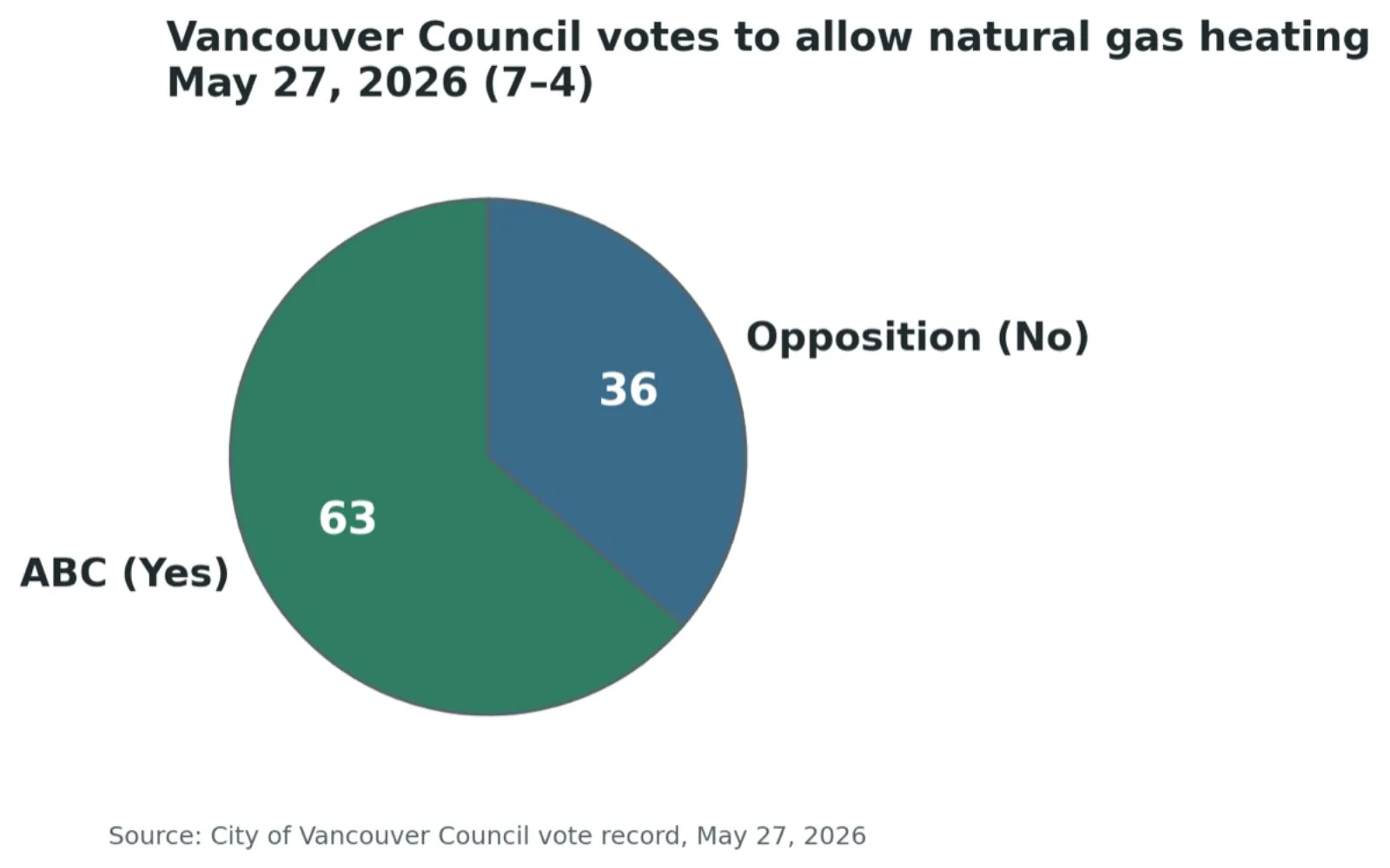
The motion, driven by ABC councillors with input from the business and development community, directs staff to harmonize Vancouver’s building bylaw with the provincial code. In plain terms: remove the requirement that all new low-rise residential buildings use only electric space heating and hot water. Builders can now choose gas again.
The council also voted to pause Energize Vancouver, a large-building energy-tracking and emissions-reduction program that would have required significant reporting on operational greenhouse-gas footprints. That program had been rolled out to council and was set for new policies later this year.
What’s critical: neither choice is mandated. The all-electric rule is gone, but builders aren’t forced back to gas. The choice has returned to the market. A builder can still go all-electric if the project economics, buyer preference, or site conditions favour it. But now, for the first time since January 2022, gas heating is a legitimate option Vancouver builders can specify.
Why now? The political and practical case
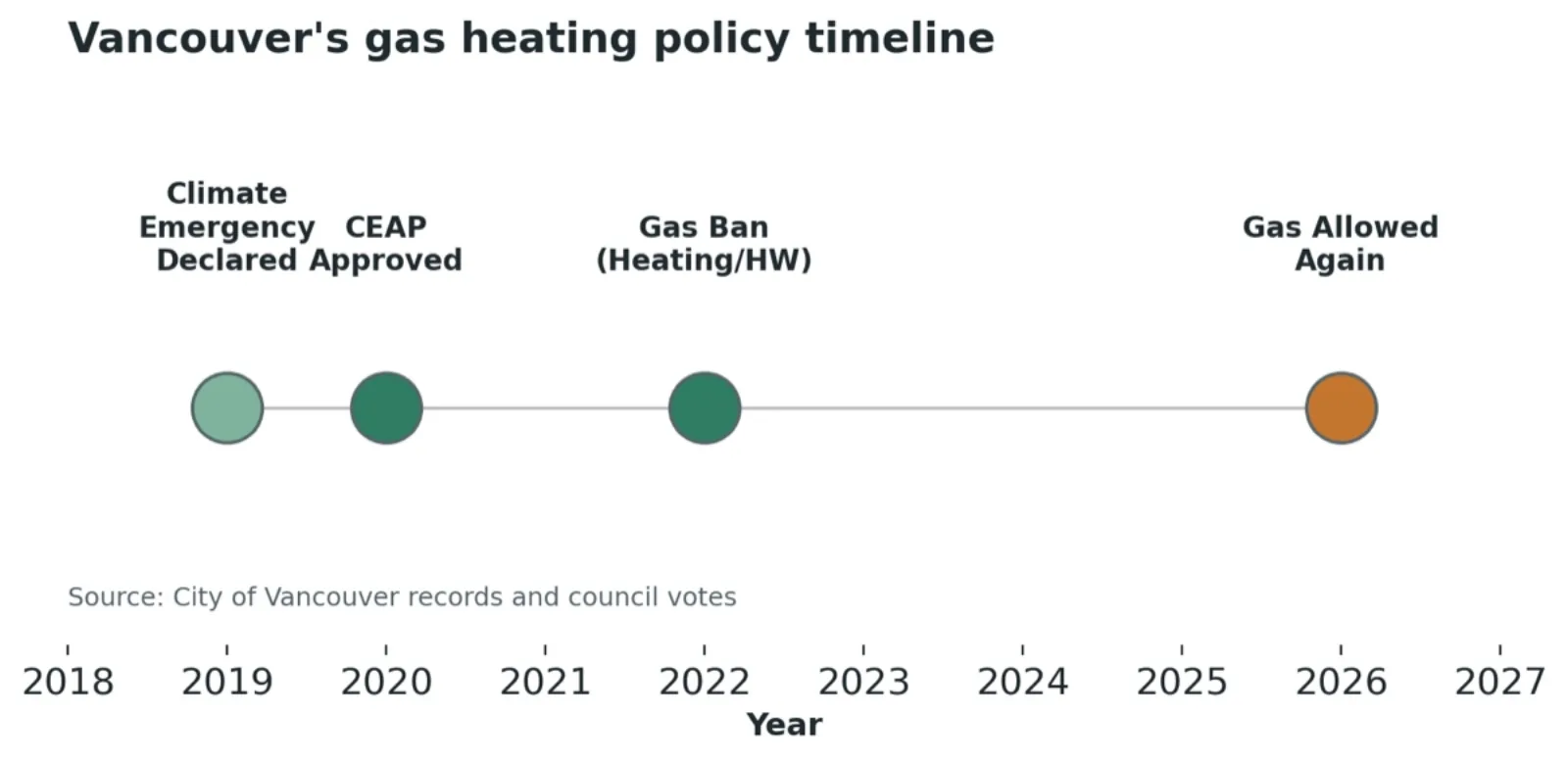
The reversal reflects three colliding pressures. First, political change: Mayor Sim’s ABC coalition has a strong majority and is prioritizing housing supply and affordability. The previous council, which approved the 2022 rule, had a different composition and climate focus. Second, builder feedback, which has been consistent: the all-electric requirement, combined with BC Hydro waiting times, uncertainty about service capacity, and design complexity, was slowing projects or making them uneconomical. Third, provincial alignment: BC’s building code allows gas. Vancouver going its own way meant every project needed tailored compliance. Harmonizing simplifies that.
The stated rationale from Council is practical: remove regulatory friction that is slowing housing delivery without abandoning climate goals. The implicit argument is that a fourplex that gets built with gas heating today is better than a zero-carbon fourplex that never breaks ground because the rules made it unfeasible.
The cost question: how much cheaper is gas?
This is where expectations and reality diverge sharply. When builders argued the all-electric rule was expensive, many people heard “hundreds of thousands of dollars.” But the official analysis, even from the previous climate-focused council, never supported that. The City’s 2024 study estimated zero-emission heating added roughly −4% to +0.9% to construction cost for small buildings. In other words, basically cost-neutral, or slightly cheaper in some cases.
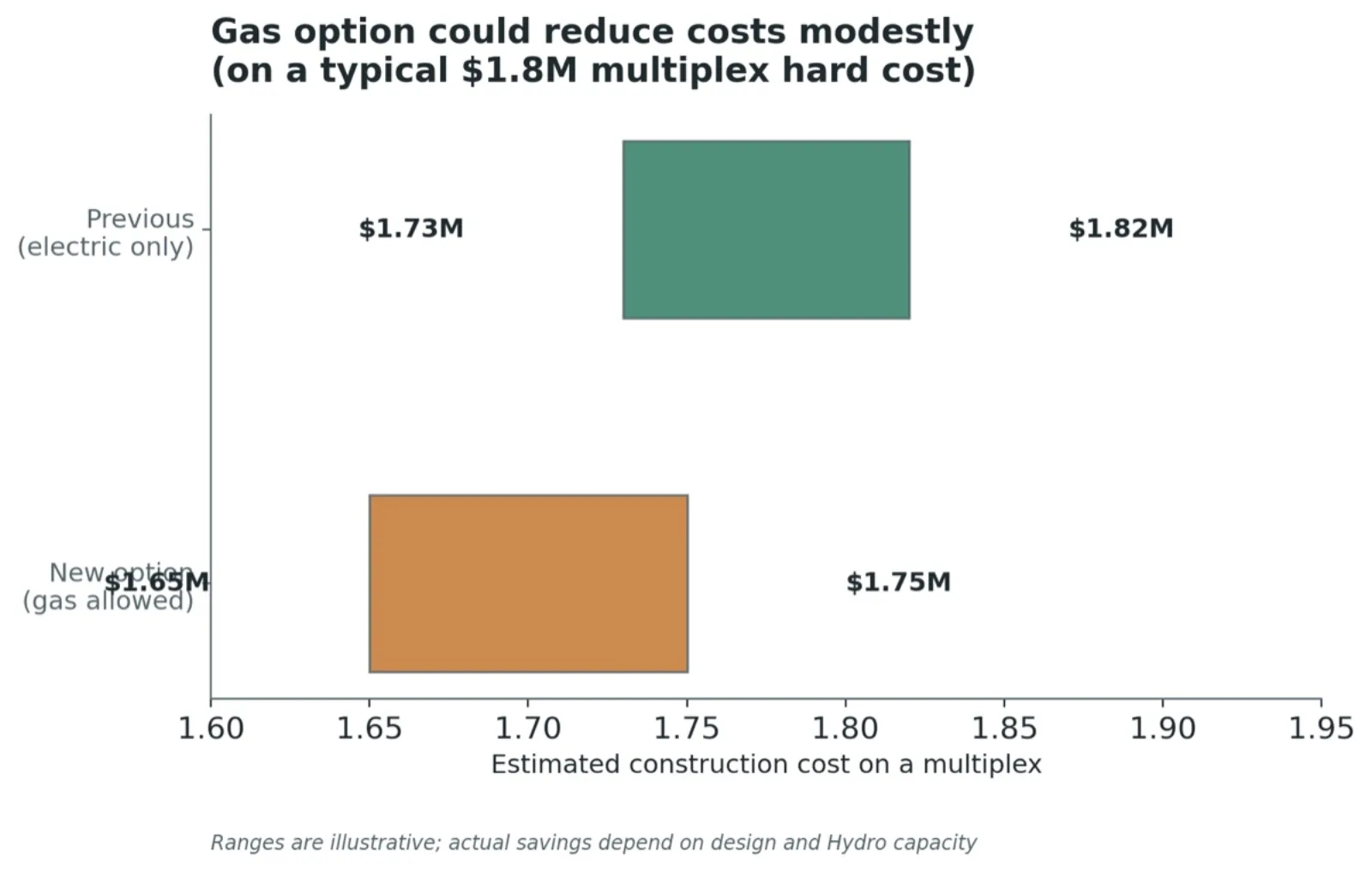
So what changed? Not the direct cost of gas equipment versus heat pumps. Rather, the option of gas reduces builder risk and uncertainty. A designer can now specify either system, and the cost difference becomes a choice, not a mandate. That choice is worth something in perceived risk and speed, even if the raw dollar difference is small.
The bigger cost relief comes elsewhere: Hydro uncertainty. The all-electric path required every builder to navigate BC Hydro service-size questions, wait for capacity studies, and potentially pay for upgrades. Not all sites triggered those delays, but the risk was real. Offering a lower-electrical-load option (gas heating) theoretically speeds that process.
The real money benefit. It’s not cheaper equipment. It’s faster timelines, reduced redesign risk, and not having to fight Hydro capacity constraints. Those things are worth more than a few thousand dollars in the economics of a tight-margin housing project.
Hydro: the waiting game just got faster
Here’s what builders say was the real pain point. When Vancouver required all-electric heating, every new multiplex needed BC Hydro to confirm service capacity for that electrical load. Hydro moves deliberately. Sites with complex loads or in areas already straining the grid faced waits of 4–6 months or more for confirmation. Some projects got redesigned mid-stream when Hydro said the original service size wasn’t available.
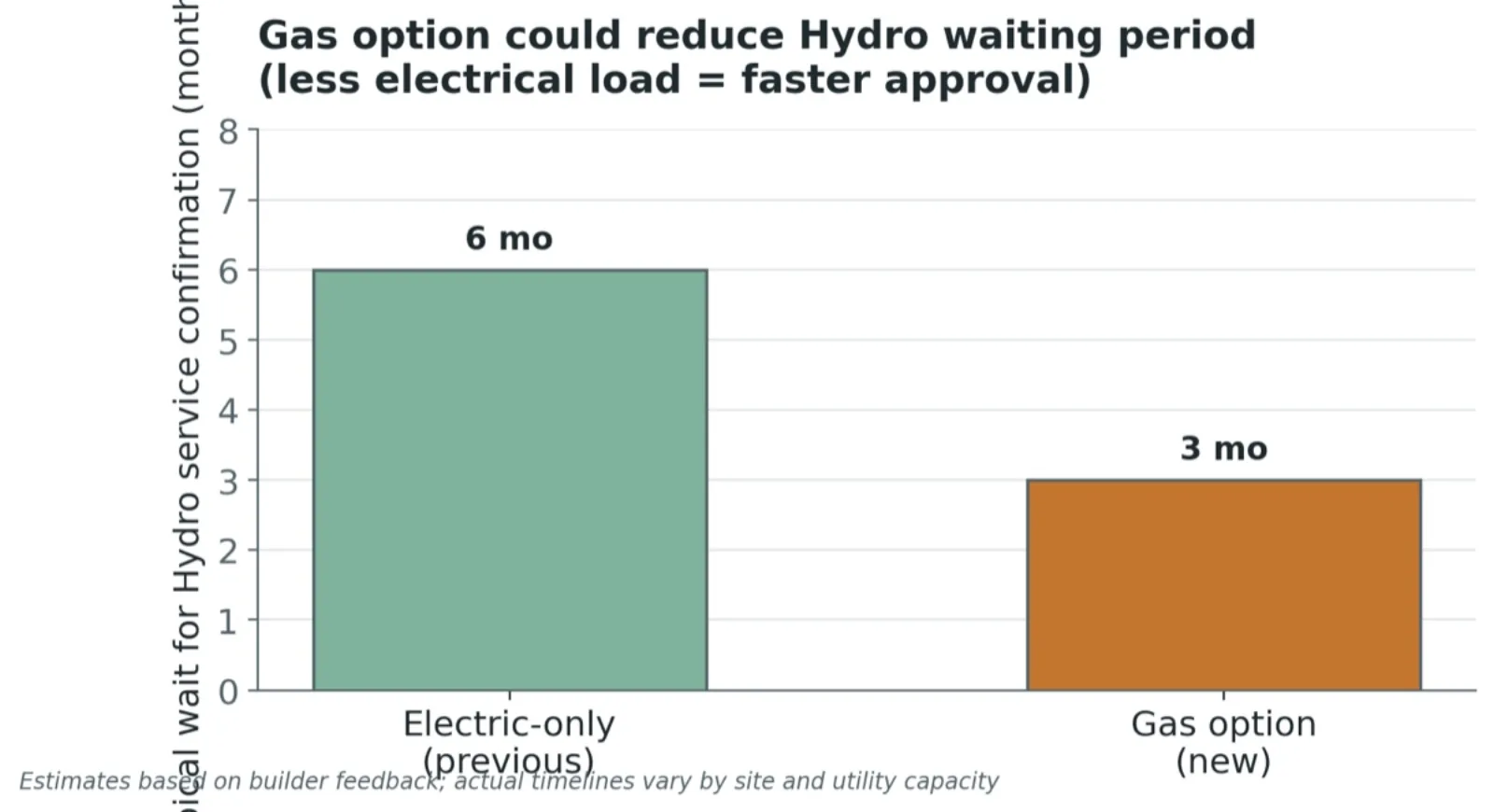
With a gas option, the calculation changes. Lower electrical load (because heating isn’t pulling from the grid) means smaller service size, lower risk of triggering upgrade requirements, and faster Hydro approval. Builder estimates suggest Hydro timelines could drop from 4–6 months to 2–3 months. That’s not trivial when a permitting delay can push a project start date back a quarter or more.
One caveat: Hydro is still Hydro. Some sites will still face delays if the overall density or load is very high. But the gas option reduces the subset of projects that hit that problem.
The amenities angle: what buyers actually want
Beyond the engineering and cost, there’s a market signal. Builders and REALTORS® have long reported that buyers have strong preferences around gas. Some want gas cooking (perceived as better heat control, faster response). Others want fireplaces (perceived as premium, atmospheric). Some simply see “gas amenities” as a luxury signal. Whether those preferences are rational is a separate question. The point is: they exist, and they influence buyer behaviour and price.
Under the all-electric rule, builders couldn’t offer gas heating (only gas stoves and fireplaces were allowed). Now they can. A gas-heated multiplex with gas cooking and a fireplace is a possible product again. Some builders may position that as a differentiated offering, potentially allowing slightly higher pricing. Whether buyers will actually pay more, and how much, is unclear. But the option, once removed, is back on the table.
What builders are saying (so far)
In the days since the vote, industry reaction has been cautiously optimistic. The BC Real Estate Association and various builder groups have said the decision removes regulatory friction. But many are also expressing a wait-and-see posture: they want to see the actual bylaw language when it’s written. A motion is not a rule. Staff still has to draft the new bylaw, and council has to formally adopt it. History suggests that process takes 2–4 months and can include amendments.
Some builders have also raised a pragmatic question: projects already in the design or permitting pipeline chose all-electric based on the old rule. Those won’t pivot back to gas at this late stage. The benefit will mainly show up in new projects starting design now or in the next few months.
What was Energize Vancouver, and why does its pause matter?
Energize Vancouver was a proposed program that would have required larger buildings (over a certain size or energy use threshold) to track and publicly report their operational greenhouse-gas emissions annually, with escalating reduction targets over time. The idea was to create transparency and accountability for operational carbon from existing and new buildings.
The program had support from environmental groups and was described as similar to schemes in cities like San Francisco. But it was controversial with developers and property owners, who said it added reporting burden and potential liability. When the Council paused it this week, they essentially shelved the program for now — no public vote expected until later this year or beyond, if at all.
The pause removes one piece of the city’s climate accountability machinery. Combined with the gas heating reversal, it signals that the current council is less interested in aggressive new climate oversight of buildings and more focused on removing barriers to housing. Whether that’s a wise trade-off is exactly the debate voters will have.
Timeline: how fast can projects pivot?
The motion passed on May 27. The new bylaw language has to be drafted by city staff. Typically, a new bylaw is presented to council within 2–4 weeks, debated, and formally adopted another 2–3 weeks later. So by mid-to-late June, the new rule could be in effect.
But projects that are already deep in permitting won’t pivot. A builder who submitted permit applications in April or May under the all-electric rule probably won’t go back and redesign. The real benefit is for projects in early design or those that haven’t yet started the detailed engineering.
A rough guess: projects that benefit from the reversal are those breaking ground in the next 6–9 months or starting design now. Anything further along is already locked into the all-electric path.
The policy whiplash question
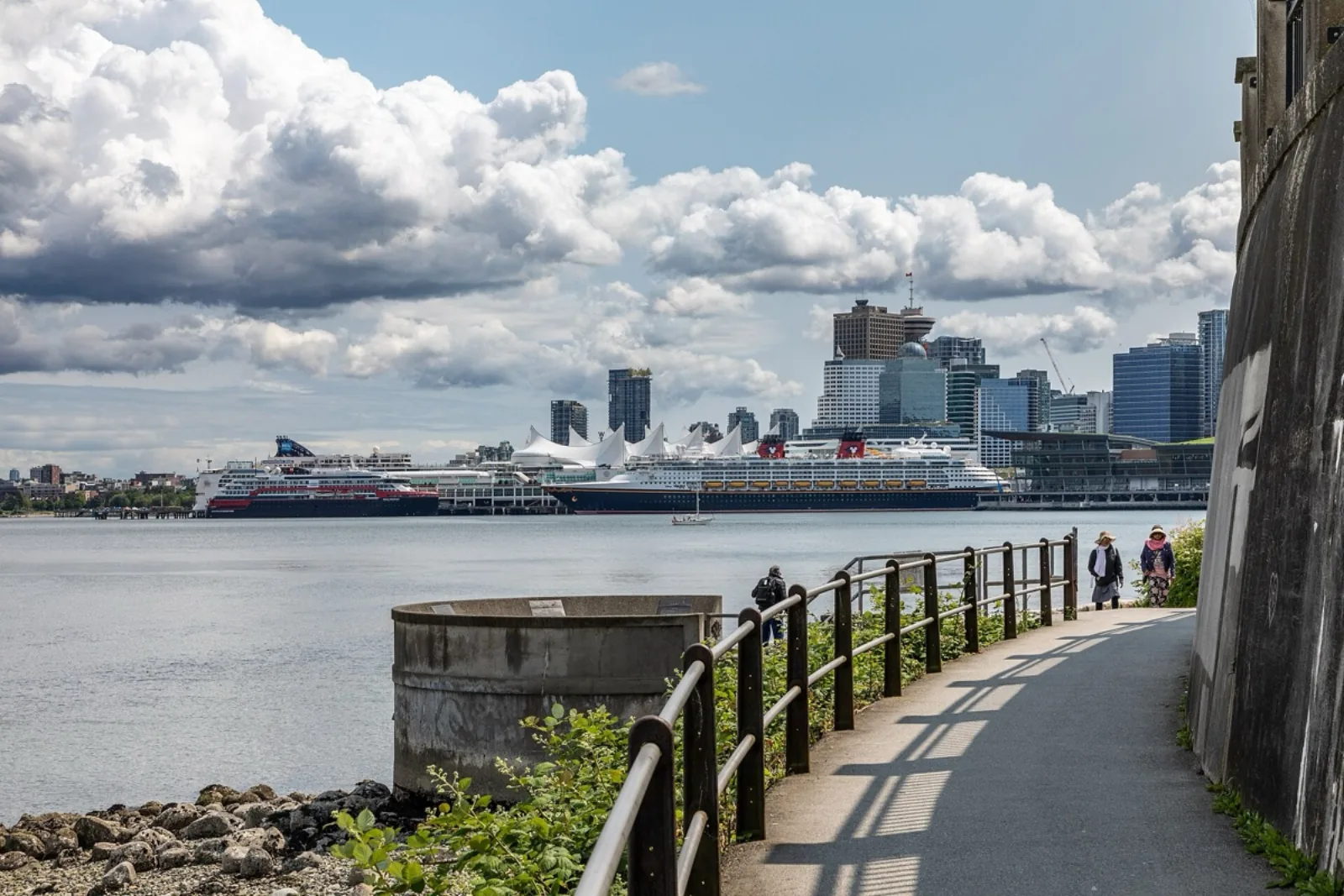
One underexamined cost of the reversal is the whiplash itself. Four years ago, Council required all-electric. Hundreds of builders, designers, and suppliers adapted. Some invested in learning, tools, and supply chains for heat-pump-based systems. Projects were designed and redesigned to comply. Now the rule is gone.
For projects that are sufficiently along, the all-electric path is cheaper to complete than to redesign. For projects not yet started, gas is an option again. But the volatility raises a real question: if rules can flip this quickly, how much confidence should builders have in any rule?
One builder said this week: “I appreciate the relief, but I’m not making long-term bets on this staying. I’ll design for gas where it makes sense, but I won’t build my whole operation around it.” That skepticism is rational. Policy reversals breed caution.
Will this actually speed housing?
That’s the unanswered question. The theory is: remove the rule, reduce cost and complexity, projects move faster, more homes get built. But rules are not usually the main blocker. Land price, financing, site constraints, permitting time, and construction cost are typically bigger factors. The gas reversal addresses maybe 5–10% of the total friction, plausibly. That matters, but it’s not a game-changer.
The vote removes one barrier. But zoning permission, affordable land, and investor appetite still constrain supply far more than whether gas is legal.
We’ll know in 12–18 months whether this actually moves the needle. If the pace of multiplex construction in Vancouver accelerates noticeably this summer and fall, the rule may have helped. If it doesn’t, the reversal will be symbolic rather than decisive.
Bottom line
Vancouver’s May 27 vote reverses a climate rule and allows gas heating in new homes again. The immediate effects will be: builders can now choose between gas and electric based on project economics and buyer preference, Hydro approval timelines may shorten, and some projects will be able to proceed slightly faster or cheaper. The Energize Vancouver pause removes a separate climate accountability program.
But the reversal doesn’t erase the climate logic that made the all-electric rule exist in the first place. Buildings are still Vancouver’s largest carbon source. Gas heating still produces more emissions than electric systems fed by BC’s clean grid. The decision is not that emissions don’t matter. It’s that speed and housing supply are mattering more right now, under this council, in this moment.
Whether that’s the right trade-off will be argued until the next council election. But for the next 12–18 months, gas is back on the menu. How much builders use that option, and whether it noticeably speeds housing delivery, will be the real measure of whether the vote changed anything.
Sources
City of Vancouver Council Motion, May 27, 2026, Harmonize Vancouver Building By-law with Provincial Building Code. · City of Vancouver staff briefing materials and prior cost analysis from the November 2024 report on gas heating alternatives. · BC Building Code and Zero Carbon Step Code documentation. · Interviews with Vancouver builders and design professionals (background, not for attribution). · BC Hydro service planning timelines and builder feedback on permitting delays.
Image credits. Hero: Vancouver skyline, Kyle Pearce / DIY Genius (CC BY-SA 2.0). Seawall: Dietmar Rabich (CC BY-SA 4.0). False Creek: Benoit Brummer / trougnouf (CC BY 4.0). Charts created for this article.
Want to see whether your Vancouver lot still pencils out as a multiplex now that the heating choice is open again? Run your address through VanPlex’s proforma calculator — it prices both the all-electric and gas-allowed paths so you can compare side by side.
— David Babakaiff, Co-Founder, VanPlex · PlexRank™ | Profit with Multiplex