
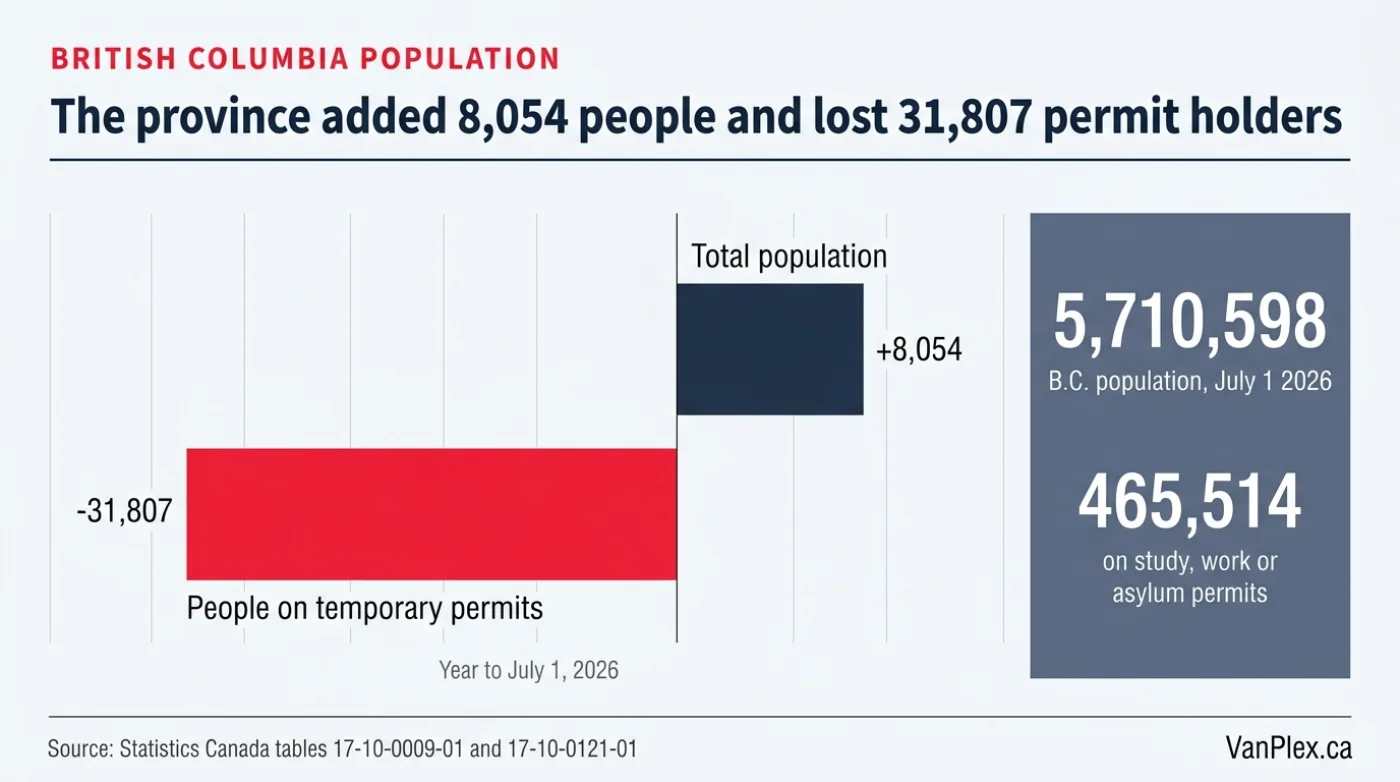
British Columbia gained 8,054 people in the year to July 1, 2026. That is growth of 0.14 percent on a base of 5.7 million. Over the same twelve months the province lost 31,807 people who were here on a study permit, a work permit, or while an asylum claim was decided. Prime Minister Mark Carney now says the question is when Canada starts adding people again.
He gave no date and no number. Both arrive with a document Ottawa has to publish by November 1. If you own a lot in Metro Vancouver, or you are part way through a multiplex, that document matters more than the interview everyone is quoting.
What Carney said
Speaking to the New York Times, Carney said: “Now the question starts to become, when do we resume some controlled increase in the population, which is the nature of Canada?” He added: “So that will happen, and we just want to make sure that we’ve got it under control.”
The Canadian Press first reported the remarks on September 29, 2026. A spokesperson for Immigration Minister Lena Diab said the Prime Minister had pointed to fewer new student and temporary worker arrivals. Asked whether any increase is planned this year, the spokesperson said the next plan will “ensure immigration remains at sustainable levels.”
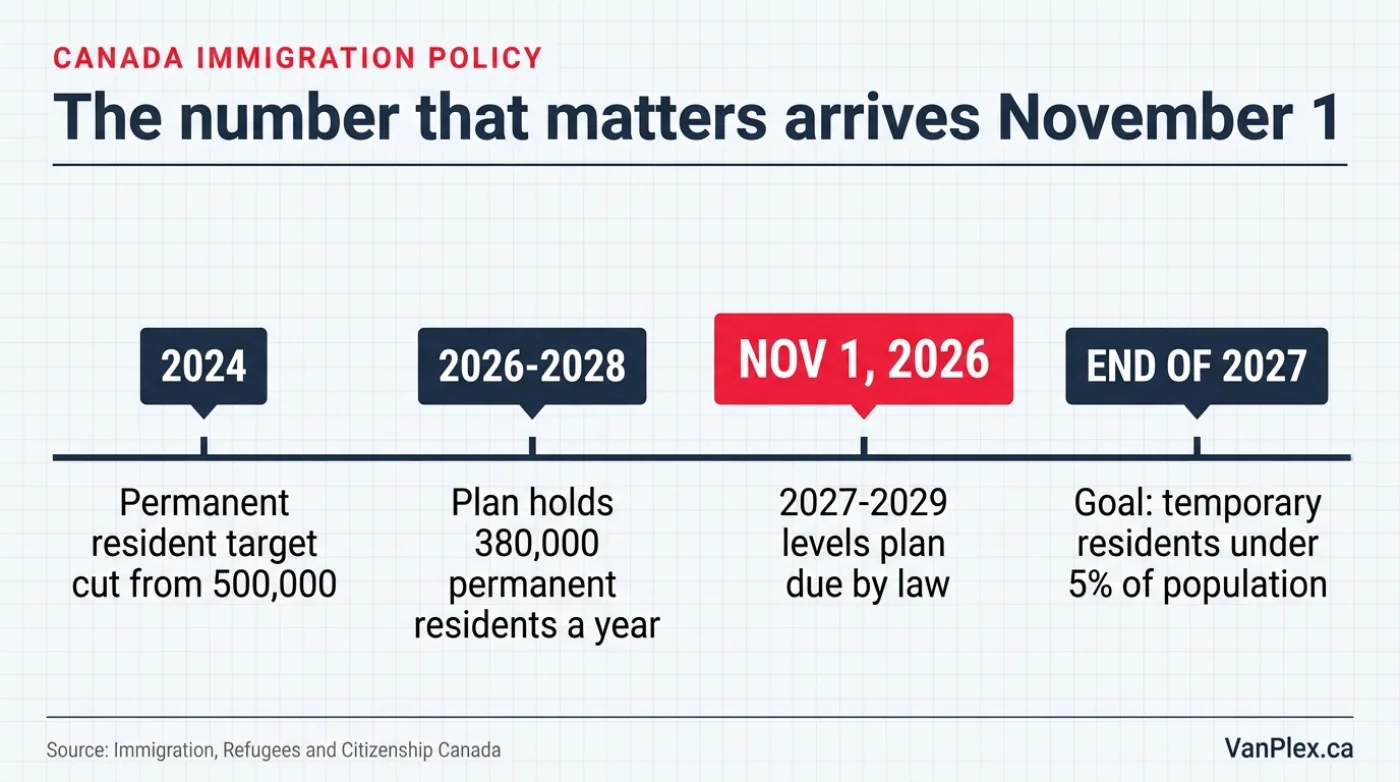
Nothing in that is a decision. The decision comes in a document called the immigration levels plan, which sets how many people Canada will admit over the next three years. The law requires the government to publish it by November 1, with a short extension if that date is not a sitting day in Parliament. November 1, 2026 is a Sunday.
The opposition answered within days. Conservative immigration critic Michelle Rempel Garner wrote that “Immigration levels need to go down, not up.”
So there are two public positions and one plan due in under four weeks.
Where the population numbers actually sit
Statistics Canada published its second quarter estimates on September 23, 2026. Here is what the year to July 1 looked like.
| July 1, 2025 | July 1, 2026 | Change | |
|---|---|---|---|
| Canada, total population | 41,608,982 | 41,798,407 | +189,425 (+0.46%) |
| Canada, people on temporary permits | 2,934,388 | 2,779,774 | -154,614 (-5.27%) |
| B.C., total population | 5,702,544 | 5,710,598 | +8,054 (+0.14%) |
| B.C., people on temporary permits | 497,321 | 465,514 | -31,807 (-6.40%) |
Source: Statistics Canada tables 17-10-0009-01 and 17-10-0121-01, retrieved October 5, 2026. Percentages calculated from those figures. “People on temporary permits” is Statistics Canada’s non-permanent resident count: residents holding a study permit, a work permit, or awaiting a decision on an asylum claim, along with their family members.
Read the B.C. rows together, because one explains the other. The province added 8,054 people in total while 31,807 permit holders left. Arithmetic says the rest of B.C.’s population grew by 39,861 over the same year. New permanent residents and births kept arriving the whole time. The total is small because the drop on the temporary side cancelled most of that out.
Nationally, 2,779,774 people were here on temporary permits on July 1, which is 6.65 percent of the population. The government’s stated goal is to get that under 5 percent by the end of 2027. That goal has not been reached.
The plan on the books today
Until a new plan is published, these are the numbers Canada is working to.
| 2026 | 2027 | 2028 | |
|---|---|---|---|
| Permanent residents admitted | 380,000 | 380,000 | 380,000 |
| of which economic | 239,800 | 244,700 | 244,700 |
| of which family | 84,000 | 81,000 | 81,000 |
| of which refugees and protected persons | 49,300 | 49,300 | 49,300 |
| of which humanitarian and other | 6,900 | 5,000 | 5,000 |
| New temporary residents arriving | 385,000 | 370,000 | 370,000 |
| of which workers | 230,000 | 220,000 | 220,000 |
| of which students | 155,000 | 150,000 | 150,000 |
Source: Immigration, Refugees and Citizenship Canada, Supplementary Information for the 2026-2028 Immigration Levels Plan. The permanent resident target carries a published range of 350,000 to 420,000.
Two things in that table matter. The permanent resident number holds flat at 380,000 for three straight years, so a “controlled increase” means raising a number that is already steady rather than reversing a decline. And the temporary side is still scheduled to shrink, from 385,000 arrivals this year to 370,000 in each of the next two.
There is also a set of admissions outside the table. The Canadian Press reported that two temporary measures will bring in about 148,000 additional permanent residents over the next two years, and those sit outside the plan’s own totals.
The C.D. Howe Institute’s immigration targets council, chaired by Parisa Mahboubi, recommends going the other way: 380,000 permanent residents in 2027, 350,000 in 2028, and 340,000 in 2029. Mikal Skuterud, an economics professor at the University of Waterloo who sits on that panel, says even those numbers are high by historical standards, which he puts at around 0.9 percent of the population a year.
What happened to rents while growth stopped
This is the part that affects a multiplex budget directly.
CMHC released its 2025 Rental Market Report on December 11, 2025. Greater Vancouver’s vacancy rate in purpose-built rental buildings went from 1.6 percent to 3.7 percent in one year, which the B.C. Ministry of Housing and Municipal Affairs described as the highest in more than 30 years. Greater Victoria reached 3.3 percent, the highest since 1999. Across B.C. municipalities of 10,000 people or more, the average went from 1.9 percent to 3.5 percent.
Asking rents followed. On September 9, 2026, the Ministry of Housing and Municipal Affairs summarised that month’s Rentals.ca report: national asking rents down 4.8 percent over the year, B.C. down 4.7 percent overall, and Vancouver purpose-built rents down 19 percent from their July 2023 peak. Four B.C. cities were among the fifteen largest annual decreases in the country.
| City | Asking rent change, year to September 2026 |
|---|---|
| Abbotsford | -10.5% |
| Coquitlam | -6.8% |
| Richmond | -6.2% |
| Kelowna | -5.2% |
Source: Rentals.ca September 2026 report, as summarised by the B.C. Ministry of Housing and Municipal Affairs on September 9, 2026. Figures are for purpose-built rental buildings.
B.C. also set the maximum allowable rent increase for 2027 at 2.2 percent, tied to inflation. That is the maximum you can raise an existing tenant’s rent, whatever happens to demand.
If you ran your numbers in 2023 and have not updated them since, this is the first difference to correct.
Building slowed at the same time
On September 10, 2026, CMHC published its fall Housing Supply Report. Canada needs between 417,000 and 469,000 homes started every year to bring affordability back to where it was before the pandemic by 2036. Construction is running below that.
CMHC’s note on Vancouver matters here: condominium apartments are the biggest source of new homes for people buying rather than renting, and condo construction has fallen to its lowest level in more than a decade. The agency says the risk to long term ownership affordability keeps growing.
So two things are moving in opposite directions. Demand has been held down by policy for two years and may be allowed to rise. Supply of homes for sale is falling now, and a building started today is finished in two to three years.
What to do about it if you are building
Here is how I would treat this, and the order matters.
Use today’s rents in your budget. A statement with no number attached is not something you can put in a spreadsheet. Vancouver purpose-built rents are 19 percent below their July 2023 peak and the vacancy rate is 3.7 percent. Those are the conditions a building finishing in 2028 starts leasing into, unless something changes. If the project only works on 2023 rents, it does not work.
Treat a rise in immigration as upside you did not pay for. If Ottawa raises the targets on November 1 and population growth picks up through 2027 and 2028, the buildings already finished are the ones that benefit. That is an argument for starting now rather than for paying more for land now.
Watch the temporary permit numbers. B.C. lost 31,807 permit holders in a year and gained 8,054 people in total. Students and temporary workers change rental demand quickly, because they arrive, rent immediately, and concentrate in a small number of neighbourhoods. The permanent resident number has held at 380,000 for three years.
Read the November 1 document itself. The plan will give a number for permanent residents and a number for new temporary arrivals, each for 2027, 2028 and 2029. Compare them against the table above. If new temporary arrivals are set higher than 370,000, rental demand in Metro Vancouver is set to rise. If they hold or drop, the rental market you see today is the one you are building into.
One honest caution. Four weeks is not long, and two sides are publicly asking for opposite things. Anyone telling you right now what the 2027 number will be is guessing.
Check your own lot first
Policy moves on a national timetable. Your lot has its own numbers. Whether a multiplex works on your property comes down to lot size, zoning, what it would cost to build, and what the finished homes rent or sell for on your street.
Put your address into the VanPlex lot check and you will get how many homes your lot can hold under B.C.’s small-scale housing rules, with the build cost and return math for your city. If you are weighing renting the finished homes against selling them, the build-to-rent guide walks through both sides on the same lot.
Then come back on November 2 and see which way the number went.
David Babakaiff, Co-Founder, VanPlex | PlexRank™ | Profit with Multiplex