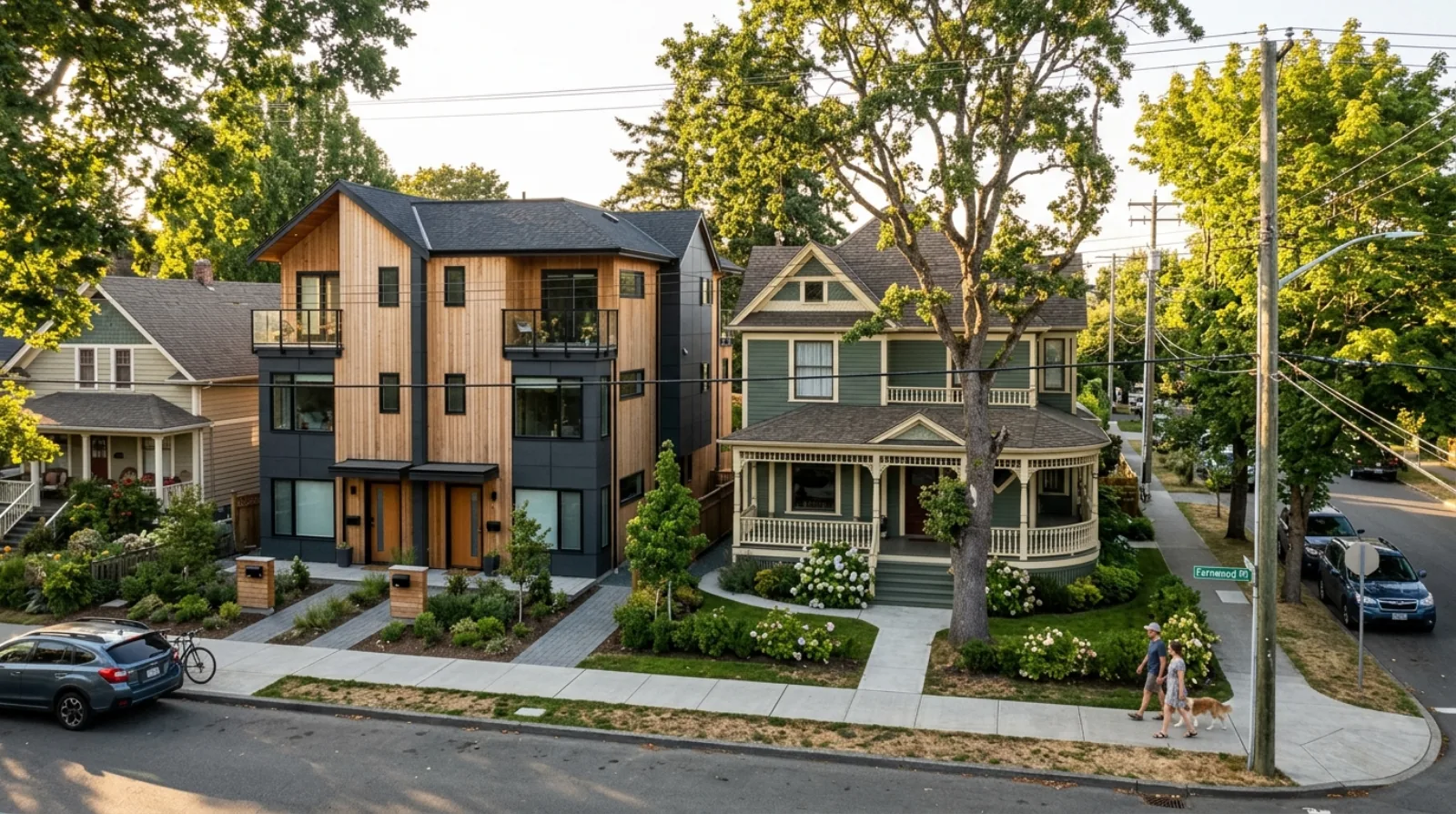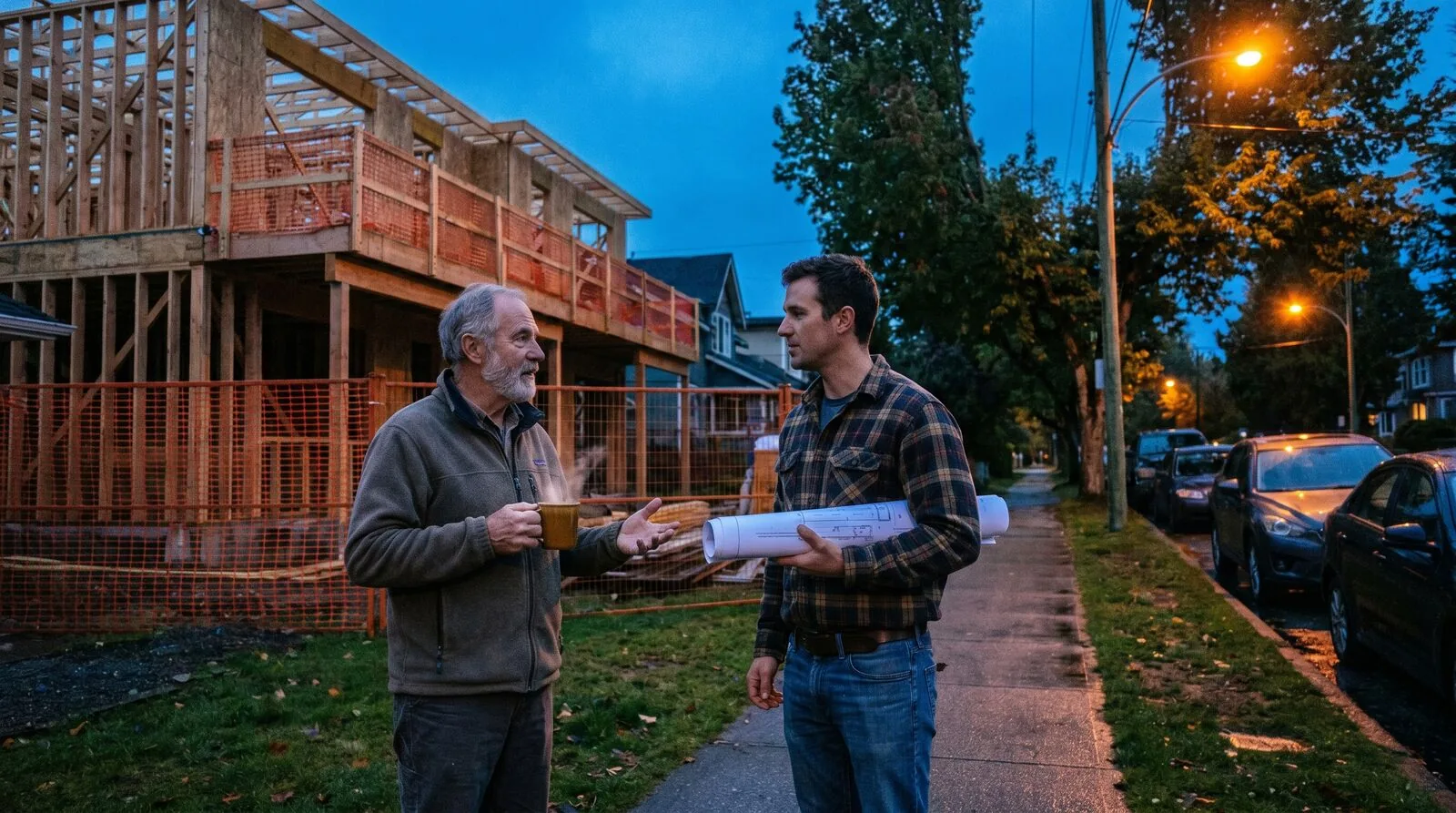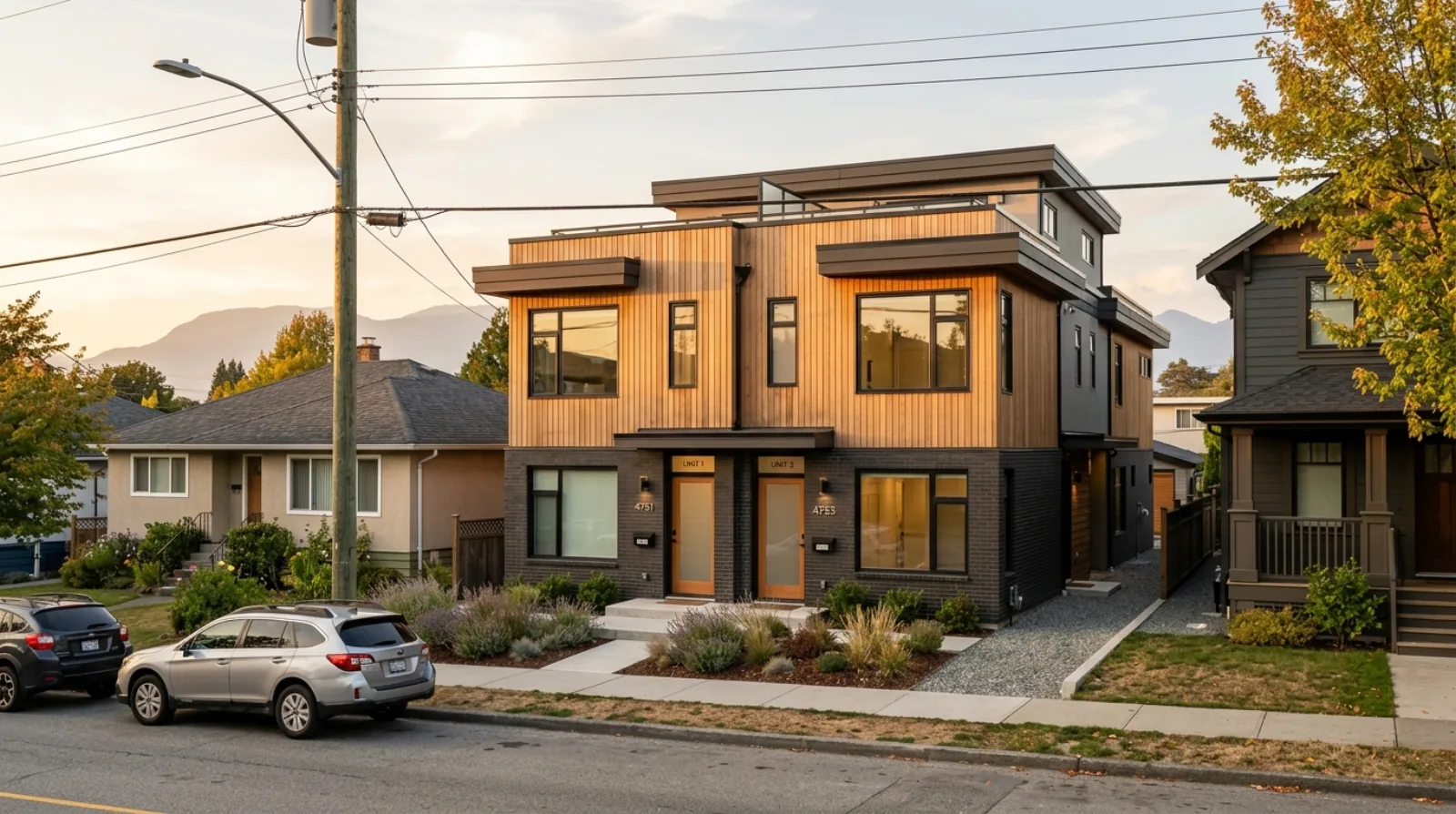

Your duplex neighbour built a shed, a new deck or a new path on their side, and nobody asked you. In a two-lot BC strata, “you” are half of the strata corporation, and the Standard Bylaws require the strata’s written approval before an owner alters the outside of a building or any common property, including the yard set aside for their use. That was the issue in Siddons v. Gilzean, 2018 BCCRT 448, a side-by-side duplex in Vancouver. The Civil Resolution Tribunal (CRT) found the neighbour broke the bylaw by building without approval, even though the work was not a “significant” change. It also found that changes made more than 2 years before the claim were too late to challenge, and that none of the work had to be registered at the Land Title Office.
Below is what the bylaws require, what the tribunal decided, and what to do when it happens to you. Our guide to strata bylaws covers the rest of the Standard Bylaws.
Two bylaws, two kinds of change
Which rule applies depends on where the work is. The strata plan shows what is inside each strata lot, what is common property, and what is limited common property, meaning common property set aside for one lot’s use, such as a fenced yard or a deck.
| Standard Bylaw 5: alterations to a strata lot | Standard Bylaw 6: alterations to common property | |
|---|---|---|
| What it covers | Structure and exterior of a building; chimneys, stairs, balconies and other things attached outside; outside doors, windows and skylights; fences and railings around a patio, balcony or yard; common property inside a lot; parts of the lot the strata insures | Any alteration to common property, including limited common property, or to common assets |
| Approval needed | Written approval of the strata, before the work | Written approval of the strata, before the work |
| Can the strata refuse? | It “must not unreasonably withhold its approval” | The bylaw sets no reasonableness test |
| Conditions | The owner can be asked to agree in writing to take on costs of the alteration | The owner can be asked to agree in writing to take on costs of the alteration |
| Bare land strata | Does not apply | Applies |
Source: Schedule of Standard Bylaws, Strata Property Act, current to October 27, 2026. A strata that filed its own bylaws follows those instead.
Inside a unit, Bylaw 5(1)(g) still reaches the parts the strata must insure, which include fixtures the developer installed as part of the original construction, such as floor and wall coverings and plumbing and electrical fixtures (s.149(1)(d)). Removing a wall between two lots has its own rule in s.70 of the Act: the strata must approve it unless it breaks building rules or local bylaws, or cuts off services to another lot.
What the tribunal decided in 2018 BCCRT 448
The duplex had operated “by consensus as issues arise”, with no formal council meetings. One owner made two rounds of changes to the yard and deck shown as limited common property for their lot:
- 2015: a shed against the outside wall, a wood privacy screen on the upper deck, and a new wood deck with a glass canopy.
- 2017: a new path along the side of the unit and landscaping.
The other owner asked the tribunal to order the work removed, to have the neighbour sign an indemnity, a written promise to cover any costs it causes, and to register the changes at the Land Title Office.
Tribunal member Eric Regehr decided, on September 12, 2018:
- The 2015 work was challenged too late. The Limitation Act sets a 2-year limit, counted here from the last day of construction to the date the tribunal accepted the claim (August 7, 2017). A cheque marked “final pymt” dated July 27, 2015 showed the work was done before then. Those claims were dismissed.
- The 2017 work was not “significant”. Section 71 bars the strata from making a significant change in the use or appearance of common property without a 3/4 vote. Using factors from a 2014 BC Supreme Court case, the tribunal found the path was not casually visible, did not affect the other owner’s use of their unit, and did not change the use of the yard. It was “primarily cosmetic”.
- The 2017 work still broke Bylaw 6. Bylaw 6(1) has no “significant” threshold. “In the context of a 2 person strata, approval from the strata requires approval from the applicant.” The neighbour needed the other owner’s written approval and did not get it.
- The fix was a vote, ordered by the tribunal. It ordered the strata to hold an annual general meeting within 30 days with a vote on approving the 2017 work, and left the terms of any cost agreement to that meeting. If the strata refused, the neighbour could come back to the tribunal and argue the refusal was “significantly unfair”.
- No registration. Sections 73 to 75 require filing only when common property is designated as limited common property or that designation is removed. “Nothing in the SPA requires that alterations to LCP need to be registered.”
- Other orders. The neighbour must let the other owner reach the shared water shutoff valve on 48 hours’ written notice, or at once in an emergency. The strata must hire an engineer, other than the neighbour’s, to inspect the exterior, with the cost shared equally. Both owners must be copied on all strata correspondence. Neither side got its tribunal fees back.
Who carries the risk of an owner’s addition
The other owner argued the new deck put the strata’s insurance at risk. The tribunal disagreed. The strata must insure fixtures on a strata lot only if the developer built or installed them as part of the original construction (s.149(1)(d)). Under that rule, the tribunal said, “any risks created by the 2017 alterations is borne by the respondent and the respondent’s insurer, not the strata or the strata’s insurer.”
That is a reason to use the condition both bylaws allow: approve the work only if the owner agrees in writing to take on its costs, including future repairs.
What to do when your neighbour builds without asking
- Check the plan. Is the work inside their strata lot, on limited common property, or on common property? That decides whether Bylaw 5 or Bylaw 6 applies. Our page on limited common property shows how to read the plan.
- Note the dates. The 2-year limit in the 2018 decision ran from the end of construction. Photos with dates and any messages about the work matter.
- Put it in writing. Ask your neighbour to request approval under Bylaw 5 or 6, and propose the conditions you want, such as a written agreement to pay for the alteration and its repairs.
- Hold the meeting. Put the approval on the agenda of a general meeting with 2 weeks’ written notice (s.45), and record the vote. In a duplex, approval needs you both.
- Use the strata’s remedy powers correctly. The strata can remedy a bylaw breach and charge the owner the reasonable cost (s.133). Before it charges anyone, it must have a complaint, give the owner the details in writing, and give them a chance to answer, including a hearing if they ask (s.135). In 2023 BCCRT 340 the tribunal refused a $2,625 charge because the strata had skipped them.
- Go to the tribunal if you must. First ask council in writing for a hearing (s.34.1; s.189.1). The tribunal’s fee is $125 online or $150 by mail. Our disputes guide covers the process.
If you want to make a change yourself
The same bylaws apply to you. Ask in writing before you start, describe the work, attach drawings, and offer to take on the costs in writing. If your neighbour refuses a Bylaw 5 request without a good reason, the bylaw itself says the strata “must not unreasonably withhold its approval”. If they refuse a Bylaw 6 request to get something unrelated, the tribunal called that kind of refusal “significantly unfair” in another duplex case, 2023 BCCRT 340. Our guide to when owners disagree explains the options when two owners cannot agree.
A short written approval process saves both owners money. A bylaw that lists small changes that need no approval, such as planting, can also help, but any bylaw change takes a 3/4 vote and has no effect until Form I is filed at the Land Title Office (s.128). In a duplex, that means both owners agree. Our bylaws guide explains how to file one.
We are building the StraPlex app for owners of 2 to 6 unit stratas, with requests, approvals, meetings and records in one place. The waitlist is below.
David Babakaiff, Co-Founder, VanPlex | PlexRank™ | Profit with Multiplex