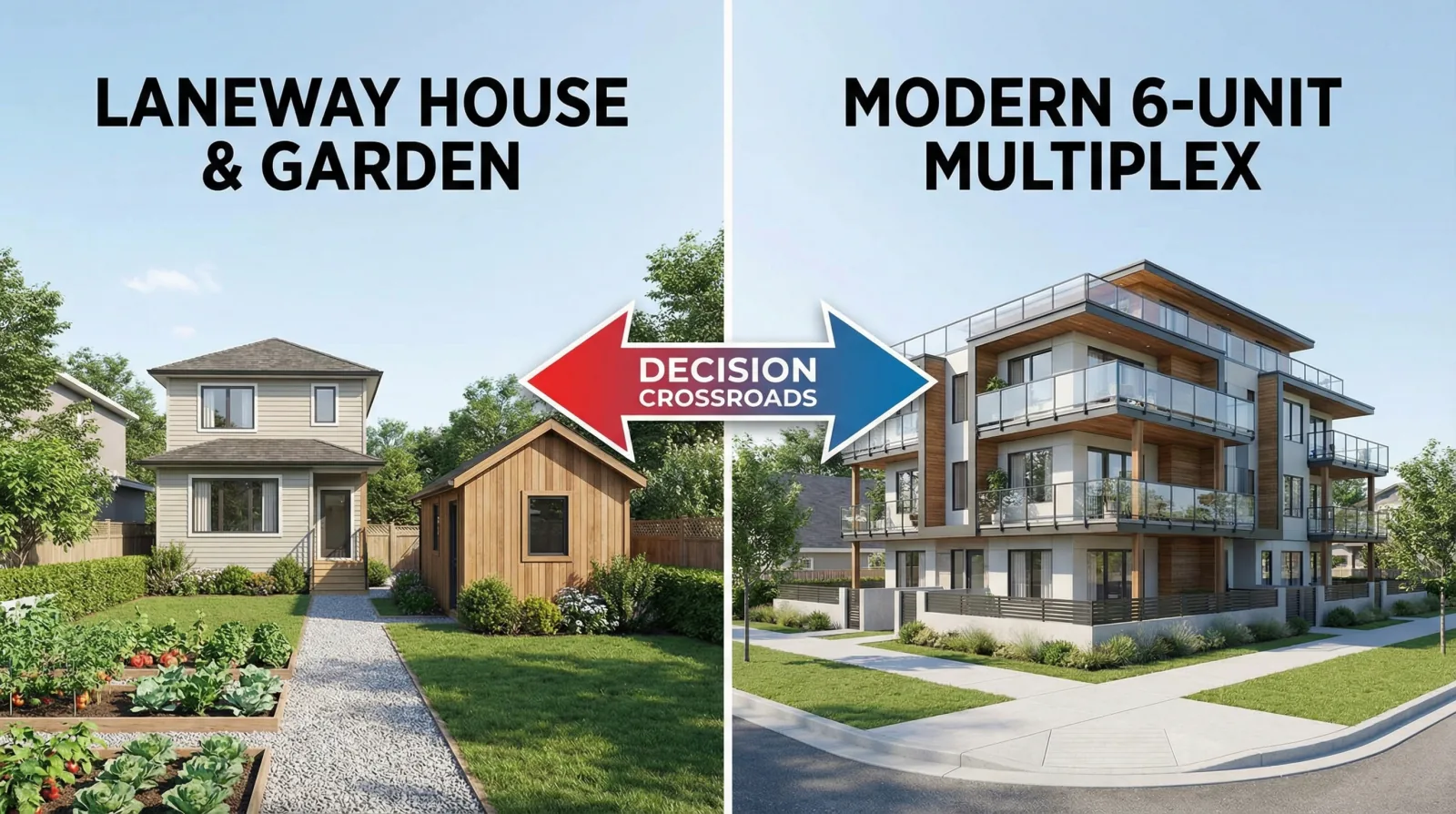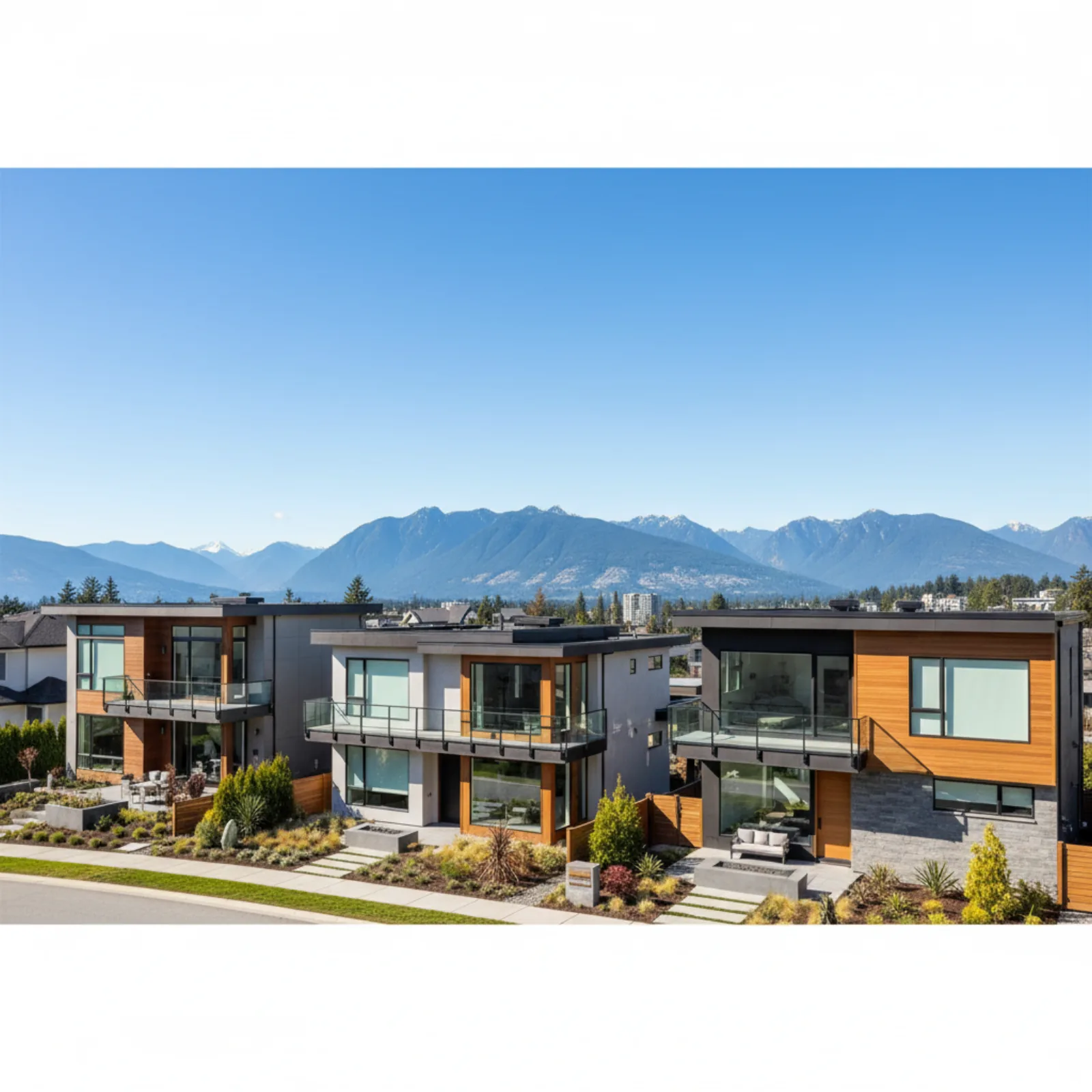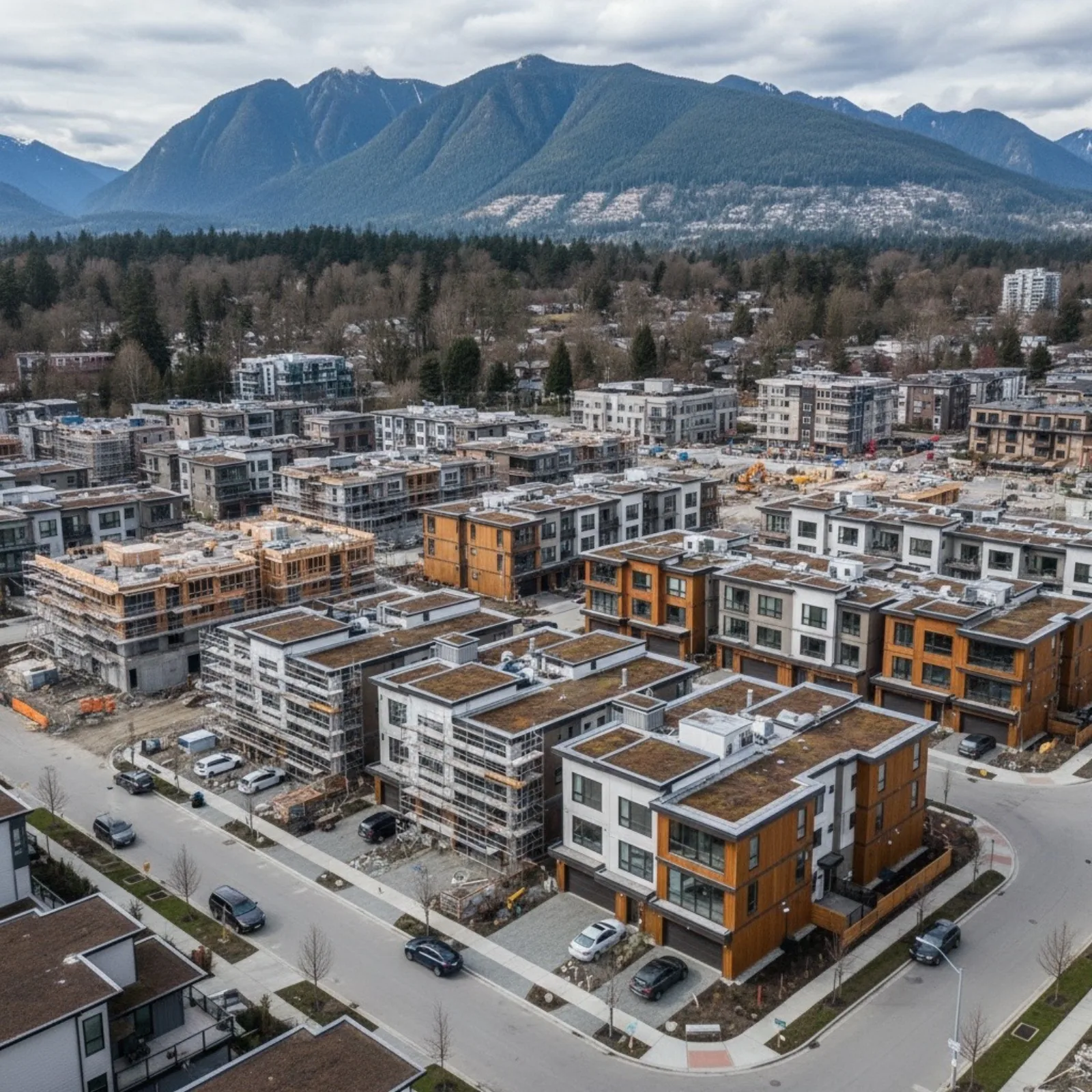

It’s January 8th. The holidays are over. Your inbox is full of investment pitches. But here’s what most won’t tell you: the 2026 multiplex opportunity isn’t about finding one great deal—it’s about building a system that executes dozens. The investors who win in 2026 will industrialize multiplex development, measuring success not by ROI on single projects, but by IRR across a repeatable pipeline.
Single deals are how hobbyists invest. Pipelines are how wealth compounds.
The Old Model Is Broken: Why Single-Deal ROI Hunting Fails
For decades, real estate investors optimized for one metric: Return on Investment (ROI). Find the best deal. Negotiate hard. Execute once. Move to the next.
That model made sense when entitlements were scarce, information was asymmetric, and capital deployment was inherently slow.
Bill 44 changed everything.
With 60,000+ lots now eligible for by-right multiplex development across Metro Vancouver, the bottleneck shifted. Opportunity isn’t scarce anymore—execution capacity is.
The data tells the story:
| Investor Profile | Annual Deals | Avg ROI | Capital Turns | 5-Year Wealth Multiple |
|---|---|---|---|---|
| Deal Hunter | 1 every 24 months | 100% | 0.5/year | 4× |
| Pipeline Builder | 3 per year | 40% | 3/year | 13.8× |
The pipeline builder with “lower” per-deal returns generates 3.4× more wealth over five years.
Why? Because capital velocity compounds.
Why ROI Misses the Point: Introducing IRR
ROI answers a simple question: How much profit did I make?
IRR answers a more important one: How fast is my capital working?
Internal Rate of Return (IRR) accounts for time. A 60% return in 12 months is dramatically better than 60% in 36 months—because in the faster scenario, you can redeploy capital two more times.
Warren Buffett built Berkshire Hathaway not by finding the highest-return deals, but by optimizing capital efficiency. His insurance float model—where capital is constantly redeployed—generated his wealth. The same principle applies to multiplex development in 2026.
Here’s the math that sophisticated investors run:
| Scenario | Total ROI | Project Duration | IRR | $1M After 4 Years |
|---|---|---|---|---|
| One Premium Deal | 100% | 48 months | 19% | $2.0M |
| Pipeline A | 50% | 14 months | 43% | $4.9M |
| Pipeline B | 35% | 10 months | 42% | $4.7M |
The 35% return pipeline nearly matches the 50% pipeline because of faster capital cycles.
This isn’t theoretical. VanPlex’s analysis of 450+ completed multiplex projects (2023-2025) shows:
- Average high-IRR project duration: 14-18 months
- Average deal-hunter project duration: 24-32 months
- Correlation between project duration and ultimate IRR: -0.73 (strong inverse)
Shorter duration drives higher IRR. Higher IRR drives faster wealth accumulation.
Throughput Over Perfection: System-Designed Execution
The mental shift from ROI to IRR changes everything about site selection.
Deal-hunters ask: “Which property has the highest profit margin?”
Pipeline builders ask: “Which properties can I execute fastest with acceptable returns?”
The second question leads to radically different site selection criteria:
| Deal-Hunter Criteria | Pipeline-Builder Criteria |
|---|---|
| Maximum FSR utilization | Standard permit pathways |
| Complex assemblies | Single-lot execution |
| Novel architectural concepts | Repeatable typologies |
| Highest per-unit exit price | Predictable exit velocity |
| Unique opportunities | Scalable opportunities |
This explains why VanPlex’s PlexRank™ scoring now weights three factors more heavily than raw ROI:
- Permit predictability: Sites with known approval timelines (under 6 months to permit)
- Construction efficiency: Lot geometry suited for panelized, repeatable builds
- Exit velocity: Neighborhoods with consistent sales absorption rates
The top 5% of properties by raw ROI overlap only 40% with the top 5% by IRR optimization. Different criteria, different winners.
City-Wide Feasibility Intelligence: Building Your Pipeline
Here’s where industrialized multiplex development separates from traditional real estate:
You need to see the entire city at once.
One-off deal hunting is inefficient because it’s sequential. You evaluate property A, pass, evaluate property B, pass, and eventually find property C. Each evaluation costs time. Time is capital’s enemy.
City-wide feasibility intelligence flips this:
- Pre-filter 86,000+ properties for baseline IRR potential (not just ROI)
- Rank by execution velocity factors: permit pathway clarity, construction complexity, exit market depth
- Identify clusters where you can develop 3-5 properties with shared resources (same architect, same builder, same systems)
- Monitor pipeline continuously for new opportunities as market conditions shift
VanPlex’s database does this systematically. The result is what institutional investors call “deal flow infrastructure”—a repeatable system for identifying and ranking opportunities without manual property-by-property analysis.
Real numbers from pipeline-focused developers in Metro Vancouver (2025 data):
| Metric | Deal-by-Deal | City-Wide System |
|---|---|---|
| Properties evaluated/month | 8-12 | 200+ (automated) |
| Conversion to execution | 1 in 20 | 1 in 8 |
| Average time to commitment | 6-8 weeks | 2-3 weeks |
| Annual project capacity | 1-2 | 4-6 |
The system doesn’t find better deals. It finds suitable deals faster.
The Filtering Effect: This Isn’t for Everyone
Let’s be direct: industrialized multiplex development isn’t for every investor.
It’s not for you if:
- You want to “hit a home run” with one perfect deal
- You measure success by bragging about ROI percentages
- You lack capital for multiple concurrent projects ($2-3M minimum working capital)
- You want hands-off passive income (this is active deployment)
It is for you if:
- You think in terms of capital velocity and compounding
- You prefer predictable 35-50% returns over volatile 100%+ targets
- You have infrastructure to execute multiple projects annually
- You understand that repetition beats optimization in wealth building
The filtering is intentional. In a world where AI has leveled information access, the competitive advantage shifts to execution infrastructure. Everyone can find the same deals. Not everyone can execute a pipeline.
Family offices entering the multiplex space in 2026 are building exactly this infrastructure:
- Dedicated development teams (2-4 people)
- Pre-negotiated builder relationships
- Standardized legal and financial frameworks
- City-wide feasibility databases (like VanPlex)
- Repeatable construction systems (panelization, modular)
They’re not hunting for deals. They’re building machines that convert capital to multiplexes and back to capital, repeatedly.
Infrastructure Over Speculation: Building Your 2026 System
The 2026 multiplex opportunity is real. But capturing it requires thinking differently:
Stop asking: “What’s the best deal I can find?”
Start asking: “How do I build a system that executes predictably at scale?”
That system has four components:
- Feasibility Intelligence: City-wide property database with IRR-optimized ranking
- Execution Partnerships: Pre-vetted architects, builders, and lenders aligned with your velocity targets
- Capital Structure: Working capital sized for 3-4 concurrent projects, not single deals
- Repeatable Playbook: Standardized designs, contracts, and timelines that compress duration
Visit VanPlex.ca to:
- Access PlexRank™ IRR-optimized scoring for 86,000+ Metro Vancouver properties
- Identify high-velocity sites with predictable permit pathways
- Connect with verified builders specializing in panelized, fast-cycle construction
- Build your pipeline with city-wide feasibility intelligence
The Capital Velocity Question for 2026
Here’s the question sophisticated investors are asking themselves this January:
“How many times will my capital turn this year?”
Not “What’s my best deal?” Not “What’s my target ROI?”
How many cycles?
The answer determines your wealth trajectory for the next decade.
Deal-hunters will find great individual opportunities in 2026. They always do. They’ll celebrate 100%+ returns. They’ll post about them.
Pipeline builders will quietly compound at 3× the rate, executing 35-50% returns three or four times per year.
In five years, we’ll see who built more wealth.
The system always wins.
David Babakaiff Co-Founder of VanPlex PlexRank™ | Profit with Multiplex