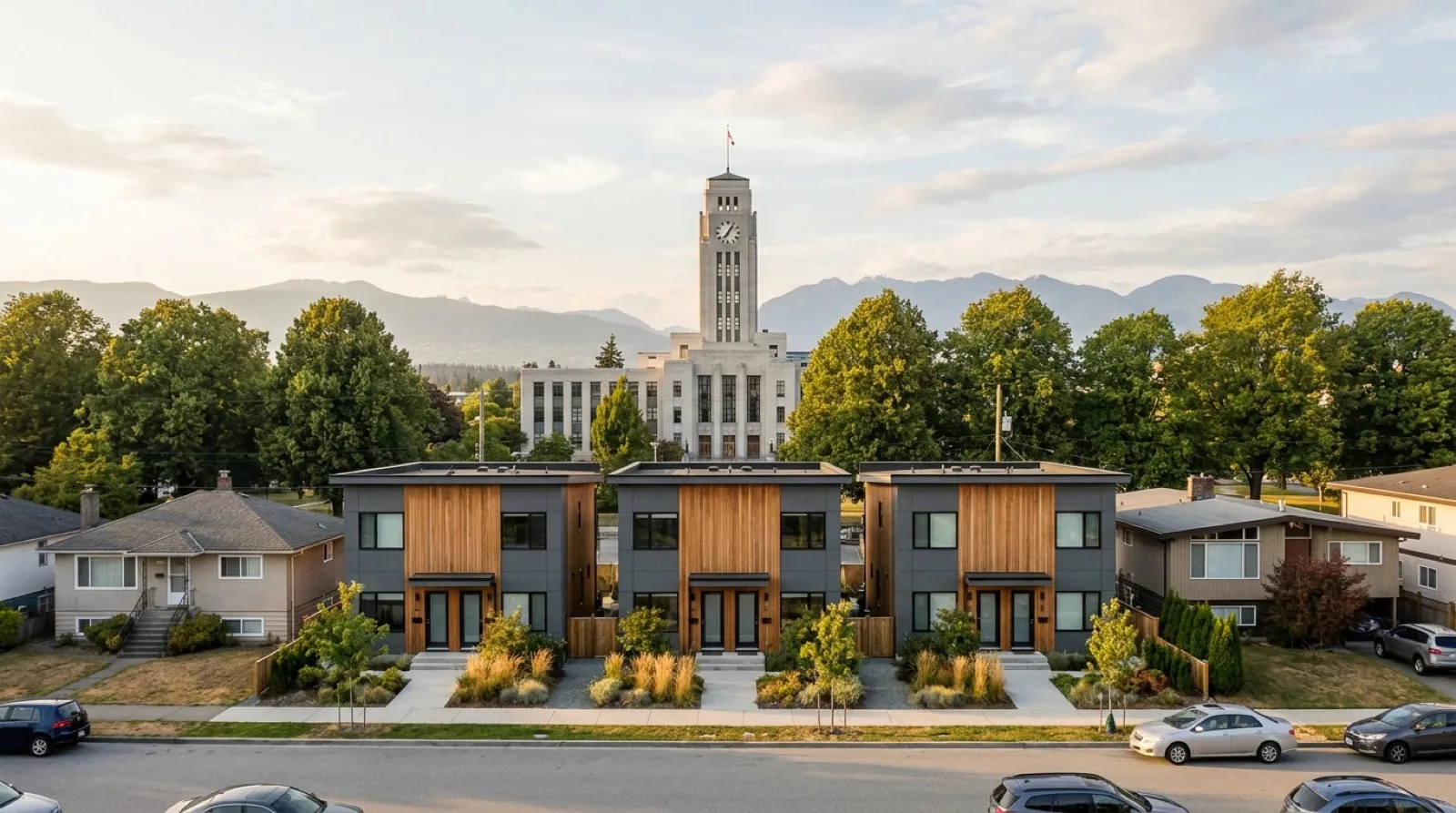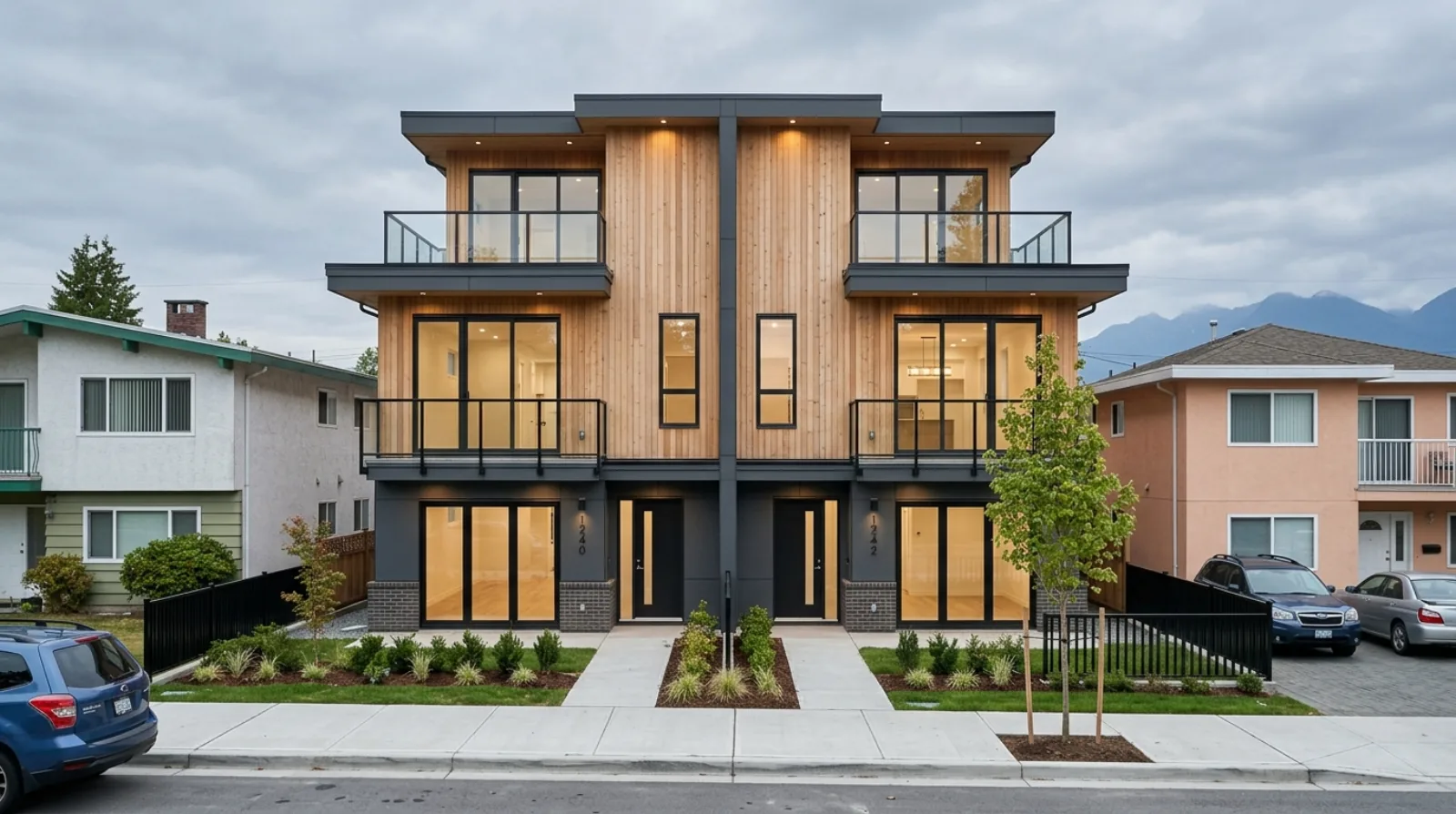
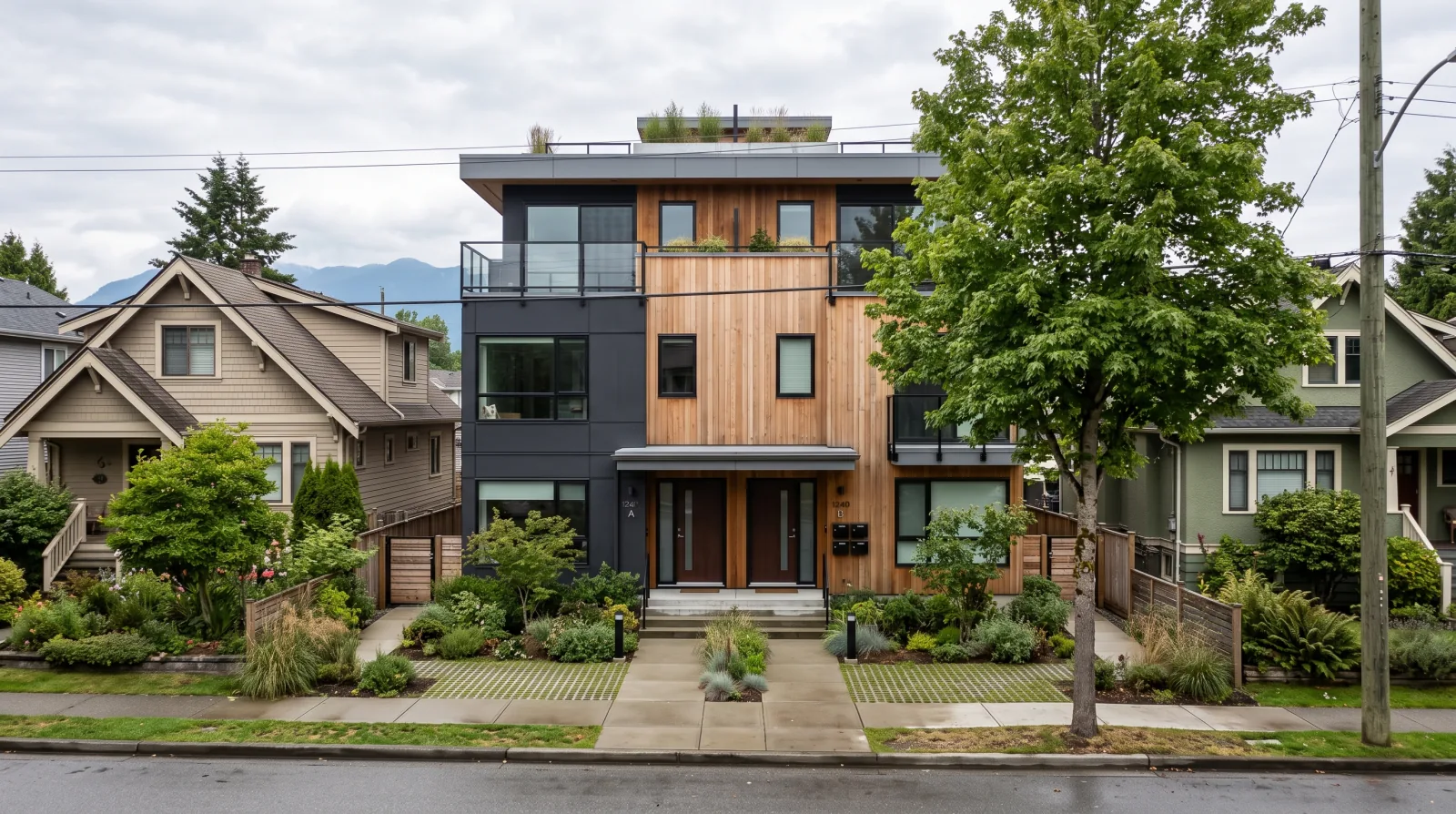
Pete Fry of the Green Party won the race for mayor of Vancouver on October 17, 2026, with 98,494 votes in the City’s unofficial count. If you own a house lot and plan to build three to six homes on it, two things matter right away: the multiplex rules in force today have not changed, and the new Council has no majority for any one party. This post sets out what Fry promised builders, what could cost them more, and what he has not yet said.
This post is by the editorial team at voche.me, a Vancouver election guide that links every campaign promise to its source. Every platform item below comes from the Green Party of Vancouver’s 2026 platform, with the PDF page number, as recorded in voche.me’s platform pages. Vote counts are preliminary; the City publishes official results on October 21.
The result, and the Council Fry will lead
The City counted 209,214 ballots on October 17. Fry took 98,494 votes for mayor and unseated Ken Sim of ABC Vancouver (The Canadian Wire, reporting the City’s unofficial count).
The ten council seats split across four parties (Daily Hive, the City’s preliminary council count):
| Councillor | Party | Votes |
|---|---|---|
| Sean Orr | COPE | 83,038 |
| Annette Reilly | Green | 78,476 |
| Chloe Leslie | COPE | 67,791 |
| Devyani Singh | COPE | 65,473 |
| Stephanie Smith | Green | 64,070 |
| Lucy Maloney | OneCity | 63,143 |
| Camil Dumont | Green | 62,540 |
| Solomon Yi-Kieran | COPE | 60,361 |
| Mike Klassen | ABC Vancouver | 57,798 |
| Bridget Burns | Green | 57,788 |
Council has 11 votes: the mayor plus ten councillors. Fry and the four Green councillors hold 5. A motion needs 6 to pass, so every housing change Fry wants needs at least one vote from COPE, OneCity or ABC. COPE holds 4 seats, which makes it the party Fry will need most often. Together, the Greens, COPE and OneCity hold 10 of the 11 seats; Mike Klassen is the only ABC councillor re-elected.
Below the last seat the gap is 2,807 votes. Bridget Burns took tenth place with 57,788, and ABC’s Joyce Gillespie was next with 54,981. The preliminary count still had one voting place to report (Daily Hive).
The outgoing ABC Council has one more scheduled public meeting, on October 27. The new Council is sworn in on November 2.
Your multiplex rules stay as they are
Council made multiplexes legal in Vancouver on September 14, 2023, and the vote was unanimous (Daily Hive). Fry was a councillor then and voted for it. The rules are a City bylaw, and they stay in force until a Council majority votes to change them.
Nothing in the Green platform proposes to undo them. The housing chapter asks for more of the same kinds of homes: “rowhomes, townhomes and infill” and wood-frame apartments of 4 to 6 storeys “in all neighbourhoods” (platform, page 6). A multiplex built under the existing R1-1 zone needs no rezoning, so most of the platform’s new conditions on rezonings would not touch it.
One open file does affect multiplex owners. On May 20, 2026, Council started a review of multiplex height, lot coverage and design rules, known as Motion 9 (VanPlex’s breakdown). The review had not reported when voche.me checked on September 22, 2026. The new Council now decides what to do with it.
What Fry promised builders
These are the platform items that change how a small building gets designed and approved. Each one is a decision Council can make, except where we say otherwise.
| Promise | What it means for a small builder | Page |
|---|---|---|
| Pre-Approved Housing Designs | The City approves a set of home and rental building plans once, so a project that uses one moves through permits faster | 7 |
| ”Vancouver Special 2.0” | Modular or prefab kit designs, with zoning and permit rules that favour them | 7 |
| Streamlined permit approvals | Fix the separation between City departments that the party says adds time and cost to approvals | 7 |
| Keep and simplify the Vancouver Building By-law | Simpler rules for larger multi-unit buildings, and trials of new rules on mass timber, exit stairs and elevators, and floor area exemptions | 7 |
| 4 to 6 storey wood-frame apartments in all neighbourhoods | Includes single-stair buildings, which have one exit stair and fit on narrower lots | 6 |
| Dynamic zoning | Standard rezonings agreed in advance for areas near transit and services | 4 |
| Lower fees and faster permits | Aimed at what the platform calls “truly affordable housing”, so a market multiplex may not qualify | 18 |
The pre-approved designs depend partly on others. The platform would seek money for them from Build Canada Homes, the federal housing agency, which the City can only apply to (page 7).
The building bylaw promise is worth a closer look. Vancouver has its own building rules under the Vancouver Charter, which other BC cities do not. The Greens would keep them and make them simpler for larger buildings, and say the outgoing ABC council had considered getting rid of them (page 7).
What could cost builders more
Some promises add conditions or costs. Most of them are aimed at large developments and rezonings. A multiplex on an R1-1 lot is neither, but check each one against your project:
- Inclusionary zoning. Large developments would have to include affordable homes on site, or give land, homes or cash toward City and non-profit housing (page 18).
- A time limit on rezonings. The platform proposes a limit on the time between a rezoning’s approval and the start of construction (page 5).
- Community benefit agreements. Major developments would have to support the local economy, hire locally and buy Canadian (page 5).
- Amenity costs. As neighbourhoods add homes, the platform says the cost of new amenities would be shared between developers, other governments and taxpayers (page 4).
- A pause on micro-suites. The party would reverse the recent council policy that allows homes as small as 250 sq ft, kitchen and bathroom included (page 7).
- Fees on vacant land used as a park. Owners who lower their tax by turning land that is waiting for redevelopment into an informal park would need permits and pay fees (page 5).
If you hold vacant land while you wait to build, item 6 is the one to watch.
What Fry has said about multiplexes
His record on small buildings is short, so it is worth reading closely.
At a UBC housing debate on September 8, 2026, Fry was asked what floor space ratio would encourage multiplexes. He gave no number and said he would support a higher one if the tree canopy was kept (The Ubyssey). Floor space ratio is the total floor area a building may have compared with the size of its lot, so a higher number means a bigger building on the same lot.
On July 28, 2026, he voted against the Villages Plan, which Council rejected 10 votes to 1. CBC News quoted him saying the plan could not pass this close to the election and that the staff work behind it was wasted (CBC News). The plan would have added denser homes around 17 neighbourhood shopping streets (VanPlex’s coverage), so its return is now a question for his Council.
At the same UBC debate he said he would reverse the pause on supportive housing (The Ubyssey).
What he has not said yet
Before the vote, voche.me asked the Fry campaign five questions. None had an answer by election day. Two matter most for builders:
- What is the funded timetable for the housing design and permitting proposals?
- What numerical targets would you use for housing delivery?
The platform does not say how many pre-approved designs there will be, how long a permit should take, or when the program would start. Until it does, plan your project on today’s permit times.
Our view: of everything in the platform, the pre-approved designs are the promise most likely to help a small multiplex builder, because the platform says a project that uses one moves through permits faster. When they arrive depends on the new Council’s first budget, and on whether COPE votes for them.
What to do now if you own a lot
- Check your lot under today’s rules. Nothing in the result changes what you can build this month. Look up your lot on the VanPlex zoning map.
- Watch October 27. The outgoing Council holds its last scheduled public meeting that day.
- Watch two items once the new Council starts on November 2: what the new Council does with the Motion 9 review, and whether the budget pays for the pre-approved designs.
- Run the numbers before you decide. A VanPlex proforma shows the homes your lot allows, the build cost and the profit at today’s rules.
By the voche.me editorial team, voche.me. Sources: the Green Party of Vancouver 2026 platform (PDF), checked September 30, 2026; the City’s preliminary counts as reported on October 18, 2026.