
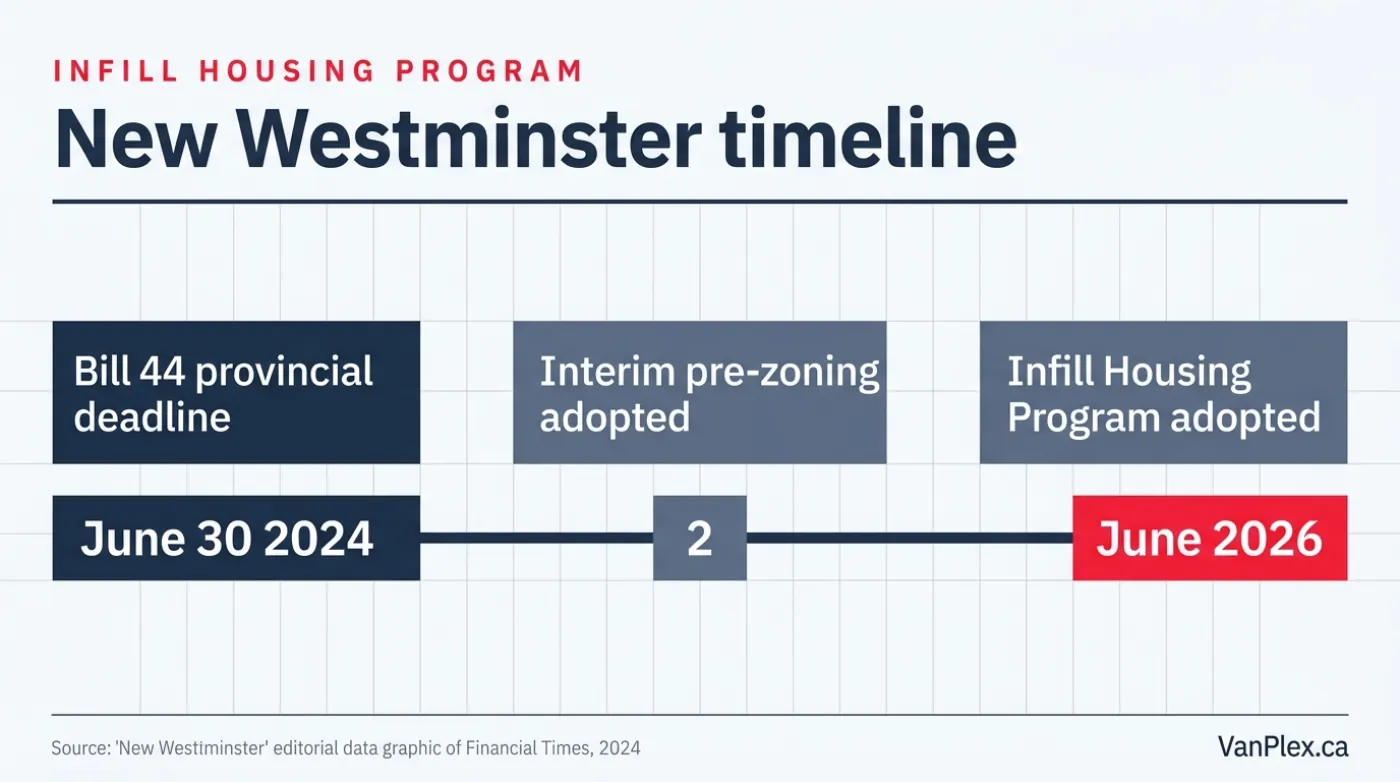
New Westminster quietly did something most BC cities are still fighting over. It pre-zoned residential lots for infill housing, and in June 2026 Council adopted its Infill Housing Program. If you own a single-family lot in the city, your property may already permit three to six homes with no rezoning application at all.
That last part matters. The slow, uncertain rezoning step is the thing that used to kill small projects. New Westminster took it off the table for most residential lots. Here is what the rules actually allow, and how to read your own lot before you get excited.
TL;DR (Key Takeaways)
- New Westminster pre-zoned residential lots for infill housing. Council adopted the Infill Housing Program in June 2026, in line with the Province’s Small-Scale Multi-Unit Housing legislation.
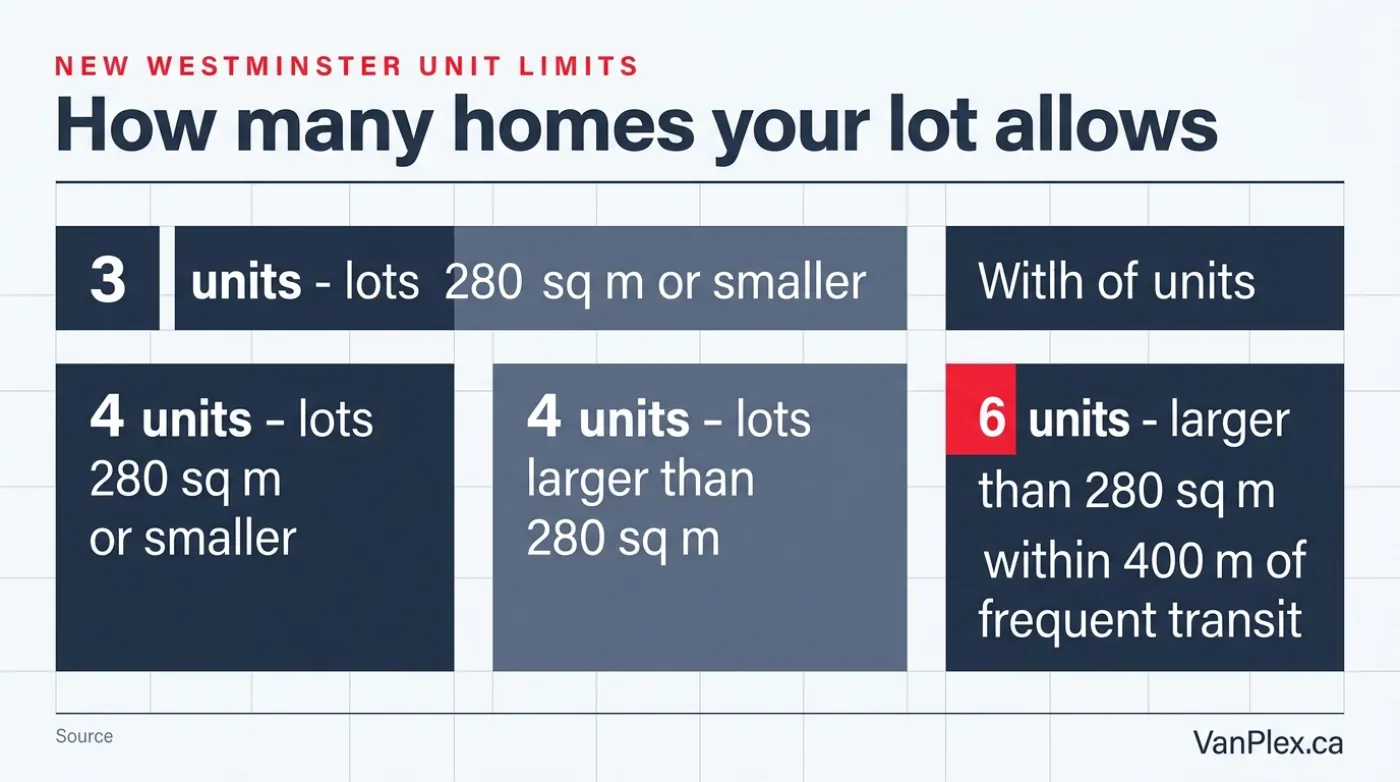
- The unit count depends on lot size and transit. At least three units on lots 280 square metres or smaller, four units on lots larger than 280 square metres, and six units on lots larger than 280 square metres that sit within 400 metres of frequent transit.
- The city was already ahead. Most residential zones in New Westminster permitted multi-unit housing before Bill 44, and about 570 properties were pre-zoned for townhouses.
- No rezoning means less risk. The permitted forms include duplexes, triplexes, fourplexes, multiplexes, laneway houses, and side-by-side townhouses up to six units.
- Lot size is the first gate, transit is the second. The jump from four to six units hinges on being close enough to a frequent bus route.
- Two lots on the same street can land differently. Zoning permission is not the same as a project that pays for itself.
What New Westminster actually permits
The permitted homes come straight from the provincial framework, but the city set the specifics. On a lot of 280 square metres or smaller, you can build at least three units. On a lot larger than 280 square metres, that rises to four units. And on a lot larger than 280 square metres that also sits within 400 metres of a bus stop the Province has flagged as frequent service, you can build up to six units.
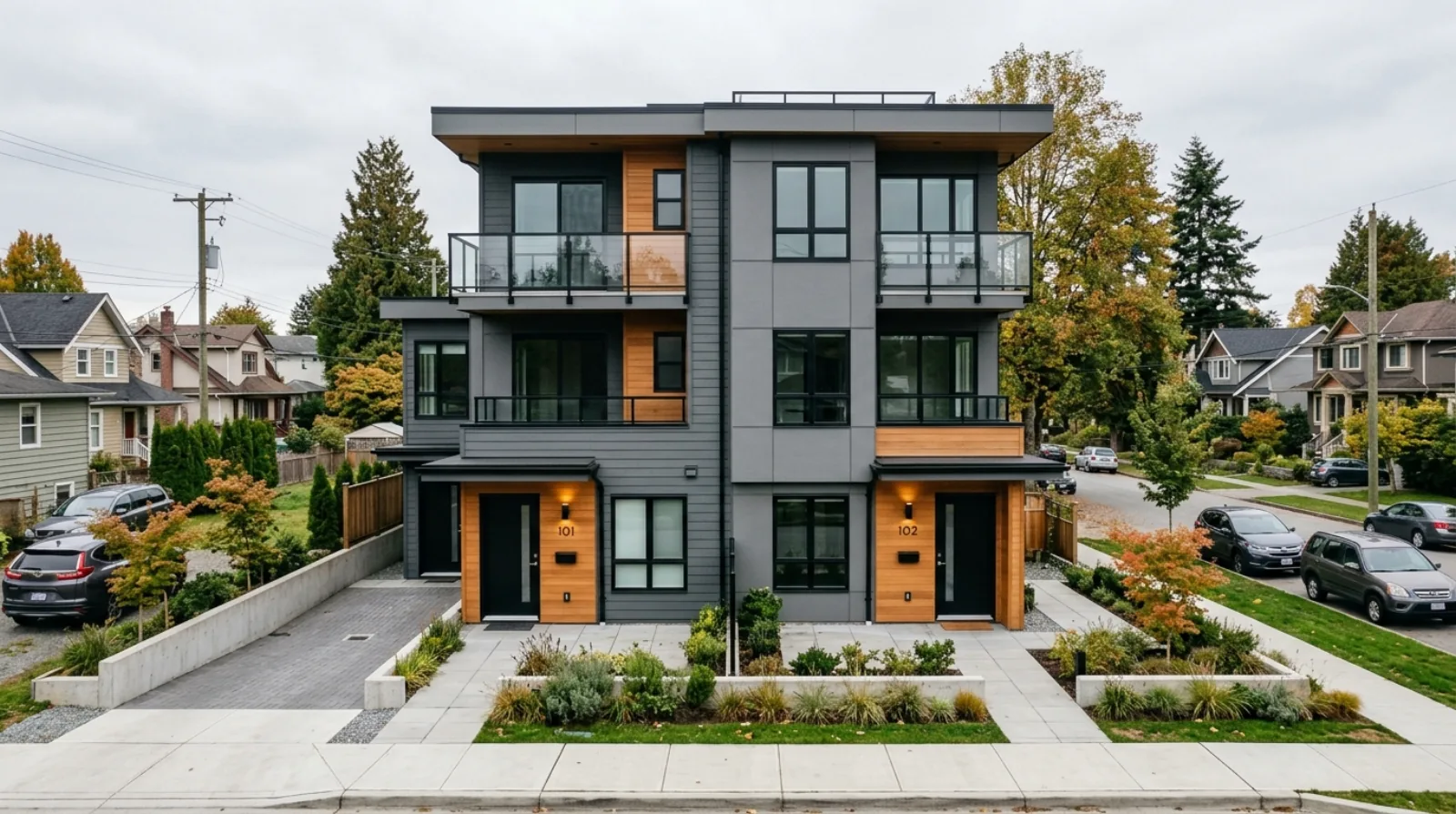
The eligible forms are broad. Pre-zoned properties allow infill housing such as duplexes, triplexes, quadraplexes, multiplexes, secondary suites, laneway houses, and side-by-side townhouses of up to six units. So this is not one narrow product. It is a menu, and the right choice depends on your lot shape, your budget, and whether you want to rent, sell, or house family.
Why New Westminster was ahead of the pack
Most BC municipalities spent 2024 and 2025 scrambling to meet the provincial deadline. New Westminster had a head start. Most of its residential zones already permitted some form of multi-unit housing before Bill 44 arrived, so the city was building on rules that already leaned toward density.
By 2026, roughly 570 properties had been pre-zoned for townhouses, and Official Community Plan amendments were moving through Council. The Infill Housing Program adopted in June 2026 pulled these pieces together. For a homeowner, the practical result is simple: fewer projects need a discretionary approval, and more can move straight to permit.
The 280 square metre line, and the 400 metre line
Two numbers decide your ceiling. The first is 280 square metres of lot area. A metric lot at 280 square metres is about 3,014 square feet, which is smaller than a standard 33-foot Vancouver lot. Most detached lots in New Westminster clear that bar, so four units is a common baseline.
The second number is 400 metres to frequent transit. That is the difference between four units and six. If your lot is a short walk from a frequent bus route, you have real optionality. If it is not, four units is your working number, and you should design around that rather than hope for an exception.
Here is the honest part. Six units is not always the best answer even when it is allowed. More units means more construction cost, a bigger loan, and a longer build. On a soft resale block, a well-built fourplex can beat a cramped sixplex. The permission sets your ceiling. The lot economics decide where you should actually land.
Rent, sell, or house family
The form you choose usually follows the goal. If you want steady income, a build-to-rent multiplex holds all units and leans on stable long-term tenants. If you want to pull out cash, some owners build to sell, though selling individual units in a multiplex is harder than most people expect and often means selling the whole building. If you want to keep family close, a mix of a larger owner unit plus rentals lets aging parents or adult children live on the same lot without sharing a kitchen.
New Westminster’s rules support all three. What they do not do is tell you which one pencils on your specific lot. That is where the real work starts.
How to read your own lot
Start with three facts: your lot area in square metres, your distance to the nearest frequent bus stop, and your lot width. Those three tell you your unit ceiling and roughly what form fits. Then test the money. Land basis, construction cost, unit mix, and likely rents or resale all have to line up before a project is worth doing.
Two lots on the same street, under the same pre-zoning, can produce very different outcomes once you run real numbers. One carries a strong sixplex. The next barely supports a fourplex. Permission is the easy part now. Selection is the hard part.
Common questions from New Westminster homeowners
Do I need to rezone my lot? For most residential lots, no. The Infill Housing Program pre-zoned properties for infill housing, which is the whole point. You still need a building permit and have to meet the design and servicing rules, but the slow discretionary rezoning step is gone for permitted forms.
How do I know if I can build six units instead of four? Two conditions. Your lot has to be larger than 280 square metres, and it has to sit within 400 metres of a bus stop the Province lists as frequent service. Miss either one and your ceiling is four units.
Is a laneway house still allowed? Yes. Laneway houses are among the permitted infill forms, alongside secondary suites, duplexes, triplexes, fourplexes, multiplexes, and side-by-side townhouses.
Does more units always mean more profit? No. Six units costs more to build and finance than four, and takes longer. On some lots and some blocks a fourplex is the stronger play. Run the numbers per lot rather than defaulting to the maximum.
New Westminster removed the hardest step for most homeowners. The next step is figuring out what your specific lot can actually carry. Check your lot in about two minutes before you commit to a plan.
David Babakaiff, Co-Founder, VanPlex | PlexRank™ | Profit with Multiplex