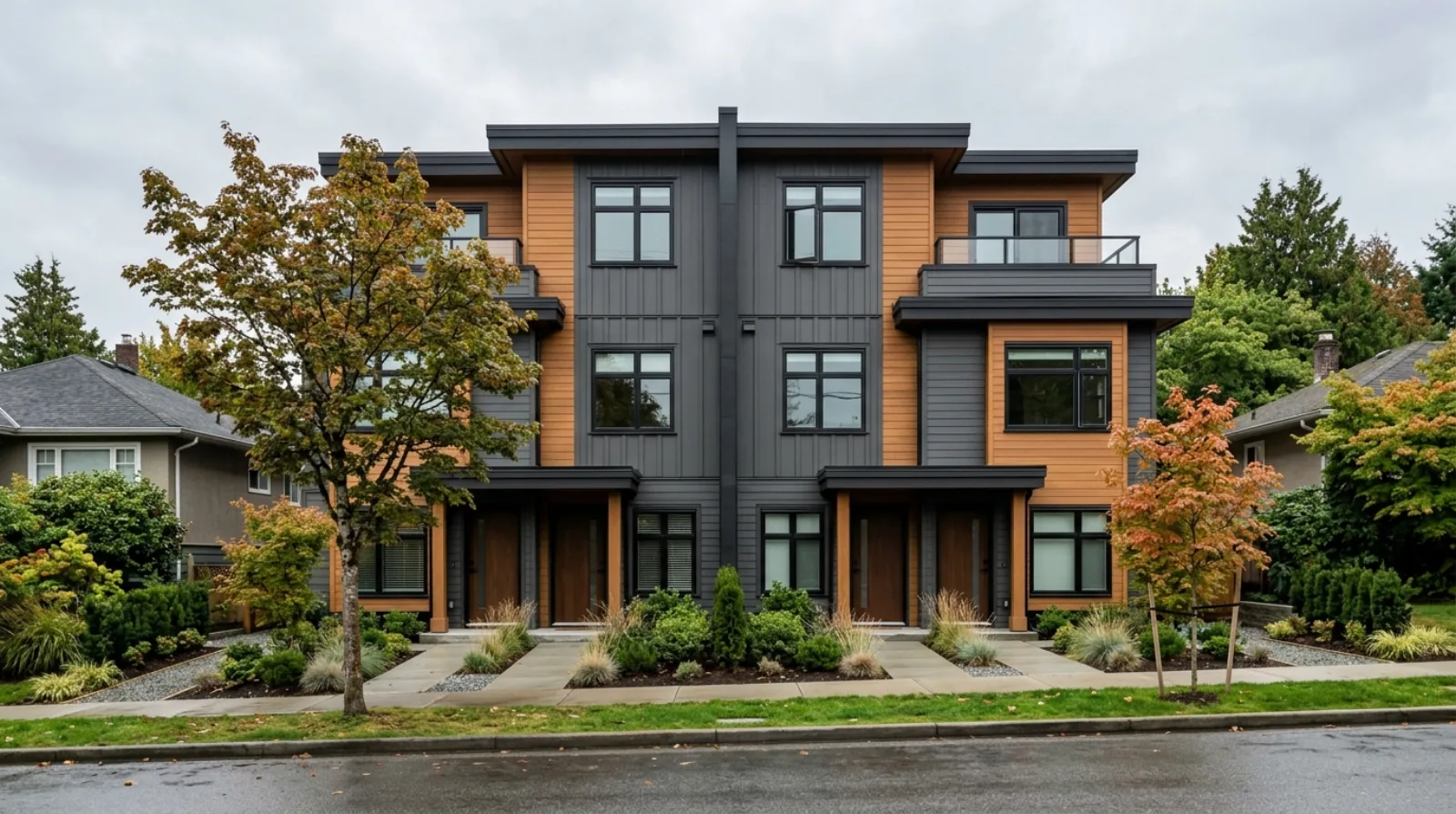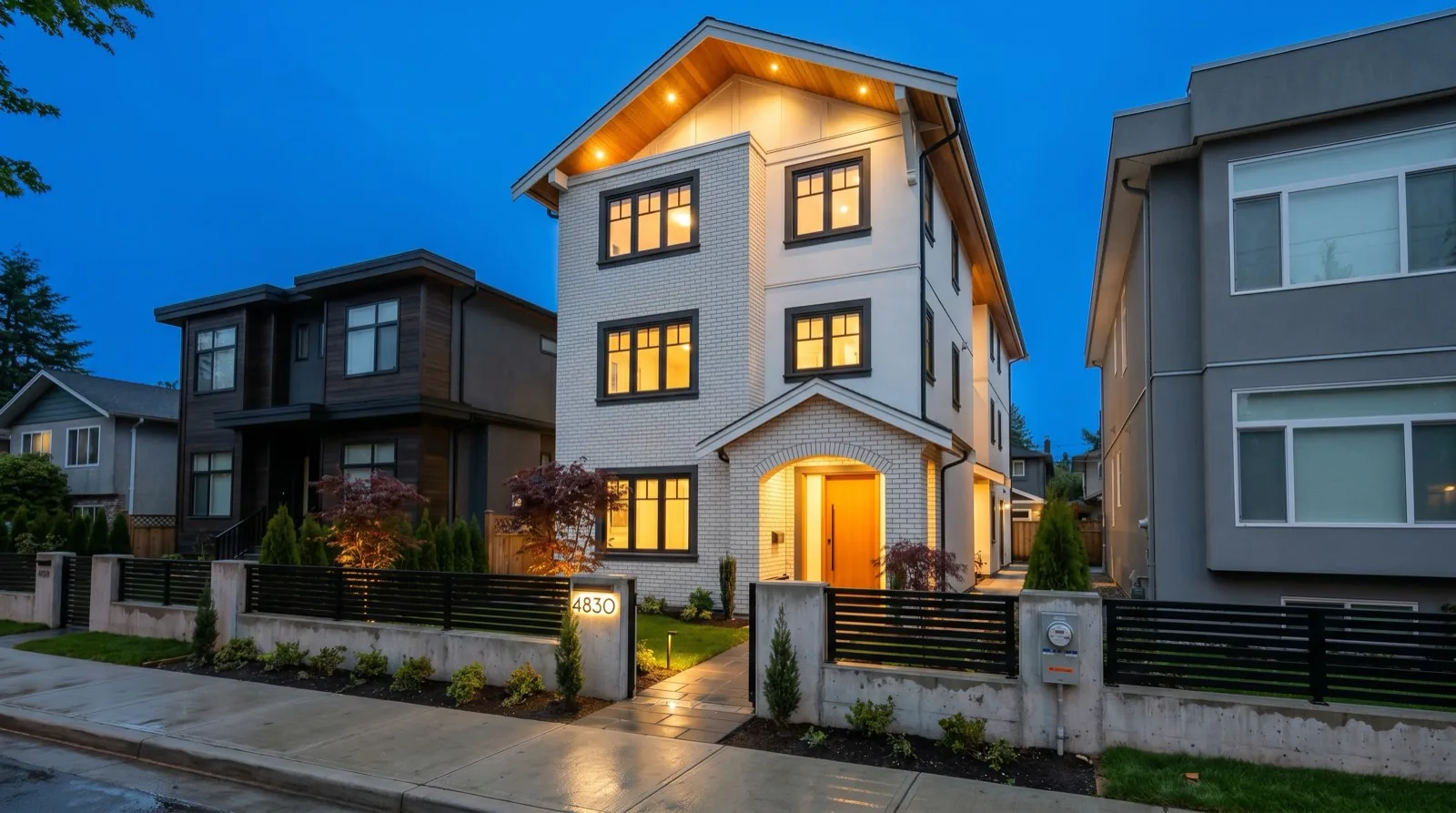

A family that owns a triplex on one title has two ways to sell one unit to someone outside the family. It can sell a share of the whole property, with a written agreement that gives the buyer the use of one unit. Or it can turn the triplex into 3 strata lots and sell one lot. The first route brings in BC’s Real Estate Development Marketing Act (REDMA) as soon as there are 2 such shares in the property. The second needs a strata plan, and city approval if the building has been lived in, but a 3-lot strata stays below the 5-lot line where REDMA’s disclosure rules start.
This post compares the two routes and explains how votes work once an outside owner joins the family. Our family plex guide covers the choices a family faces before anyone sells.
Route 1: sell a co-ownership share
In this route the family and the buyer all stay on one title as co-owners, and a co-ownership agreement says who lives in which unit. REDMA calls the buyer’s interest a “shared interest in land”: an interest in land owned by the person “and at least one other person”, where, as part of the deal, “that person’s right of use or occupation of the land is limited to a part of the land” (REDMA s.1).
The same section makes “2 or more shared interests in land in the same parcel” a “development property”. In a triplex where the buyer’s share is limited to unit 3 and a family member’s share is limited to unit 1, there are already 2. At that point the family is a developer under REDMA, and Part 2 of the Act applies:
- No marketing before filing. The developer must not market a unit until it has prepared a disclosure statement and filed it with the Superintendent of Real Estate (s.14).
- The buyer reads it first. The buyer gets a copy and signs a statement that they had a chance to read it before the purchase agreement is made (s.15).
- Deposits go into trust. Any deposit is held by a brokerage, lawyer or notary in a trust account at a BC savings institution (s.18).
- 7 days to cancel. The buyer may cancel within 7 days after the later of the agreement and the signed statement (s.21(2)). If they never got a disclosure statement they were entitled to, they may cancel at any time (s.21(3)).
- A filing fee. $2,250 to file a disclosure statement for fewer than 10 units (REDMA Regulation s.13).
The REDMA Regulation lists exemptions, such as selling the whole development property in a single transaction, industrial or commercial property, and leases of 3 years or less. None of them covers a small family building. The Superintendent can grant an exemption on request under s.20 of the Act. Ask a lawyer whether your sale counts as “marketing” before you talk to any buyer.
Route 2: stratify and sell a strata lot
Here the family files a strata plan that turns the triplex into 3 strata lots, each with its own title, and sells one of them.
- City approval if lived in. If anyone has ever lived in the building, it is “previously occupied” (Regulation s.14.1) and the city must approve the plan under s.242 of the Strata Property Act. The city must refuse unless the building “substantially complies” with its bylaws and the building regulations. Our strata conversion guide lists the 2026 fees we confirmed, for example $2,000 for up to 4 units in Burnaby, $6,799.30 for more than two units in Coquitlam’s standard zones, and $500 in Saanich.
- Tenant rules. If units are rented, many cities add tenant steps. In Coquitlam, a conversion of 3 or more rental units is not favoured when the vacancy rate is under 4.0%, and at least 60% of tenants must be in favour. In Victoria, Council decides when tenants live in the building.
- Principal units only. Several cities limit strata lots to the main homes in a building. Vancouver says “a secondary suite cannot be defined as a separate strata lot under any circumstances”, and Burnaby, Coquitlam and Richmond also bar suites from becoming strata lots. A “triplex” that is really a house, a suite and a laneway home may not qualify.
- Below REDMA’s line. REDMA counts “5 or more strata lots in a stratified building” as development property, so a 3-lot strata is outside it. The buyer gets the 3-business-day Home Buyer Rescission Period instead, and pays 0.25% of the price to cancel within it.
The family then becomes the owner developer, with its own duties before and after the first sale, including an interim budget for the buyer and a first annual general meeting.
The two routes side by side
| Co-ownership share | Strata lot | |
|---|---|---|
| Title | One title, shared by all co-owners | Its own title for each lot |
| REDMA disclosure statement | Yes, at 2 or more shared interests | No, below 5 strata lots |
| Buyer’s right to cancel | 7 days after signing (s.21) | 3 business days, 0.25% fee |
| City approval | None under the Strata Property Act | Yes if previously occupied (s.242) |
| Who decides about the building | Whatever the co-ownership agreement says | The Strata Property Act, the bylaws and owner votes |
| Each owner’s share of costs | Set by the agreement | Unit entitlement (s.99) |
Sources: REDMA s.1, s.14 to s.21; REDMA Regulation s.13; Strata Property Act s.242, s.99; Property Law Act s.42. Our page on title choices compares more options.
How votes work after the sale
If you choose the strata route, the outside buyer joins a 3-lot strata with the family. Each lot has one vote (s.53(1)), and with fewer than 4 lots every owner is on council (Standard Bylaw 9(2)).
| Vote | What it takes in a 3-lot strata |
|---|---|
| Majority, such as the budget | 2 of the votes cast |
| 3/4, such as a bylaw change or a special levy | One “no” vote blocks it |
| Unanimous, such as a new fee formula | All 3 lots; no court override under 10 lots (s.52) |
One rule catches families. If two or more people share the vote for one lot, and the chair is told they disagree on how to vote, “the chair must not count their vote” (s.57(2)). Say two siblings own lot 1 together and a parent owns lot 2. If the siblings split on a budget, their vote is not counted, and the outcome turns on the other two lots. Agree in writing, inside the family, how a shared lot will vote before the outside buyer arrives. Our guide to when owners disagree covers deadlocks in 2-lot and 3-lot stratas.
What we would do
For a sale to an outside buyer, the strata route gives the buyer a separate title and a set of rules written in the Act, and it keeps the family outside REDMA’s filing. The co-ownership route avoids the city step, but adds a disclosure statement and leaves every rule to a private agreement. Either way, surveyor and lawyer fees are quoted per job and have no published figure. Our family plex guide has a checklist for the conversation with your family before you call either one.
We are building the StraPlex app for owners of 2 to 6 unit stratas, with votes counted the way the Act counts them, including shared lots, so a family strata can see where it stands before a meeting. The waitlist is below.
David Babakaiff, Co-Founder, VanPlex | PlexRank™ | Profit with Multiplex