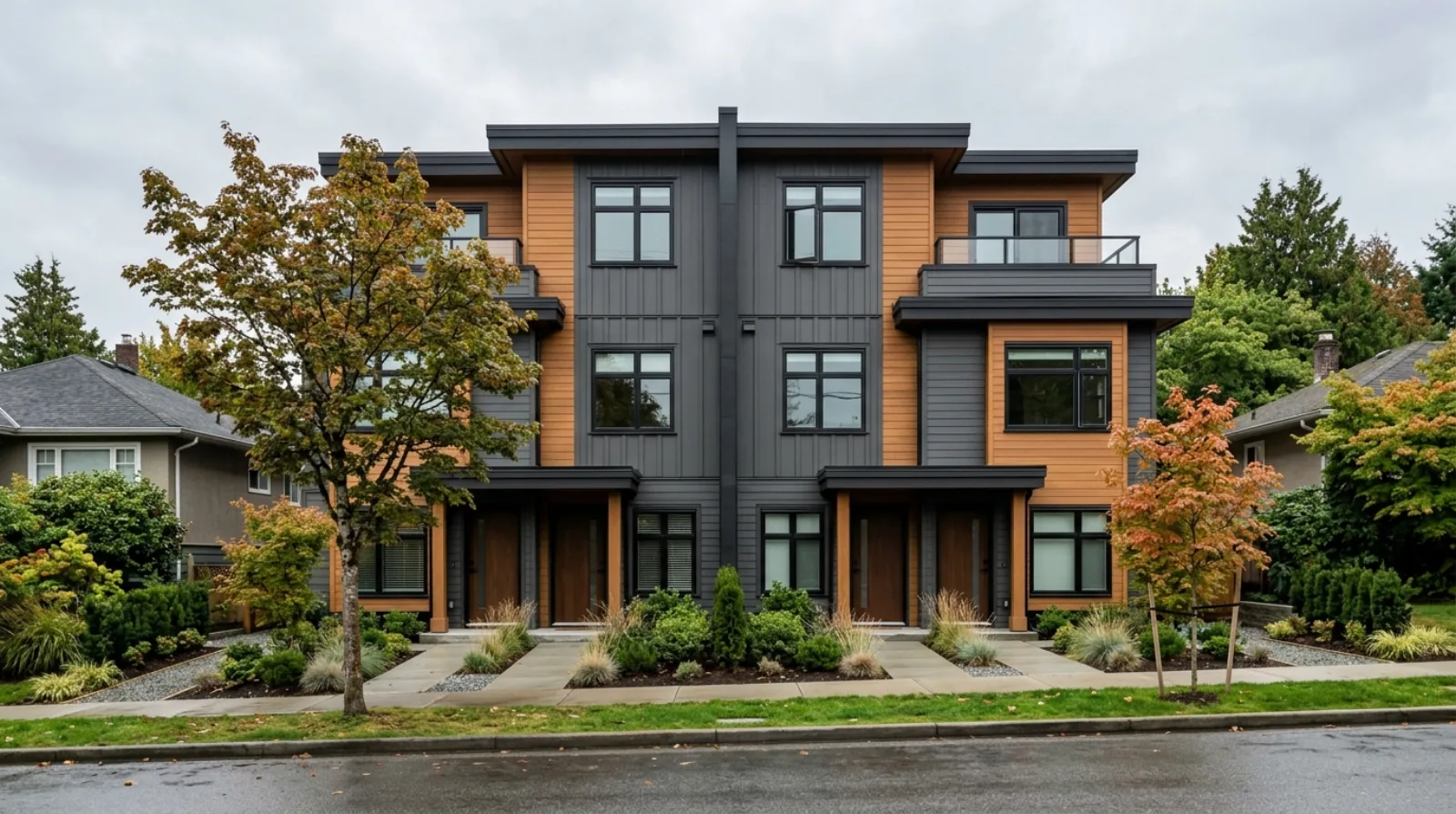

First buyers in a new Vancouver fourplex wrote to a strata advice column in December 2025 with two worries. The developer had told them there would be no strata fees for the first year, and the building’s insurance was due to run out in a month. Both points have a clear answer in the BC Strata Property Act. The developer pays the strata’s costs only up to the last day of the month of the first sale. From the next month, owners pay monthly fees set by an interim budget the developer must hand to every buyer before they sign. And the developer must keep the insurance in force until at least 4 weeks after the first annual general meeting.
This post sets out who pays what in a new small strata, month by month, and what to ask for if your developer’s promise does not match the law. Our page on owner developer duties has the full list of the developer’s legal jobs.
Who pays, month by month
| Period | Who pays the strata’s costs | Where |
|---|---|---|
| Plan filed, up to the end of the month of the first sale | The owner developer pays the actual expenses | SPA s.7 |
| At the first sale | Developer puts the opening money into the contingency reserve fund | SPA s.12 |
| From the first day of the next month, until the first annual budget starts | The strata pays its expenses, and each owner pays a monthly share set by the interim budget | SPA s.14(1), (2) |
| Within 8 weeks after the first AGM | Developer pays any amount by which real costs beat the interim budget, plus a penalty at 10% over or more | SPA s.14(4), (5); Regulation s.3.1(1) |
| After the first AGM | The first annual budget, approved by owners by majority vote | SPA s.21 |
Sources: Strata Property Act, Part 3; Strata Property Regulation s.3.01 and s.3.1. Both current to October 27, 2026.
“No fees for the first year” does not fit that table. Section 14(2) says that during the interim budget period “the owners must pay to the strata corporation, each month, their monthly share” of the estimated expenses and the reserve contribution. If a developer offers to cover your share as a sales incentive, get the promise written into your purchase contract. The Act still names you, the owner, as the person who owes the strata each month.
The interim budget you should have received
Section 13 makes the developer prepare an interim budget for the 12 months that start on the first day of the month after the first sale. The developer must deliver a copy to each buyer before the buyer signs the purchase agreement (s.13(1)(b)).
It must show three things (s.13(2)):
- the estimated operating expenses for those 12 months
- the contribution to the contingency reserve fund, at least 10% of the estimated operating expenses (Regulation s.3.01(1))
- each strata lot’s monthly share of both, worked out by unit entitlement under s.99
Unit entitlement is the number for each lot on the Schedule of Unit Entitlement filed with the strata plan. It sets each owner’s share of costs. Our budget and contingency reserve fund guide explains how the 10% minimum carries into every later year.
If you never got an interim budget, ask the developer for it in writing. Under s.36 an owner can also ask the strata for its records, and the strata must provide copies within 2 weeks at no more than 25 cents a page (Regulation s.4.2).
What the developer owes if the budget was too low
An interim budget that is set low makes the building look cheap to run. The Act puts the cost of a low guess on the developer.
If the strata’s real costs during the interim period are higher than the interim budget, the developer pays the difference within 8 weeks after the first AGM (s.14(4)). If the overrun is 10% or more, the developer also pays a penalty (s.14(5); Regulation s.3.1(1)):
| Real costs compared with the interim budget | Developer pays |
|---|---|
| Under 10% over | The difference |
| 10% to under 20% over | The difference, plus 2 times the difference |
| 20% or more over | The difference, plus 3 times the difference |
On a $10,000 interim operating budget with $11,500 of real costs, the difference is $1,500, the penalty is $3,000, and the developer pays $4,500 in total. At $12,500 of real costs, the difference is $2,500 and the developer pays $10,000 in total (our arithmetic on the Regulation’s multipliers).
If real costs come in lower, the strata refunds owners in proportion to what they paid, unless no owner would get more than $100, in which case the strata may put the money in the reserve fund (s.14(6), (7)).
Those amounts are money owing to the strata, and sections 112 to 118 of the Act, the same sections that cover unpaid strata fees, apply to collecting them (s.18).
The reserve fund starts at the first sale
At the first sale, the developer must open the contingency reserve fund by paying in the minimum the Act sets (s.12(1)). The amount depends on how long after the plan was filed the first sale happens:
- First sale within 1 year of the plan being filed: at least 10% of the estimated operating expenses in the interim budget (s.12(2); Regulation s.3.01(1)).
- First sale later than that: the lesser of 10% times the number of years or part years since the plan was filed, or 50% (s.12(3); Regulation s.3.01).
The developer may not spend reserve money on the strata’s expenses (s.12(4)), and the fund belongs to the strata (s.12(5)). During the interim period the strata itself may not use reserve money for expenses that accrue before owners approve the first annual budget (s.14(3)).
The insurance question
This was the second half of the buyers’ letter, and it is the more urgent one. Every strata, at any size, must insure the common property, the common assets and the buildings shown on the strata plan for full replacement value (s.149), and carry at least $2,000,000 of liability insurance (Regulation s.9.2).
For a new building the developer has an extra duty. Section 15 says the developer “must ensure that the term of any insurance policy entered into by or on behalf of the strata corporation continues for at least 4 weeks after the first annual general meeting.” A policy that ends before the owners have met and elected a council breaks that rule.
Two other sections help if the date is close:
- The strata must tell owners and tenants as soon as feasible of any material change in its insurance, including a higher deductible (s.154(c)).
- Buying or keeping the insurance the Act requires counts as preventing significant loss, so it can be paid without a vote under s.98(3) and (3.1).
Ask the developer, in writing, for the policy, the end date and the renewal plan. Our strata insurance guide explains what the strata policy covers and what your own policy should add.
When the first AGM must happen
The developer runs the strata until owners elect a council at the first annual general meeting (s.5). That meeting must be held within the 6 weeks that start on the earlier of two dates (s.16(1)):
- the date 50% plus one of the lots have been sold, or
- 9 months after the first sale
In a fourplex, the third sale starts the clock if it comes before the 9-month mark. If the developer is late, any owner may call the meeting, and the developer owes the strata $1,000 for a delay of up to 30 days plus $1,000 for each further 7 days (s.17; Regulation s.3.1(2)).
At that meeting the developer must hand over a list of documents (s.20(2)), including the building permit plans, every contract, the registered strata plan, the names of the main contractors (Regulation s.3.2), and all warranties and manuals. The developer must also put a first annual budget before the meeting, which owners approve by majority vote (s.21(4)), with at least 10% going to the reserve (Regulation s.3.4). Within 1 week after the meeting, the developer hands control of the money and the keys to the new council (s.22). The first year checklist turns that list into tasks.
Questions to send your developer this week
Our page on owner developer duties lists each duty with its section, if you need to quote one.
- Please send the interim budget you were required to deliver under s.13. What is my lot’s monthly share?
- On what date did the first sale register, and when did you pay the opening reserve fund contribution under s.12? How much was it?
- Please send the strata insurance policy and its end date. How will you keep it in force until 4 weeks after the first AGM, as s.15 requires?
- On what date will the first AGM be held under s.16?
Keep the answers. They become part of the strata’s records, and the next buyer of any unit will ask for them.
We are building the StraPlex app for owners of 2 to 6 unit stratas, with the records, the budget and the insurance dates in one place. The waitlist is below.
David Babakaiff, Co-Founder, VanPlex | PlexRank™ | Profit with Multiplex