
If a Tampa house in a flood zone needs repairs that cost half of what the building is worth, or more, it can’t simply be fixed. It has to be brought up to today’s flood and building rules first, which often means raising it. That’s the 50% rule. After Hurricanes Helene and Milton in 2024, the City of Tampa started mailing letters to owners whose houses may be over that line. We’re the editors at BIMINIO Properties, and we buy houses for cash in Tampa.
What the rule says
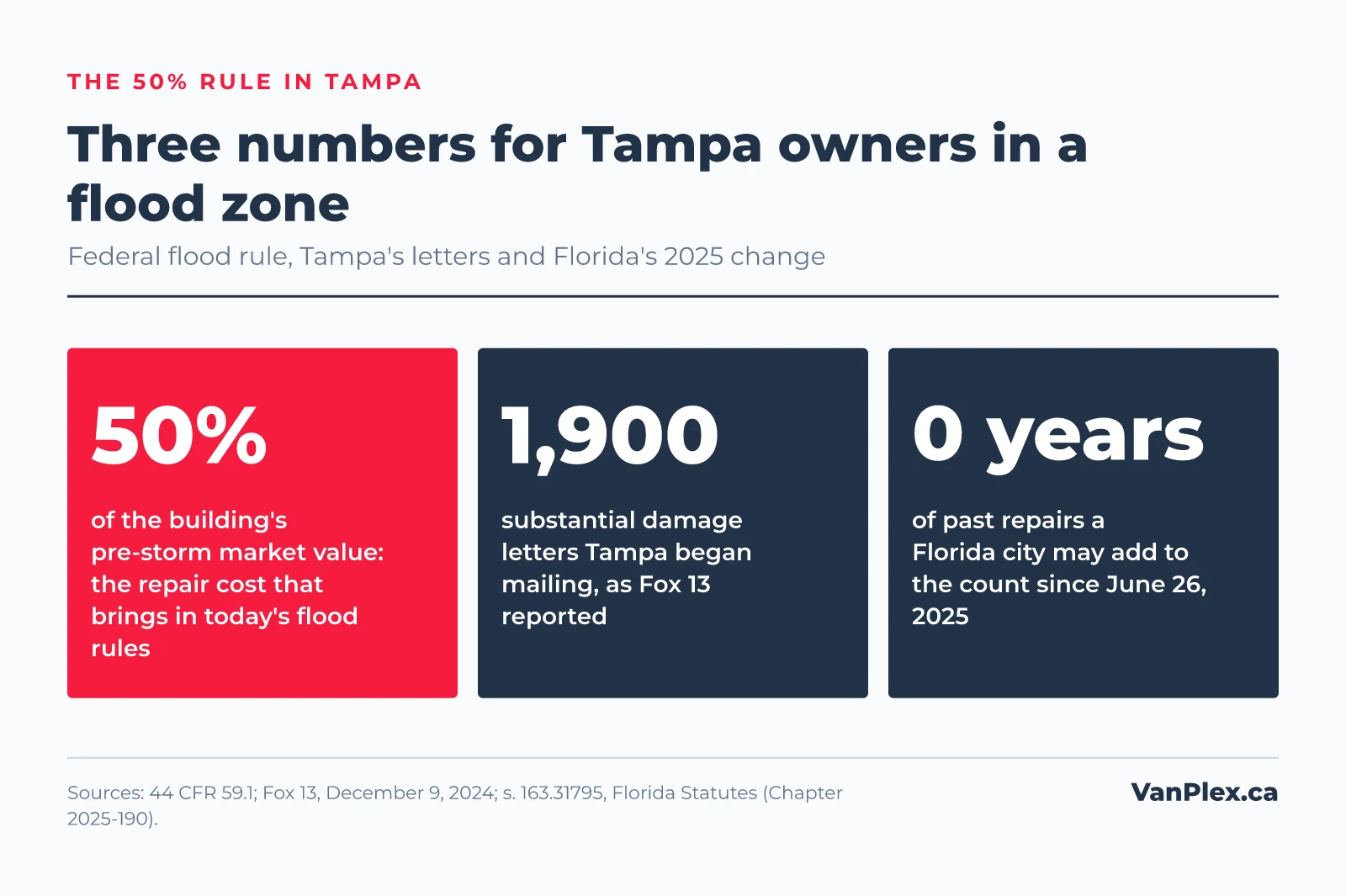
The rule comes from the federal flood insurance program. 44 CFR 59.1 defines “substantial damage” as damage “whereby the cost of restoring the structure to its before damaged condition would equal or exceed 50 percent of the market value of the structure before the damage occurred.”
“Structure” means the building, so the land under it isn’t counted. “Before the damage occurred” means the city uses what the building was worth before the storm.
The same section defines “substantial improvement” the same way for planned work: a renovation or addition whose cost reaches 50% of the building’s market value. It also says the term “includes structures which have incurred ‘substantial damage’, regardless of the actual repair work performed.”
What Tampa did after the 2024 storms
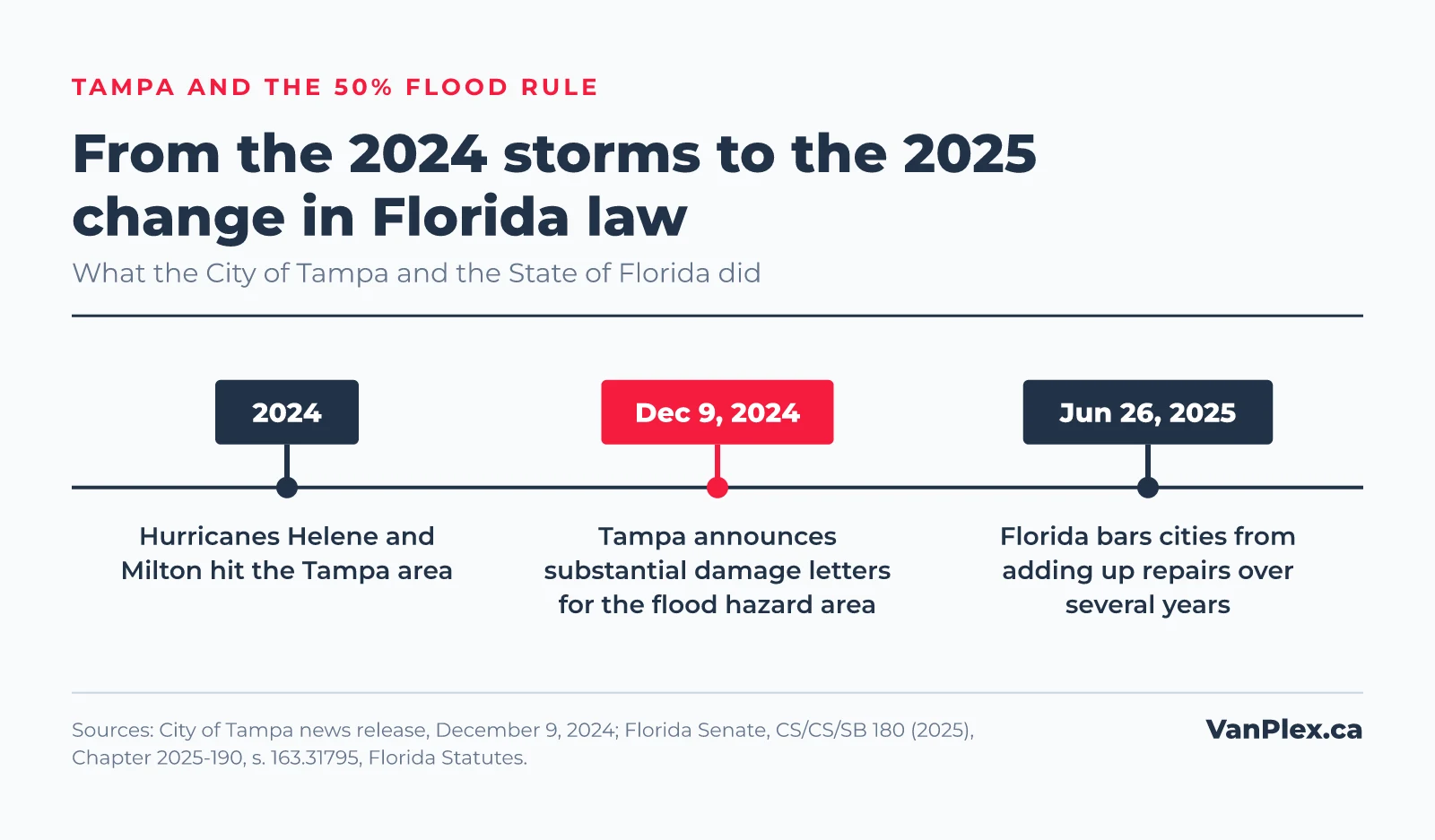
On December 9, 2024, the City of Tampa announced it would mail substantial damage letters to owners of homes and businesses in the flood hazard area after Hurricanes Helene and Milton (City of Tampa). Fox 13 reported the city was starting to mail “some 1,900” of them (Fox 13).
The city’s release puts the rule in one line: “Substantially damaged means the cost to repair your house or business is more than half of its value.” And the result in another: “If it is substantially damaged, it cannot be repaired without meeting current floodplain and building code requirements.”
A letter is the first step. Abbye Feeley, the city’s Development and Economic Opportunity Administrator, said the next step is to fill out the Substantial Damage Determination form that comes with it. She also said: “If the structure is deemed substantially damaged, you may need to elevate your home or flood-proof your business.” Fox 13 quoted her as saying the city is “not here to tell everyone that they have to tear their home down.”
What Florida changed in 2025
Some Florida cities used to add up every repair over a set number of years and compare the total with the 50% line. That window is called a “cumulative substantial improvement period”, or a lookback.
Senate Bill 180 ended it. The governor approved it on June 26, 2025, as Chapter 2025-190, Laws of Florida (Florida Senate). It created section 163.31795 of the Florida Statutes, which says a local government in the National Flood Insurance Program “may not adopt or enforce an ordinance for substantial improvements or repairs to a structure which includes a cumulative substantial improvement period.”
So in Tampa, repairs from earlier years can no longer be added to today’s permit to reach the 50% line.
How the 50% math works, in an example
Say a house in a Tampa flood zone has a building value of $180,000 before the storm. The land is worth more, but the land isn’t counted. Half of $180,000 is $90,000.
| Repair estimate | Share of the building value | Result |
|---|---|---|
| $60,000 | 33% | Under the line: repair as before, with permits |
| $90,000 | 50% | At the line: substantially damaged |
| $120,000 | 67% | Over the line: substantially damaged |
These numbers are an example. Your city sets the market value it uses and the repair costs it counts, and the form that comes with the letter is where you give your figures. For your own house, the City of Tampa makes the call.
Older houses on valuable lots reach the line sooner for this reason. When most of the property’s value is in the land, the building value is small, and a flooded floor, drywall and wiring can pass half of it.
Your three choices if your house is over the line
- Repair it to today’s rules. That can mean raising the house or flood-proofing it, as the city’s release says. The cost is on top of the storm repairs.
- Tear it down and build new. A new building is designed to today’s flood rules from the start. Some owners do this themselves. Others sell the lot to a builder who does it.
- Sell it as is. You sell the house in its current state and let the buyer deal with the determination and the rebuild.
The right choice depends on what the repairs cost, what you can borrow, and whether you want to live there through a rebuild.
If you sell as is
Tell the buyer about the letter and the determination. A buyer who plans to rebuild will price the lot, the demolition and the new building. A buyer who plans to repair will price the elevation work.
At BIMINIO we buy houses in Tampa in any condition, including flood-damaged ones. We send a written cash offer within 24 hours, and you pick a closing date from 7 to 35 days. A cash offer is below full market value, and we say that every time. You can see how it works on our Tampa page.
Before you sell, settle your insurance claim. Florida has deadlines for reporting a property claim, and our post on storm damage claims lists them.
If you’re a builder looking at these lots
For a builder, a substantially damaged house on a good Tampa lot can be a land purchase. The building may be worth little to you, but the lot is worth what you can build on it under today’s flood rules. Run the numbers before you make an offer. VanPlex makes a custom proforma for any United States address, Tampa included.
This post explains the rule in general. For a decision on your own house, call the City of Tampa’s Development and Economic Opportunity department and read the letter they sent you.
The editors, BIMINIO Properties