
Duplex Design Guide for BC
Everything you need to know about building a duplex in BC — from standardized designs and lot requirements to costs and municipal rules.
Key Takeaways
- ✓ Duplexes are now permitted on virtually all single-family lots across BC under SSMUH legislation.
- ✓ BC's standard catalogue offers two duplex designs: Duplex 1 (side-by-side) and Duplex 2 (stacked).
- ✓ Minimum lot requirements are typically 33 ft frontage and 3,800 sq ft area.
- ✓ Total construction cost ranges from $800K to $1.4M depending on size, finishes, and location.
- ✓ Units can be stratified and sold individually, creating flexible exit strategies for builders.
What Is a Duplex Under BC Building Code?
A duplex is a residential building containing exactly two dwelling units on a single lot. Under the BC Building Code, a duplex is classified as a Part 9 residential building (up to 3 storeys, 600 m² per unit), which means it follows the same prescriptive construction standards as a single-family home rather than the more complex Part 3 requirements for larger multi-unit buildings.
BC's Small-Scale Multi-Unit Housing (SSMUH) legislation, effective June 2024, requires all municipalities to permit at least a duplex on any lot previously zoned exclusively for single-family use. This makes the duplex the most broadly permitted multiplex type in the province.
Which BC Catalogue Designs Apply?
The BC standardized housing designs catalogue, created by Leckie Studio Architecture, includes two duplex-specific concepts. Using these pre-approved designs can reduce permit timelines and design costs.
Side-by-Side Duplex
Two units arranged horizontally with a shared party wall down the centre. Each unit gets its own ground-level entrance, private yard space, and independent systems. Best for lots with 33 ft+ frontage where street presence matters.
Stacked Duplex
Two units arranged vertically -- one at grade, one above. Works well on narrower lots. Upper unit can have a separate exterior staircase or internal entry. Maximizes floor area on compact sites.
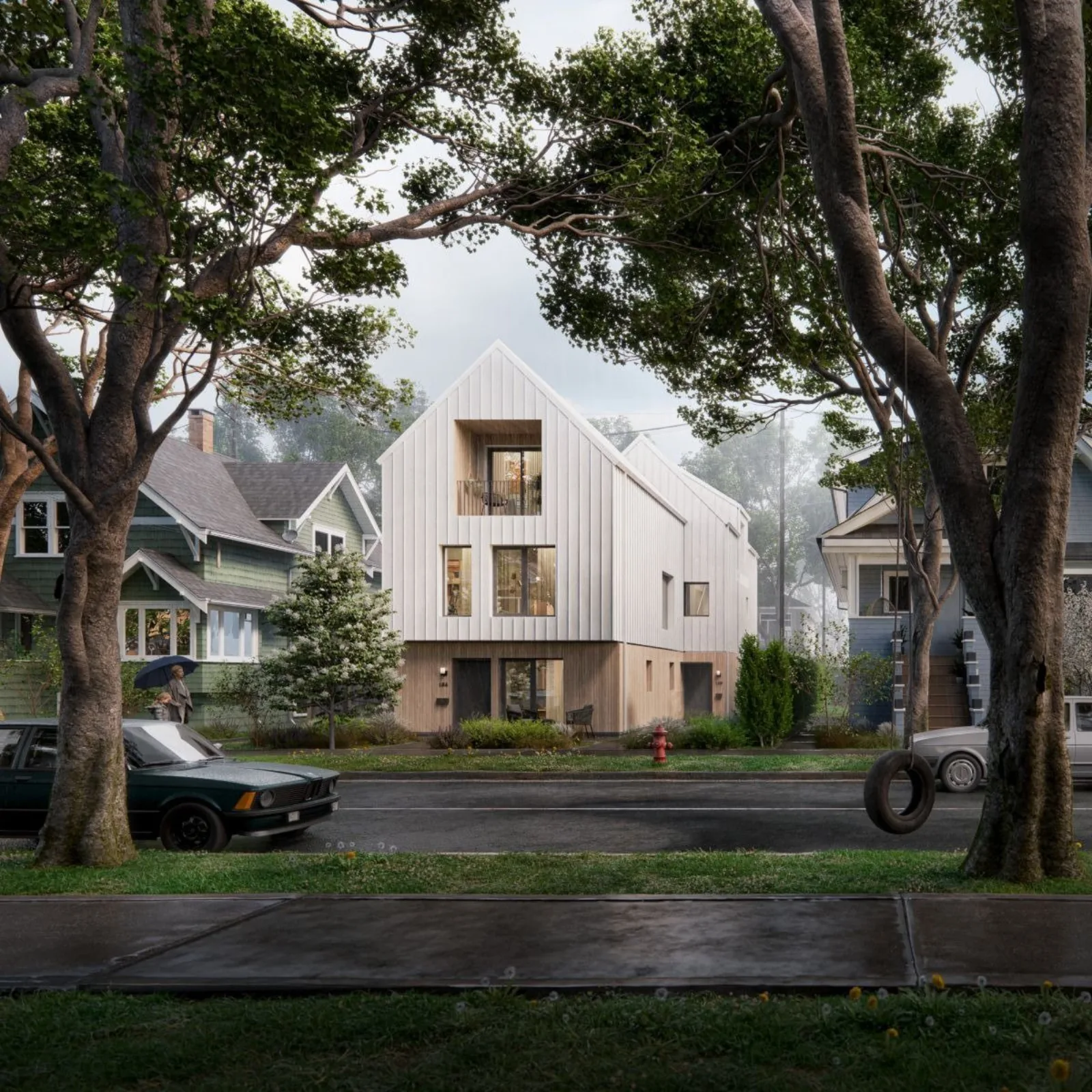
BC Government Standard Design Renderings
BC Standard Duplex — BC Standardized Housing Designs Catalogue
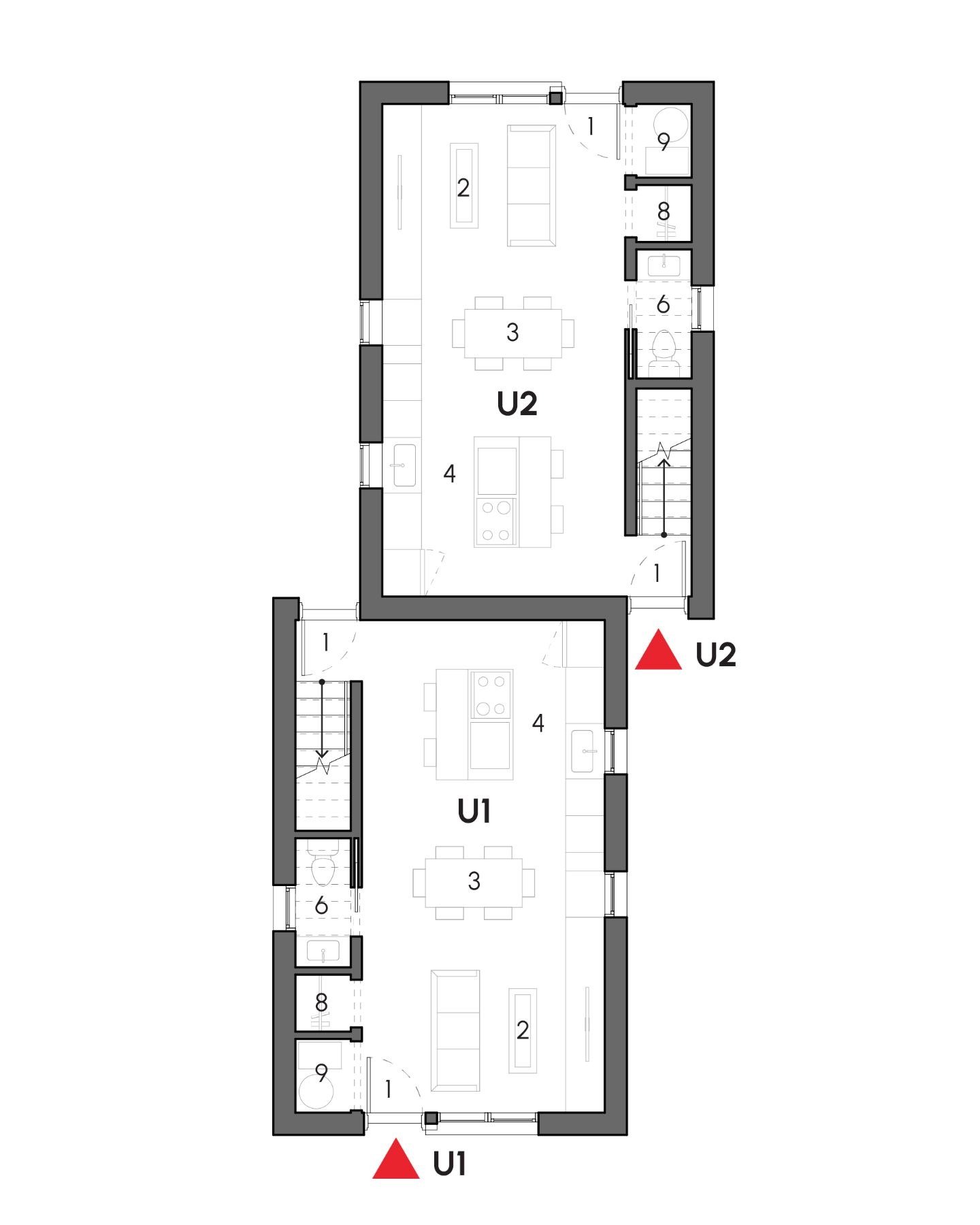
BC Standard Duplex — Main Floor Plan
Images sourced from the BC Standardized Housing Designs Catalogue (gov.bc.ca). Designs created by Leckie Studio Architecture + Design and partner firms under contract to the Province of British Columbia.
Lot Requirements
The following table summarizes typical lot requirements for duplex construction across Metro Vancouver. Specific dimensions may vary by municipality.
| Specification | Side-by-Side (Duplex 1) | Stacked (Duplex 2) |
|---|---|---|
| Minimum Frontage | 33 ft | 33 ft |
| Minimum Depth | 100 ft | 90 ft |
| Minimum Lot Area | 3,800 sq ft | 3,800 sq ft |
| Typical Zones | R1, RS-1, RS-2 | R1, RS-1, RS-2 |
| Max Height | 10.7 m (35 ft) | 10.7 m (35 ft) |
| Max FSR | 0.70 - 0.85 | 0.70 - 0.85 |
Typical 33 ft Lot Layout — Side-by-Side Duplex
UNIT A
~800 sq ft
UNIT B
~800 sq ft
Illustrative lot layout — actual setbacks vary by municipality
Design Considerations
Accessibility
At least one unit in a duplex must have a barrier-free path from the street to the main entrance, and the principal floor must be adaptable to wheelchair access. This typically means a stepless entry, wider doorways (min 860 mm clear), and reinforced bathroom walls for future grab bar installation.
Fire Separation
The party wall or floor/ceiling assembly between units requires a minimum 1-hour fire-resistance rating. This is achieved through double-layer Type X drywall on each side of the assembly. Each unit must also have interconnected smoke alarms and independent egress.
Sound Transmission
Assemblies separating dwelling units must achieve a minimum STC 55 rating (apparent field measurement of ASTC 50). Stacked duplexes also need impact insulation class (IIC) of 55 for floor/ceiling assemblies. Resilient channels, staggered studs, or double-stud walls are common solutions.
Privacy
Good duplex design offsets windows between units and uses landscaping, fencing, or architectural screening to create private outdoor areas for each household. Side-by-side configurations naturally provide better visual separation than stacked layouts.
Where Are Duplexes Permitted in BC?
Under SSMUH legislation, duplexes are permitted in every BC municipality on lots previously zoned for single-family housing. The table below shows specific municipal adoption details for Metro Vancouver.
| Notes | |||
|---|---|---|---|
| Vancouver | 6 | Adopted | All R1-1 zones; duplex permitted on lots 33 ft+ |
| Burnaby | 4 | Adopted | R1 zones; duplex on standard lots |
| Surrey | 4 | Adopted | All single-family zones |
| Coquitlam | 4 | Adopted | RS-1 and RS-2 zones |
| New Westminster | 4 | Adopted | Most residential zones |
| North Vancouver (City) | 4 | Adopted | RS zones; simplified permit |
| North Vancouver (District) | 4 | Adopted | Select residential zones |
| Port Coquitlam | 4 | Adopted | RS-1 zones |
| Richmond | 4 | Adopted | Single-family zones; flood construction level applies |
| Langley (Township) | 4 | Adopted | Urban residential zones |
How Much Does It Cost to Build a Duplex in Vancouver?
A duplex in Metro Vancouver typically costs $800,000 to $1.4 million to build for both units combined. Hard construction costs run $400 to $500 per square foot; soft costs (design, permits, and fees) add another $80,000 to $120,000. Final cost depends on size, site conditions, and finish level.
Hard Costs
$400 - $500
per sq ft
Soft Costs
$80K - $120K
permits, design, fees
Total Project Cost
$800K - $1.4M
for both units combined
Hard costs include foundation, framing, mechanical, electrical, plumbing, and finishes. Soft costs include architectural design, engineering, permits, surveys, legal, and project management.
Energy Requirements
All new duplexes in BC must comply with the BC Energy Step Code. Most municipalities require a minimum of Step 3 (some are already at Step 4 or 5). Duplexes benefit from shared walls which reduce heat loss, making it easier to achieve higher energy performance steps. Key requirements include high-performance windows (U-0.28 or better), continuous exterior insulation, heat recovery ventilation (HRV), and airtightness testing below 2.5 ACH50.
Run the Numbers for Your Property
Use the VanPlex proforma calculator to model duplex development scenarios on your specific lot -- including construction costs, financing, rental revenue, and return on equity.
Try the Proforma CalculatorFrequently Asked Questions
What is the difference between a side-by-side and stacked duplex?
A side-by-side duplex (Duplex 1) places units horizontally with a shared centre wall, giving each unit its own entrance at grade. A stacked duplex (Duplex 2) places one unit above the other, which works better on narrow lots but requires separate entrances at different levels. Side-by-side is generally preferred for privacy and ease of construction.
Can I stratify a duplex and sell each unit separately?
Yes. Under updated BC legislation, SSMUH units including duplexes can be stratified. This means you can create separate strata lots for each unit and sell them independently, which provides a flexible exit strategy for developers and investors.
What is the minimum lot size for building a duplex in BC?
Most municipalities require approximately 3,800 sq ft of lot area with at least 33 ft of frontage. However, requirements vary by city -- some allow duplexes on smaller lots if they are within transit-oriented areas. Always confirm with your local planning department.
How many parking spaces do I need for a duplex?
Under BC's SSMUH legislation, municipalities cannot require more than one parking space per unit (two total for a duplex). Properties within 400 m of frequent transit may have reduced or zero parking requirements, depending on the municipality.
Related Design Guides
- Triplex designs and floor plans for lots where a third unit improves the return.
- Fourplex designs and layouts for standard 33 ft and 50 ft Vancouver lots.
- Sixplex designs for larger lots near frequent transit.
- Bare land vs building strata in BC if you plan to sell each duplex unit separately.
- Vancouver zoning map to check how many units your lot allows before choosing a design.
Ready to Analyze Your Property?
Enter any BC address to get a free multiplex feasibility analysis with proforma projections.