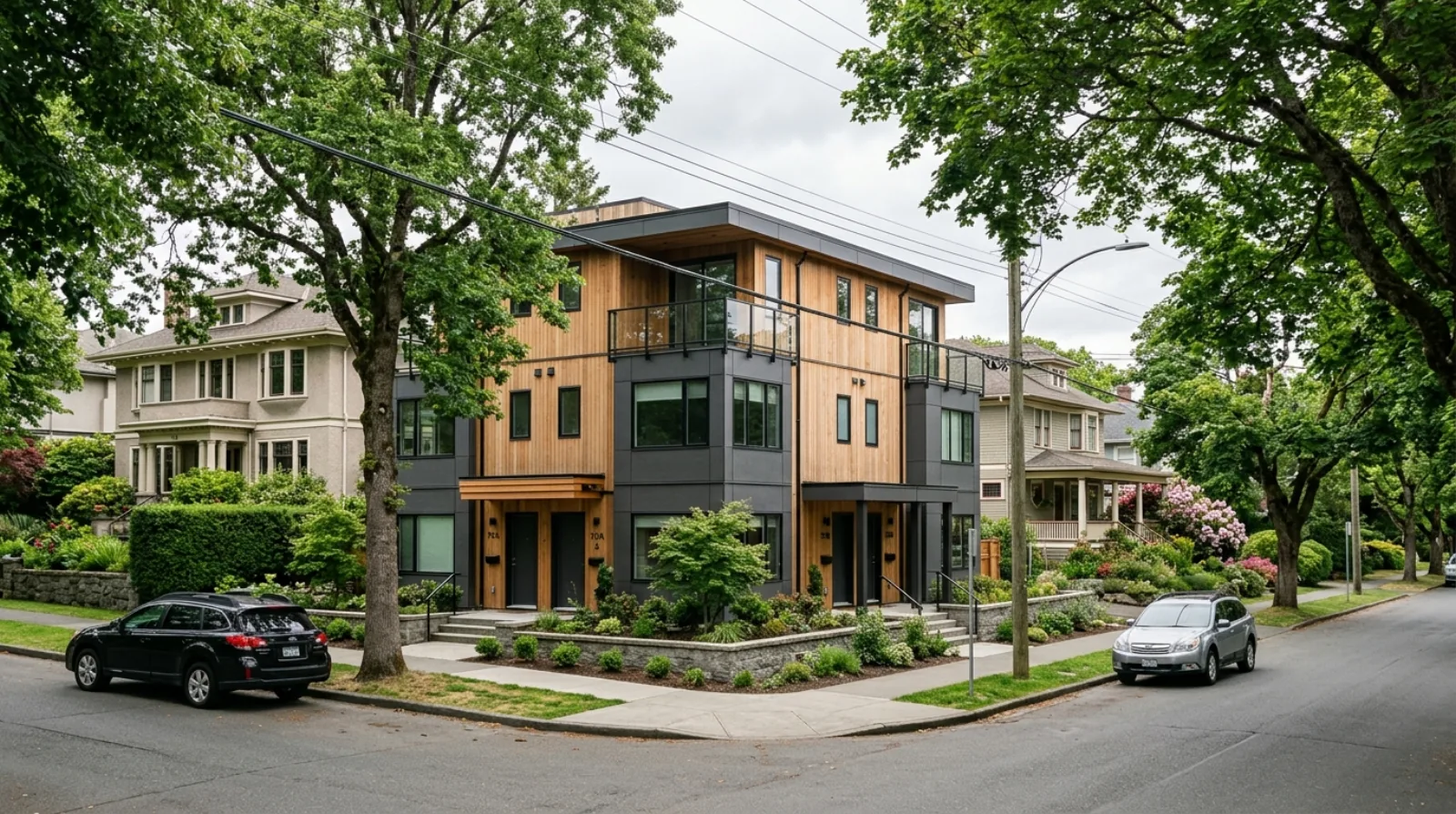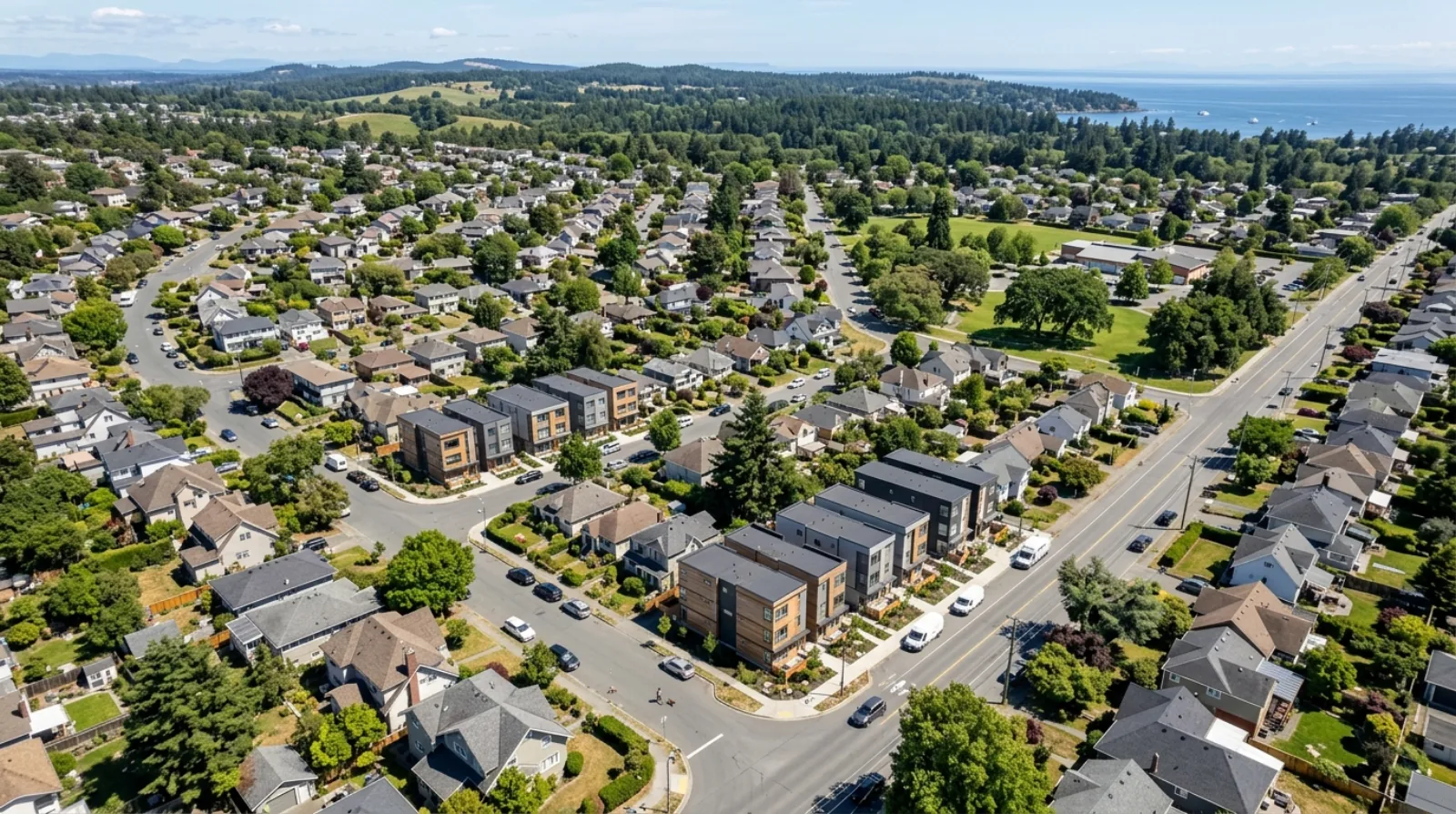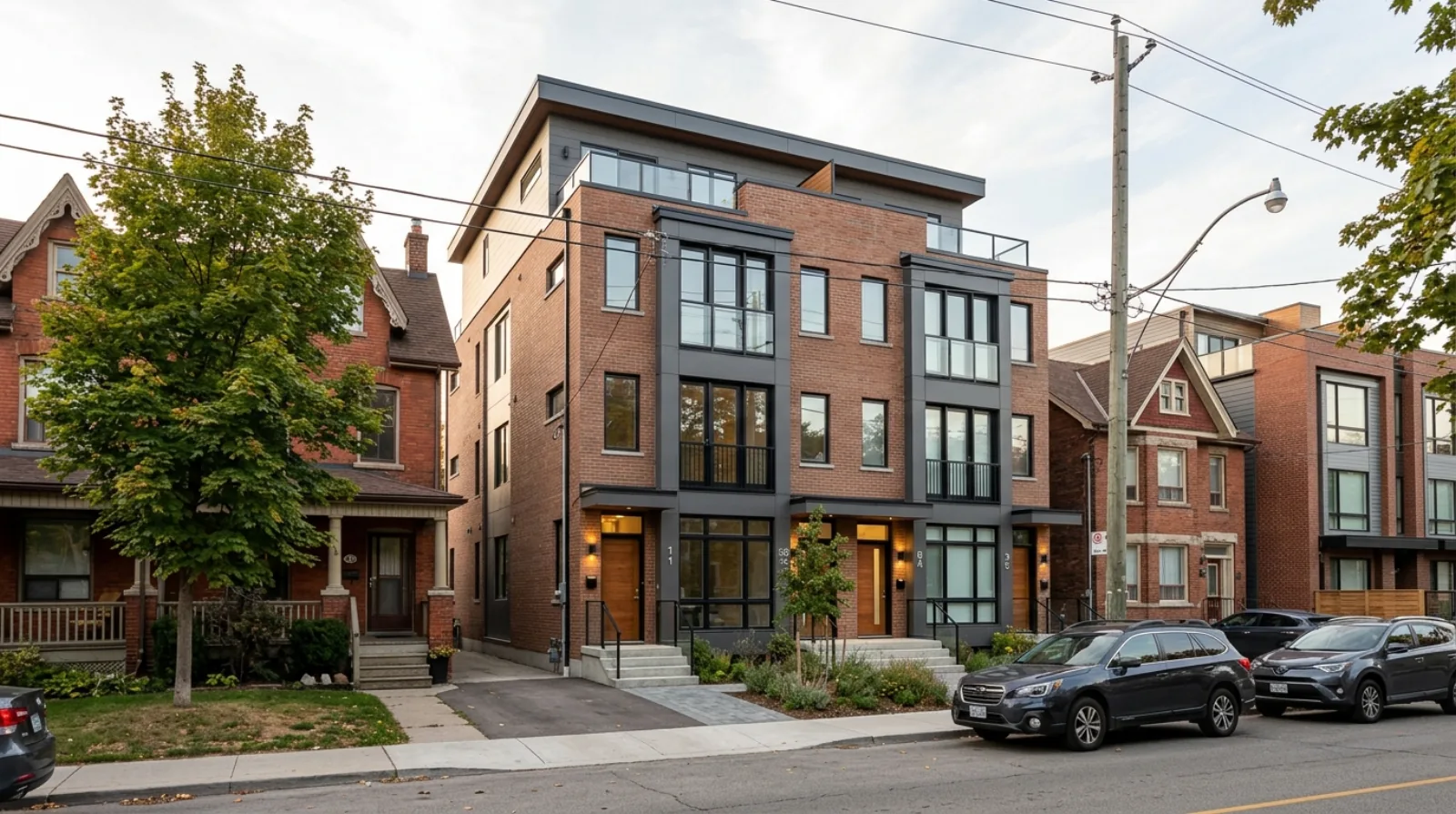
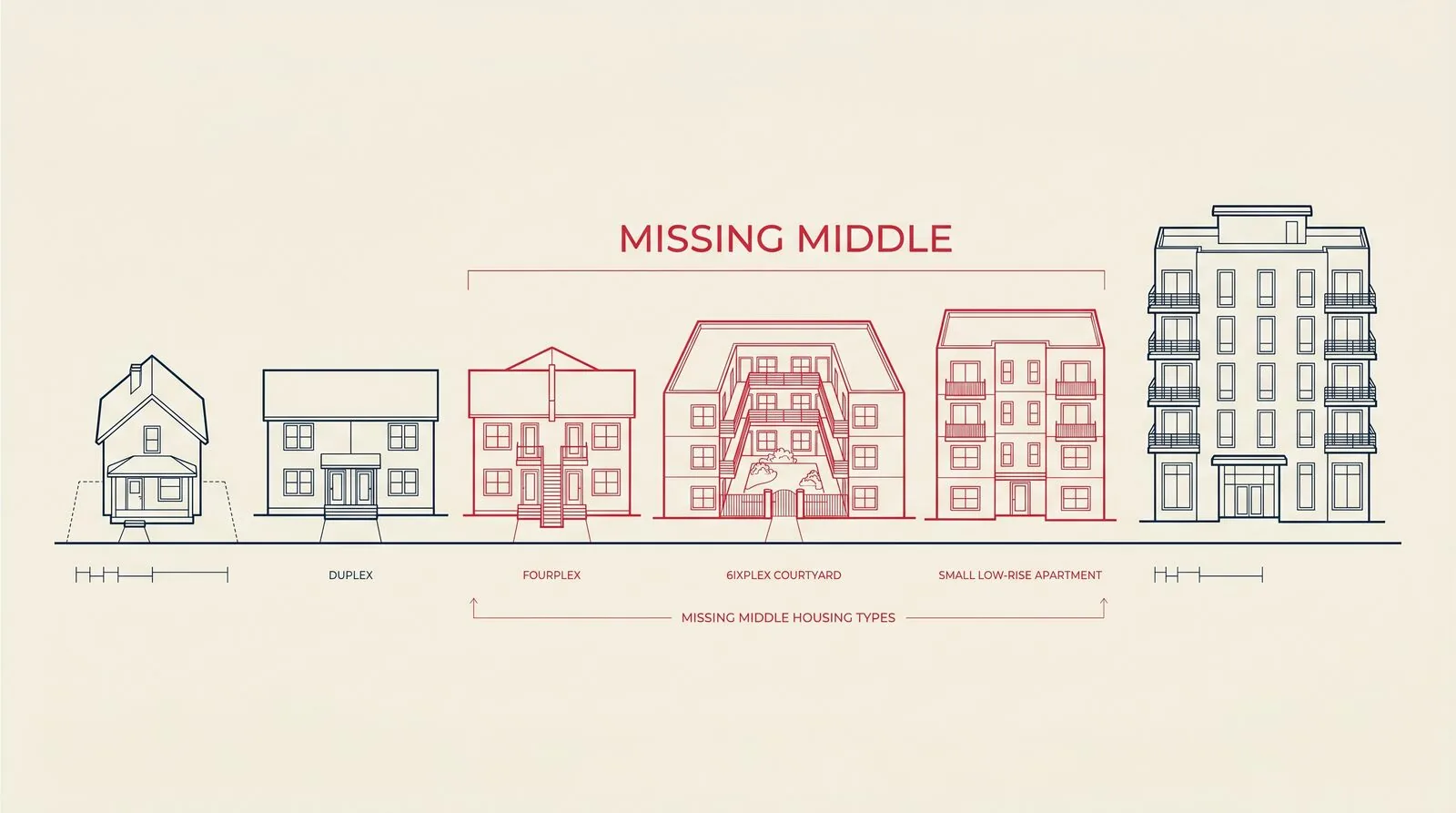
The phrase “missing middle” came out of a 2010 sketch by an American architect named Daniel Parolek. He drew a strip of building types that had once been common in North American neighbourhoods — duplexes, fourplexes, courtyard buildings, small walk-ups — and labelled them “missing” because almost none had been built since the late 1940s. The name stuck. Cities adopted it. BC built a housing strategy around it. By 2024 the phrase was in provincial legislation.
I’ve used the term constantly. We use it on this site. But the longer I work in this space the more I think it confuses owners more than it helps them.
Where the name came from
Parolek was working at Opticos Design in Berkeley. The sketch he produced in 2010 showed eight building types arranged left-to-right by scale: detached house, duplex, fourplex, courtyard apartment, bungalow court, townhouse, mansion apartment, live-work. His point was that single-family zoning on one end and apartment towers on the other had pushed everything in between out of the legal market. The “missing” piece was the middle of the scale graph.
The CMHC picked up the framing in a 2018 research insight. Vancouver published its first “Making Home” pilot in 2019 using the term. By the time Bill 44 passed in late 2023, “missing middle” was the standard label for everything from duplexes to sixplexes.
Three problems with the name
1. It implies the buildings disappeared on their own
They didn’t. They were zoned out. Vancouver’s first single-family-only district covered the West End in 1928. By 1956 most of the city west of Main and south of Broadway was restricted to one detached house per lot. The University of British Columbia’s School of Community and Regional Planning has documented how every Canadian metro followed the same pattern between 1945 and 1975. Fourplexes weren’t outcompeted in the market. They were made illegal to build.
The word “missing” makes it sound passive. The accurate word is “banned.” That changes the politics. Owners on a 33-foot lot today aren’t waiting for the market to rediscover small multiplexes — they’re waiting for their council to undo a rule written when their grandparents were children.
2. “Middle” suggests middle-income — and it’s not always true
Plenty of policy documents conflate the two. The City of Vancouver’s Housing Vancouver Strategy repeatedly pairs “missing middle” with “missing middle income.” That’s a separate problem. A new fourplex on a Kerrisdale lot in 2026 will not produce middle-income housing. Land basis alone makes that math impossible.
The building type and the household income are independent variables. A sixplex can be expensive strata in Point Grey or affordable rental in Renfrew. The form doesn’t dictate the affordability — the financing structure, land basis, and tenure do. We wrote about this in the strata vs rental tenure piece for that exact reason.
3. It hides huge differences in what each building type actually is
A duplex and a sixplex are both “missing middle.” They share almost nothing operationally. A duplex on a 33-foot Vancouver lot is two units, usually two storeys, no elevator, no commercial fire-rated corridors, often built by a small GC who’s done custom homes before. A sixplex is six units, often three storeys, often two staircases until the recent single-stair reform, commercial fire code, sprinklered, often a different financing path entirely.
Lumping them under one label has led owners to assume their lot can do “missing middle” without knowing whether they mean duplex or sixplex. Those are different projects with different costs, different approval timelines, and different end markets. We covered the specific tradeoffs in duplex vs fourplex on a 33-foot lot.
What people actually mean when they say it
In my conversations with Vancouver lot owners over the past two years, “missing middle” usually means one of three things, and they’re not the same:
- A small multiplex (3–6 units) on a single existing lot. This is what Bill 44 mostly enabled. The BC SSMUH policy manual is built around this scale.
- A two-to-four storey walk-up apartment building. This is what Parolek’s original sketch was about and what Tokyo, Auckland, and Minneapolis have been building since their reforms. Vancouver still mostly doesn’t permit this on R1 lots — you’d need RM-1 or higher.
- Anything not a tower or a single-family home. The throwaway version. Townhouses, stacked townhouses, fiveplexes, six-storey rentals. All “missing middle” by this definition.
When a council member, a homeowner, and a developer use the same phrase but mean three different things, the conversation gets bad fast.
A better vocabulary
I’m not going to win this fight. The phrase is in legislation. But internally — when planning a project, sizing a lot, or talking to a homeowner about what they can actually build — I try to use specific terms:
- Plex (3–6 units, single lot, no elevator, walk-up). This is the Bill 44 category. Most of our projects fall here.
- Walk-up apartment (8–24 units, often two or three lots assembled, two-to-four storeys). This is the European and Tokyo middle. Mostly not legal in Vancouver R1.
- Townhouse / stacked townhouse (rowhouse form, 3–10 units). Different fire code path again. Different end market.
- Sixplex with single stair. A specific BC sub-category enabled by Building Code reform in 2024. Not the same as a sixplex with two stairs — the floor plate efficiency is dramatically different.
These categories aren’t elegant. They don’t fit on a sketch. But they’re how the buildings actually get financed, designed, and built. When someone calls and says “I want to do missing middle on my lot,” my first question is always: which of these four are you actually picturing?
Why this matters for owners
If you’re a homeowner sitting on a 4,000–7,000 sq ft lot in Metro Vancouver and you’re trying to figure out what you can do, the phrase “missing middle” probably won’t help you. What helps:
- Your zone: R1-1 in Vancouver, RS-1 in older neighbourhoods, RM-1 in some pockets. Each has different unit limits.
- Your frontage: 33 feet vs 50 feet vs 66 feet drives whether you’re in fourplex or sixplex territory.
- Your tenure choice: rental vs strata changes the FSR available — see the rental-bonus piece.
- Your land basis: this kills more projects than zoning. We’ve covered why most lots fail the BTR test.
If you want a specific number for your address, our proforma tool runs the math on your actual lot. If you want a mental model, start with the missing middle hub and the Bill 44 explainer.
The phrase “missing middle” got us this far. It pushed Bill 44 through the legislature. It put fourplexes in the news. But for the people who actually have to build, finance, and live in these buildings, the more specific you are about which type you mean, the less time you’ll waste.
What I tell first-time owners
When someone asks “is my lot good for missing middle,” I usually answer with three questions:
- Are you trying to keep the property and rent it, or build to sell?
- Are you OK with not living on-site, or do you need one of the units to be yours?
- Do you have a rough idea of your land basis — what you paid, how long ago?
Those three answers tell me whether they’re looking at a duplex hold, a strata fourplex flip, a sixplex rental, or none of the above. The phrase “missing middle” doesn’t appear in any of the answers. And that’s fine. The point isn’t the label. The point is what gets built and who lives in it.
— David Babakaiff, Co-Founder, VanPlex