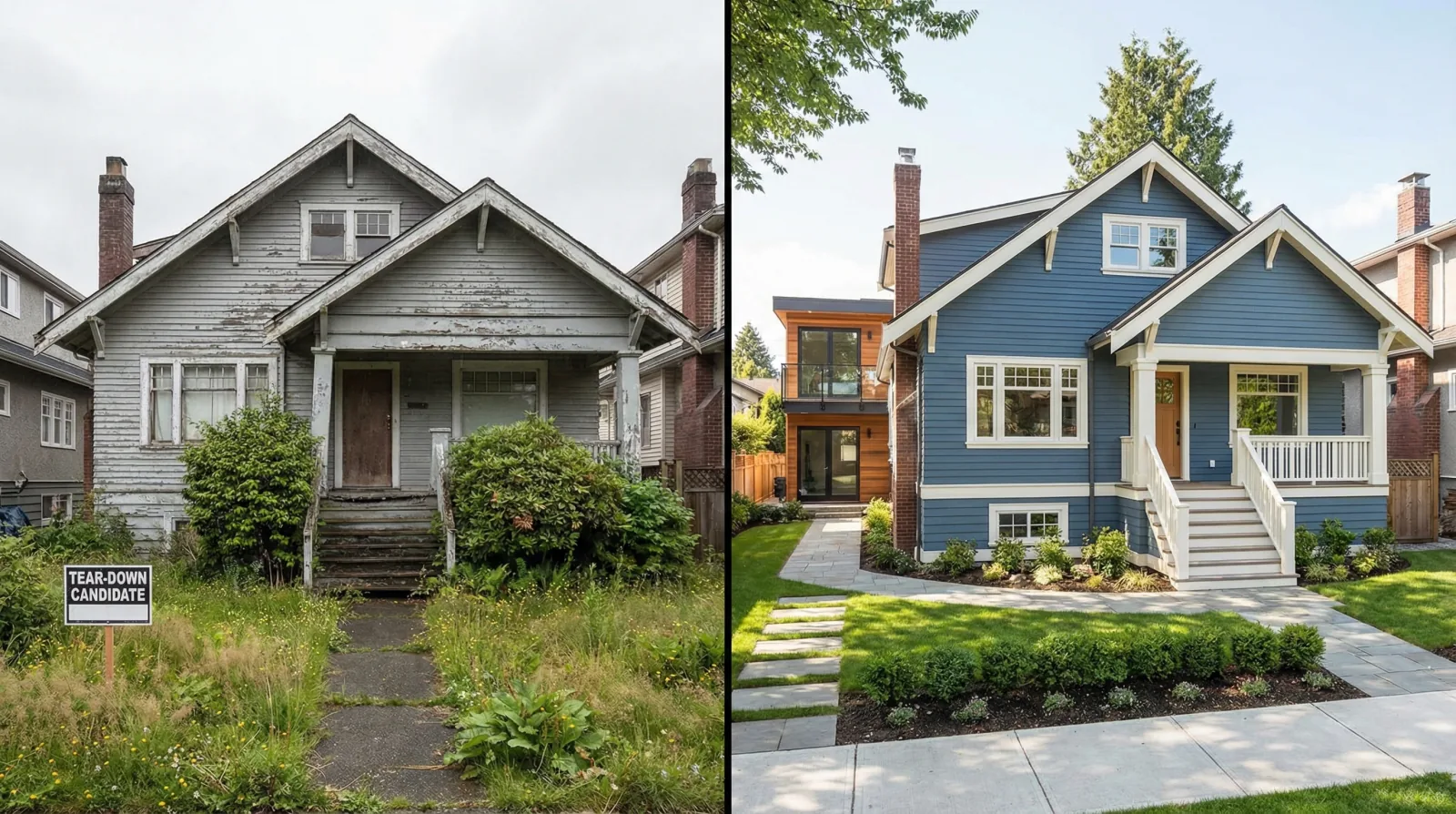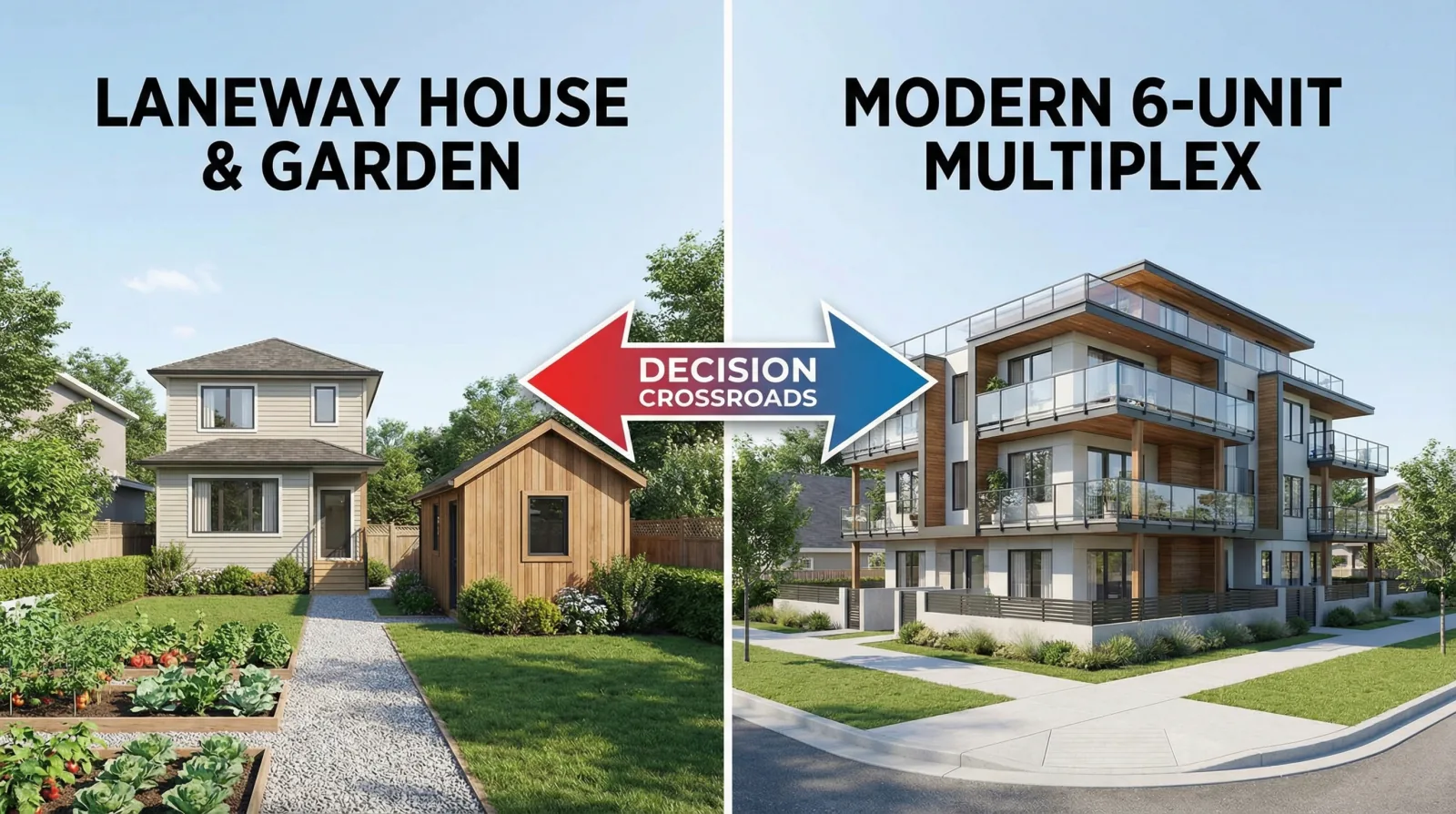

If you own your Vancouver or Burnaby home outright—no mortgage—you have an advantage that professional developers would pay millions for. Here’s why the mortgage-free position is the single biggest factor in multiplex development success. For a full picture of what that advantage looks like in practice, see the homeowners overview.
The Math That Changes Everything
When a professional developer builds a multiplex, their cost structure looks like this:
| Developer Cost | Amount |
|---|---|
| Land Acquisition | $2,500,000 |
| Acquisition Financing (18mo @ 8%) | $300,000 |
| Construction Costs | $2,200,000 |
| Soft Costs | $350,000 |
| Contingency | $200,000 |
| Total Investment | $5,550,000 |
Now compare that to a mortgage-free homeowner developing the same property:
| Homeowner Cost | Amount |
|---|---|
| Land Acquisition | $0 (already own it) |
| Acquisition Financing | $0 |
| Construction Costs | $2,200,000 |
| Soft Costs | $350,000 |
| Contingency | $200,000 |
| Total Investment | $2,750,000 |
The difference: $2.8 million in equity you don’t have to earn—you already have it.
Why Developers Can’t Compete with You
Professional developers operate under constraints that don’t apply to homeowners:
Required Returns
- Developers need 20-25% returns to satisfy investors
- Homeowners can profit at 10-15% returns
- This means more properties “pencil” for homeowners
Timeline Pressure
- Developers pay carrying costs every month they hold land
- Homeowners face no carrying cost pressure
- Delays hurt developers; they’re manageable for homeowners
Exit Requirements
- Developers must sell everything to repay acquisition debt
- Homeowners can retain 1-2 units and still profit
- Flexibility creates better outcomes
The Compounding Effect of No Mortgage
Consider two identical $3M properties being developed into fourplexes:
Scenario A: Developer (with acquisition debt)
- Must achieve $6M+ in sales to hit target returns
- Any market softness threatens viability
- Cannot retain units without restructuring
Scenario B: Mortgage-Free Homeowner
- Needs $5M in sales to achieve same profit
- 15% market buffer built in
- Can keep 2 units and still clear $500K+
The homeowner’s position is fundamentally stronger at every stage of the project.
How Mortgage-Free Status Affects Financing
Construction lenders evaluate risk based on your equity position:
| Equity Position | Typical Terms |
|---|---|
| 60%+ equity | Prime rates, 75% LTC |
| 40-60% equity | Prime +1-2%, 65% LTC |
| Under 40% equity | May require private lending |
| Mortgage-free | Best rates, highest LTC |
With a mortgage-free property as collateral, you access:
- Lower interest rates (potentially 2-3% less than developers pay)
- Higher loan-to-cost ratios (more of the project financed)
- Faster approvals (simpler underwriting)
- More lender options (banks compete for low-risk deals)
The Psychological Advantage
Beyond the numbers, mortgage-free homeowners operate from a position of strength:
No Desperation
- You’re not forced to sell at any particular price
- Market timing pressure is eliminated
- You can wait for optimal exit conditions
Optionality
- Keep all units and rent them
- Sell all units and maximize cash
- Hybrid approach: keep some, sell some
- Defer decision until market conditions clarify
Sleep Factor
- Construction delays don’t threaten your financial security
- Cost overruns are manageable, not catastrophic
- Market corrections are opportunities, not emergencies
Who Should Not Develop (Even If Mortgage-Free)
Being mortgage-free is necessary but not sufficient. Before committing, it’s worth reviewing what Bill 44 actually permits on your lot — the rules vary by municipality. Development may not suit you if:
- You need the equity for near-term expenses
- The property has significant environmental or structural issues
- You’re uncomfortable with an 18-24 month project timeline
- Your lot doesn’t support economically viable unit counts
- You’re in a location where unit values don’t justify construction costs
The Ideal Mortgage-Free Candidate
You’re well-positioned for multiplex development if:
✅ Property is paid off or nearly so ✅ Lot is 33+ feet wide ✅ Located in Vancouver, Burnaby, or compliant municipality ✅ Current home value $2M+ (land value supports development) ✅ 18-24 month timeline is acceptable ✅ You have $50-100K liquid reserves for soft costs ✅ You’re comfortable with construction complexity (with professional management)
Your Competitive Moat
Here’s what makes your position unassailable. The advanced proforma tool lets you model the numbers before committing to anything.
- You can’t be outbid for the land (you already own it)
- You don’t need investor returns (it’s your money)
- You control the timeline (no debt service pressure)
- You choose the exit (sell, rent, or hybrid)
This combination of advantages means that in head-to-head competition, homeowners will increasingly out-execute professional developers—and that’s exactly what’s happening across Metro Vancouver.
Take the First Step
If you own your home free and clear in Vancouver, Burnaby, or another Bill 44-compliant municipality, you have an asset that’s worth significantly more than its current market value suggests.
Visit vanplex.ca to see what your mortgage-free property could become under the new zoning rules—and how much additional equity you could unlock without giving up your neighborhood.
David Babakaiff, Co-Founder of VanPlex
PlexRank™ | Profit with Multiplex