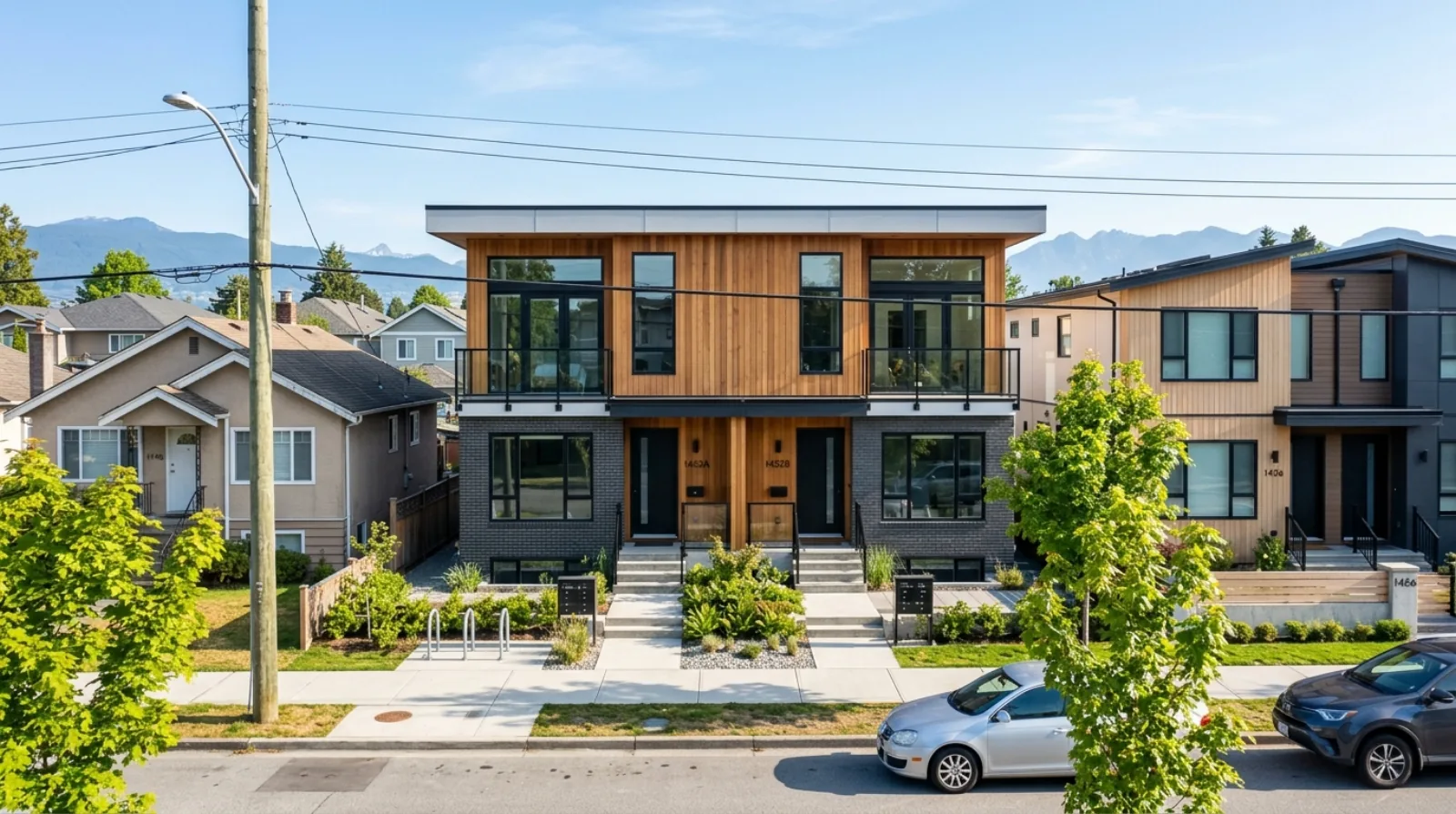

2025 quietly reshaped Canadian residential development. Bill 44 eliminated entitlement risk across 60,000+ urban lots, creating a new investable category: by-right, small-scale urban development. The investment section covers how professional capital is approaching this as a distinct asset class. Vancouver received 518 applications from eligible lots—proving viability is narrow while eligibility is broad. 2026 marks the shift from policy certainty to capital deployment.
Not through price appreciation. Not through rate cuts. But through policy certainty.
Bill 44 didn’t just add density. It eliminated entitlement risk across tens of thousands of urban lots. That single change created a new investable category: by-right, small-scale urban development.
For investors, 2025 wasn’t about deployment. It was about signal.
TL;DR (Key Takeaways)
- Bill 44 eliminated rezoning risk across 60,000+ eligible lots in Metro Vancouver
- Vancouver received 518 multiplex applications by December 2025 (less than 1% of eligible lots)
- Build-to-hold economics broke: rental income supports $1.8M mortgage vs $2.5M+ total costs
- Only ~2% of eligible properties generate 100%+ pre-tax returns
- 2026 trends: professional capital, panelized construction, stratified exits, land repricing
- Multiplex is a filtered development asset class, not mass housing opportunity
What 2025 Actually Proved (Beyond the Headlines)
By mid-December 2025, Vancouver alone had received 518 multiplex permit applications since Bill 44 came into effect.
That number matters — not because it’s large, but because it’s small.
Out of approximately 60,000 eligible single-family lots in Vancouver, fewer than 500 property owners moved forward with applications. The data is clear:
Eligibility is broad. Viability is narrow.
That’s exactly what investors want to see at the birth of a real asset class. Mass eligibility combined with selective viability creates opportunity for systematic analysis and capital advantage.
The 518 applications clustered around predictable characteristics:
- 4-plexes and 5-plexes (optimal unit economics)
- Lots with favorable frontage and geometry
- Sites where stratified exit pricing clearly worked
- Owners or developers committed to sale, not long-term hold
This filtering is not a bug. It’s what transforms a housing policy into an investable development category.
How Did Entitlement Risk Disappear?
Municipalities were forced to comply with Bill 44 by December 31, 2025. Many cities—including the City of Vancouver—passed compliant bylaws in the final weeks of the year, under threat of provincial penalties.
The result was structural:
- Rezoning risk collapsed to zero
- Discretionary political hearings disappeared
- Approval timelines became knowable and contractable
Kelowna offered an early preview of what capital-friendly execution looks like, with some multiplex building permits issued in under 30 days once zoning compliance was confirmed and submissions were complete.
For institutional and professional investors, this represents the critical inflection point:
Uncertainty moved from “Can I build?” to “Can I execute?”
That shift—from political risk to execution risk—is what allows capital to scale.
Why Did Build-to-Hold Quietly Break in 2025?
One of the least discussed shifts in 2025 was economic, not regulatory.
Land values and construction costs reset higher throughout the year. Rents did not.
In most urban Metro Vancouver markets, the math now looks like this:
| Component | Build-to-Hold Reality (2025) |
|---|---|
| Total project cost | $2.5M+ (land + construction) |
| Rental income capacity | Supports ~$1.8M mortgage |
| Result for mortgage-free owner | One new unit + $800K debt |
| Cash flow profile | Negative or break-even |
| Duration risk | Exposed to rate/market changes |
Even mortgage-free homeowners—theoretically the best-positioned participants—face negative leverage when building to hold rental units.
Rental income simply does not support the debt required to finance typical multiplex construction costs at current land values.
As a result, multiplex activity in 2025 consolidated around a build-to-sell model — though build-to-rent still makes sense in specific circumstances described below:
- Short project duration (18-24 months)
- Stratified unit exits
- Capital recycling into next project
- Pre-sales where possible
This is not rental housing development. It’s small-scale merchant building.
What Percentage of Properties Actually Work?
Across Vancouver and Burnaby, systematic feasibility modeling based on VanPlex’s analysis of 86,000+ properties shows the following distribution:
| Feasibility Tier | % of Eligible Lots | Description |
|---|---|---|
| Fails outright | ~65% | Negative or minimal returns |
| Marginal | ~20-25% | 10-30% returns, high execution risk |
| Builder-grade | ~10-12% | 30-60% returns, requires expertise |
| Top tier | ~2% | 100%+ pre-tax returns |
That 2% top tier is not random luck or market timing.
It’s the intersection of:
- Lot geometry (frontage, depth, corner vs mid-block)
- Zoning optimization (FSR, height, setbacks)
- Fee structure (DCLs, CACs, utility connections)
- Unit mix and floor plate efficiency
- Exit pricing and stratification economics
This selectivity is what makes multiplex investable as an asset class—and why intuition-based approaches systematically fail.
Is Multiplex Development Viable Without Professional Analysis?
The short answer: rarely.
The 2025 data proved that eligibility does not equal opportunity. Without systematic feasibility analysis, most participants either:
- Pursue marginal projects with under 20% returns that don’t justify risk
- Overpay for land based on broad eligibility rather than specific viability
- Miss top-tier opportunities that less sophisticated buyers overlook
Professional developers and family offices entering the space in 2026 will compete on analytical infrastructure, not just capital. The ability to systematically identify, underwrite, and execute the top 2-10% of opportunities will determine returns.
VanPlex’s PlexRank™ system was built specifically for this filtering problem—providing feasibility scoring across Vancouver and Burnaby’s 86,000+ properties to identify which lots actually generate exceptional returns.
2026: Where Capital Is Actually Heading
Four structural trends are already forming for 2026 and beyond:
1. Professionalized Deal Flow
Fewer homeowner-led projects. More special purpose vehicles (SPVs), structured equity partnerships, and repeatable underwriting frameworks.
Expect to see:
- Family offices allocating to multiplex as a development category
- Syndicated equity structures for multi-property pipelines
- Institutionalized due diligence and risk management
- Standardized legal and financial frameworks
2. Construction Industrialization
Panelization and hybrid modular systems are compressing construction timelines and reducing variance—both critical for short-duration capital deployment.
Key developments:
- Panelized wall and floor systems (30-40% faster framing)
- Repeatable multiplex typologies optimized for code compliance
- Volumetric bathroom and kitchen pods
- Supply chain integration reducing material waste
Speed and predictability will separate winners from losers.
3. Stable Rates Favor Speed, Not Yield
With interest rates likely to hold steady rather than plunge in 2026, investors increasingly prefer defined short-term exits over long-duration income bets.
The optimal capital structure for multiplex in 2026:
- 18-24 month project timelines
- Stratified pre-sales or quick post-completion exits
- Minimal carry period
- Capital recycling into next pipeline project
This aligns multiplex with merchant building economics, not buy-and-hold real estate investing.
4. Land Repricing Is Inevitable
The Bill 44 arbitrage exists today because land pricing has not yet fully adjusted to reflect by-right multiplex entitlements.
But that window is closing:
- Early transactions are resetting price expectations
- Sophisticated buyers are underwriting to feasibility, not eligibility
- Land assemblies are beginning to reflect multiplex value
- Arbitrage windows narrow as repricing completes
First movers capture the spread. Late entrants compete at adjusted land prices.
What Should Investors Do Now?
For institutional capital, family offices, and professional developers evaluating the multiplex category in 2026:
Stop thinking about this as housing. Start underwriting it as filtered urban development.
The opportunity is not to chase “eligible” lots at scale. It’s to systematically identify the 2-10% that actually work—and move before the market fully reprices them.
That requires:
- Feasibility analysis infrastructure (not intuition)
- Execution capability (permitting, construction, exits)
- Capital structure aligned with 18-24 month timelines
- Portfolio approach (not one-off projects)
Visit VanPlex.ca to:
- Access PlexRank™ feasibility scoring for 86,000+ properties
- Identify top-tier multiplex opportunities before land repricing completes
- Connect with verified builders, architects, and financing partners
- Understand which specific properties generate 100%+ returns
The Strategic Insight for 2026
Multiplex is not a housing trend.
It’s a filtered development asset class hiding inside a mass rezoning.
2025 established policy certainty and revealed the viability distribution. That was the signal year.
2026 is when professional capital moves—and when arbitrage windows begin to close.
The investors who succeed will be those who treated 2025 as reconnaissance and 2026 as deployment.
If you’re tracking this space from an institutional or professional investor perspective, I’m curious:
- Are you underwriting multiplex as development yet?
- Or still thinking about it as housing?
The distinction will determine your returns.
David Babakaiff Co-Founder of VanPlex PlexRank™ | Profit with Multiplex