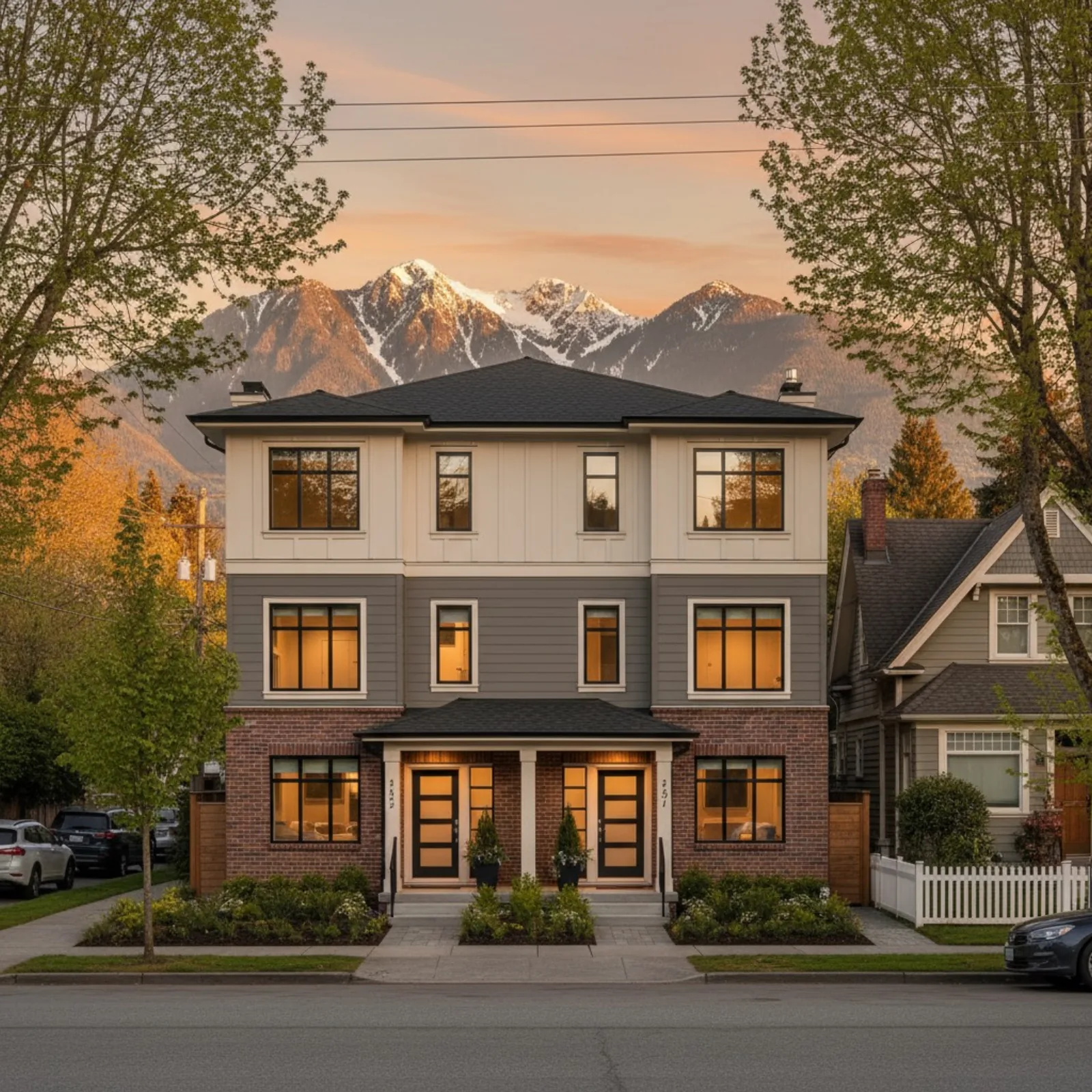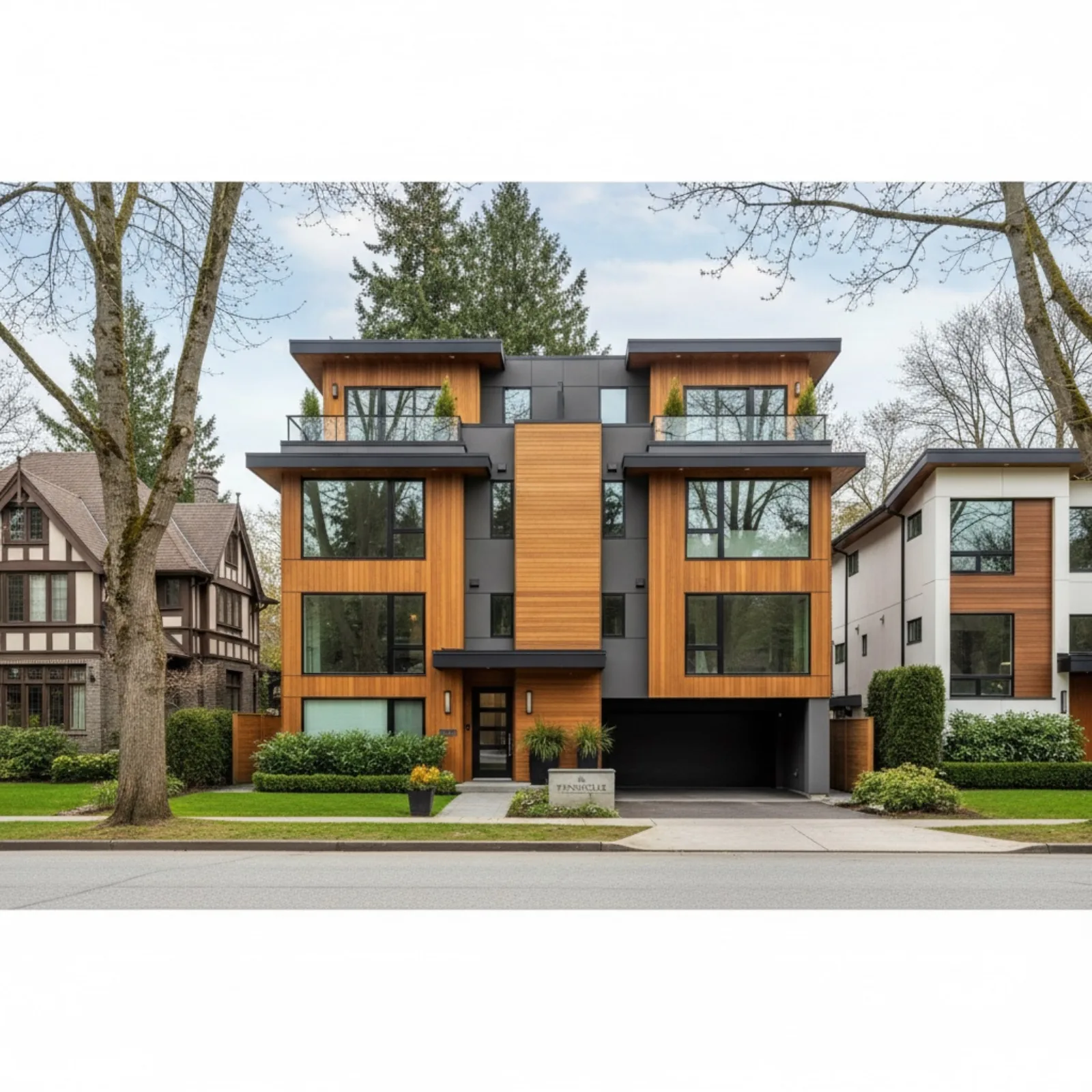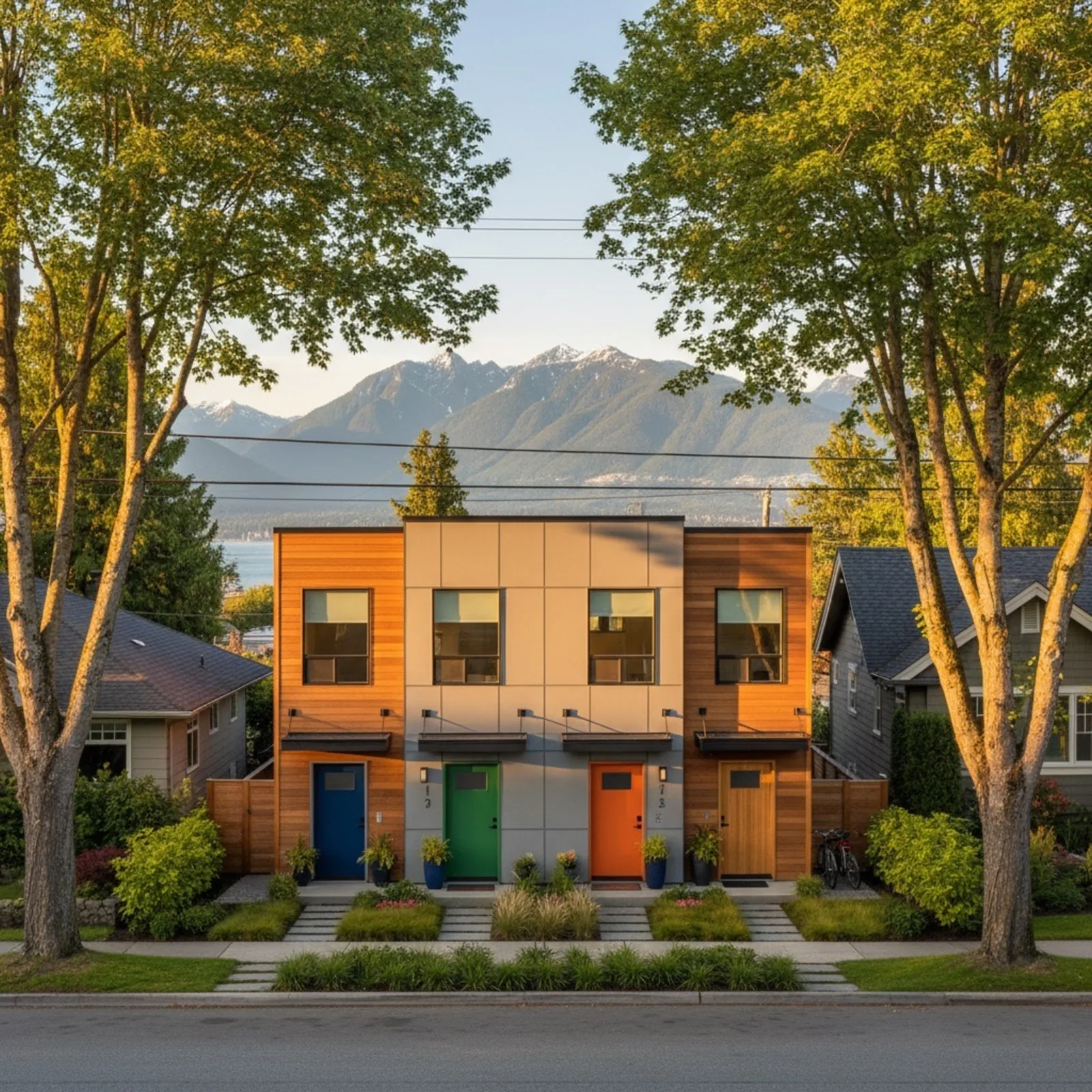

2025 will be remembered as the year multiplex housing in British Columbia moved from policy theory into real-world execution.
For more than a decade, conversations about “gentle density” lived in reports, pilot programs, and political debates. In 2025, that changed. Municipalities across BC were forced to act, homeowners began submitting real applications, and the economics of small-scale housing became visible for the first time.
What emerged was not a blanket opportunity for everyone — but a new asset class with very specific winners.
This is a recap of how multiplex evolved through 2025, what cities actually approved, and where the momentum is heading in 2026.
Bill 44 forced the issue — and cities responded late
Bill 44 set a hard deadline: municipalities had to adopt compliant small-scale multi-unit housing bylaws by the end of 2025 or face provincial penalties.
That pressure mattered.
Several cities waited until the final weeks of the year to pass their bylaws, refining details right up to the cutoff. The City of North Vancouver, for example, passed its fourth reading in early December 2025, formally bringing multiplex zoning into effect just weeks before the deadline.
This pattern repeated across the region. The result is that many municipalities entered 2026 with brand-new rules, untested workflows, and planning departments still adjusting to the volume and complexity of applications.
In short: the zoning is now real, but the systems are still catching up.
Vancouver’s first data point: 518 applications and counting
By mid-December 2025, the City of Vancouver had received 518 multiplex permit applications since Bill 44 came into effect.
That number alone is revealing.
Out of tens of thousands of eligible single-family lots, only a small fraction of owners moved forward. This confirmed what early feasibility work suggested: eligibility does not equal viability.
Most applications clustered around:
- 4-plexes and 5-plexes
- Lots with favorable frontage
- Sites where resale math clearly worked
- Owners or developers willing to sell units rather than hold rentals
The “everyone can build” narrative quietly faded. What replaced it was a more realistic understanding: multiplex behaves like small-scale development, not a renovation or lifestyle upgrade.
Kelowna showed what streamlining can look like
While Vancouver worked through volume, Kelowna quietly became one of the most efficient multiplex approval environments in the province.
In several cases, multiplex building permits were issued in less than a month once zoning compliance was clear and submissions were complete.
This demonstrated something critical for 2026:
Process speed matters as much as zoning permission.
Municipalities that reduce friction will attract more capital, more experienced builders, and more sophisticated projects. Those that don’t risk pushing activity elsewhere — even when zoning technically allows it.
The economics shifted in 2025 — and it wasn’t just OSFI
Much of the public discussion focused on lending rules and regulatory tightening. But the deeper force reshaping multiplex strategy was simpler:
Build-and-hold stopped working.
Land prices and construction costs no longer align with rental income the way they once did.
A typical example illustrates the issue:
- A 4-plex built at roughly 1.0 FSR
- Three units rented, one retained by the owner
- Market rents supporting approximately $1.8M in mortgage capacity
- Total project costs landing closer to $2.5M or more
The result?
Even a mortgage-free homeowner can end up with one new unit and an $800,000 mortgage.
This is why 2025 marked a clear pivot away from “build, hold, rent” and toward build, stratify, and sell.
What 2025 made clear: multiplex is its own asset class
By the end of 2025, several truths were difficult to ignore:
- Only a small percentage of lots produce strong returns
- Frontage, zoning nuance, and fee structures matter enormously
- Early movers capture value before land prices reset
- Feasibility analysis is no longer optional
- Multiplex behaves more like development than home improvement
In Vancouver and Burnaby, internal modeling consistently showed that roughly 2% of properties can double their value under the right conditions. These are not edge cases — but they are rare, specific, and highly competitive.
Looking ahead: what 2026 is likely to bring
More capital, fewer amateurs
As feasibility becomes clearer, 2026 will see more professional capital entering multiplex. Small developers, family offices, and structured partnerships will replace most homeowner-led attempts.
Faster builds through panelization and modular
Labour constraints and cost pressure are accelerating interest in:
- Panelized construction
- Hybrid modular systems
- Repeatable multiplex typologies
Speed, predictability, and cost certainty will define winners.
Interest rates likely to hold, not plunge
In a Canada-centric outlook, rates are expected to remain relatively stable rather than dramatically fall. That favors short-duration projects with clear exits, not long-term holds.
Land prices will start to adjust
As more data becomes public, viable multiplex lots will increasingly trade at development-informed prices. The arbitrage window created by Bill 44 will narrow.
What this means for homeowners right now
2025 opened the door.
2026 will decide who actually walks through it.
For homeowners, the key questions are no longer:
- “Is multiplex allowed?”
- “Can I build units?”
They are:
- “Is my property one of the few that actually works?”
- “Do I exit through redevelopment or sale?”
- “Do I partner, or do I step aside?”
Those answers depend on data, not headlines.
The window is narrowing
The most important development of 2025 was not the number of applications filed — it was the clarity that emerged about which properties actually work.
Early movers who identified top-tier sites captured value before the market adjusted. As 2026 progresses, land prices for viable multiplex lots will increasingly reflect their redevelopment potential.
The arbitrage opportunity created by Bill 44 is real, but it is time-limited.
Professional developers, family offices, and structured capital are now competing for the same small pool of exceptional sites. Homeowners who wait risk entering a market where land prices have already reset and margins have compressed.
At VanPlex, we focus on one thing: separating viable multiplex opportunities from the rest.
Before design, before financing, before assumptions — feasibility comes first.
If you own property in Vancouver, Burnaby, or emerging multiplex markets, the most important step is understanding whether your lot sits in the top tier of opportunity or not.
Visit VanPlex.ca to:
- Run an instant eligibility and feasibility check for your property
- Calculate your site’s multiplex potential using PlexRank™ analysis
- Understand whether 2026 is the right year to act — or to sell
- Access the data that separates viable opportunities from the rest
2026 will reward clarity, speed, and informed decisions.
—
David Babakaiff
Co-Founder, VanPlex.ca
PlexRank™ | Profit with Multiplex