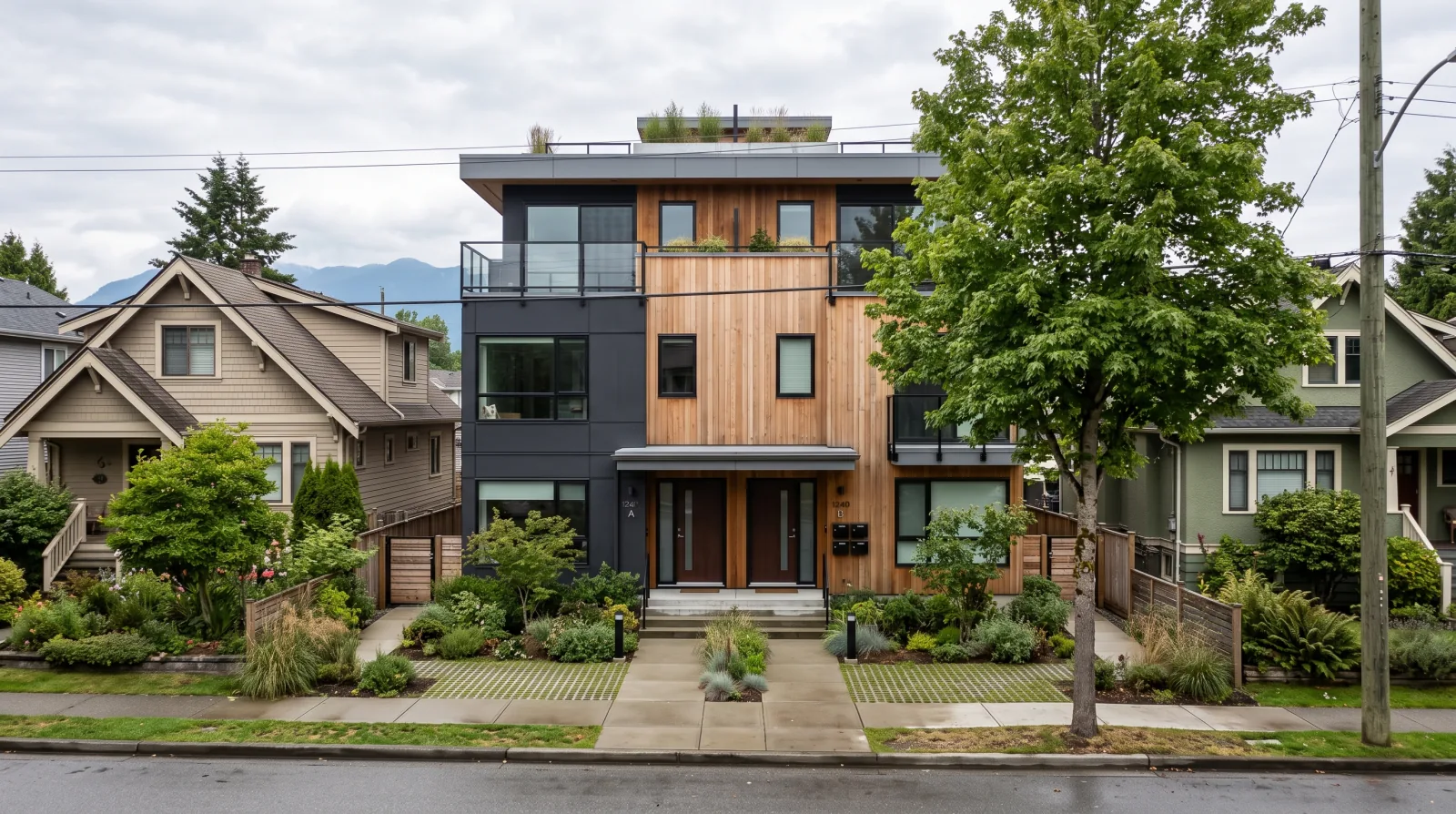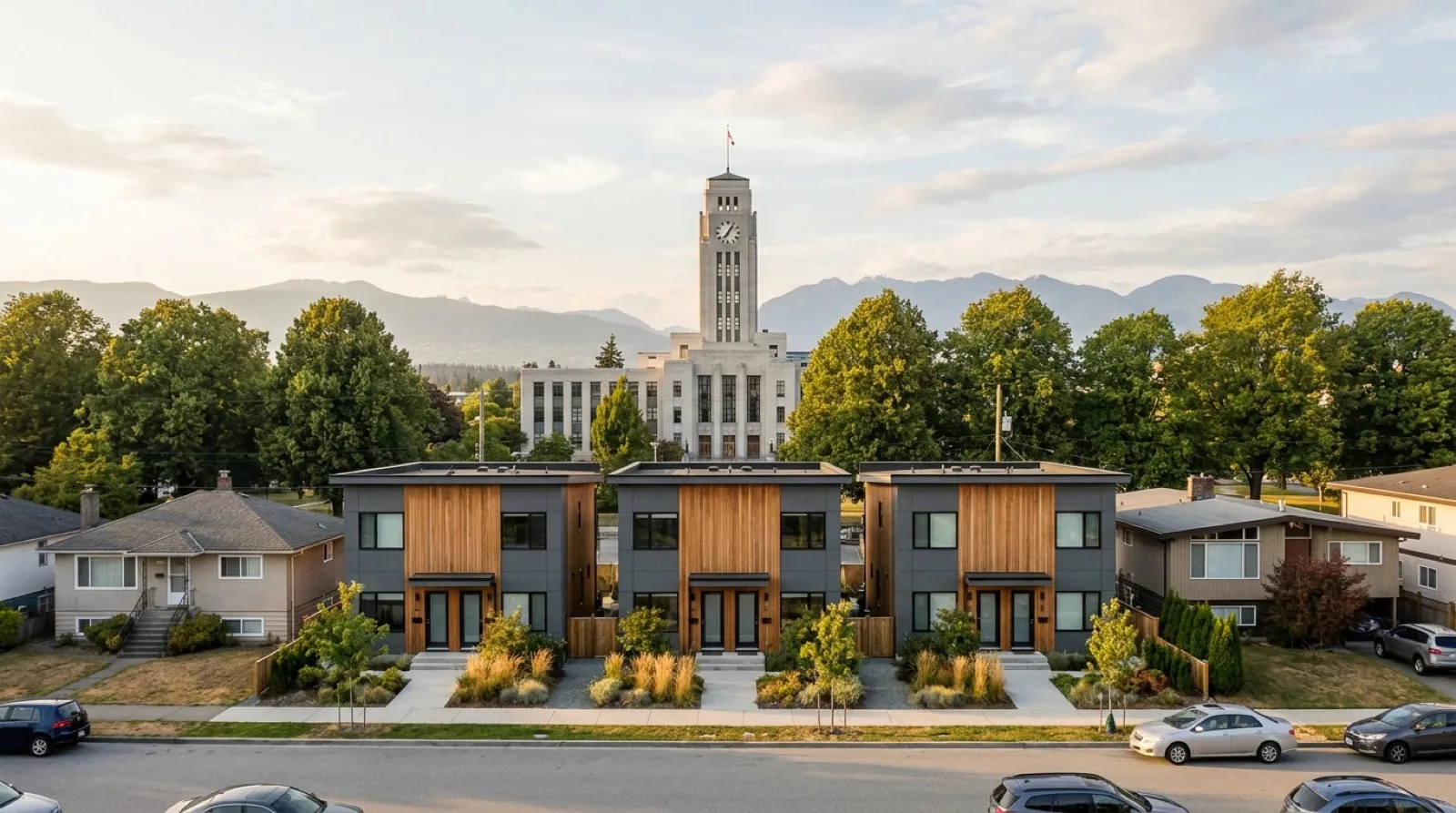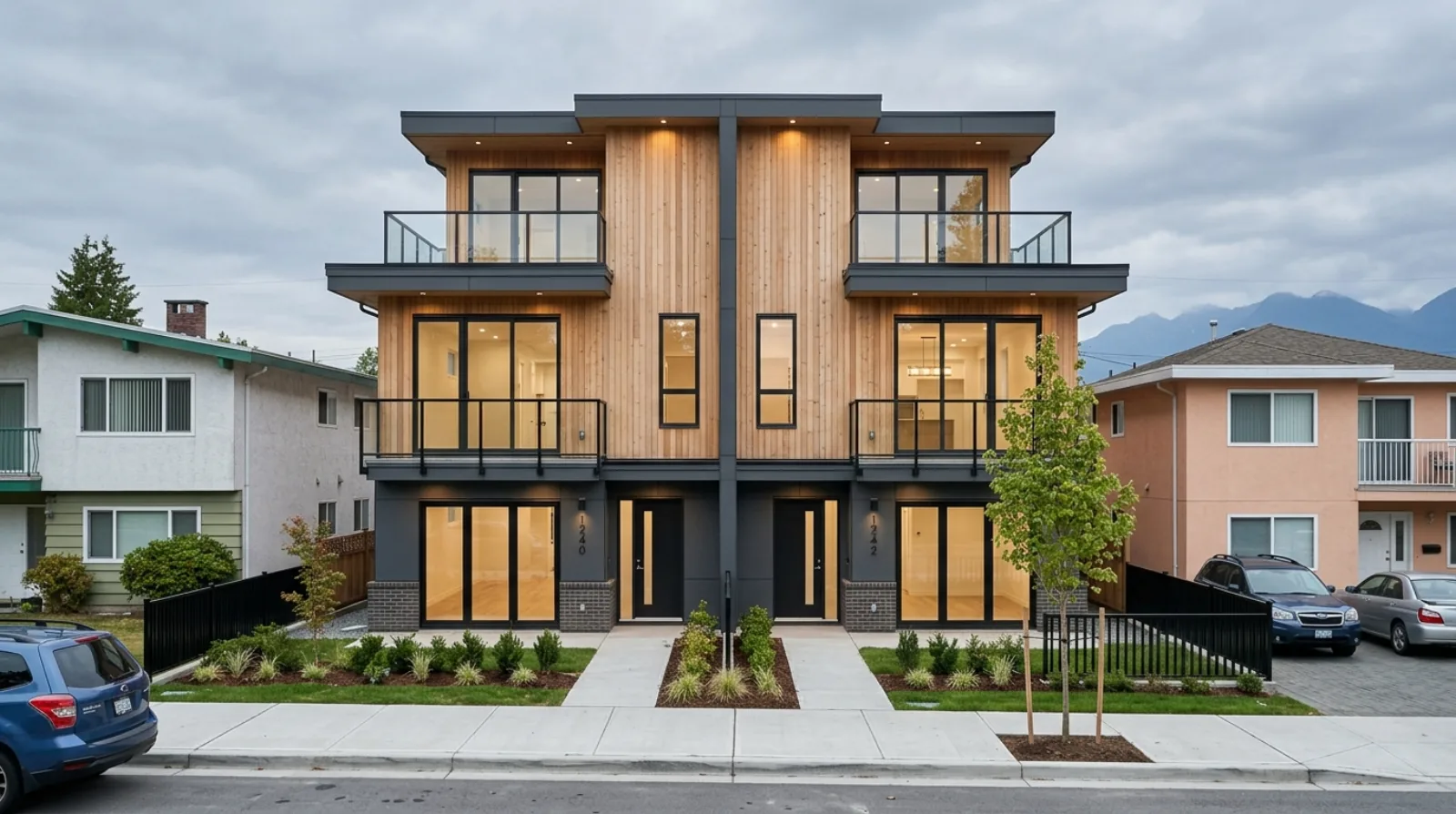
Pete Fry won Vancouver’s mayor race on October 17, 2026, with 98,494 votes in the City’s unofficial count. His published housing plan promises faster approvals, pre-approved designs, prefabricated options and new rules on building form. Those could help small projects. The Green Party platform he ran on also asks for cleaner, greener new construction. My question for the incoming council is simple: once every change is added together, does a multiplex cost less to deliver per home?
The platform items below are campaign commitments. The new council is sworn in on November 2, and it still has to turn these promises into rules. Until it votes, the multiplex rules in force today apply to your lot.
What the incoming council has promised builders
The Green Party of Vancouver’s 2026 platform puts these items in writing. Page numbers are from the platform PDF, last updated September 29, 2026.
| Promise | What it says | Page |
|---|---|---|
| Pre-Approved Housing Designs | City-approved designs for homes and rental buildings that move through permits quickly, “reducing approval times and costs” | 7 |
| ”Vancouver Special 2.0” | Kit designs, modular or prefab, that can be permitted and built quickly | 7 |
| Faster permits | ”Resolve department silos that add time and cost to building approvals” | 7 |
| Prefab and wood frame | ”Permit for faster, more affordable construction, including prefab, modular, and wood frame” | 6 |
| Dynamic zoning | Standard rezonings agreed in advance, with flexible design rules for height, setbacks, trees and building form | 4 |
| Building for a changing climate | New and retrofit construction “built cleaner and greener” | 6 |
| Decarbonizing new builds | Bring back a ban on fossil gas for heat and hot water in new construction | 11 |
| Lifecycle emissions | Count the emissions from making and building, as well as from running a building, in City reporting | 11 |
The first five items aim to lower the cost or time of building. The last three can add cost before they save any. Every one of them lands on the same proforma.
The new council does not control that outcome by itself in one vote. The Greens hold 5 of 11 votes, so every change needs at least one vote from another party. I covered the full result and the council seats in Mayor Pete Fry: What Changes for Vancouver Multiplexes.
There are two affordability tests
The first test is getting into the home. That is the down payment, the mortgage or the rent a household needs to live there.
The second test is living in it. That is the energy bill, the maintenance and the cost of staying comfortable over the years.
Better insulation, a building that leaks less air, better windows, and heating and cooling systems designed for the building can make a home more comfortable and use less energy. Those benefits matter. But the builder pays the construction cost on day one, and the owner sees the savings over many years.
If the extra cost up front cannot be financed, cannot be covered by what buyers will pay, and cannot be absorbed inside the project, the homes may never get built. Lower energy bills later do not solve the financing gap today.
What that looks like on a sixplex
The figures in this section are invented to show the math. They describe no rule anyone has proposed in Vancouver.
Suppose a package of new requirements adds a net $150,000 to a six-home project, after design savings and incentives. That is $25,000 per home ($150,000 divided by 6), before the extra interest on a larger construction loan.
It does not follow that buyers will pay another $25,000. The market sets sale prices. So the $25,000 has to come from somewhere:
| Where the $25,000 per home can go | What happens |
|---|---|
| Higher sale price | Only if buyers in that neighbourhood will pay it, which the market decides |
| Lower land price | A builder pays the owner $150,000 less for the lot |
| Lower homeowner proceeds | An owner who builds keeps $150,000 less at the end |
| No project | The lender will not fund it, and the house stays a single house |
For a family hoping to replace an older house with several homes and keep one of them, that can change the whole decision.
The answer depends on the design
Higher performance costs different amounts on different projects. A compact building with shared walls, simple shapes and well-planned systems may reach it for less than a complicated design.
Three goals also get mixed together that should be measured one at a time:
- Using less energy. Insulation, air tightness and windows.
- Changing the energy source. For example, electric heat pumps in place of gas, which the platform’s gas ban would require (page 11).
- Lowering the emissions from construction itself. The materials and the building process, which the platform wants the City to start reporting (page 11).
Each one has its own cost and its own benefit. Putting them in one bundle hides which part pays for itself. Our green multiplex guide covers the BC energy rules, green financing and city-by-city requirements.
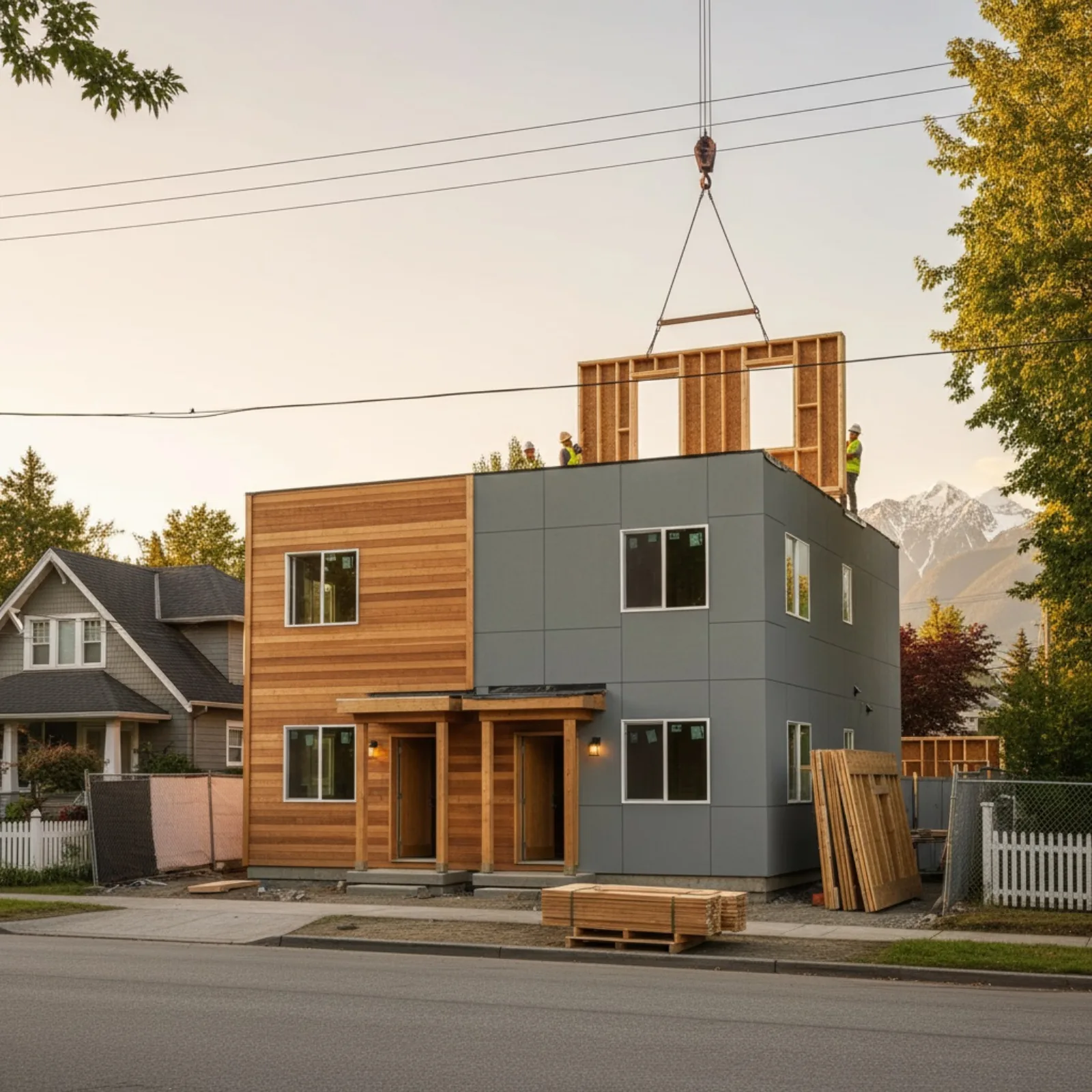
Canadian wood, mass timber and off-site construction show the trade-off well. The Fry campaign said in its September 16 housing release that mass timber and wood-frame construction are “faster and more cost-effective to build” (Daily Hive). Off-site building can be faster, and a faster build improves an investor’s yearly return, which means more housing gets financed. On the small projects we look at, my experience so far is that off-site mass timber still costs more than a site-built wood frame. That is the kind of claim to settle with real designs and real prices.
So I want to see actual designs compared side by side. A blanket claim that better performance is free is as unhelpful as a blanket claim that it is unaffordable.
Vancouver already has pre-reviewed designs to test this on
Vancouver is listed as a local partner of CMHC’s federal Housing Design Catalogue. The City pre-reviews designs from that catalogue to support faster approvals; its listed designs are a duplex, a rowhouse and three designs for a small extra home on a lot (BC ADU 01, AB ADU 02 and ON ADU 01) (CMHC Housing Design Catalogue, local government partners).
That gives the new council something to work with on day one. The useful next test is whether a design that repeats, a faster approval and simpler construction can cover the cost of higher performance on the same lot.
Test the whole policy package on real properties
Before council adds another requirement, I would ask it to publish the before and after numbers:
- What happens to the total development cost, and to the cost per finished home?
- How much living space can the design actually deliver once walls, stairs and equipment take their share?
- Do shorter approvals and simpler rules cover the added costs?
- What are the expected household energy savings, and on what assumptions?
- How many more, or fewer, properties can support a project that makes financial sense?
Those questions need answers at two scales:
| Scale | Why it matters |
|---|---|
| Property by property | Lots differ in width, lane access, trees and slope, so one rule lands differently on each |
| Citywide | Council needs to know whether its rules grow or shrink the number of homes that can actually be built |
At VanPlex, that is how we approach feasibility. We connect the rules to each property, then look at the pattern across the city. Being allowed to build and being able to pay for the build are separate tests, and a lot has to pass both.
What this means for your property
A new council that supports multiplexes is good news. Your lot’s numbers change only when council changes a rule that touches them, and that has not happened yet.
If you are considering a multiplex, start with what works on your lot under today’s rules. From there you can test how changes to floor area, construction cost, energy performance or approval time move the result.
Vancouver should aim for homes that are comfortable, efficient and possible to pay for. Measuring all three together is how we will find out whether the policy works.
Want to see the possibilities for your property? Start with a VanPlex proforma, then talk to our team to review the assumptions and bring in a builder to check the construction plan and costs.
David Babakaiff, CEO & Co-Founder of VanPlex
PlexRank™ | Profit with Multiplex
Sources: Green Party of Vancouver, Platform 2026 (PDF), last updated September 29, 2026, read October 20, 2026; Daily Hive, “Pete Fry unveils Green Party of Vancouver’s housing plan”, September 16, 2026; CMHC Housing Design Catalogue, local government partners, read October 20, 2026; vote count from The Canadian Wire, reporting the City’s unofficial count on October 18, 2026.