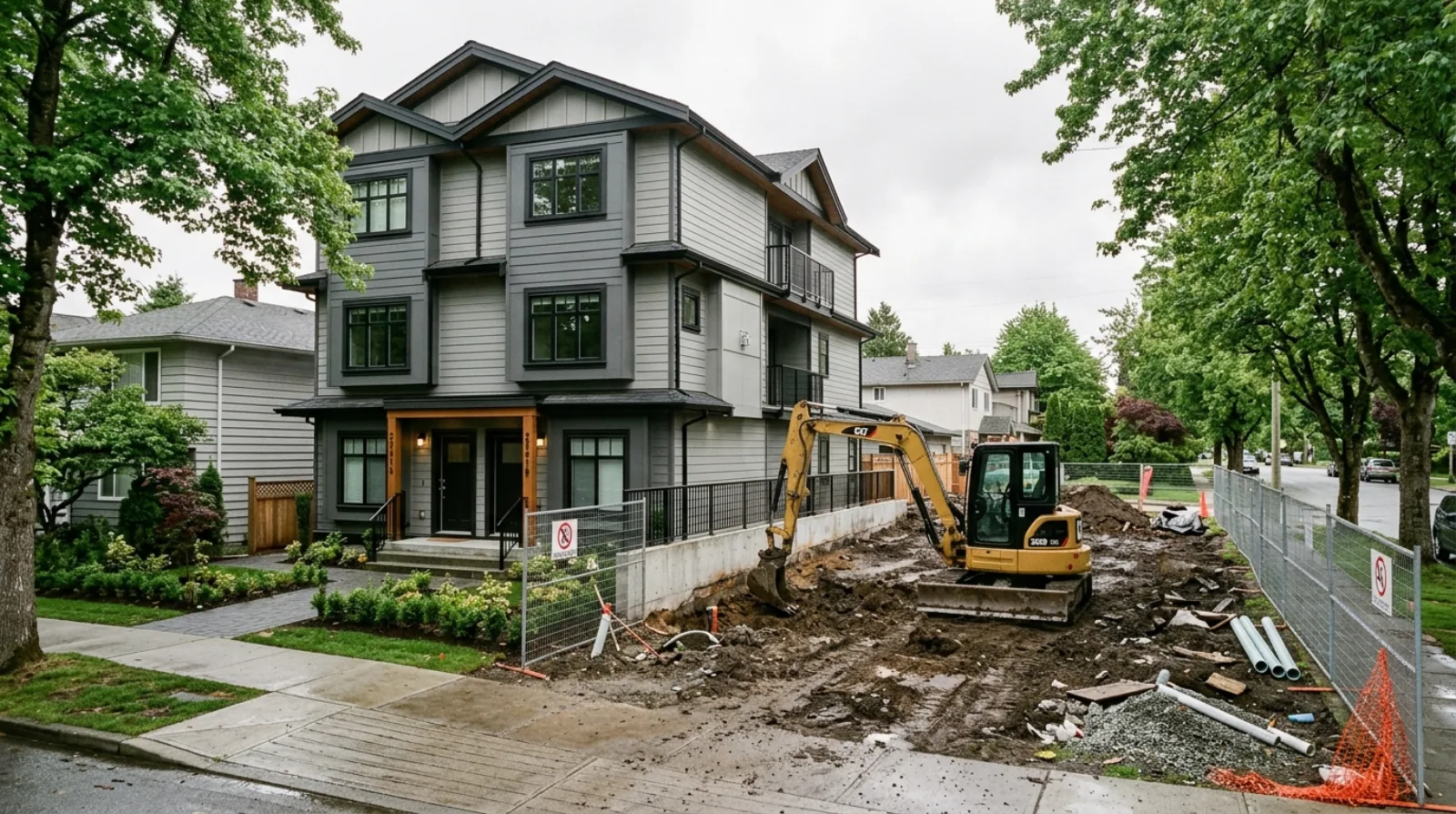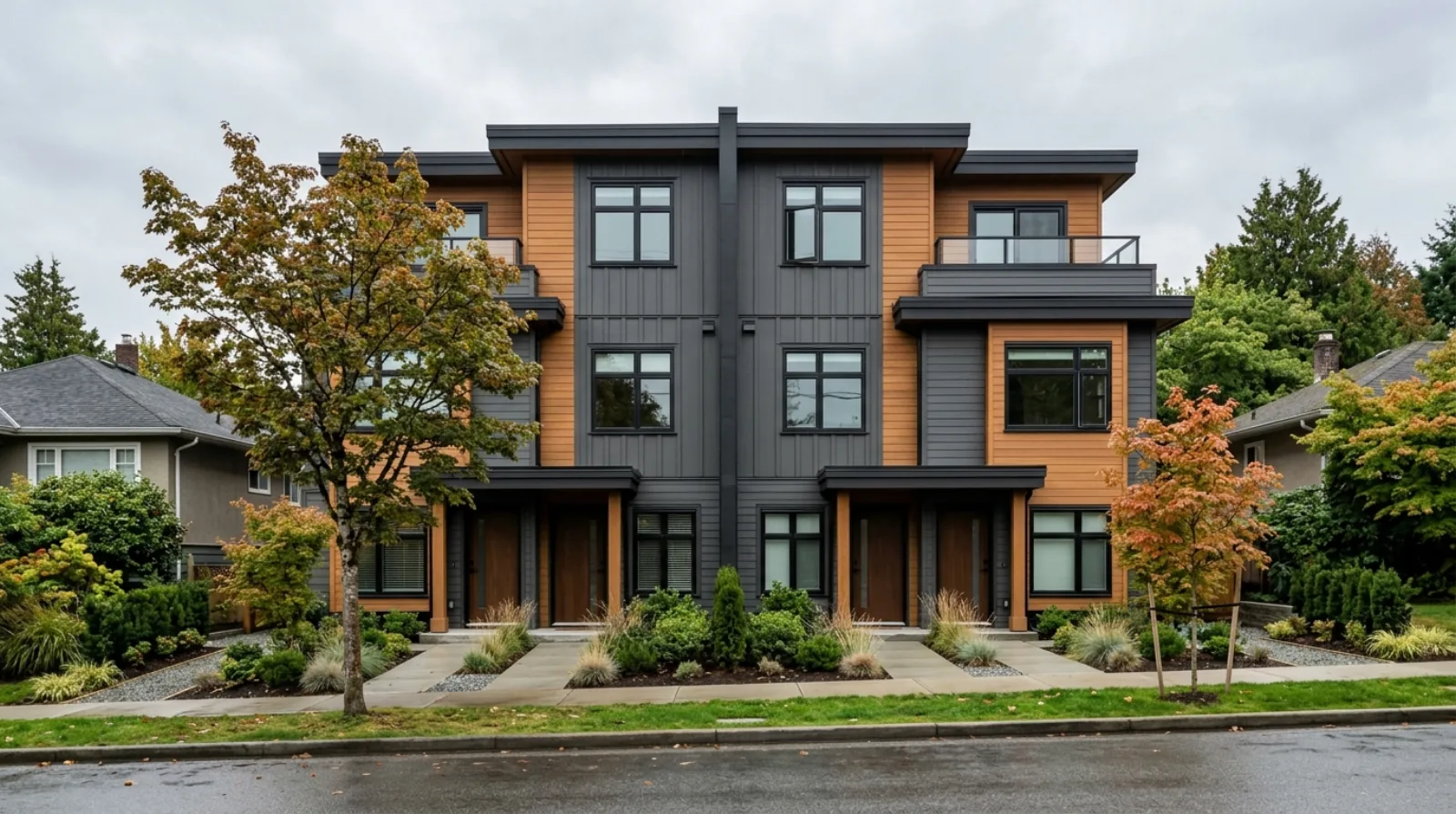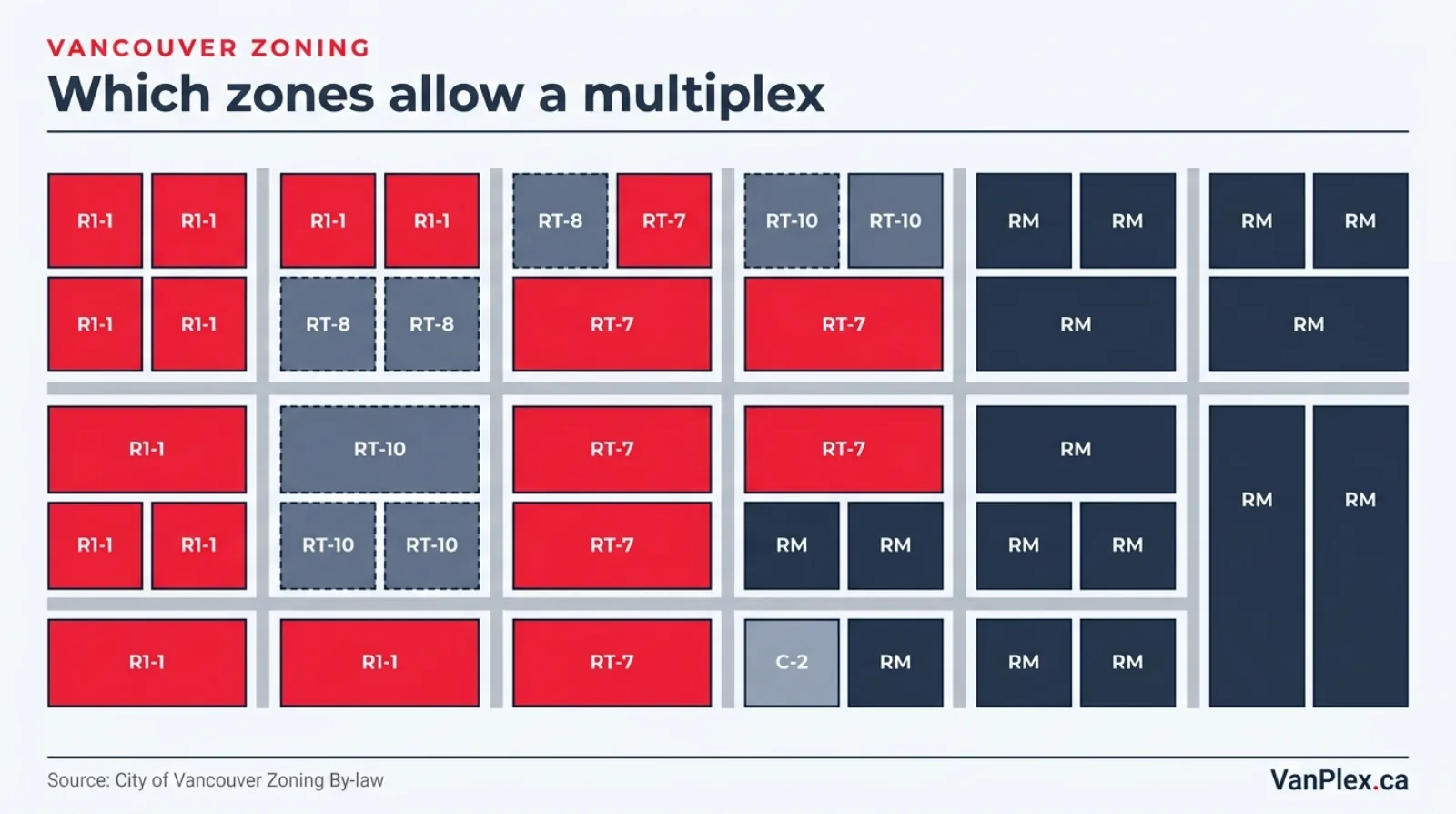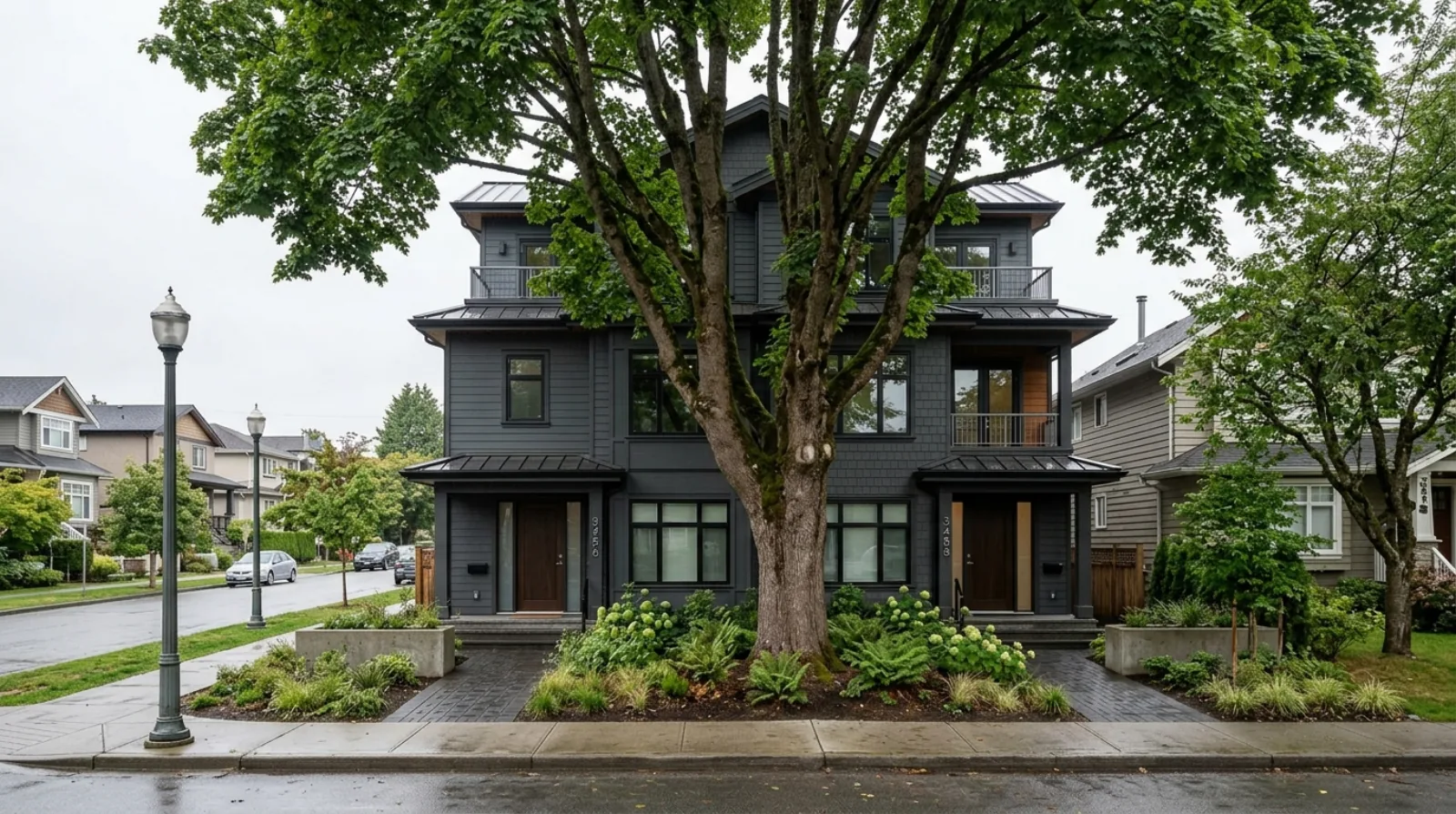

A single mature tree in your front yard can move your building. Not figuratively. Vancouver’s tree protection rules can force your building envelope to shift, shrink a unit, or change your whole site plan, and builders who find out at the permit stage lose time and money they did not budget. The tree was there before your drawings. Your drawings have to answer to it.
The good news is the rules are clear enough to design around if you know them before you start. Here is what Vancouver’s Protection of Trees By-law asks of a multiplex, how retention works by lot width, and what the cash-in-lieu option really costs.
What the bylaw covers
The Protection of Trees By-law exists to keep and strengthen Vancouver’s urban forest while still letting owners remove trees for maintenance and development. It applies to multiplex development, which the bylaw treats as up to six dwelling units, or up to eight rental dwelling units. So a standard Bill 44 multiplex sits squarely inside these rules.
The core idea is retention first, replacement second, and removal only when justified. You keep existing trees where you can. Where you genuinely cannot, you plant replacements. And where even that is not possible, there is a cash option. The bylaw is not trying to stop your project. It is trying to make sure your project does not quietly strip the block of its trees.
Retention by lot width
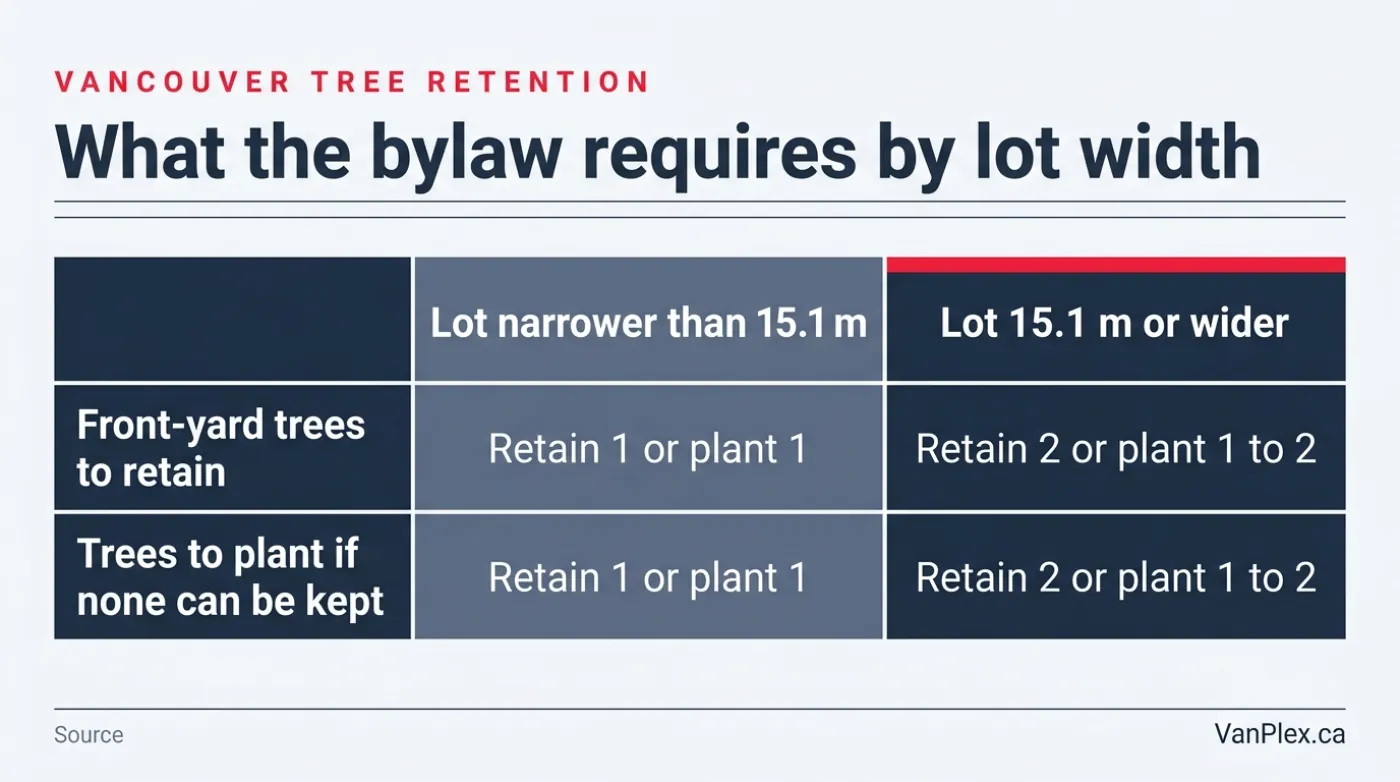
Here is the rule that drives your site plan, and it hinges on one measurement: your lot width. For sites less than 15.1 metres wide, you must retain a minimum of one existing tree in the front yard. If an existing tree cannot be retained, or there are no existing trees, you plant a minimum of one tree in the front yard instead.
For sites 15.1 metres wide or wider, the bar doubles. You must retain a minimum of two existing front-yard trees, or where existing trees cannot be retained, plant a minimum of one or two trees. So the wider your lot, the more front-yard tree the bylaw expects you to preserve or replace. This is why 15.1 metres is a number worth memorizing before you draw anything.
When you can remove a tree
You cannot just cut down a tree because it is in the way. The Director of Planning may issue a removal permit only under specific conditions. Two of the most relevant for builders: when the tree location is inside the building envelope and siting changes cannot allow it to be retained, and when the tree is within required construction access.
Read that carefully, because the phrase “siting changes cannot allow retention” is doing real work. The City expects you to try to design around the tree first. If a reasonable shift in your building’s footprint would save it, you are expected to make that shift. Removal is the fallback when retention genuinely is not workable, not the default when it is inconvenient. That is exactly why the tree has to be part of your design from the first sketch.
What cash-in-lieu really costs
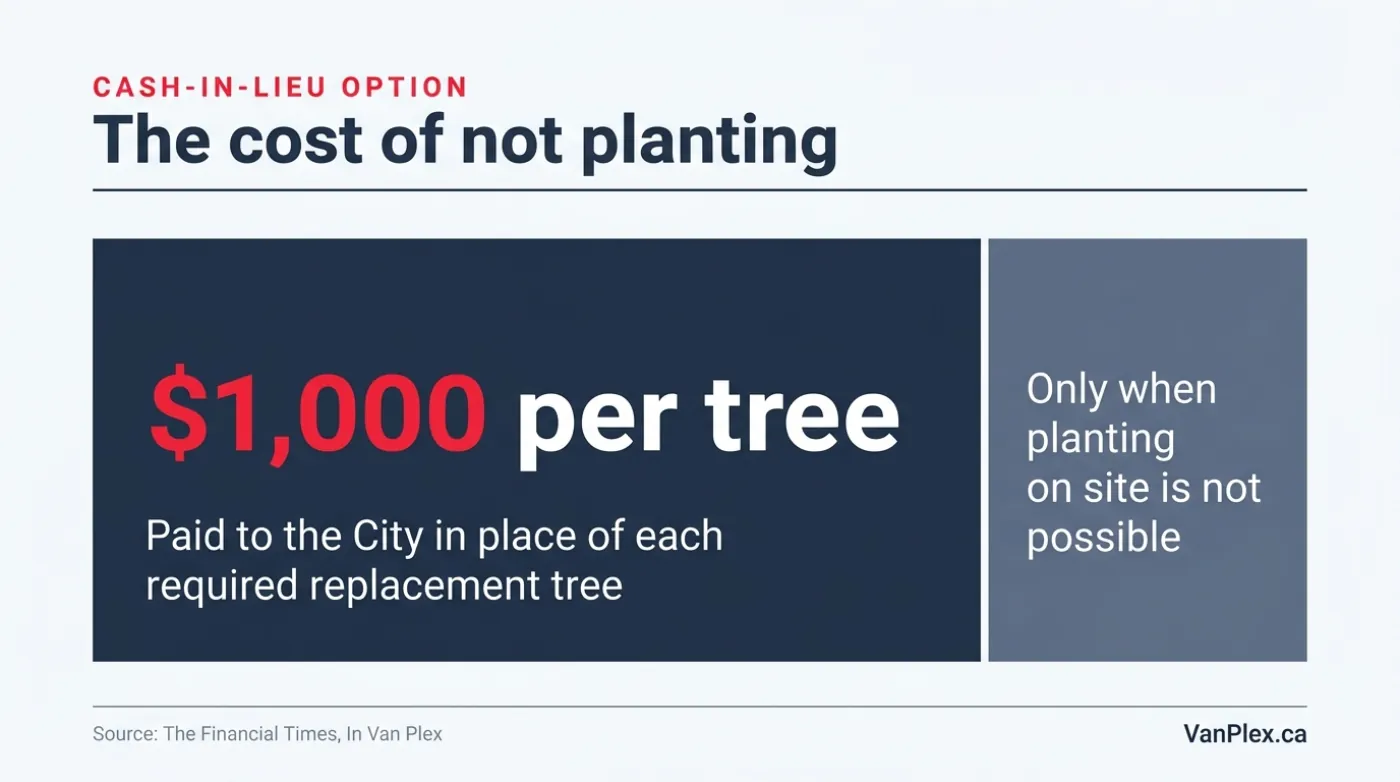
Sometimes you cannot plant the replacement trees the bylaw would require, because the site simply does not have room once the building, access, and services are placed. For that case there is a cash-in-lieu option. If the owner elects to pay the City instead of planting, the rate is $1,000 for each tree that would otherwise have to be planted.
That number is small relative to a multiplex budget, which tempts some builders to treat it as a shortcut. Do not lean on it. Cash-in-lieu is for when planting is genuinely impossible, not a way to skip the design work. And a treeless lot is a harder sell and a worse place to live. On most projects, keeping or planting real trees serves the building and the eventual buyers better than writing a cheque.
How to design around a protected tree
Start with an arborist and a survey before the architect finalizes the footprint. Locate every existing tree, its size, and its critical root zone. Then place the building so the trees you must retain sit outside the construction disturbance area. This is far cheaper to do on paper than to fix after the drawings are done.
The trap is treating the tree as an afterthought. A designer who lays out the ideal building and then discovers a protected tree in the middle of it has to redo the plan, often losing floor area or a unit. A designer who starts from the tree keeps their options open. Same lot, same bylaw, very different outcome, decided by the order you do the work.
Common questions about Vancouver’s tree bylaw
How many trees do I have to keep for a multiplex? It depends on lot width. Less than 15.1 metres wide: retain at least one front-yard tree, or plant one if none can be kept. 15.1 metres or wider: retain at least two, or plant one or two where retention is not possible.
Can I remove a tree that is in the way of my building? Only under the bylaw’s conditions. The Director of Planning may allow removal when the tree is inside the building envelope and siting changes cannot save it, or when it falls within required construction access. You are expected to try to design around it first.
How much is the cash-in-lieu payment? $1,000 per tree that would otherwise have to be planted, paid to the City when the owner chooses to pay instead of planting. Use it only when on-site planting genuinely is not possible.
Does the bylaw apply to rental multiplexes too? Yes. The multiplex category in the bylaw covers up to six dwelling units, or up to eight rental dwelling units, so rental projects are included.
The tree is a fixed input, like the lot line and the setback. Design with it from the first sketch and it costs you nothing. Ignore it and it can cost you a unit. Check your lot before you draw so the site plan works the first time.
David Babakaiff, Co-Founder, VanPlex | PlexRank™ | Profit with Multiplex