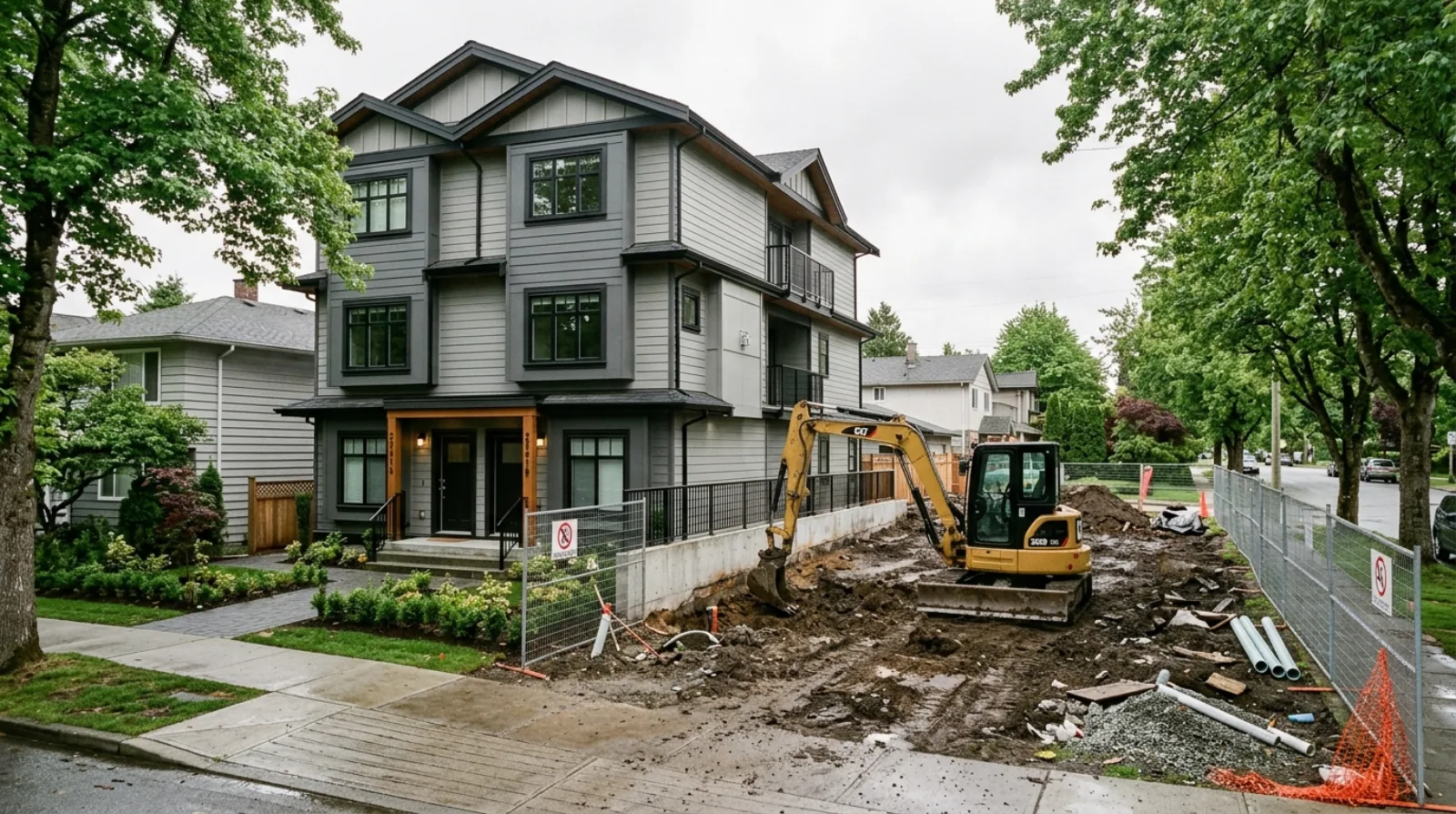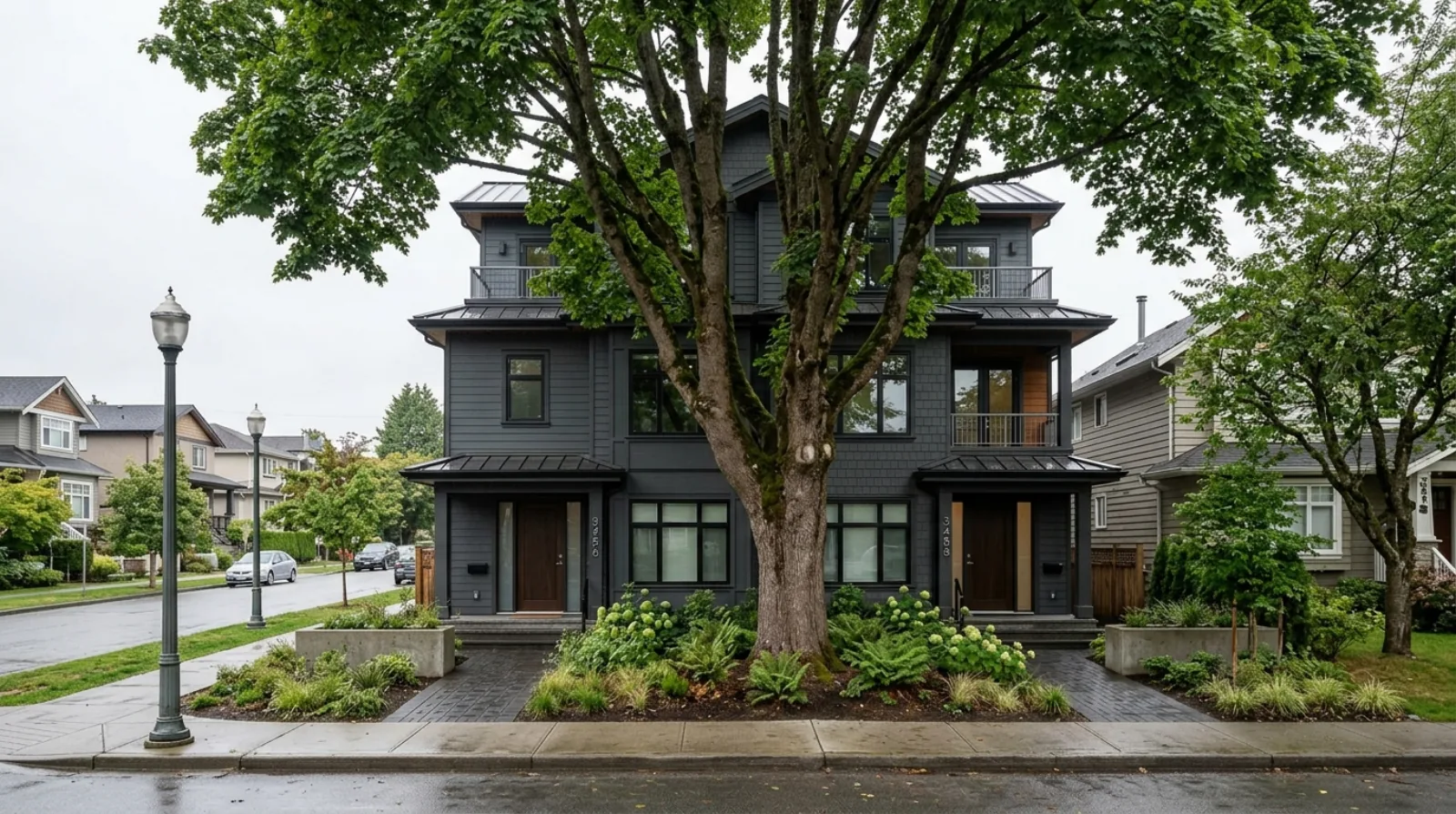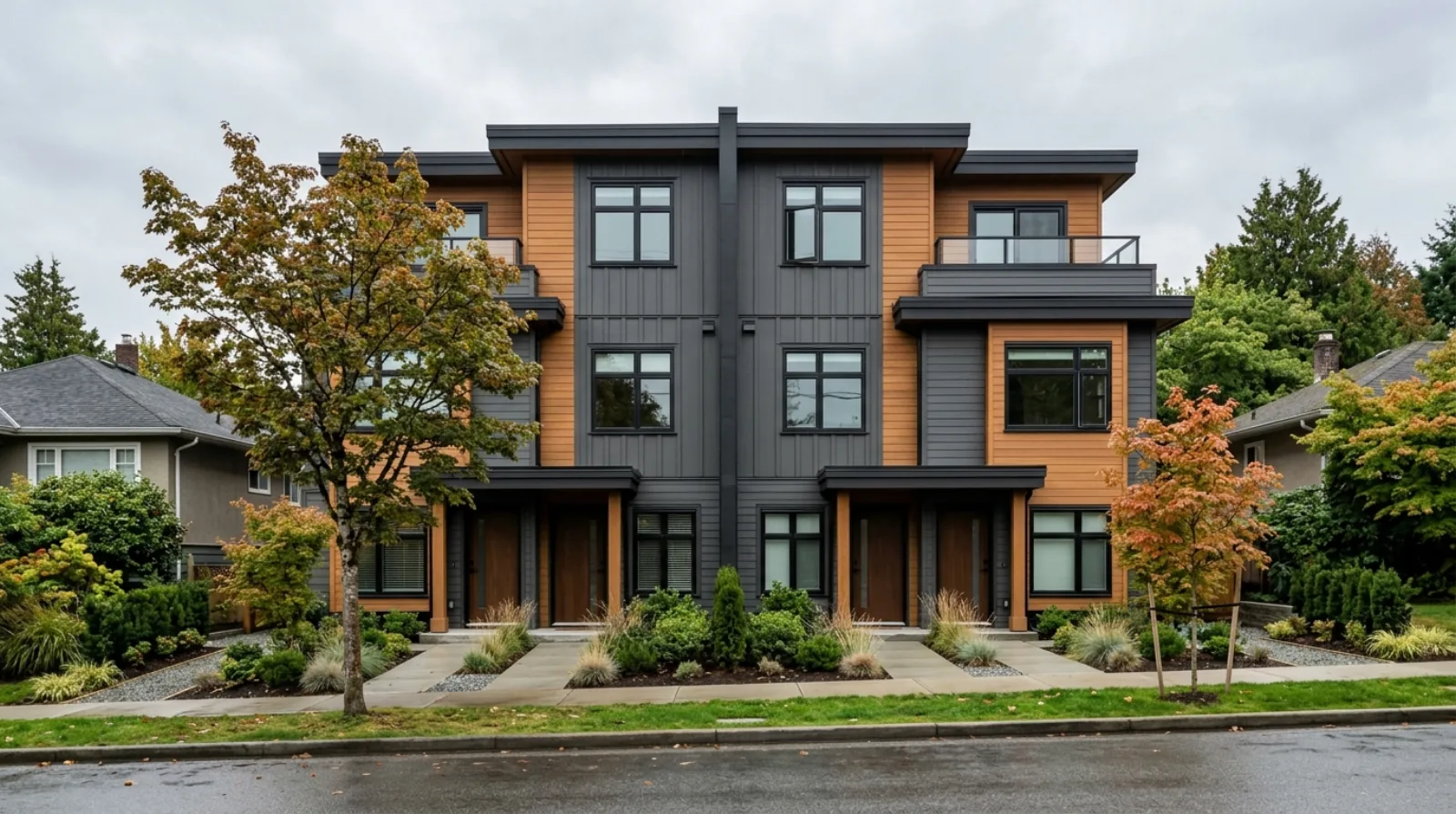

Two owners, one wall. It sounds simple until the roof leaks over the shared wall and nobody agreed in advance who pays. Party wall agreements are the boring legal document that decides that answer, and for attached multiplex homes in BC they are not optional paperwork. They are what keeps two neighbours from fighting over a wall they both depend on.
If you are building side-by-side units on separate lots, or converting to a form where each half is owned separately, this is the document that protects you. Here is how party walls work in BC and what the agreement has to cover.
What a party wall actually is
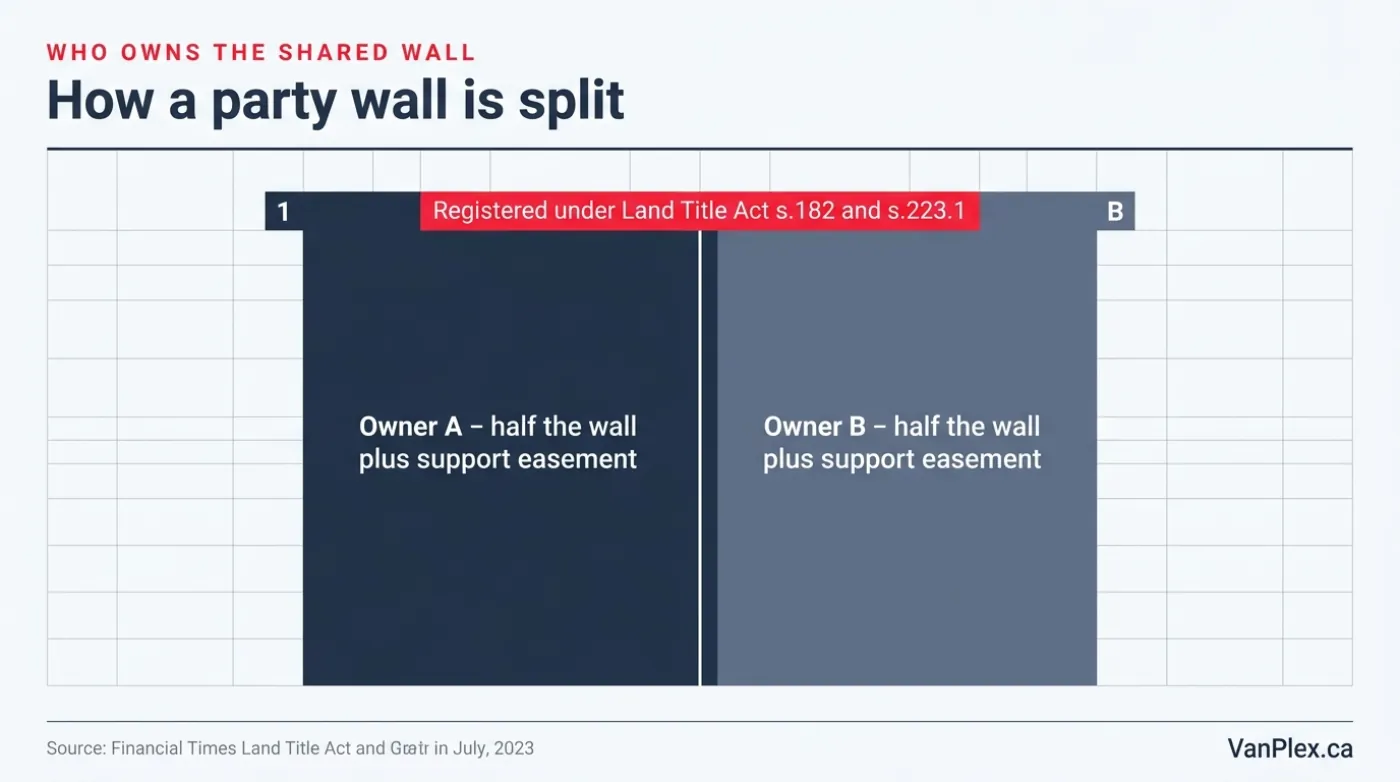
A party wall is the wall between two connected buildings owned by different people, and it usually sits half on each owner’s land. The classic arrangement gives each owner title to one-half of the wall, plus an easement in the other half so the wall keeps supporting their side. There is a second version too, where the wall belongs entirely to one owner but the neighbour holds a right to have it kept as a dividing wall.
The reason this matters for multiplex is structure. In a side-by-side arrangement, each half literally leans on the shared wall. Neither owner can knock it down, weaken it, or let it fall into disrepair without hurting the other. The law recognizes that dependence, and the party wall agreement writes down the rules so it does not turn into a dispute.
Strata versus separate lots: two different worlds
This is where builders get confused, so slow down here. If you build a multiplex and strata-title the units, the shared walls are common property. In a strata, easements for support and shelter exist without registration in a land title office, and they charge the common property that provides that support to each strata lot. The Strata Property Act and the strata’s bylaws handle a lot of the shared-wall logic for you.
But if you build side-by-side homes where each half sits on its own separate legal lot, those are not strata lots. There is no common property and no strata corporation to manage the wall. The party wall framework has to be set up deliberately, by contract, and registered on title. Skip it and you have two owners with an interlocking wall and no written rules for it. That is a lawsuit waiting to happen.
What the agreement needs to cover
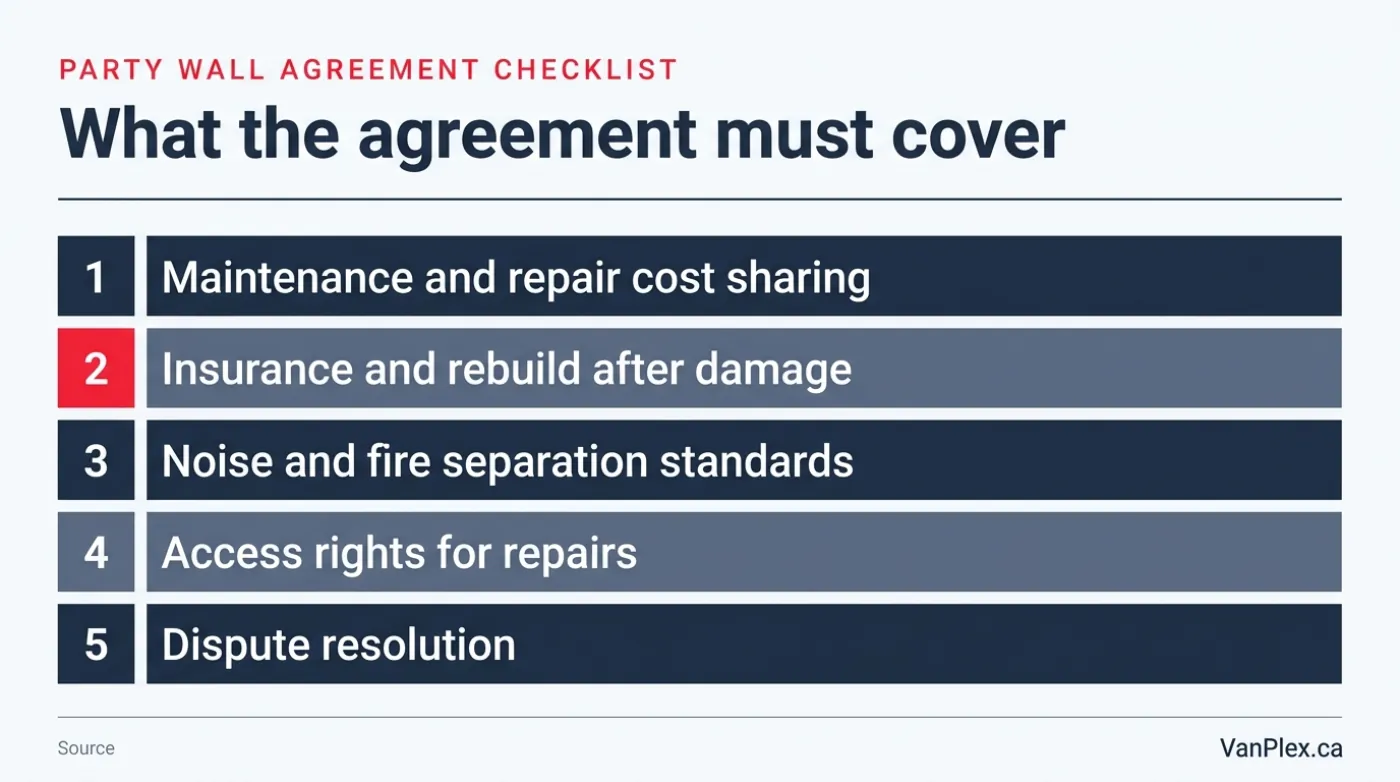
A good party wall agreement is not long, but it has to answer the predictable questions before they come up. Maintenance and repair: who pays, and how is the cost split. Insurance and rebuild: what happens if fire or water damages the wall, and how the two owners coordinate a rebuild. Fire separation and noise: the wall usually has to meet a fire-rating and sound standard, and the agreement should protect it.
It also needs practical access terms. If one owner has to open the wall or enter the neighbour’s side to make a repair, the agreement grants that access on fair terms. And it needs a dispute resolution path, so a disagreement goes to a defined process instead of straight to court. These are the terms that seem unnecessary right up until the day they are the only thing keeping the peace.
Why “we’ll just work it out” fails
The first two owners might get along fine. The problem is that property changes hands. The friendly handshake between the original neighbours means nothing to the buyer who shows up three owners later. A registered party wall agreement runs with the land, so it binds every future owner on both sides. A verbal understanding binds no one.
There is also a construction standard buried in the building code for these walls. The Building Code Appeal Board has ruled on party wall construction in duplex situations, which tells you the fire and structural details of that shared wall get real scrutiny. Build it wrong and you have a code problem on top of an ownership problem.
Where this fits in your project
Decide the ownership structure early, because it changes everything downstream. Strata-titling the units keeps the shared walls as common property under the Strata Property Act. Splitting into separate lots means you must set up and register party wall agreements yourself. Neither is wrong, but they are different paths with different paperwork, and you want to choose on purpose rather than discover it at the lawyer’s office.
Get your lawyer to draft the agreement before construction, tie it to the actual wall you are building, and register it on both titles. It is a small cost now that prevents an expensive fight later.
Common questions about party walls
Do I need a party wall agreement if I strata-title my multiplex? Usually not a separate one. In a strata, support and shelter easements exist without registration and burden the common property. The Strata Property Act and your bylaws handle the shared walls. Party wall agreements matter most when units sit on separate legal lots.
Who owns the shared wall? In the standard party wall setup, each owner owns the half of the wall on their side, plus an easement in the other half for support. In some cases the wall belongs to one owner subject to the neighbour’s right to keep it as a dividing wall.
Where is this registered? On title, under the Land Title Act. Party wall agreements are addressed in sections 182 and 223.1. Because it is registered, it binds future owners, not just the two who signed it.
What if my neighbour refuses to pay for a repair? That is exactly what the agreement is for. A well-drafted party wall agreement sets out cost sharing and a dispute resolution process, so you have a defined path instead of an argument. Without one, you are relying on general law and probably a lawyer.
The wall is shared whether you plan for it or not. The only choice is whether the rules are written down before the first problem. Check how your lot could be configured so you set up ownership the right way from the start.
David Babakaiff, Co-Founder, VanPlex | PlexRank™ | Profit with Multiplex