Victoria, BC | Multiplex Resource Hub
The Victoria Multiplex Guide: Houseplexes Under the Missing Middle
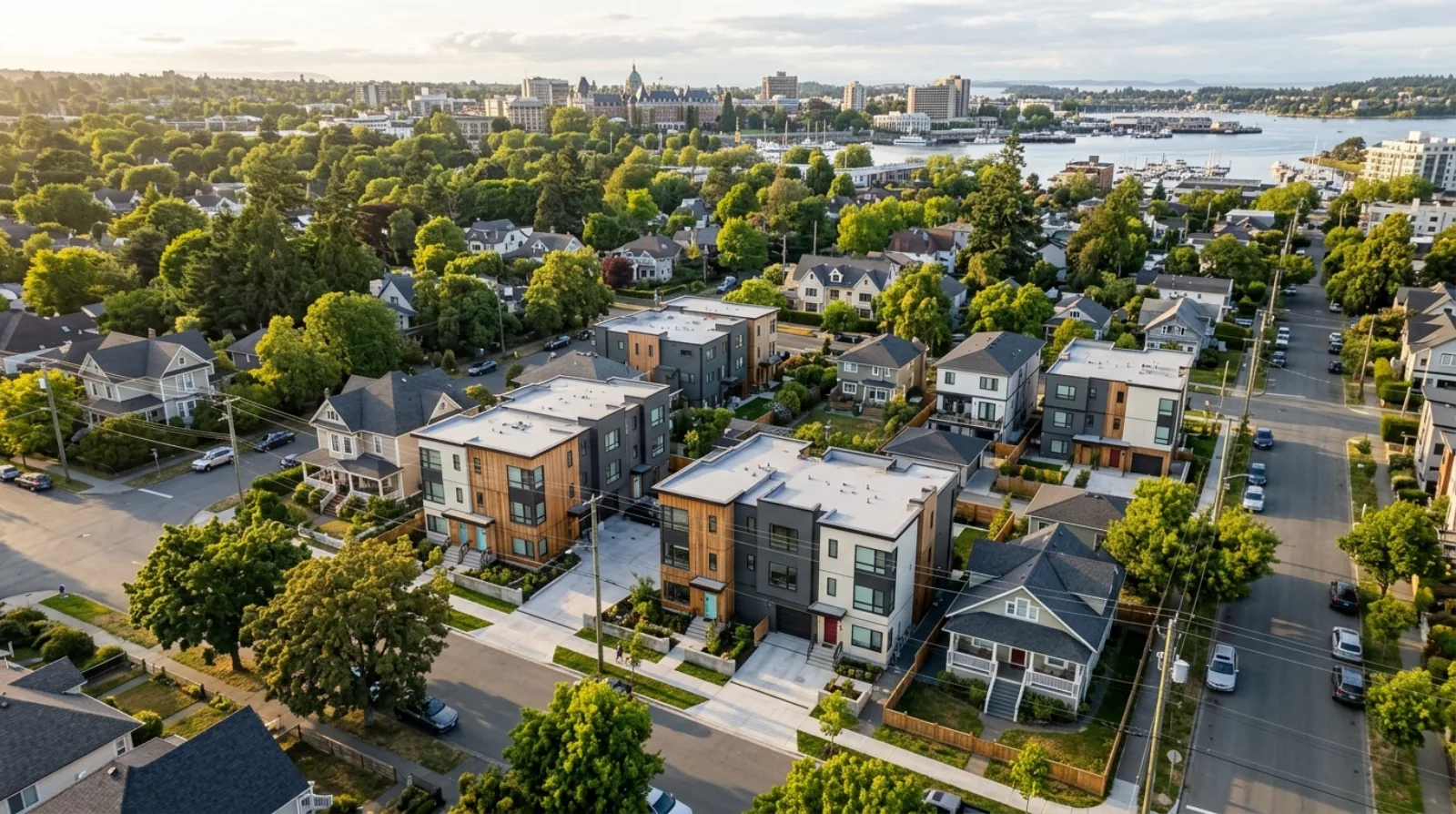
Victoria let owners replace a single house with a houseplex of up to six homes — no rezoning, no public hearing — when it adopted the Missing Middle Housing Initiative on January 26, 2023. This hub documents every rule that follows: the Schedule P height and setback limits, the four-unit cost threshold, heritage retention, and how the rest of the Capital Region handled the same provincial mandate. Every claim cites the City of Victoria, the Province of BC, or CMHC.
Unit counts from the City of Victoria Schedule P — Missing Middle Regulations. Housing target from BC Gov News — first housing targets set. No-public-hearing path from Engage Victoria — Missing Middle FAQs.
What This Hub Gives You
- ✓The two-part eligibility test — a Traditional Residential designation plus an R1-B, R1-G, R1-A, or R-2 zone.
- ✓The exact Schedule P limits: 11–12 m height, 40% site coverage, 1.0 FSR, and the 0.77-space parking ratio that can reach zero.
- ✓The four-unit threshold where development permits and per-unit cost charges begin.
- ✓Neighbourhood profiles for Fernwood, Fairfield, Oaklands, Hillside-Quadra, James Bay, and Burnside-Gorge.
- ✓How Saanich, Esquimalt, the West Shore, and Oak Bay implemented Bill 44 — including Oak Bay\'s provincial intervention.
Who This Hub Is For
Victoria Homeowner
You own a Victoria lot and want to know if the Missing Middle rules let you replace one house with a houseplex of up to six homes.
Check eligibility →Investor / Developer
You are targeting Greater Victoria infill and need the difference between the City's Missing Middle rules and the provincial Bill 44 floor next door.
Bill 44 vs Missing Middle →Builder / Designer
You are designing for Victoria and need Schedule P's height, setback, FSR, and the 0.77-space parking ratio in one place.
Read Schedule P →The Core Tension
Why Victoria led, not followed
Victoria adopted its Missing Middle Housing Initiative on January 26, 2023 — before the provincial Bill 44 deadline. Houseplexes and corner townhouses became permitted forms in Traditional Residential areas, so a compliant project skips rezoning and the public hearing entirely.
Why it still confuses owners
Two density regimes now overlap: the City's Missing Middle rules in Schedule P and the provincial Bill 44 / SSMUH floor. Which one controls your lot depends on its OCP designation and zone — and most owners cannot tell which applies.
What this hub does
It documents the rules with citations — every claim links to the City of Victoria, the Province of BC, CMHC, or Statistics Canada. No invented costs, no marketing. Facts you can act on before you spend money on a survey.
Six Categories, One Answer
Zoning & Policy
The Missing Middle Initiative, houseplex vs corner townhouse, Schedule P rules, Bill 44 overlap, design guidelines, and tenant protection.
Permits & Cost
The no-public-hearing permit path, the four-unit DCC threshold, what actually drives cost, and the project timeline.
Site & Design
Lot width and setbacks, heritage and character retention, parking reform, and BC's single-exit-stair changes.
Neighbourhoods
Fernwood, Fairfield & Gonzales, Oaklands, Hillside-Quadra, James Bay, and Burnside-Gorge.
Capital Region
How Saanich, Esquimalt, the West Shore, and Oak Bay implemented Bill 44 — and where each differs.
Market & Money
CMHC rent and vacancy data, strata-vs-rental structure, and how houseplex projects get financed.
The Victoria Houseplex Decision Funnel
Is the lot designated Traditional Residential?
Missing Middle applies only where the Official Community Plan designates the lot Traditional Residential. That is the first gate — before you ever look at the zone.
Is it zoned R1-B, R1-G, R1-A, or R-2?
Those four low-density zones are where houseplexes and corner townhouses became permitted forms. A different zone may carry different — sometimes greater — permissions.
Houseplex or corner townhouse?
A standard lot supports a houseplex of up to six units. A corner lot can support a corner townhouse of up to twelve. Lot width and street frontage decide which is on the table.
What Makes Victoria Different
Policy clarity
5/5Houseplexes are permitted forms, not rezonings. A compliant project has no public hearing.
Heritage & character review
3/5Older neighbourhoods carry heritage and character homes that shape — and sometimes complicate — design.
Rental market softening
3/5CMA purpose-built vacancy reached 3.3% in 2025, the highest since 1999. Underwrite to current data.
No-rezoning advantage
5/5Skipping rezoning and the public hearing removes the single biggest source of timeline risk.
Three Likely Outcomes
Likely End State
Single Permit Path
The lot is Traditional Residential, zoned R1-B/G/A or R-2, and a compliant houseplex of three or fewer units skips both the development permit and municipal cost charges.
Likely End State
Design-Reviewed Houseplex
Four or more units triggers a development permit reviewed against the General Urban Design Guidelines, plus per-unit cost charges — still no rezoning, no public hearing.
Likely End State
Look Next Door
The lot is not Traditional Residential, or sits in Saanich, Esquimalt, or the West Shore — where the provincial Bill 44 framework, not Victoria's Missing Middle, sets the unit count.
Best For
- ✓ Victoria owners whose lot is designated Traditional Residential and zoned R1-B, R1-G, R1-A, or R-2.
- ✓ Corner lots wide enough for a corner townhouse — the only form that reaches up to twelve units.
- ✓ Projects that can stay at three units to skip both the development permit and municipal cost charges.
Usually Fails When
- ✕ The lot is not designated Traditional Residential, so Missing Middle simply does not apply.
- ✕ Existing tenants would be displaced and the Tenant Protection obligations were not budgeted.
- ✕ The pro forma assumes the tight rental market of 2022–23 instead of the 3.3% vacancy CMHC reported for 2025.
What To Verify Before Spending Money
- → The OCP land-use designation AND the zone for the parcel — both gates must be open.
- → Whether the form is a houseplex (most lots) or a corner townhouse (corner lots only).
- → The current DCC and ACC schedules from the City bylaws before underwriting any four-plus-unit project.
Explore The Hub
Frequently Asked Questions
Can I build a multiplex in Victoria without rezoning?
Yes, in most Traditional Residential areas. Victoria's Missing Middle Housing Initiative, adopted January 26, 2023, made houseplexes and corner townhouses permitted forms in the R1-B, R1-G, R1-A, and R-2 zones. If your project complies with the Schedule P Missing Middle Regulations, no rezoning and no public hearing are required — you go straight to the permit process.
How many units can I build on a Victoria lot?
A houseplex is defined as three to six self-contained dwelling units, so up to six on a typical Traditional Residential lot. On a corner lot, a corner townhouse can have up to twelve units. Both forms are subject to a 3-bedroom requirement: the greater of two units or 30% of the units must be three-bedroom homes.
What is a houseplex in Victoria?
A houseplex is Victoria's term for a building with no fewer than three and no more than six self-contained dwelling units, where at least half the units have direct access to the outside. It is the core form enabled by the Missing Middle Housing Initiative, distinct from a corner townhouse, which is a separate form reserved for corner lots.
Which zones allow Missing Middle housing in Victoria?
Four low-density zones — R1-B, R1-G, R1-A, and R-2 — where the lot is also designated Traditional Residential in the Official Community Plan. Both conditions must be true. The designation comes first: a lot in one of those zones but not designated Traditional Residential is not automatically eligible.
Does Bill 44 (SSMUH) apply in the City of Victoria?
Victoria's position is that the provincial Small-Scale Multi-Unit Housing rules add little inside the City, because its zoning already permitted more than a duplex-with-suites in many areas and it has no "restricted zones" in the way the legislation defines them. In practice, the City's own Missing Middle rules are the ones a Victoria builder works from. In neighbouring municipalities, Bill 44 is the controlling framework.
When does a Victoria houseplex need a development permit?
A development permit is generally required for residential development with more than three primary units — so a four-, five-, or six-unit houseplex is reviewed against the General Urban Design Guidelines. A project that displaces existing tenants also requires a development permit through the citywide Tenant Protection development permit area, regardless of unit count.
How much do development charges add to a Victoria houseplex?
We do not quote construction or cost estimates here. What we can tell you from the bylaw: Victoria exempts residential projects with fewer than four self-contained dwelling units from Development Cost Charges. The fourth unit is the one that brings per-unit DCCs and Amenity Cost Charges into play — which makes the three-to-four-unit decision a financial one, not just a design one. Always pull the current schedules from the bylaw before underwriting.
Explore Related Guides
Kelowna
Kelowna Multiplex Guide
The Okanagan sibling: Bill 44 SSMUH, the Infill Fast-Track, and where 3–6 unit infill pencils.
BC-Wide
Missing Middle Hub
The province-wide framework: duplex to sixplex, feasibility, financing, and design quality.
BTR
Build-to-Rent Multiplex
The rental-hold framework — CMHC MLI Select, financing tiers, and BC cities compared.
Context
Gentle Density Guide
The thinking behind missing middle, and why BC rewrote its housing rules in 2023–24.
Official City of Victoria Sources
Province of BC — Policy Sources
Screen Your Victoria Lot for a Houseplex
Enter any Greater Victoria address to check the zone, Traditional Residential designation, and how many units the Missing Middle rules allow.