Ottawa, Ontario | Missing Middle Multiplex
Missing Middle Housing in Ottawa
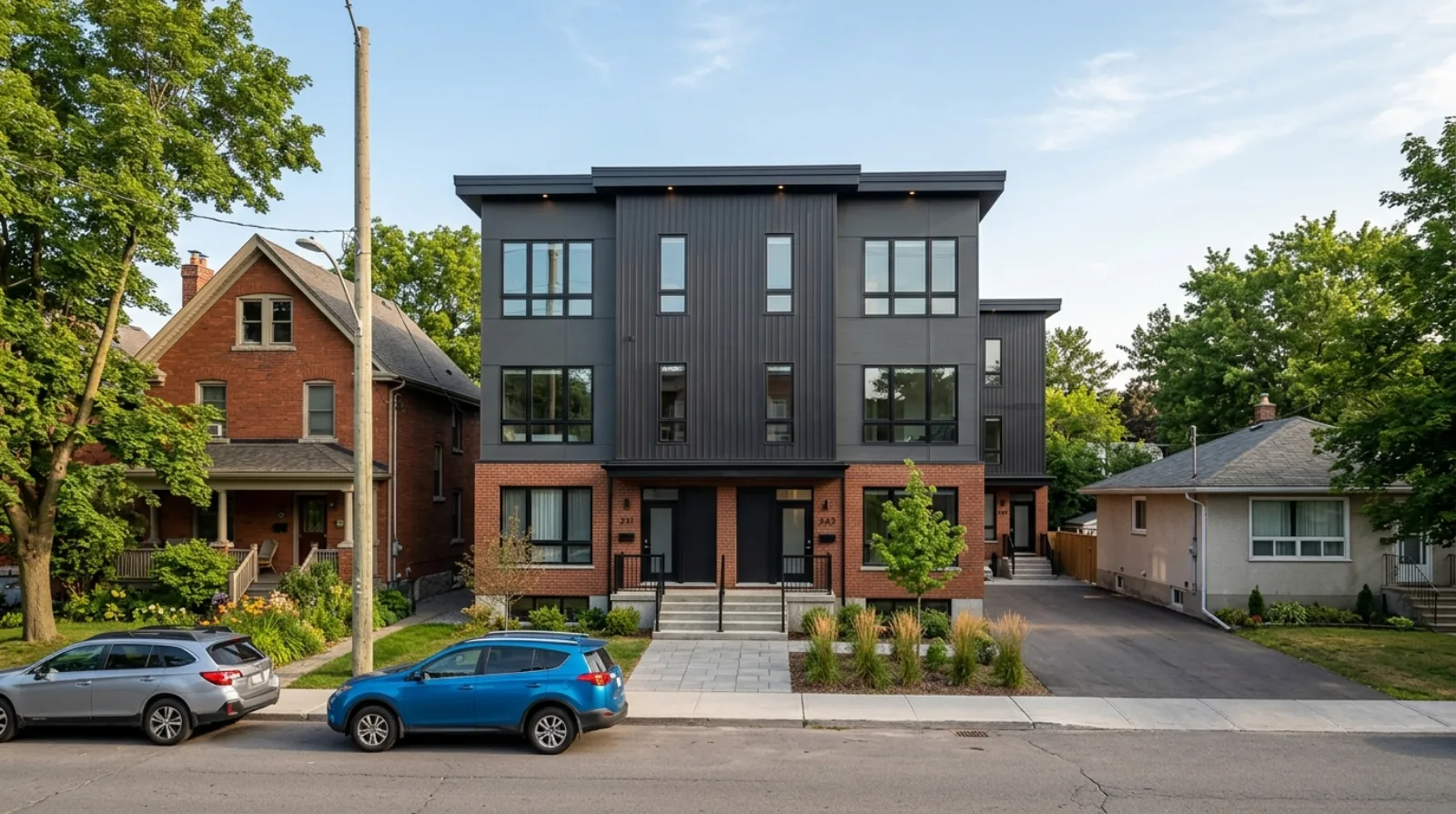
A working reference for building a missing middle multiplex in Ottawa. It covers the two policy layers — Ontario's Bill 23 and Ottawa's Zoning By-law 2026-50 — the new N1–N4 Neighbourhood zones, parking reform, and the economics of getting units built. Every external claim links to a primary source.
The Short Version
- ✓Ontario's Bill 23 guarantees three units as-of-right on most lots. Ottawa's By-law 2026-50 goes to four.
- ✓Ottawa scrapped building-type zoning for size-based N1–N4 zones — your unit cap depends on the N-zone, not whether the rules say "duplex."
- ✓Parking minimums are gone city-wide, which is what makes a small multiplex fit a standard lot.
- ✓Permitted is not the same as buildable. Frontage, servicing, and cost drivers decide whether the multiplex pencils.
Who Is This For?
Homeowner
You own a single or semi in an Ottawa neighbourhood and want to know how many units your lot now allows.
See what you can build →Builder / investor
You build small multiplexes and need the Ontario policy, the Ottawa by-law, and the economics in one place.
Read the by-law explainer →Policy reader
You follow the housing debate and want a cited summary of how Bill 23 and By-law 2026-50 fit together.
Start with Bill 23 →The Core Tension
Two layers of rules
Ontario's Bill 23 sets a province-wide floor of three units on most lots. Ottawa's Zoning By-law 2026-50 goes further, allowing up to four units as-of-right and more in higher N-zones.
Two definitions of "missing middle"
Builders mean a 2-to-6-unit multiplex. The City of Ottawa officially defines missing middle as buildings of roughly 8 to 16 units. The hub keeps both straight.
What this hub does
It separates the legislation from what actually gets built on an Ottawa lot — frontage, servicing, the N-zone, and the cost drivers that decide whether a multiplex pencils.
Ontario Floor vs the Ottawa By-law
Two rule sets stack on every Ottawa lot. The province sets the minimum; the City decides how far above it to go. Here is how they compare for a missing middle multiplex.
| Dimension | Ontario (Bill 23) | Ottawa By-law 2026-50 |
|---|---|---|
| As-of-right unit floor | 3 units on most residential lots (Bill 23) | Up to 4 units on a serviced residential lot |
| Mechanism | Provincial floor every municipality must allow | Municipal by-law that goes beyond the floor |
| Zoning structure | Set by each municipality | Size-based Neighbourhood zones (N1–N4), not building type |
| Parking minimums | Removed near major transit (Bill 23) | Removed city-wide under By-law 2026-50 |
Sources: Bill 23, More Homes Built Faster Act, 2022 and City of Ottawa Zoning By-law 2026-50. Confirm any specific parcel on geoOttawa.
How To Read This Hub
Read the two policy layers
Bill 23 sets the Ontario three-unit floor. Ottawa Zoning By-law 2026-50 layers a four-unit as-of-right baseline and the N1–N4 zones on top. Read both before assuming a unit count.
Find your N-zone
Ottawa replaced building-type R1–R5 zoning with size-based Neighbourhood zones. Your unit cap and height depend on whether your lot is N1, N2, N3, or N4. Check geoOttawa.
Test whether the lot pencils
Frontage, lot area, servicing, and the cost drivers decide whether a fourplex or six-unit multiplex is actually buildable — not just permitted on paper.
Reading The Opportunity
Policy clarity
4/5Bill 23 and By-law 2026-50 are both public and well-documented. The interaction between them is what trips people up.
As-of-right opportunity
4/5Four units on a serviced lot with no rezoning and no parking minimum is a real, fast pathway in established neighbourhoods.
Affordability impact
2/5New multiplex units rent at the top of the local market. Affordability comes from supply at scale over years, not unit by unit.
Lot-by-lot variation
5/5Kanata, the Glebe, Vanier, and Barrhaven start from very different lot sizes, land values, and N-zones.
Best For
- ✓ Ottawa homeowners who want a citable answer about what their lot now allows under By-law 2026-50.
- ✓ Builders and investors who need the Ontario policy, the Ottawa N-zones, and the multiplex math in one place.
- ✓ Policy readers who want the Bill 23 vs Ottawa by-law relationship explained with sources, not slogans.
Usually Fails When
- ✕ You want a single dollar figure for what an Ottawa multiplex costs — cost depends on the site, servicing, and scope.
- ✕ You assume every lot can hit the maximum N-zone unit count — frontage, lot area, and servicing decide feasibility.
- ✕ You expect new multiplex units to be cheap — they rent at the top of the local market; affordability is a supply-at-scale effect.
What To Verify Before Spending Money
- → Your lot's Neighbourhood zone (N1–N4) on geoOttawa before assuming any unit count.
- → Whether your lot is fully serviced — the four-unit as-of-right rule applies to serviced residential lots.
- → Your frontage and lot area against the by-law's standards for the multiplex form you want.
Explore The Hub
Frequently Asked Questions
What is missing middle housing in Ottawa?
How many units can I build on an Ottawa lot as-of-right?
What is Ottawa Zoning By-law 2026-50?
How is Ottawa different from BC for building a multiplex?
Did Ottawa remove parking minimums for multiplexes?
Who is this Ottawa missing middle hub for?
Compare With the BC Story
BC & Canada
Missing Middle Housing Hub (BC)
The Bill 44 / SSMUH version of this hub, covering Vancouver, Burnaby, Surrey, and the rest of Metro Vancouver.
BC Legislation
Bill 44 and BC's SSMUH Mandate
How BC's province-wide four-to-six-unit mandate differs from Ontario's three-unit floor and Ottawa's by-law approach.
Official Sources Referenced
Coming to Ottawa
Get Early Access When VanPlex Launches in Ottawa
We model missing middle multiplex feasibility lot-by-lot. Join the Ottawa early-access list and we'll tell you what your lot can build under Zoning By-law 2026-50 the day Ottawa goes live.