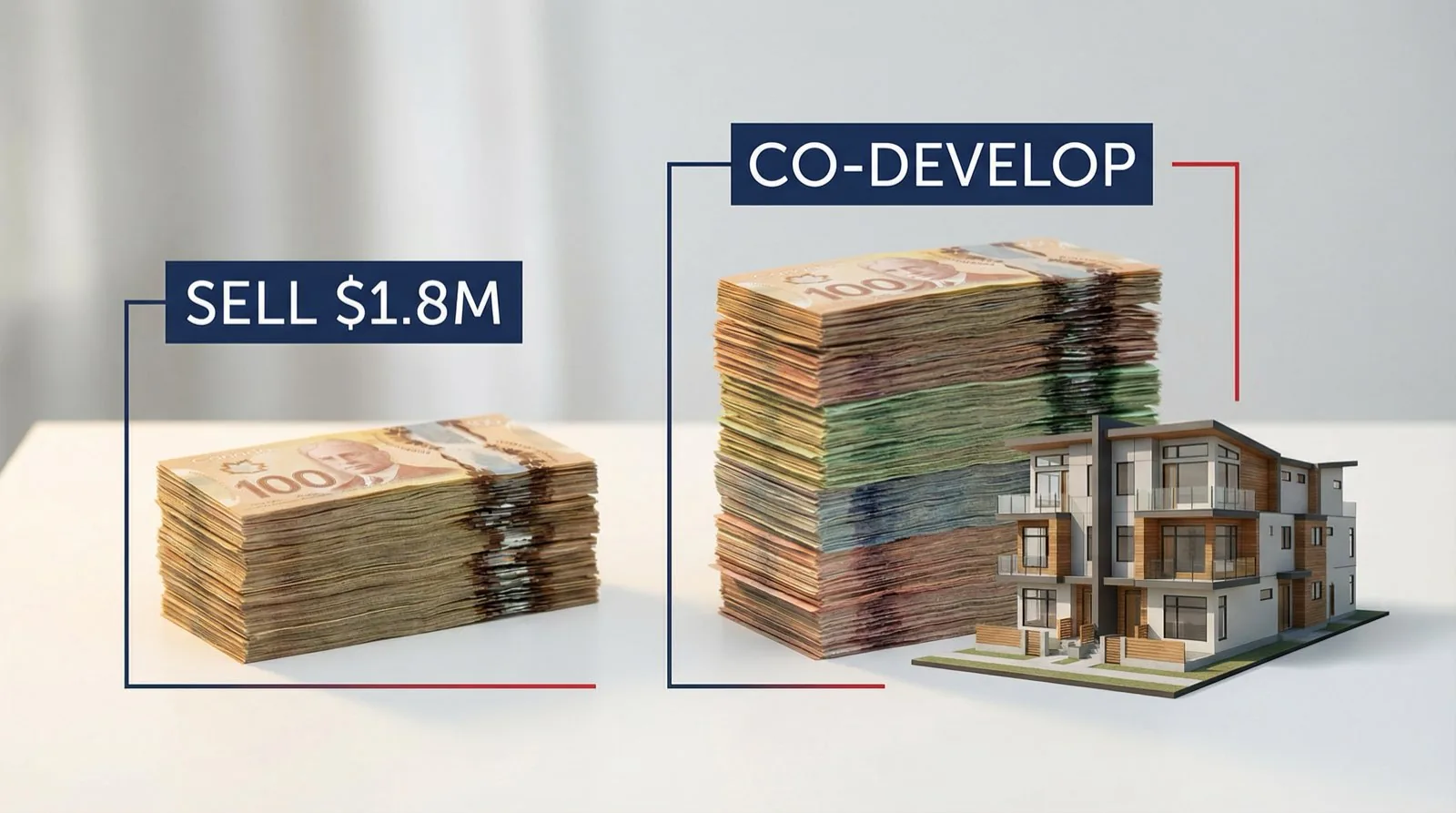

Everyone has an opinion about co-development. Very few people have run the actual numbers on the same lot two ways. This post does exactly that: a $1.8M Vancouver lot, worked end-to-end, selling versus co-developing, after tax, after fees, after time.
The numbers are 2026 market numbers. The lot is a real one (details anonymized). The math is conservative on both sides.
TL;DR
- Clean sale of a $1.8M lot nets roughly $1.64M after tax for a long-held principal residence.
- Co-developing the same lot into a 4-plex and keeping 2 units nets roughly $2.52M in unit value, but takes 22 months and carries real execution risk.
- The gap is $880K. That is the price of patience and risk tolerance.
- On a tax-adjusted per-month basis, the gap is about $40K/month of “waiting premium”. Worth it for some owners. Not for others.
The Lot
- 33 by 122 feet (~4,026 sq ft), east side Vancouver
- R1-1 zoning, clean title, no peat, standard slope
- 1950s bungalow, original owner, fully paid off
- Current assessed value: $1,800,000 ($1.55M land, $250K improvements)
- Fair market value (pre-listing): $1,850,000
Path A: Clean Sale
Gross sale price: $1,850,000
Deductions:
- Real estate commission (3.5% total): -$64,750
- Legal fees: -$2,500
- Minor conveyancing: -$1,000
Net proceeds before tax: $1,781,750
Tax treatment: The owner has held this as principal residence for 40 years. Principal Residence Exemption applies. Zero capital gains tax owed.
Net in hand: $1,781,750
Time to completion: 60 to 90 days.
Wait — what about the downsizing cost? Let’s account for the owner buying a replacement home or condo.
If the owner buys a $1.2M condo in the same neighbourhood (Property Transfer Tax $22,000, legal $2,500, moving $5,000), they are left with:
$1,781,750 - $1,200,000 - $22,000 - $2,500 - $5,000 = $552,250 cash + a $1.2M condo.
Total asset position: $1,752,250 (condo + cash).
Path B: Co-Development (Land-for-Units)
Deal structure:
- Land contribution agreed at $1,800,000
- Builder funds $2,400,000 of hard + soft construction
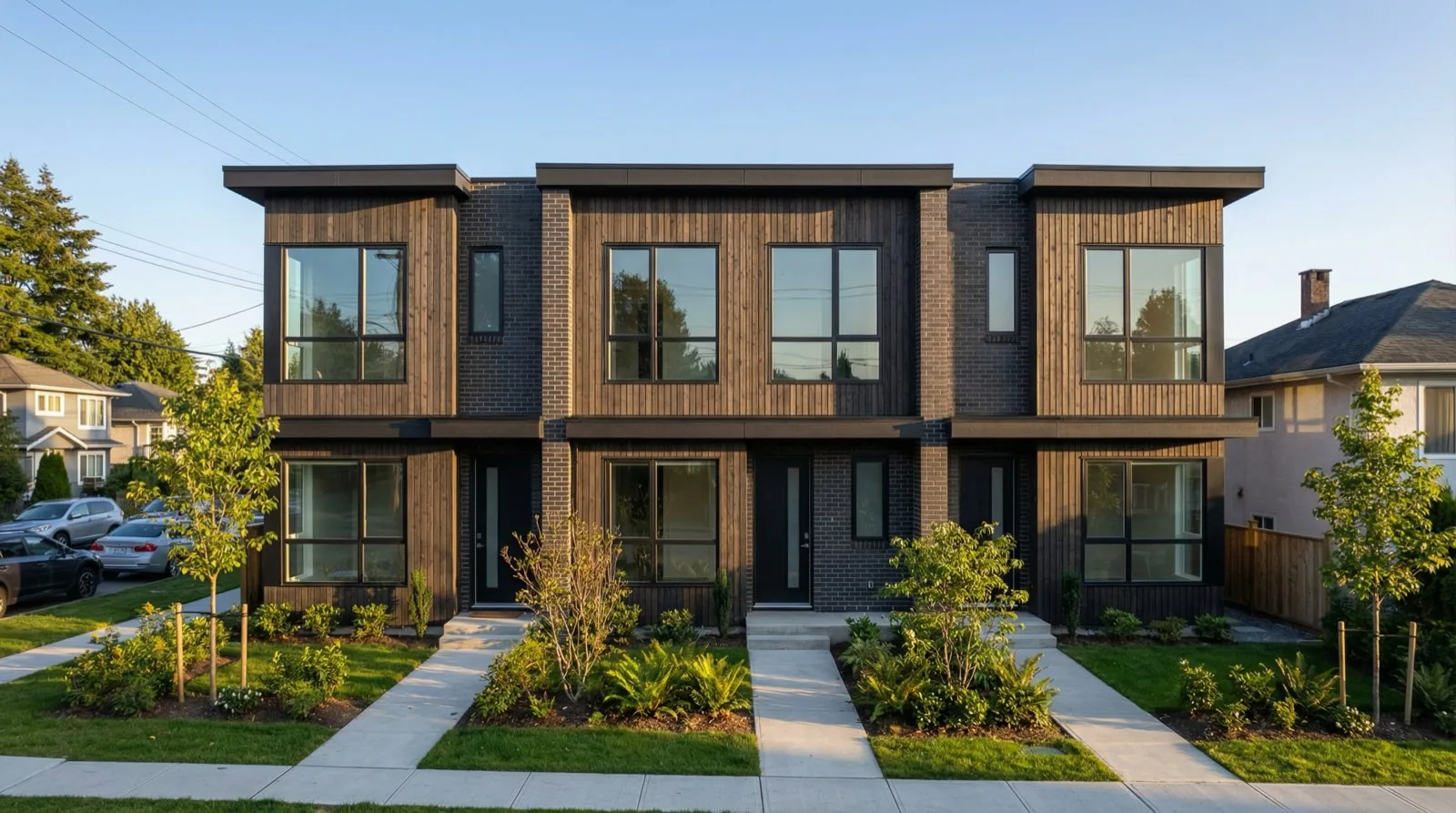
- 4 strata units built at 1,200 sq ft each
- Expected finished unit value (2026 east side, new construction): $1,400,000 per unit
- Split: 2 units to homeowner, 2 units to builder
Homeowner receives:
- Unit A: to live in (principal residence, 1,200 sq ft) — $1,400,000 value
- Unit B: to rent out or sell — $1,400,000 value
Gross unit value: $2,800,000
Now the costs and tax drag:
1. Property Transfer Tax on unit transfers. Each unit over $2M triggers higher brackets. On a $1.4M unit: 1% of $200K + 2% of $1.2M = $26,000 per unit. But: the newly-built home exemption applies if the homeowner occupies Unit A as principal residence (full exemption up to $750K, partial to $800K). Assume partial exemption saves $8K on Unit A. Full PTT on Unit B.
- PTT Unit A: ~$18,000 (after partial exemption)
- PTT Unit B: ~$26,000
2. GST. New construction is subject to 5% GST. The GST New Housing Rebate applies on the principal residence (Unit A) for purchases under $450K — you get a partial rebate. On Unit B (rental), the GST/HST New Residential Rental Property Rebate applies, recovering up to $6,300 federal.
Assume net GST cost on Unit A: ~$55,000 (5% on $1.4M minus rebate on first $350K). Net GST cost on Unit B: ~$63,700.
3. Legal, accounting, CPA advisory throughout the project: -$18,000
4. Interim rent during construction (22 months × $3,500/mo): -$77,000
5. Opportunity cost of delayed downsizing: harder to quantify, ignored for this calc.
Total out-of-pocket drag: ~$257,700
Net homeowner position at completion:
$2,800,000 gross unit value
- $257,700 costs and tax drag = $2,542,300 net unit value
Side-by-Side
| Metric | Sell | Co-Develop |
|---|---|---|
| Gross value realized | $1,850,000 | $2,800,000 |
| Cash out-of-pocket | -$68,250 (RE, legal) | -$257,700 (PTT, GST, rent, legal) |
| Tax drag | $0 (PRE) | Already in drag number above |
| Net position | $1,781,750 | $2,542,300 |
| Timeline | 60-90 days | 22 months |
| Risk | Near-zero | Real execution risk |
| Asset type at end | Cash | 2 new strata units |
Delta: $760,550 in favour of co-development.
But That Number Is Wrong
Both sides are wrong in different ways. Let me fix them.
Sell side: The $1,781,750 is cash. If that cash earns 4% in a high-interest account for 22 months (the co-dev timeline), it becomes ~$1,912,700. The fair comparison number is $1,912,700.
Co-dev side: The $2,542,300 is unit value, not liquid cash. To convert Unit B to cash, subtract 3.5% sale cost and 50% capital gains inclusion on appreciation above the cost base at completion. If there’s no appreciation beyond cost (conservative), Unit B nets ~$1,351,000 after sale. Unit A remains $1,400,000 as a paid-off primary residence.
Fair co-dev comparison number: $1,400,000 + $1,351,000 = $2,751,000 in blended cash + home value.
Fair sell comparison number: $1,912,700 cash + $1,200,000 condo - $22K PTT on condo purchase = $3,090,700 in blended cash + home value.
Wait. Selling wins?
Not quite. The $1,200,000 condo purchased in the sell scenario gets you a 700 sq ft unit in a 20-year-old building. The $1,400,000 retained Unit A in the co-dev scenario gets you 1,200 sq ft of brand-new construction on your own block. These are not the same asset.
On an apples-to-apples lifestyle basis, the co-dev is worth roughly $300K to $500K more in quality of life that doesn’t show up in the spreadsheet.
The Real Answer
The math says: selling and investing the cash conservatively gets you to roughly the same blended position as co-developing, with far less risk and effort — if you’re comparing total dollars.
The math does NOT say: selling gets you the same lifestyle outcome. Co-developing lets you stay in your neighbourhood, in a brand-new home, in a building where one of the other units pays you rent.
Which matters more is a personal question, not a financial one. See our deal structures page for other split scenarios, and read the honest decision framework if you’re still unsure.
For broader context on multiplex ROI, see our Kelowna MF1 analysis.
Assumptions and Caveats
- Build costs: $600/sq ft all-in is typical 2026 Vancouver. Add 10-20% if your lot has any complications.
- Unit values: $1,167/sq ft for new east side strata is conservative. West side is 30-50% higher.
- PTT and GST math requires a CPA review — these are estimates.
- 22-month timeline assumes no permit delays and no builder trouble. Real projects go long more often than they come in early.
- The PRE change-of-use rules are more complex than this post suggests. Model with a real estate CPA.
Numbers are a tool, not an answer. Your risk tolerance, timeline, and lifestyle goals are the answer.