
Why Capital Investors Are Reassessing Small-Format Multifamily in Vancouver and Burnaby
Multifamily investing has traditionally been defined by two dominant choices:
- Purpose-built rental, offering stable but modest yields, and
- Large-scale multifamily towers, offering higher potential returns but requiring extended timelines, entitlement exposure, and significant development risk.
A third category is now emerging.
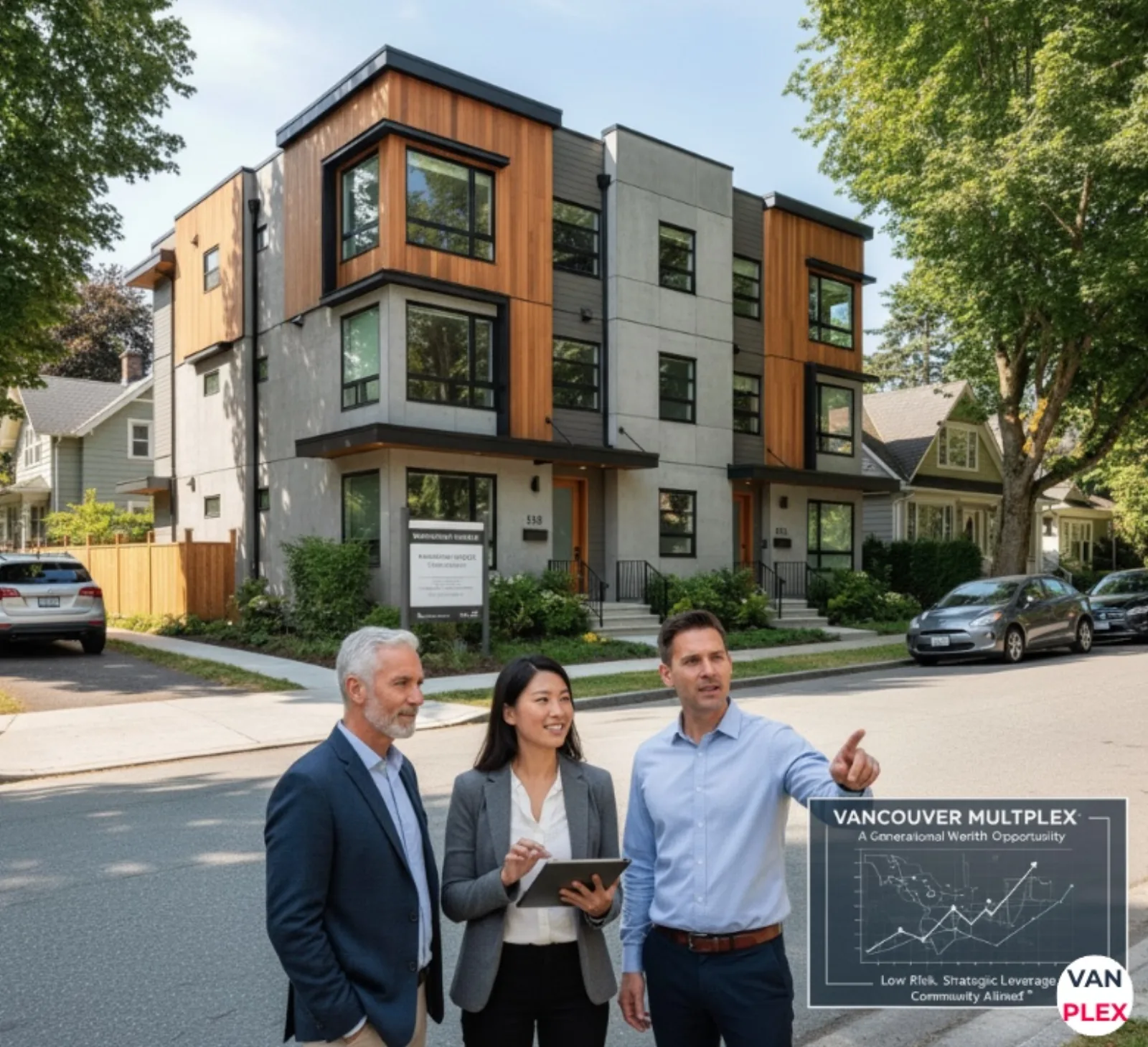
British Columbia’s Bill 44—which permits 4–6 units by right on the majority of single-family lots—has created a scalable, policy-supported path for small-format multifamily. For investors evaluating whether to commit capital, the investment overview at VanPlex lays out the asset class thesis in plain terms. These multiplex developments combine the operational simplicity of low-rise infill with an economic profile that can, in many cases, project stronger returns than conventional multifamily assets.
As capital markets search for IRR-generating opportunities that do not require multi-year entitlement processes, multiplexes are gaining traction as a distinct asset class. Preliminary feasibility studies and early project completions suggest that the return dynamics merit serious institutional attention.
A New Middle Ground in Risk and Duration
Multiplex projects occupy a unique position between conventional multifamily categories:
1. Shorter Development Duration
Typical multiplex projects can complete in under two years—often in roughly 18 to 23 months, based on representative project timelines.
This is significantly shorter than large towers, which can require five to seven years from acquisition to stabilization.
2. Lower Regulatory Exposure
Bill 44 enables multiplex development as-of-right, meaning that projects generally do not require rezoning, public hearings, or extensive entitlement negotiations.
For investors accustomed to zoning risk, this regulatory clarity reduces one of the largest variables in development underwriting.
3. Predictable Exit Liquidity
Multiplex units—typically 2–3 bedroom strata homes—appeal to multi-generational families, downsizers, and young professionals. These buyers rely on conventional residential financing, not commercial debt, making absorption less vulnerable to macro-driven pre-sale volatility.
Collectively, these features result in a risk profile that is more stable than large multifamily development, but with projected returns that can surpass those of traditional rental assets.
Illustrative Return Dynamics: A Representative Example
Consider a representative feasibility scenario on Vancouver’s west side (examples and projections only):
- Lot size: Approx. 6,100 sq. ft.
- Buildable area: Approx. 7,600 sq. ft. under multiplex zoning
- Construction + soft costs: Projected at roughly $4 million
- Estimated end value: Based on local multiplex comparables, potentially in the range of $5–6 million
While each property varies, this type of project may illustratively model to a projected return on equity in the mid-double-digit range, depending on capital structure, market conditions, and execution efficiency.
In nearby Burnaby, where land basis is often lower and transit access is strong, some feasibility projections indicate that returns could reach higher thresholds under the right conditions.
These projections are not guarantees, but they illustrate why investors are increasingly evaluating multiplexes alongside conventional multifamily alternatives.
Positioning Multiplexes Within a Multifamily Portfolio Strategy
From a capital allocation standpoint, multiplexes offer several advantages:
Faster Capital Recycling
Shorter project durations enable more efficient capital rotation relative to large multifamily towers.
Reduced Exposure to Commodity and Rate Volatility
Compressed timelines inherently limit exposure to multi-year fluctuations in construction inputs and interest rates.
De-Risked Entitlement
Policy certainty removes a historically unpredictable part of the underwriting process.
Segmented Deployment, Lower Concentration Risk
Instead of placing $50M–$200M into a single large-scale asset, investors can deploy capital into multiple smaller projects, smoothing volatility across a portfolio.
End-User Driven Demand
Family-oriented strata units have demonstrated stronger resilience in slower markets compared to investor-dependent condo segments.
This combination creates a compelling “third lane” for capital seeking both yield and risk control.
Why Multiplexes Are Emerging as a Distinct Asset Class
Several structural factors are giving multiplexes staying power:
- Regulatory stability through by-right zoning
- Consistent demand for ground-oriented homes in urban cores
- Repeatable design and construction templates, reducing variance in budgets and timelines
- Strong exit liquidity based on end-user financing
- Projected returns that, in some examples, surpass traditional multifamily pathways
These dynamics suggest multiplex development is evolving beyond an infill strategy—it is becoming a recognized, data-supported category of small-format multifamily.
The Strategic Case for Capital
In an environment where multifamily investors face compressed yields, rising costs, and extended entitlement cycles, multiplexes offer a differentiated combination of:
- Attractive projected return profiles
- Shorter development windows
- Lower regulatory risk
- Broad end-buyer demand
- Scalable deployment opportunities across hundreds of qualifying lots
While every project requires rigorous due diligence, early feasibility modeling shows that multiplex development has the potential to outperform many traditional options—particularly when integrated into a balanced portfolio strategy. You can model individual properties using our pro forma calculator or review real completed projects in our case studies.
David Babakaiff
Co-Founder, VanPlex.ca
Vancouver Multiplex Index™ | Profit with Multiplex