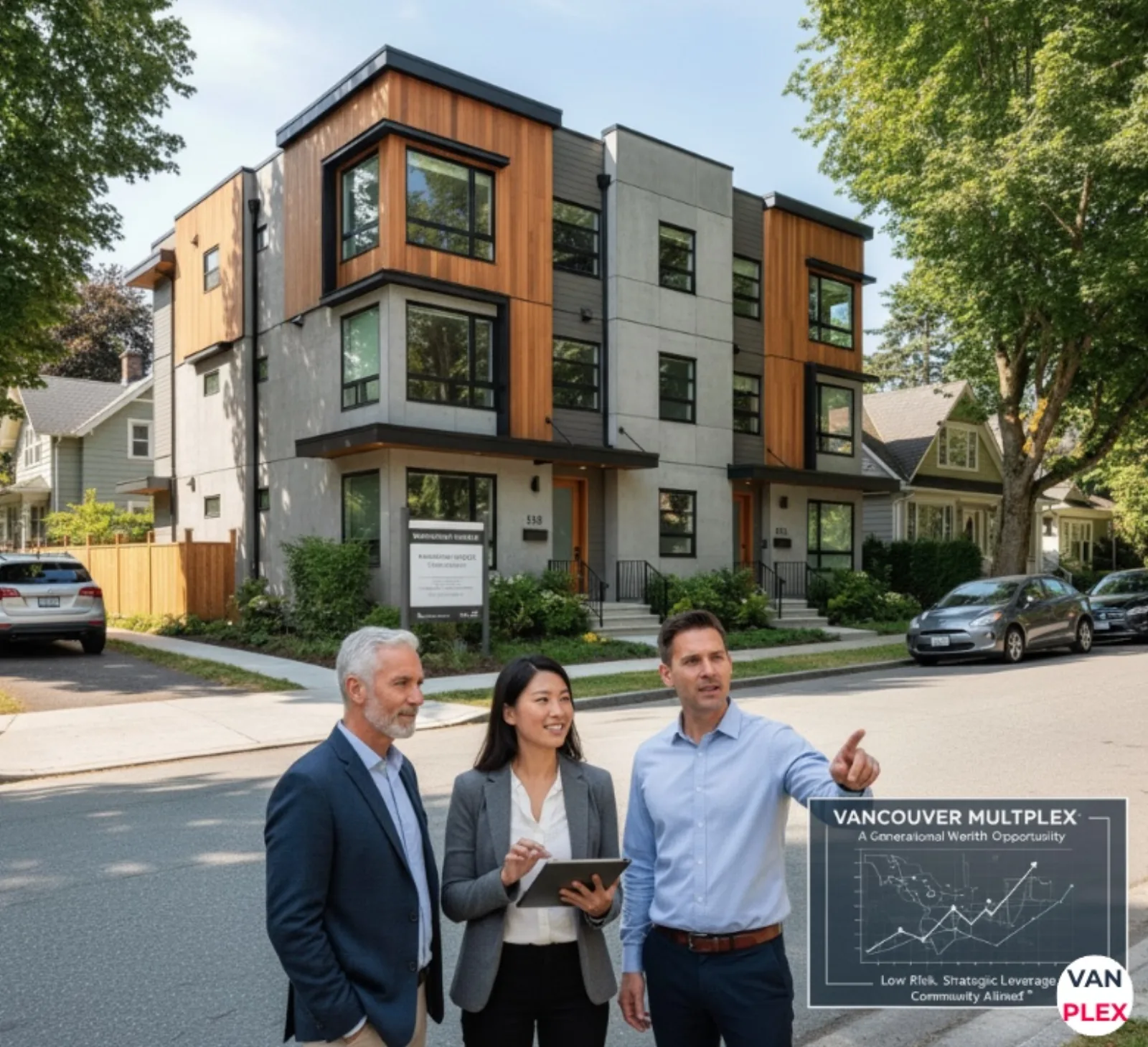

Across Canada, real estate headlines are dominated by rising interest rates, affordability crises, and stalled developments. Traditional multifamily projects, once a cornerstone of institutional real estate portfolios—have been squeezed by higher financing costs, compressed yields, and longer timelines. Many investors have responded by retreating to the sidelines, waiting for macroeconomic conditions to stabilize.
This defensive posture, while understandable, obscures a quieter transformation underway in Vancouver and Burnaby. These two cities are experiencing a structural shift driven by zoning reform and technological innovation, which is opening a previously inaccessible segment of the market to institutional players: small-scale multiplex development.
For investors willing to act early, this represents more than a niche play. It marks the emergence of a new institutional strategy.
Zoning Reform Has Unlocked Hidden Density
In December 2023, British Columbia passed Bill 44, a sweeping reform that rezoned more than 96,000 single-family parcels across Vancouver and Burnaby. The new rules allow three- to six-unit multiplex developments by right, eliminating lengthy rezoning battles and political uncertainty.
This change fundamentally alters the development equation in these cities:
- By-right approvals reduce entitlement risk and accelerate timelines.
- Established neighborhoods with mature infrastructure can now support medium-density infill.
- Land values have not fully adjusted to reflect multiplex potential, creating temporary pricing inefficiencies.
In effect, parcels once treated as single-family assets now function as multiplex development sites—but many are still priced as if nothing has changed. This disconnect is creating a rare arbitrage opportunity.
Technology Has Solved the Scaling Problem
Historically, scattered-lot infill development was ill-suited for institutional investors. Underwriting dozens or hundreds of individual parcels was slow, expensive, and inconsistent. This operational friction kept most large investors out of the space.
That is changing. AI-driven zoning and feasibility platforms can now:
- Instantly confirm zoning eligibility and development potential
- Generate buildable area calculations and ROI models in seconds
- Layer in comparable sales, construction costs, and projected exit pricing
- Screen entire neighborhoods programmatically, not manually
What was once fragmented and boutique can now be approached as a scalable, data-driven investment strategy—a prerequisite for institutional participation.
An Attractive Risk–Return Profile
Multiplex development offers a risk–return proposition that looks increasingly attractive relative to conventional multifamily in today’s market:
- Pricing inefficiency: Upzoned lots remain mispriced relative to their development potential.
- Shorter timelines: Typical cycles run 18–24 months, compared to 36–60 months for large multifamily projects.
- High projected returns: Early projects are modeling 100+ percent ROE due to land arbitrage and efficient build-to-sell strategies.
- Diversified income: Multiple units on one parcel generate more stable revenue streams.
- Demand resilience: Vancouver and Burnaby face persistent housing shortages, especially for family-sized units.
For institutions seeking to deploy capital into real estate strategies with strong structural tailwinds, multiplex development checks several critical boxes simultaneously.
Why Vancouver and Burnaby Stand Apart
Not every Canadian metro offers this alignment of policy, pricing, and fundamentals. Vancouver and Burnaby are uniquely positioned for three reasons:
- Policy clarity – Bill 44 is already implemented; municipalities have adjusted processes.
- Urban fundamentals – Both cities combine high demand with mature infrastructure.
- Market inefficiency – The pricing lag between upzoned land and development value is still wide but narrowing.
These characteristics mirror earlier transformational cycles—such as the condo boom of the 1980s or urban intensification in the 2000s—when early movers were able to secure prime positions before the broader market recalibrated.
The Strategic Window
Today, institutional capital has not yet entered the multiplex market at scale. The reasons are familiar: inertia, unfamiliarity with a new asset class, and the absence of standardized data.
But these are temporary barriers. The underlying drivers—zoning reform, technology, and pricing arbitrage—are already in place. As soon as a critical mass of institutional players mobilizes, pricing will adjust rapidly, compressing returns and eliminating early-mover advantages.
For decision makers, the relevant question is not whether the opportunity is real. It is whether they will be positioned before the market fully wakes up.
A Deliberate Institutional Strategy
For family offices, private equity real estate funds, and institutional allocators evaluating entry, several strategic principles can guide a successful approach:
- Adopt technology-enabled sourcing and underwriting to identify high-potential parcels at scale.
- Develop local execution partnerships with specialized architects and builders to ensure delivery discipline.
- Pursue programmatic, not opportunistic, acquisitions to leverage operational efficiency.
- Align capital structures with shorter development cycles to maximize capital velocity.
- Act during the pricing lag, not after institutional competition normalizes the market.
Conclusion: A Quiet Frontier with Institutional Potential
Vancouver’s multiplex market is not yet a headline story—but it should be.
Policy change has unlocked new development capacity. Technology has transformed scalability. Pricing inefficiencies remain, but they are narrowing. Together, these dynamics create a frontier market for multifamily investors—one that is strategically positioned for institutional strategies, but still largely untapped. The investment overview covers the specific return thresholds and capital structures that are emerging. For projects where rental hold makes sense, see the build-to-rent multiplex guide for how that model differs from a strata exit strategy.
Periods of uncertainty often produce the most durable opportunities. For institutions willing to move deliberately, Vancouver’s multiplex boom represents one of those moments.
David Babakaiff
Co-Founder, VanPlex.ca
Vancouver Multiplex Index™ | Profit with Multiplex