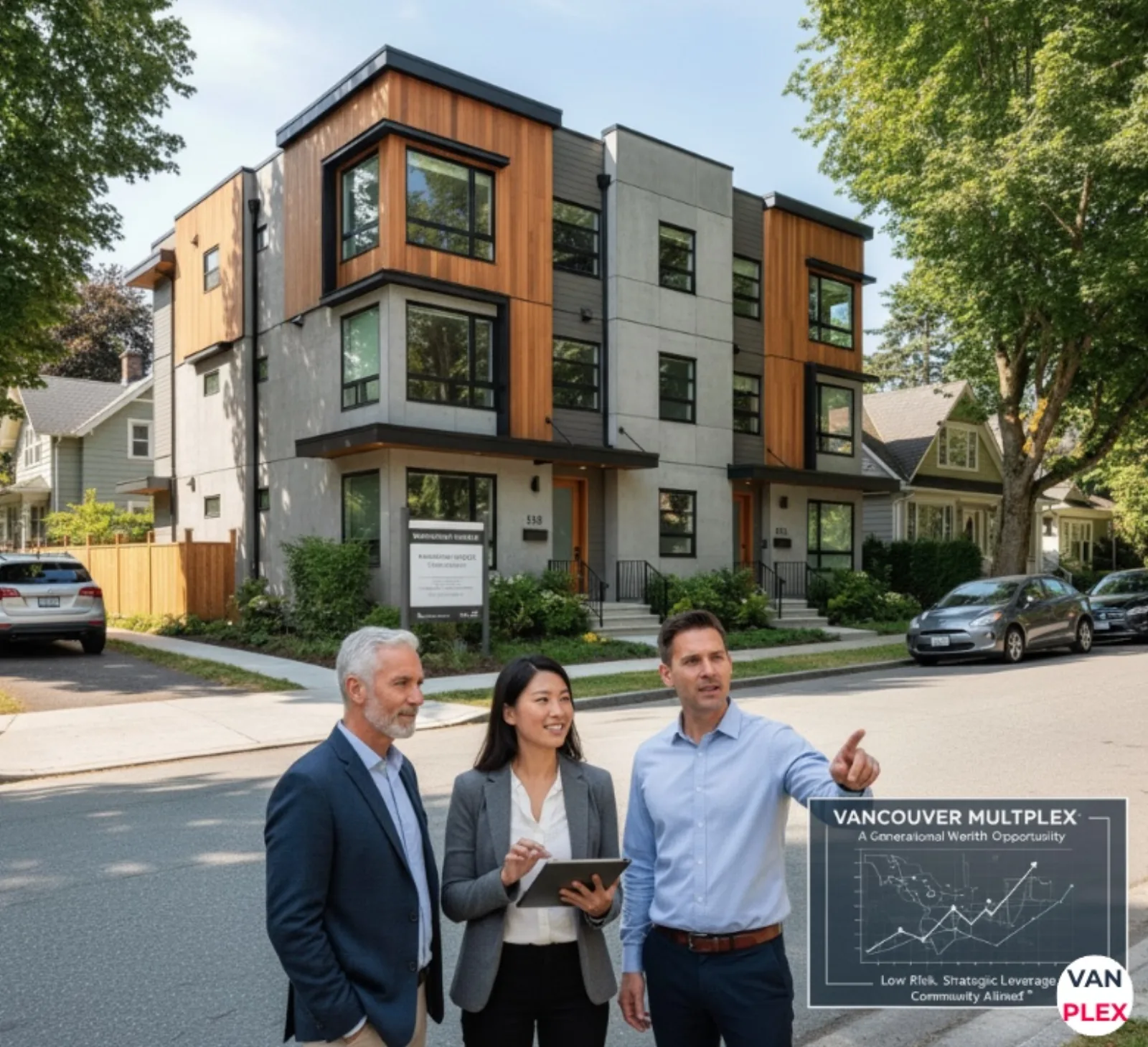

Across North America, institutional investors have spent decades treating traditional multifamily assets—apartment towers, stabilized mid-rise rentals, and large garden-style communities—as the default vehicles for scale and predictable returns.
But in Vancouver and Burnaby, a new asset class is quietly emerging. A sweeping zoning reform (Bill 44) and shifting economics are creating a multiplex development opportunity that mirrors early-stage multifamily cycles: fragmented, data-sensitive, and potentially lucrative for first movers with disciplined capital. Our investment overview explains how institutional and accredited investors can access this pipeline.
The key to understanding this opportunity isn’t policy headlines. It’s math.
A Policy Shift Meets Market Discipline
Bill 44 upzoned more than 97,000 single-family parcels in Vancouver and Burnaby, allowing 3–6 units to be built by right. It was heralded as a transformational moment for “missing middle” housing.
However, zoning alone doesn’t create investable opportunities. Project viability depends on actual economics: buildable area, costs, achievable exit values, financing conditions, and owner capital structures.
That’s where the Vancouver Multiplex Index comes in. It evaluates more than 86,000 R1-1 and R1 properties through a Return on Equity (ROE) lens, revealing which parcels truly meet institutional investment thresholds.
The Vancouver Multiplex Index: A Market Reality Check
The Index models each property using real inputs:
- Zoning and buildable area, including net-zero exemptions
- Current construction costs
- Comparable sales and realistic exit values
- Financing structures and lending conditions
Each lot receives an ROE score based on a sub-two-year development horizon—the realistic timeline for multiplex delivery.
The findings are clear:
- Over 86,000 properties analyzed
- Roughly 22,000 are negative on feasibility
- Half the properties fall below a 20% ROE, insufficient for most developers
- The practical investor bar is 60%+ ROE
- About 30,000 properties clear that bar on paper
- After filtering for low- or no-debt ownership, the true actionable set is ~14,750 parcels
This is the real multiplex investment universe: not 70,000 parcels, but fewer than 15,000 that actually pencil under current market conditions.
The 100% ROE Club: Institutional-Grade Arbitrage
Within the 14,750-property core is a micro-segment of roughly 3,627 parcels—about 4% of the total—where projected ROE exceeds 100%.
These are the asymmetric opportunities where redevelopment can double invested equity within two years, driven by underpriced land, favorable zoning geometry, and fragmented market awareness.
For institutional investors, this is where disciplined underwriting and rapid execution can capture arbitrage before pricing adjusts.
Why Headlines Mislead
Bill 44 counts eligible lots. Investors must count feasible projects. The build-to-rent multiplex model is one structured approach that pairs institutional capital with predictable rental cash flows rather than a single-event sale.
Policy ambition and market reality are not the same. Financing constraints, construction costs, and pricing discipline filter out the majority of upzoned properties.
The gap between policy potential and market feasibility is exactly where institutional investors can build an early advantage—through data-led acquisition, precise targeting, and capital structure optimization.
Strategic Implications for Institutional Capital
-
Anchor Strategies Above 40% ROE
Below this threshold, delays and cost variability erode returns. ROE discipline is the primary screen for viable pipeline.
-
Prioritize Debt-Light Owners
The 14,750 properties held by low- or no-debt owners offer the highest conversion probability and cleaner capital stacks.
-
Target the 100% ROE Micro-Set
These deals are scarce but offer institutional-scale upside. Speed and precision matter.
-
Align Capital Structure to Short Development Cycles
Multiplex deals typically operate on 18–24 month horizons, with equity-first land acquisition and moderate leverage for construction. Velocity matters as much as margin.
ROE: The Practical Line Between Risk and Reward
The 60%+ ROE threshold is not arbitrary. With firm construction costs and softening resale values, it represents the minimum buffer required to justify development risk and timeline uncertainty.
Above that line, projects retain margin resilience and cycle velocity. Below it, even minor delays can wipe out returns—particularly in a high-rate or soft pricing environment.
From Model to Deployment
The Vancouver Multiplex Index was built for execution, not just reporting. The typical institutional pathway looks like this:
- Instant ROE Screen at the parcel level
- Feasibility & Sensitivity Modeling with current inputs
- Capital Stack Alignment based on owner debt profile
- Delivery through standardized plan sets, vetted builders, and predictable permitting — a workflow our development services team manages end to end
For institutional investors looking to explore these pathways, VanPlex.ca provides address-level ROE data and feasibility tools, enabling rapid site screening and investment modeling.
To explore larger capital deployment strategies, the VanPlex.ca/invest portal offers institutional investors a structured overview of pipeline opportunities, financial models, and co-development frameworks tailored for multiplex assets.
Conclusion: A Rare Institutional Opening
Multiplex development is emerging as Vancouver and Burnaby’s next institutional multifamily investment opportunity. But the investable universe is smaller, sharper, and more data-driven than the headlines suggest. Institutional investors who rely on zoning figures alone will misread the market. Those who focus on the 60%+ ROE core—and selectively target the 100%+ ROE elite segment—have a window to secure early, high-conviction positions before competition and pricing converge.
The scale is real but only for capital willing to look past policy narratives and focus on hard numbers. Visit VanPlex.ca to evaluate properties or VanPlex.ca/invest to learn how institutional investors are entering the multiplex market strategically.
David Babakaiff
Co-Founder, VanPlex.ca
Vancouver Multiplex Index™ | Profit with Multiplex