
Insurance is one of the most overlooked aspects of multiplex development. The coverage requirements, cost structures, and policy types differ significantly from single-family homes—and getting it wrong can be expensive. Here’s what Vancouver and Burnaby homeowners need to know. For context on the overall development process, our development services page shows where insurance fits within the full project timeline.
TL;DR (Key Takeaways)
- Three phases require different coverage: Demolition, Construction, Completed Building
- Builder’s Risk insurance is mandatory during construction ($3,000-8,000 for 18-month project)
- Completed multiplex insurance costs $4,000-8,000/year (vs $2,000-4,000 for single-family)
- Strata insurance required if units are stratified—separate from individual unit policies
- Liability coverage should be $5M+ during construction, $2M+ post-completion
- Key factors: Number of units, construction type, rental vs owner-occupied
The Three Insurance Phases
Multiplex development requires different coverage at each stage:
| Phase | Coverage Type | Typical Cost | Duration |
|---|---|---|---|
| Pre-Construction | Existing home policy | Existing premium | Until demolition |
| Construction | Builder’s Risk + Liability | $3,000-8,000 | 12-18 months |
| Completion | Building + Strata/Unit | $4,000-8,000/year | Ongoing |
Understanding these phases prevents coverage gaps that could expose you to significant financial risk.
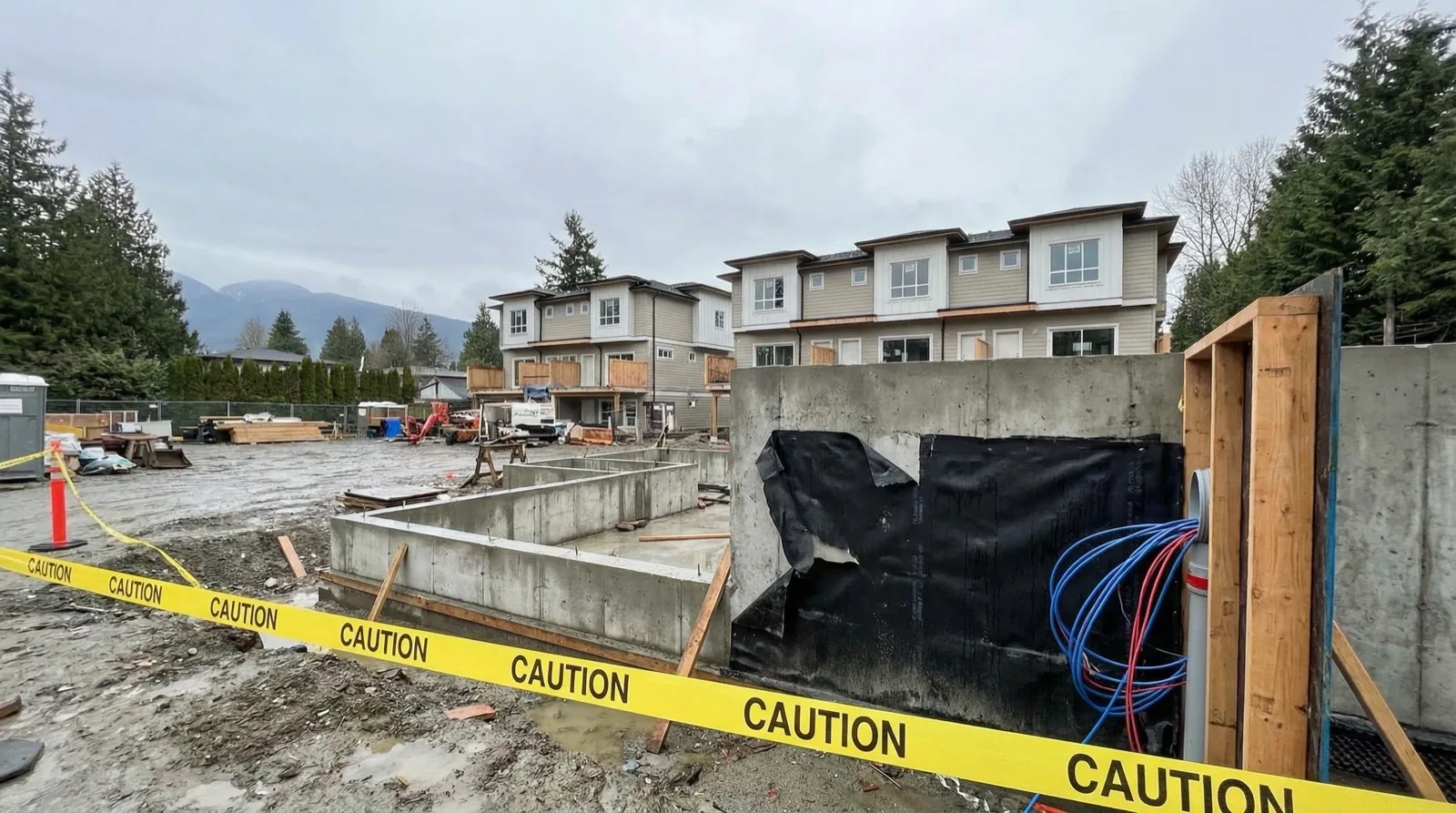
Phase 1: Builder’s Risk Insurance
During construction, Builder’s Risk insurance protects against:
- Fire and explosion
- Wind, hail, and storm damage
- Theft of materials and equipment
- Vandalism
- Water damage
- Collapse
Key Coverage Amounts:
- Building coverage: Full replacement cost (typically $2-3M for a fourplex)
- Soft costs coverage: 10-15% of construction value
- Debris removal: $50,000-100,000
- Delay coverage: Lost rental income if completion is delayed
What Builder’s Risk Doesn’t Cover:
- Faulty workmanship (covered by contractor’s warranty)
- Design defects
- Normal wear and tear
- Pollution cleanup
- Workers’ compensation (separate policy required)
Phase 2: Construction Liability
Separate from Builder’s Risk, you need liability coverage during construction:
General Liability
- Covers injuries to third parties
- Property damage to neighboring properties
- Recommended minimum: $5,000,000
- Cost: Often bundled with Builder’s Risk
Wrap-Up Liability (Optional)
- Single policy covering all contractors
- Simplifies claims process
- Eliminates coverage disputes
- Recommended for projects over $3M
Phase 3: Completed Building Insurance
Once your multiplex is complete, insurance requirements depend on your structure:
Scenario A: You Own Entire Building (Rental)
| Coverage | Recommended Amount |
|---|---|
| Building | Full replacement cost |
| Liability | $2,000,000 minimum |
| Loss of Rent | 12 months coverage |
| Flood | If in flood zone |
| Earthquake | Strongly recommended in BC |
Annual premium: $5,000-10,000 depending on location and construction type
Scenario B: Stratified Units (Strata Corporation)
Two layers of insurance required:
-
Strata Corporation Policy
- Building common property
- Common liability
- Shared by all owners through strata fees
-
Individual Unit Policies
- Unit improvements
- Contents
- Additional liability
- Loss assessment coverage
Cost Factors That Affect Premiums
Several factors influence your multiplex insurance costs:
Construction Type
- Wood frame: Higher premiums (fire risk)
- Concrete/steel: Lower premiums
- Sprinklered: 10-20% discount available
Number of Units
- More units = higher premiums
- But cost per unit often decreases with scale
Rental vs Owner-Occupied
- Full rental: Higher premiums
- Owner-occupied (you live in one unit): Lower premiums
- Mixed use: Middle ground
Location
- Fire response time affects rates
- Flood zone designation
- Historical claims in area
- Proximity to fire hydrants
The Earthquake Question
British Columbia sits in an active seismic zone. Earthquake insurance is optional but important to consider:
Arguments For:
- Catastrophic risk mitigation
- Lenders may require it
- Peace of mind for significant investment
Arguments Against:
- High premiums (often $3,000-5,000/year for multiplex)
- High deductibles (typically 10-15% of coverage)
- May not cover total loss scenarios
Our Recommendation: Get quotes and evaluate based on your risk tolerance. Most mortgage lenders for new construction will require earthquake coverage.
Insurance During the Development Process
Here’s how insurance flows through a typical multiplex project:
Month 0: Project Initiation
- Maintain existing homeowner’s policy
- Begin shopping for Builder’s Risk
Month 2-3: Pre-Construction
- Existing policy remains in force
- Builder’s Risk quote secured
- Construction loan requires proof of insurance
Month 4: Demolition Begins
- Existing policy cancelled or converted
- Builder’s Risk policy activated
- Contractor provides certificate of insurance
Month 4-18: Construction
- Builder’s Risk in force
- Monthly construction progress reported to insurer
- Coverage amount may adjust as building progresses
Month 18-20: Completion
- Builder’s Risk converted or replaced
- New building policy issued
- Strata insurance if applicable
Common Insurance Mistakes to Avoid
Mistake 1: Coverage Gaps
- Problem: Existing policy cancelled before Builder’s Risk activated
- Solution: Coordinate transition dates carefully
Mistake 2: Underinsurance
- Problem: Coverage amount doesn’t reflect rising construction costs
- Solution: Review and update coverage amounts quarterly
Mistake 3: Missing Contractor Verification
- Problem: Assuming contractors have adequate coverage
- Solution: Request certificates and verify limits before work begins
Mistake 4: Ignoring Soft Costs
- Problem: Only insuring hard construction costs
- Solution: Include permits, design fees, financing costs in coverage
Mistake 5: No Loss of Income Coverage
- Problem: Delays mean no rental income, but bills continue
- Solution: Include business interruption/loss of rent coverage
Working with Insurance Brokers
For multiplex development, work with a commercial insurance broker who understands:
- BC construction requirements (the permits process creates specific milestones where coverage must be in place)
- Strata insurance regulations
- Multi-unit residential coverage
- Development project timelines
Questions to ask potential brokers:
- How many multiplex projects have you insured?
- Which carriers do you work with for Builder’s Risk?
- How do you handle the transition from construction to completion?
- What’s your claims support process?
The Bottom Line
Insurance for multiplex development is more complex than single-family, but it’s a solvable problem. Budget 1-2% of project cost for insurance over the development timeline, work with experienced brokers, and coordinate coverage transitions carefully.
The cost of proper insurance is minimal compared to the risk of being uninsured or underinsured during a multi-million-dollar construction project. Our design guidelines include structural specifications that also affect which insurance products are available and at what cost — another reason to standardize design early.
Visit vanplex.ca to run a full feasibility analysis on your property—including realistic insurance cost projections.
VanPlex Team
PlexRank™ | Profit with Multiplex