
Trump’s 25% tariffs on Canadian lumber, steel, and gypsum just added $10,900 to every new single-family home. But multiplex construction absorbs this hit differently—and the math actually makes multiplexes more competitive against single-family, not less. Here’s why material efficiency is the hidden advantage nobody’s discussing.
The $10,900 Problem
The Canadian Home Builders’ Association (CHBA) and National Association of Home Builders (NAHB) calculated the tariff impact on residential construction:
25% tariffs apply to:
- Softwood lumber (from Canadian sources)
- Steel and aluminum products
- Gypsum board/drywall
- Selected building materials
Single-family home impact: $10,900 average cost increase
But this figure assumes single-family construction patterns. Multiplex construction uses materials differently.
Why Multiplexes Absorb Tariffs Better
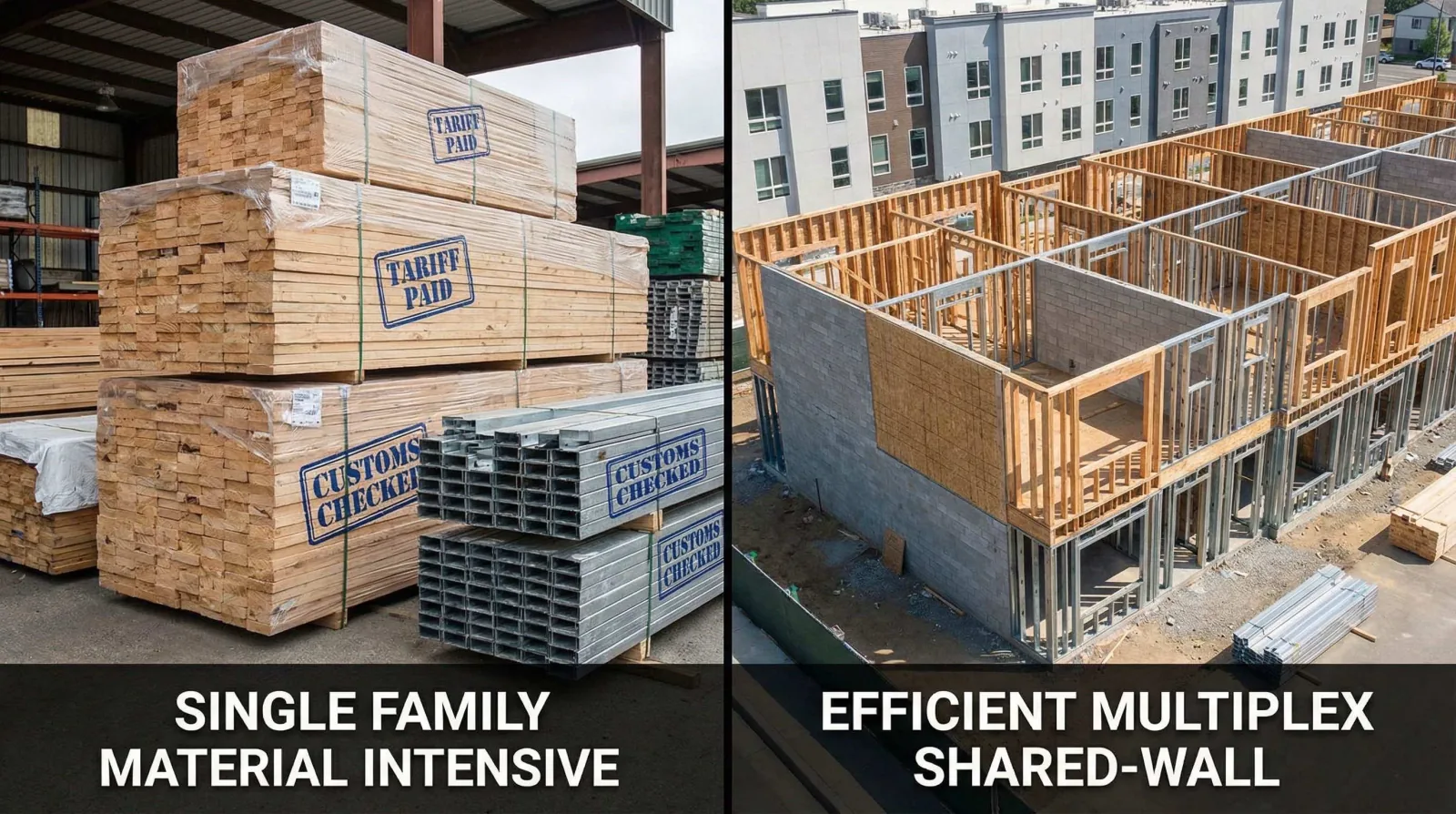
The math is straightforward: shared walls mean less exterior surface area per unit.
Single-family home (2,500 sqft):
- Four exterior walls
- Full perimeter foundation
- Complete roofing surface
- Individual utility connections
- Material cost exposure: 100%
Fourplex (4 x 1,000 sqft units = 4,000 sqft):
- Shared party walls eliminate 40-50% of exterior framing
- Shared foundation across all units
- Single roof system (though larger)
- Consolidated utility connections
- Material cost exposure: 60-70% per unit
| Component | Single-Family | Fourplex Per Unit | Multiplex Advantage |
|---|---|---|---|
| Exterior framing | $28,000 | $14,000 | 50% reduction |
| Foundation | $35,000 | $12,000 | 66% reduction |
| Roofing | $18,000 | $8,000 | 56% reduction |
| Utilities | $15,000 | $6,000 | 60% reduction |
| Tariff-exposed materials | $10,900 | $2,725 | 75% reduction |
The shared-wall advantage compounds when tariffs hit lumber and steel hardest.
Breaking Down Tariff Exposure by Component
Not all construction materials face equal tariff exposure. Here’s where the 25% tariffs concentrate:
High tariff exposure (lumber-intensive):
- Wall framing: 40% of tariff impact
- Floor/roof sheathing: 25% of tariff impact
- Roof trusses: 15% of tariff impact
Moderate tariff exposure (mixed materials):
- Windows/doors: 10% of tariff impact (aluminum/steel components)
- Siding: 5% of tariff impact (varies by material choice)
Low tariff exposure (domestic or exempt):
- Concrete: Domestic supply, minimal tariff impact
- Drywall/interior: Some Canadian gypsum exposed, but alternatives available
- Electrical/plumbing: Largely domestic sourcing
Multiplexes concentrate savings in the high-exposure categories through material efficiency.
The Competitive Shift
Tariffs change the relative economics of single-family versus multiplex development:
Pre-tariff comparison (same 7,000 sqft lot):
| Metric | Single-Family | Fourplex |
|---|---|---|
| Buildable area | 3,500 sqft | 4,200 sqft |
| Construction cost | $1.4M | $1.85M |
| Cost per sqft | $400 | $440 |
| Total development cost | $4.2M (with land) | $4.65M (with land) |
| Sale value | $3.8M | $4.8M |
| Net profit | -$400K | +$150K |
Post-tariff comparison:
| Metric | Single-Family | Fourplex |
|---|---|---|
| Tariff impact | +$10,900 | +$10,900 total ($2,725/unit) |
| New construction cost | $1.41M | $1.86M |
| New cost per sqft | $403 | $443 |
| New total development | $4.21M | $4.66M |
| Sale value | $3.8M | $4.8M |
| Net profit change | -$410.9K | +$139K |
Single-family loses $10,900 in profit. The fourplex loses $10,900 spread across four units—$2,725 per unit—while generating far higher total profit. The relative advantage of multiplex development increases.
Material Substitution Accelerating
Tariffs are pushing builders toward alternatives:
Steel studs replacing wood framing:
- Cost: comparable at scale
- Tariff exposure: steel faces tariffs, but wall systems use less total material
- Trend: accelerating in BC, especially for multi-story construction
Concrete construction increasing:
- Cost: historically 10-15% premium over wood
- Tariff exposure: domestic concrete supply, minimal tariff impact
- Trend: becoming cost-competitive as lumber tariffs increase wood costs
Alternative cladding materials:
- Fiber cement (domestic production available)
- Engineered wood products (different tariff treatment)
- Metal panel systems (premium segment)
For multiplex development specifically, concrete podium construction with wood-frame upper floors becomes more attractive. The podium (concrete) absorbs no lumber tariffs; only upper floors face exposure.
Regional Supply Chain Implications
BC’s construction supply chain faces particular tariff dynamics:
Canadian lumber sources:
- BC interior mills (directly exposed to US tariffs on exports)
- Pricing influenced by US market tariffs even for domestic consumption
- Expect 8-15% domestic lumber price increases as mills adjust
Alternative supply options:
- European lumber (limited availability, higher shipping)
- US-origin lumber (higher base cost, no tariff)
- Engineered wood products (different manufacturing, different tariff treatment)
What this means for BC builders:
- Secure lumber pricing early in project planning
- Consider material locks with suppliers
- Budget 10-15% material contingency above pre-tariff estimates
Timing Implications: Build Now or Wait?
Tariff uncertainty creates strategic timing questions:
Arguments for starting now:
- Current tariffs are “known” costs—can be budgeted
- Potential for tariff escalation (additional duties, expanded categories)
- Material price increases haven’t fully hit supply chain
- Construction labor availability may tighten as demand rebounds
Arguments for waiting:
- CUSMA renegotiation could reduce tariffs by 2027
- Material substitution options improving
- Supply chain adjustments may reduce premiums
- Political uncertainty makes all projections speculative
VanPlex analysis: For projects that pencil at current costs including tariff impacts, starting now likely makes sense. Tariff reductions are speculative; tariff increases are also possible. Waiting adds carrying costs ($15,000-$25,000/month on typical lots) while providing uncertain future benefit.
How Developers Are Responding
Based on conversations with Vancouver-area multiplex builders:
Value engineering focus:
- Reviewing every framing specification for material reduction
- Switching to 24” OC framing where code allows (versus 16” OC)
- Optimizing window sizing to reduce header requirements
- Using advanced framing techniques that reduce lumber by 15-20%
Design optimization:
- Favoring rectangular building footprints (less perimeter)
- Reducing roof complexity (fewer valleys, dormers)
- Maximizing shared wall ratios in multi-building configurations
- Designing for standard lumber dimensions to minimize waste
Supply chain management:
- Pre-ordering lumber at project approval
- Locking prices with suppliers for 6-12 month horizons
- Evaluating alternative suppliers (US mills, European imports)
- Considering material storage between permit and construction start
The Unit Economics Comparison
Here’s how tariffs affect development economics on a typical 50ft x 120ft Vancouver lot:
Single-family redevelopment:
- Current house: $2.8M land value
- Demolition: $35,000
- New construction: $1.4M + $10,900 tariff = $1.41M
- Total cost: $4.25M
- Sale value: $3.9M
- Result: -$350K loss
Fourplex development:
- Current house: $2.8M land value
- Demolition: $35,000
- New construction: $1.75M + $10,900 tariff = $1.76M
- Total cost: $4.6M
- Sale value: $5.2M (strata)
- Result: +$600K profit
The tariff adds $10,900 to both scenarios. But the fourplex spreads that cost across four units generating positive returns, while single-family absorbs the full hit into an already negative project.
Tariff Impact on Build-to-Hold vs. Build-to-Sell
The $10,900 tariff impact hits build-to-hold and build-to-sell models differently:
- Tariff cost capitalized into construction loan
- Recovered over rental income stream (20-30 years)
- Interest on tariff costs: ~$7,000-$10,000 additional over 25 years
- Total tariff impact: $18,000-$21,000 over life of investment
Build-to-sell (strata):
- Tariff cost recovered at sale
- Passed to buyer through pricing
- No carrying cost on tariff impact
- Total tariff impact: $10,900 (or share absorbed by margin)
The build-to-sell model handles tariff impacts more efficiently—another factor favoring strata development in current conditions.
What About Prefab and Modular?
Factory-built construction faces different tariff dynamics:
Potential advantages:
- Material purchasing at volume discounts
- Manufacturing efficiency reduces waste
- Some components sourced domestically
- Transportation costs may offset some material savings
Potential disadvantages:
- Canadian prefab facilities use Canadian lumber (full tariff exposure)
- US-sourced modules face import tariffs
- Scale benefits require project volume
Current assessment: Prefab doesn’t clearly escape tariff exposure, but manufacturing efficiency may reduce net material use. Monitor specific manufacturer pricing.
Strategic Recommendations
Based on tariff analysis, here’s how to approach multiplex development:
1. Confirm project viability at current costs. Model tariff impact explicitly. If project works at current lumber/steel prices plus tariff premiums, proceed.
2. Lock material pricing early. Get supplier commitments at permit approval. Don’t assume prices will improve.
3. Design for material efficiency. Work with architect on advanced framing, optimized footprints, and standard dimensions.
4. Consider timing carefully. Carrying costs of waiting ($15K-$25K/month) often exceed potential tariff savings.
5. Monitor policy developments. CUSMA negotiations, exemption applications, and alternative sourcing may create opportunities.
VanPlex Tariff-Adjusted Analysis
Our PlexRank™ feasibility modeling includes tariff impact calculations:
- Current lumber and steel price tracking
- Material-specific cost estimates by project type
- Tariff sensitivity analysis (what if tariffs increase to 35%?)
- Build timeline recommendations based on cost projections
Visit VanPlex.ca to see how tariffs affect your specific property’s development economics—and whether the multiplex advantage outweighs the added costs.
David Babakaiff, CEO & Co-Founder of VanPlex
PlexRank™ | Profit with Multiplex