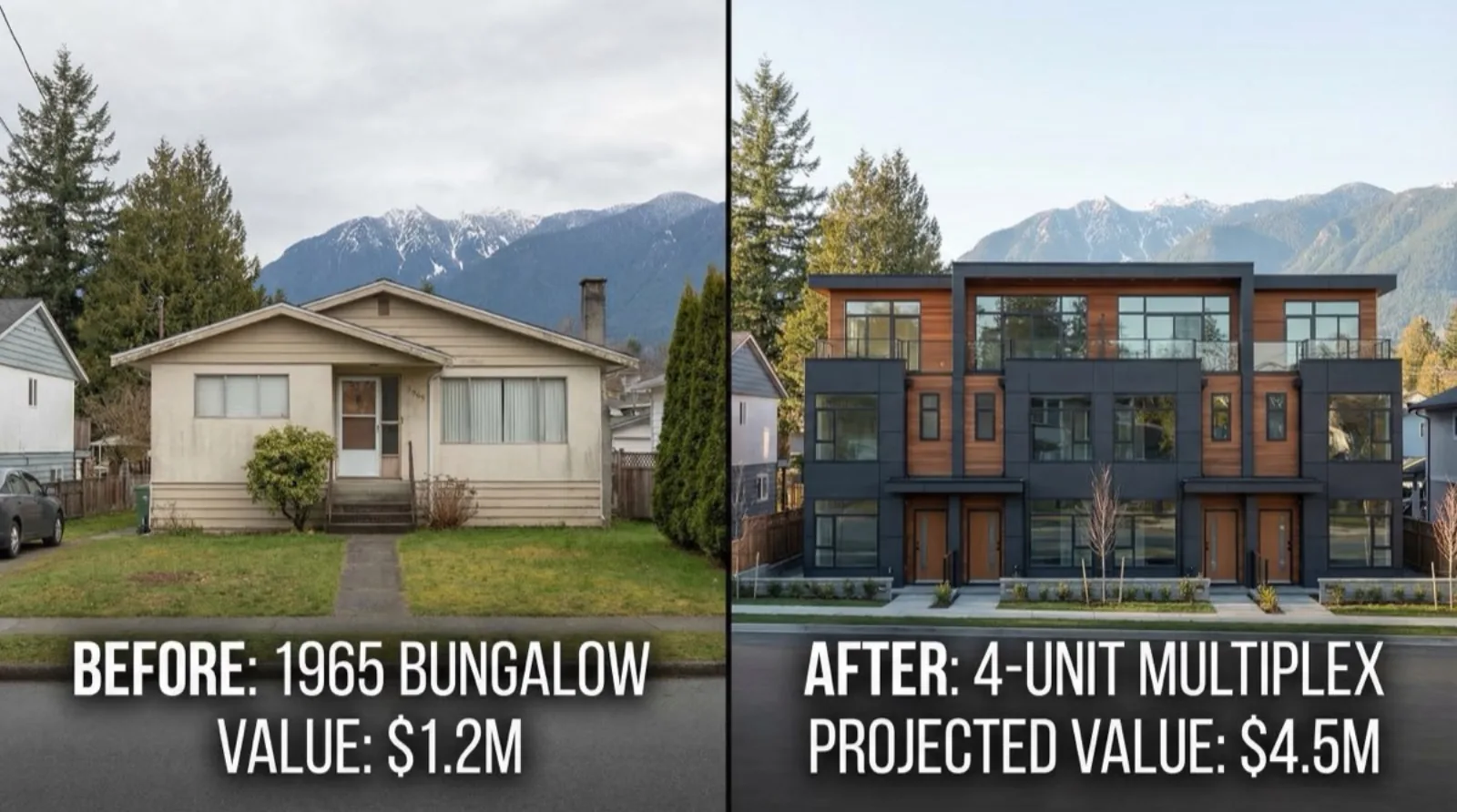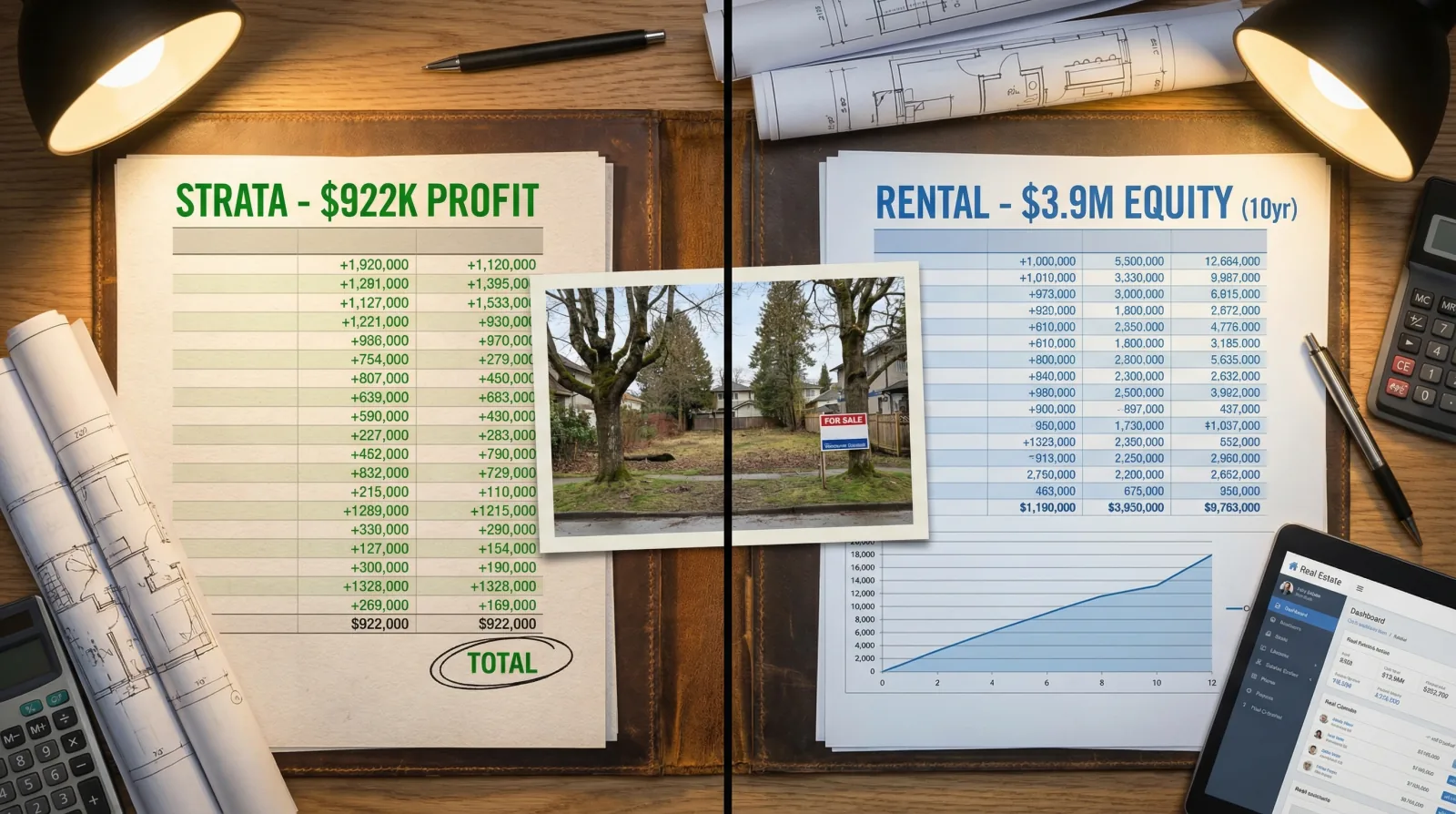

One Vancouver builder is paying $82,000 per unit in density bonus fees—before permits, carrying costs, or a single nail is hammered. This sixplex developer’s experience exposes the $200,000+ in fees and levies that don’t make the headlines. Here’s the real cost breakdown and why it changes the math on which projects actually work.
TL;DR (Key Takeaways)
- $82,000/unit density bonus documented for sixplex development (Globe & Mail, Jan 2026)
- $200,000+ in total fees/levies beyond the density bonus
- 12+ months carrying costs during permit wait add another $50K-$150K
- Fourplex on smaller lot has better economics than sixplex on large lot
- Fee recalibration expected in Vancouver’s 2026 budget cycle
- Developer CAC negotiations can reduce fees 15-30% on qualifying projects
- Build-and-sell strata model absorbs fees better than build-and-hold rental
The $82,000 Number Nobody Talks About
The Globe & Mail reported in January 2026 on a Vancouver multiplex builder paying $82,000 per unit in density bonus fees alone. Six units times $82,000 equals $492,000—nearly half a million dollars before construction begins.
But that’s not the complete picture. Here’s the full fee breakdown for a typical Vancouver sixplex on a 7,000+ sqft lot:
| Fee Category | Amount | When Due |
|---|---|---|
| Density Bonus (6 units) | $492,000 | Building Permit |
| Development Cost Levies (DCL) | $45,000-$75,000 | Building Permit |
| Community Amenity Contribution (CAC) | $25,000-$50,000 | Negotiated |
| Utility Connections | $20,000-$40,000 | Pre-construction |
| Permit Fees (DP + BP) | $15,000-$25,000 | Application |
| Total Pre-Construction Fees | $597,000-$682,000 |
For a sixplex project budgeted at $3.5M in hard construction costs, fees represent 17-19% of the build budget. That’s not a rounding error—it’s a project killer for marginal sites.
Why Sixplex Economics Are Upside Down
The density bonus structure creates a counterintuitive outcome: building more units can reduce your return on equity.
The math problem: Density bonuses scale with unit count. More units = more fees. But construction costs don’t scale linearly—a sixplex costs more per unit to build than a fourplex due to:
- Fire separation requirements between units
- Multiple egress pathways
- Complex mechanical systems
- Longer permit review timelines
Sample comparison (same 7,000 sqft lot):
| Metric | Fourplex | Sixplex |
|---|---|---|
| Density Bonus | $0 | $492,000 |
| Other Fees | ~$80,000 | ~$115,000 |
| Construction Cost | $1.8M | $2.9M |
| Total Development Cost | $1.88M | $3.51M |
| Sellable Value (strata) | $3.4M | $5.2M |
| Net Profit | $1.52M | $1.69M |
| ROE (on $2.8M land) | 54% | 60% |
The sixplex generates only $170,000 more profit despite $1.63M more in development cost. On a risk-adjusted basis, the fourplex often wins.
The Hidden $200,000
Beyond the headline density bonus, multiple fees accumulate:
Development Cost Levies (DCL): Vancouver charges DCLs based on gross floor area. Current rates (2026) run $15-$25/sqft depending on area plan. A 5,000 sqft multiplex pays $75,000-$125,000.
Community Amenity Contributions (CAC): Nominally voluntary, but practically mandatory for rezonings or density increases. CAC negotiations have ranged from $10,000 to $100,000+ depending on project scale and neighborhood.
Utility connection fees: Water, sewer, and electrical connections for multi-unit buildings exceed single-family rates. Budget $20,000-$40,000.
Professional fees for fee negotiation: Many developers hire permit expeditors or planners specifically to navigate fee structures. Cost: $5,000-$15,000.
Carrying costs during permit delays: At current interest rates, a $2.8M land asset costs $15,000-$25,000/month in carrying costs. A 12-month permit delay adds $180,000-$300,000 to your effective project cost.
Where the Density Bonus Comes From
Vancouver’s density bonus policy dates to 2023, when the city established fees for developments exceeding base zoning density. The theory: if Bill 44 allows 4-6 units where previously only 1 existed, the land value increase should be partially captured for public benefit.
The bonus structure:
| Unit Count | Density Bonus |
|---|---|
| 1-4 units | $0 (base zoning) |
| 5 units | $41,000/unit for units 5+ |
| 6 units | $82,000/unit for units 5-6 |
That’s why fourplexes avoid the density bonus entirely while sixplexes pay $164,000-$492,000 depending on how the formula is applied.
Fee Recalibration: What’s Coming in 2026
Vancouver’s finance department is reviewing the fee structure as part of the 2026 budget process. Here’s what’s being discussed:
Option A: Graduated reduction. Lower the per-unit bonus for projects near transit or in housing priority areas. Potential reduction: 25-40%.
Option B: In-kind contribution alternative. Allow developers to provide affordable units in lieu of cash density bonus. One below-market unit could offset $200,000+ in fees.
Option C: Deferral to occupancy. Push fee collection from building permit to certificate of occupancy. This doesn’t reduce fees but eliminates 12-18 months of carrying costs on fee capital.
Staff recommendation expected Q2 2026. Any changes would apply to new applications—projects already in the pipeline remain under current fee structure.
The Fourplex Sweet Spot
VanPlex’s analysis of 86,000+ Vancouver lots reveals a clear pattern: fourplex developments on 4,500-6,000 sqft lots consistently outperform sixplex developments on larger lots.
Why fourplexes win:
- No density bonus. Zero fees for units 1-4 under current structure.
- Simpler permitting. Qualifies for concurrent DP/BP stream.
- Lower construction complexity. Two buildings with two units each vs. complex six-unit configurations.
- Faster timeline. 6-8 months permit + 9-10 months build vs. 10-14 months permit + 11-14 months build.
- Better financing terms. Banks view fourplexes as lower risk; LTV ratios are more favorable.
The lot size calculation:
| Lot Size | Optimal Configuration | Fee Exposure |
|---|---|---|
| Under 4,000 sqft | Duplex or triplex | Minimal |
| 4,000-6,000 sqft | Fourplex | Zero density bonus |
| 6,000-8,000 sqft | Fourplex (larger units) | Zero density bonus |
| 8,000+ sqft | Fourplex or accept sixplex fees | Depends on math |
Counter-intuitively, bigger lots don’t always mean bigger returns.
Developer CAC Negotiation Strategies
Experienced developers treat fees as negotiable, not fixed. Here’s how they approach it:
Community benefit framing. Developers who can demonstrate project benefits (rental units, family-sized units, accessibility features) have leverage for CAC reductions. Documentation matters.
Phased payment structures. Instead of lump-sum payment at permit, negotiate payments tied to construction milestones. This preserves capital for construction.
In-kind contributions. Public realm improvements, utility upgrades, or community amenities can offset cash CAC requirements. A $30,000 sidewalk improvement might offset $50,000 in CAC.
Area plan engagement. Projects in areas with adopted community plans have clearer (and sometimes lower) fee expectations. Review your area plan before project scoping.
Appeals process. Fee calculations are disputable. Successful appeals typically reduce fees 10-20%. Cost of appeal: $5,000-$15,000 in professional fees, 2-3 months delay.
The Carrying Cost Calculator
Permit delays turn fee problems into carrying cost crises. Here’s the math:
Assumptions:
- Land value: $2.8M
- Financing rate: 7% (construction loan)
- Property tax: $12,000/year
- Insurance: $6,000/year
Monthly carrying cost: $22,000
| Permit Timeline | Carrying Cost | Total Fee Burden |
|---|---|---|
| 6 months | $132,000 | Base fees + $132K |
| 9 months | $198,000 | Base fees + $198K |
| 12 months | $264,000 | Base fees + $264K |
| 18 months | $396,000 | Base fees + $396K |
A 12-month permit delay adds $264,000 to your effective fee burden—more than half the density bonus itself.
Who Actually Pays the Fees
The fee burden is ultimately distributed across three parties:
Landowners absorb fees through reduced land values. If buyers know a lot requires $500K in density bonus fees, they bid $500K less for the land. Long-term, fees suppress land prices.
Unit buyers absorb fees through higher purchase prices. In a supply-constrained market, developers pass fees through to strata buyers. Current Vancouver multiplex units price 15-20% above comparable condo units—fees are a factor.
Developers absorb fees through reduced margins. When land prices are sticky (sellers expect pre-Bill 44 values) and buyer willingness is capped (comparable housing limits prices), developers take the hit.
In practice, all three share the burden. The question is ratio—and that depends on market conditions.
Build-and-Sell vs. Build-and-Hold Fee Math
Fee structures favor strata (build-and-sell) over rental (build-and-hold):
Build-and-sell (strata):
- Fees recovered at sale: immediately
- Carrying costs: minimized
- Risk: market timing
Build-and-hold (rental):
- Fees recovered over: 15-25 years of rental income
- Carrying costs: capitalized into ongoing debt service
- Risk: interest rate exposure
Example: $500,000 in fees with 7% interest:
- Build-and-sell: $500K upfront, recovered at sale
- Build-and-hold: $35,000/year in debt service for 25 years = $875,000 total cost
The rental model pays $375,000 more for the same fees due to financing costs. This is why build-and-sell dominates Vancouver multiplex development in 2026.
The Real Project Killers
After analyzing hundreds of Vancouver multiplex proformas, the fees that most often kill projects aren’t the visible ones:
1. BC Hydro transformer requirements. $40,000-$80,000 unbudgeted cost discovered post-permit. Not technically a city fee, but a de facto requirement.
2. Unexpected DCL rate increases. Vancouver adjusts DCL rates periodically. Projects designed under old rates face higher costs when permits finally issue.
3. Rainwater management engineering. Non-standard sites require custom drainage engineering. Cost: $15,000-$40,000.
4. Tree removal fees and replacement. Significant trees on site trigger protection bylaws. Fees and replacement requirements can add $20,000-$50,000.
5. Archaeological assessment. Sites in mapped areas require assessment before excavation. Cost: $10,000-$25,000, plus potential project delays if finds occur.
Budget 15-20% contingency specifically for fee surprises. Projects budgeting 10% consistently overrun.
How VanPlex Accounts for Fees
Our PlexRank™ feasibility analysis includes all fee categories:
- Density bonus calculation based on unit count and lot characteristics
- DCL estimates using current rate schedules
- Utility connection cost estimates
- Carrying cost projections based on typical permit timelines
- Contingency buffers for fee surprises
When we report that 98% of lots don’t pencil financially, fee burden is a major factor. Many sites are physically buildable but economically non-viable once fees are included.
Strategic Recommendations
Based on the fee reality, here’s how to approach Vancouver multiplex development:
1. Start with fourplex analysis. Even on large lots, run the fourplex numbers first. The density bonus avoidance often outweighs the additional units.
2. Budget fees at 20% of hard costs. The 10-15% guidance in many articles is outdated. Current fee structures require 18-22% allocation.
3. Compress permit timeline. Every month of delay costs $20,000+. Invest in permit expediting, pre-application meetings, and streamlined design.
4. Negotiate everything. CAC, DCL payment timing, in-kind contributions—all are negotiable with proper documentation and professional representation.
5. Track policy changes. The 2026 fee recalibration could change the math significantly. Projects in early planning should monitor staff recommendations.
Visit VanPlex.ca to see how fee structures affect your specific property’s development potential. Our analysis includes current fee schedules and carrying cost projections for realistic project economics. The permits overview explains each stage of the City’s approval process and what to expect with timing. Use the advanced proforma calculator to model whether the numbers work for your specific lot after all fees are included.
David Babakaiff, CEO & Co-Founder of VanPlex
PlexRank™ | Profit with Multiplex