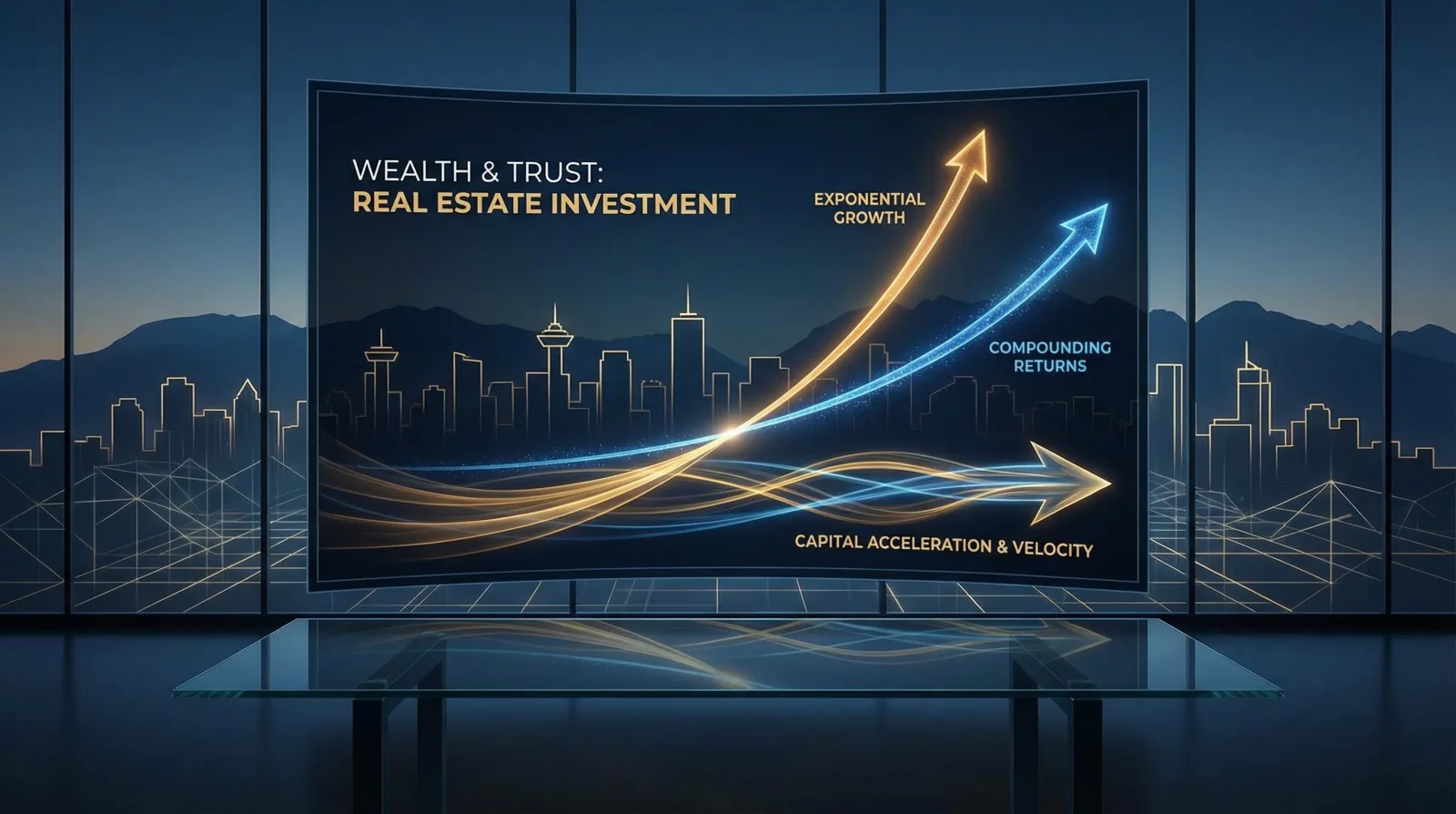

This is a math exercise, not a projection: at a hypothetical 70% ROE held constant every cycle, $500K compounding can reach $7M or $100M over the same decade, depending only on how fast capital is recycled. At 12-month cycles, $500K becomes $100.8M. At 24-month cycles, it becomes $7.1M. Same starting point. Same assumed return per cycle. Completely different outcomes. No real portfolio holds 70% ROE for ten straight cycles; the point is to show why execution velocity matters as much as the size of any single return.
The Opportunity Is Real (And Bigger Than Most Realize)
I’ve spent 25 years in BC construction, including winning the 2024 Best Multiplex Unit award in GVRD. I’ve seen cycles come and go. But I’ve never seen an opportunity window quite like what’s opening right now—or one where the difference between good execution and great execution is so mathematically stark.
At VanPlex, we run PlexRank analysis on every single-family lot in Vancouver and other cities to identify multiplex conversion potential under BC’s new zoning rules.
Every city has a bell curve with high ROE on the right and the rest mediocre or even losing money. Here’s a snapshot of most of the R1-1 properties in Vancouver:
| ROE Range | % of Properties | Development Viability |
|---|---|---|
| Negative to 15% | 50% | Do not build |
| 15-40% | 30% | Marginal—market-dependent |
| 40-60% | 12% | Viable with careful execution |
| 60-100% | 6% | Strong candidates |
| 100%+ | 2% | Optimal for velocity strategy |
And this is just Vancouver. Bill 44 applies province-wide.
Most investors see this and think: “Great, I need to find the highest ROE properties.”
That’s not wrong. But it’s incomplete—and it misses the factor that actually determines whether you build serious wealth or just make decent returns.
The Variable That Matters More Than ROE
This chart should change how you think about multiplex investing:
| Starting Capital | ROE per Cycle | Cycle Length | 10-Year Result |
|---|---|---|---|
| $500,000 | 70% | 12 months | $100.8 Million |
| $500,000 | 70% | 18 months | $17.2 Million |
| $500,000 | 70% | 24 months | $7.1 Million |
Same starting capital. Same ROE per multiplex cycle. Same 10-year timeline.
The only difference? How fast you recycle that capital.
All investors know this theory of course. But two things are necessary: a multiple production platform that can actually be faster than the norm by a meaningful margin, and second, the “guts” to actually re-invest and compound once the total gets bigger.
The math is simple but the implications are profound: velocity beats magnitude. A 70% ROE recycled annually will crush even a 100% ROE recycled every two years.
This isn’t news to sophisticated investors. But I don’t think most people have internalized just how dramatic the spread becomes over a decade.
The Supply Cliff Is Coming
Here’s the second piece of the puzzle that makes the next three years such a pivotal time.
Building permit applications across BC and the Vancouver area have fallen to record lows. The projects that would normally be completing in 2027-2028-2029? Many of them were never started.
| Metric | Peak (2023) | Current (2026) | Change |
|---|---|---|---|
| Large-scale multifamily starts | 12,400 units | 6,600 units | -47% |
| Vancouver permits per capita | 7.2/1,000 | 4.1/1,000 | -43% |
| Active multiplex applications | 382 | 472 | +24% |
We’re heading into a supply cliff.
The developers building now—into what feels like an uncertain market—are going to be delivering product into a severely undersupplied market 12-18 months from now.
This is the contrarian moment. The brave capital that moves now, while others wait for “clarity,” will capture outsized returns.
The Secret Sauce Isn’t a Secret—It’s Execution
Every developer claims they can build fast. Few actually do.
The difference between a 12-month and 24-month project timeline usually comes down to three factors:
Permitting velocity: Do they have pre-approved or repeatable plans? Established relationships with municipal planning departments? A track record that reduces review cycles?
Construction efficiency: Are they running lean crews with proven systems? Do they leverage superior off-site construction? Do they have supply chain relationships that prevent material delays? Is the project management actually project management, or just hope with a Gantt chart?
Design-for-approval: Were the plans designed to sail through permitting, or designed to look good and then fight through approvals?
None of this is revolutionary. It’s just hard. It requires years of iteration, relationship building, and process refinement.
The developers who have figured this out don’t advertise it. They just quietly outperform while others explain why their projects are taking longer than expected.
What This Means For Investors
If you’re looking at multiplex opportunities in 2026, here’s the framework I’d suggest:
ROE matters, but that’s only where it starts. PlexRank shows there are plenty of high-ROE opportunities across strategies — from quick-turn sell-on-completion to build-to-rent multiplex. Don’t chase the absolute highest ROE if it comes with execution risk.
Velocity is the multiplier. Evolving manufacturing systems and installation logistics are key to reducing the time to build.
The supply cliff rewards the brave. Waiting for “better conditions” means competing with everyone else who also waited. The window is now, but only if you can execute fast enough to hit the delivery window.
Align with industry platforms, not operators. The basics stay the same—good operators have all their paperwork together and permit submissions are complete. They have tested crews and suppliers, and it takes about 24 months from dirt to sold. An industry platform changes the game to industrial-like production with new logistics to match the new asset class, meaningfully cutting months off the cycle time and increasing your profit.
The Platform vs. Operator Distinction
| Factor | Traditional Operator | Industry Platform |
|---|---|---|
| Timeline (dirt to sold) | 22-26 months | 14-18 months |
| Design approach | Custom each time | Repeatable, pre-approved |
| Permitting process | Sequential, reactive | Concurrent, proactive |
| Construction method | Site-built, weather-dependent | Off-site components, assembly |
| Material sourcing | Project-by-project | Supply chain relationships |
| Cycle potential (10 years) | 4-5 cycles | 6-7 cycles |
The compounding effect of that cycle difference is enormous:
- 5 cycles at 70% ROE: $500K → $7.1M
- 7 cycles at 70% ROE: $500K → $28.9M
That’s a 4x difference in terminal wealth from the same starting point and same per-project returns.
The Next Three Years
I believe we’re entering a period where the multiplex opportunity is real, the supply dynamics favor builders, and the difference between mediocre and exceptional returns will come down almost entirely to execution speed.
The investors who understand this—who prioritize velocity alongside returns—will compound their way to outcomes that look impossible from today’s vantage point.
The math doesn’t lie.
$500K can become $7M or $100M over the same decade, at the same ROE.
The only question is: how fast can you recycle?
David Babakaiff is Co-Founder and CEO of VanPlex, a Vancouver-based vertically integrated multiplex development company. VanPlex’s PlexRank system analyzes properties across BC for high ROE multiplex conversion potential under Bill 44. Its production division shaves months off conventional build time.
Want to see the PlexRank analysis for a specific property? Use the advanced proforma calculator to check your property’s potential.