
Sixplex & Townhouse Design Guide for BC
Maximum density under SSMUH — sixplex and townhouse designs, lot requirements, and transit-proximity rules for 6-unit builds.
Key Takeaways
- ✓ Six-unit projects represent the maximum density achievable under SSMUH on transit-adjacent lots.
- ✓ BC catalogue offers Townhouse 1 (Sixplex) and Townhouse 2 (Townhouse Row) for different lot shapes.
- ✓ Transit proximity is required -- lots must be within 400 m of frequent transit service.
- ✓ Total construction cost ranges from $1.8M to $3.0M, with excellent per-unit economics.
What Is a Sixplex Under BC Building Code?
A sixplex is a residential building containing six dwelling units on a single lot. A townhouse row similarly provides six units but arranges them horizontally as individual multi-storey homes. Under the BC Building Code, both types can be classified as Part 9 residential buildings if each unit is under 600 m² and the building is 3 storeys or less.
Under SSMUH legislation, six units are the maximum permitted on single-family lots that meet transit proximity requirements (within 400 m of frequent transit). This makes sixplexes and townhouse rows available primarily in well-served urban areas where higher density is most appropriate.
Which BC Catalogue Designs Apply?
The BC standardized housing designs catalogue includes two concepts for six-unit projects, each with a distinct layout approach.
Sixplex
Six units arranged across 2-3 storeys in a single building massing, similar to a small apartment building. Works on lots with 50 ft+ frontage. Units share common circulation (hallways or stair cores). Efficient use of land area with compact footprint. Best for maximizing density on deeper lots.
Townhouse Row
Six units arranged side-by-side, each spanning 2-3 storeys with its own ground-level front door. Requires wider lots (66 ft+). Provides a streetscape similar to traditional rowhousing with individual unit identity. Each unit has private front and rear outdoor spaces. Best for neighbourhood compatibility.
BC Government Standard Design Renderings
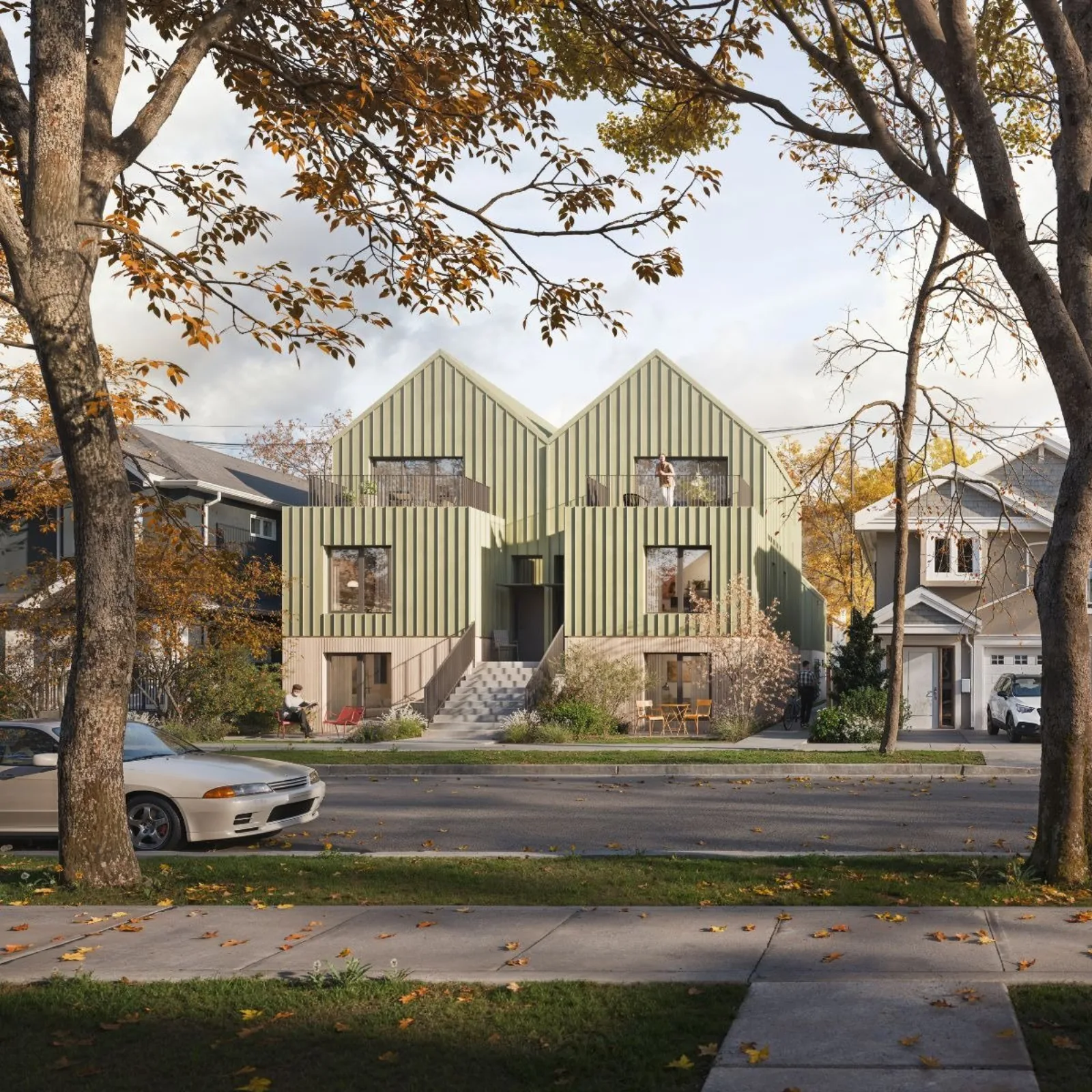
BC Standard Courtyard Sixplex — Front View
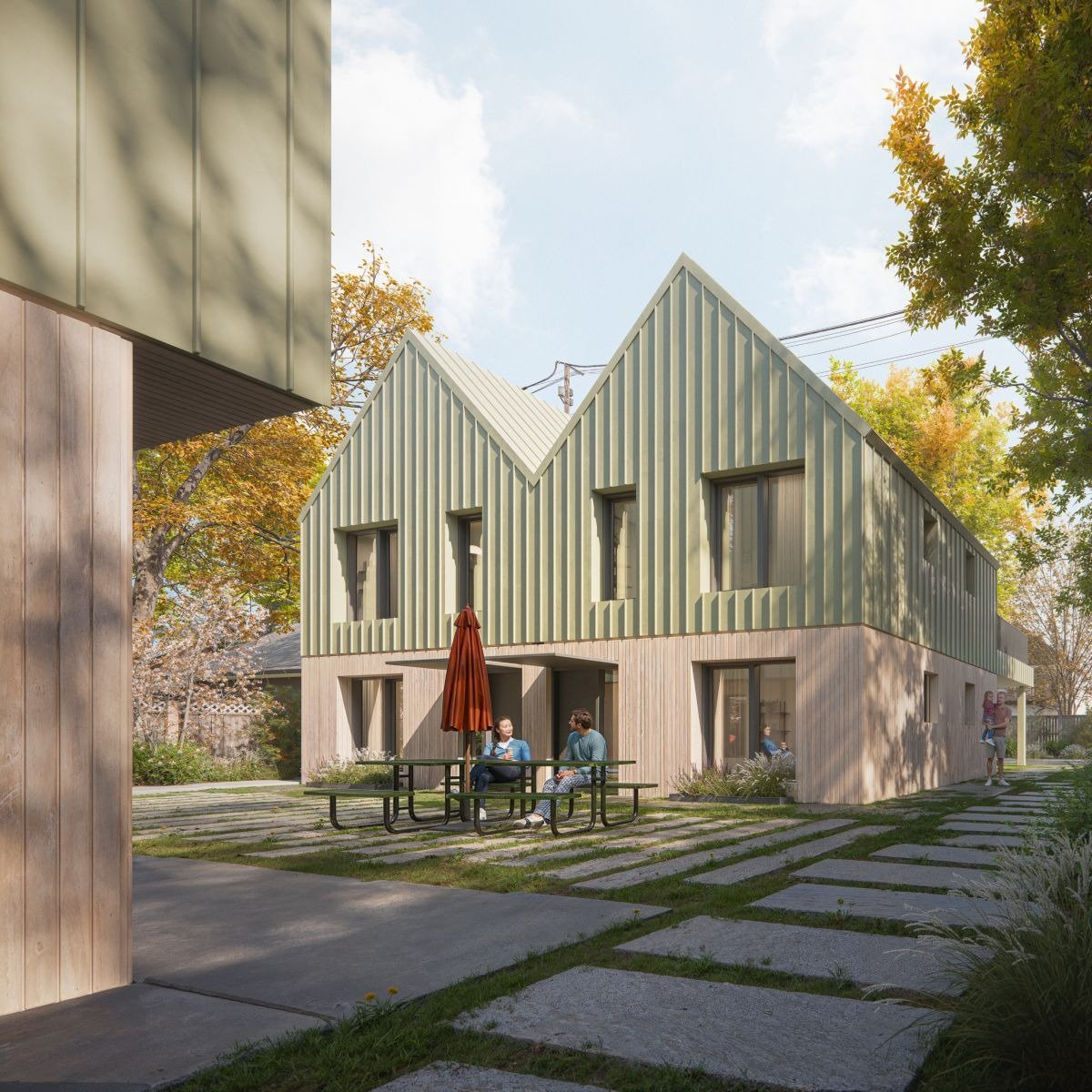
BC Standard Courtyard Sixplex — Rear View
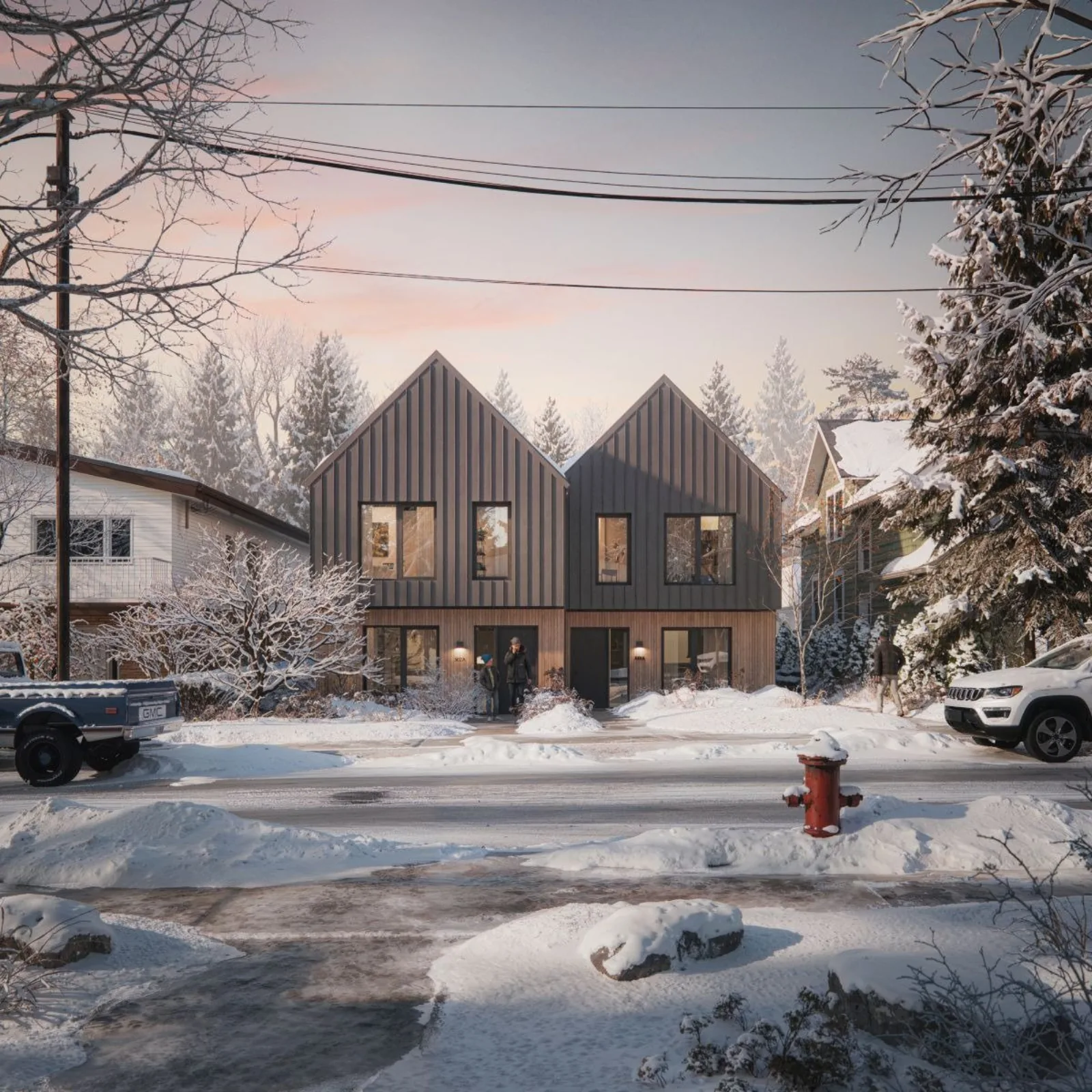
BC Standard Rowhouse — Housing Design Catalogue
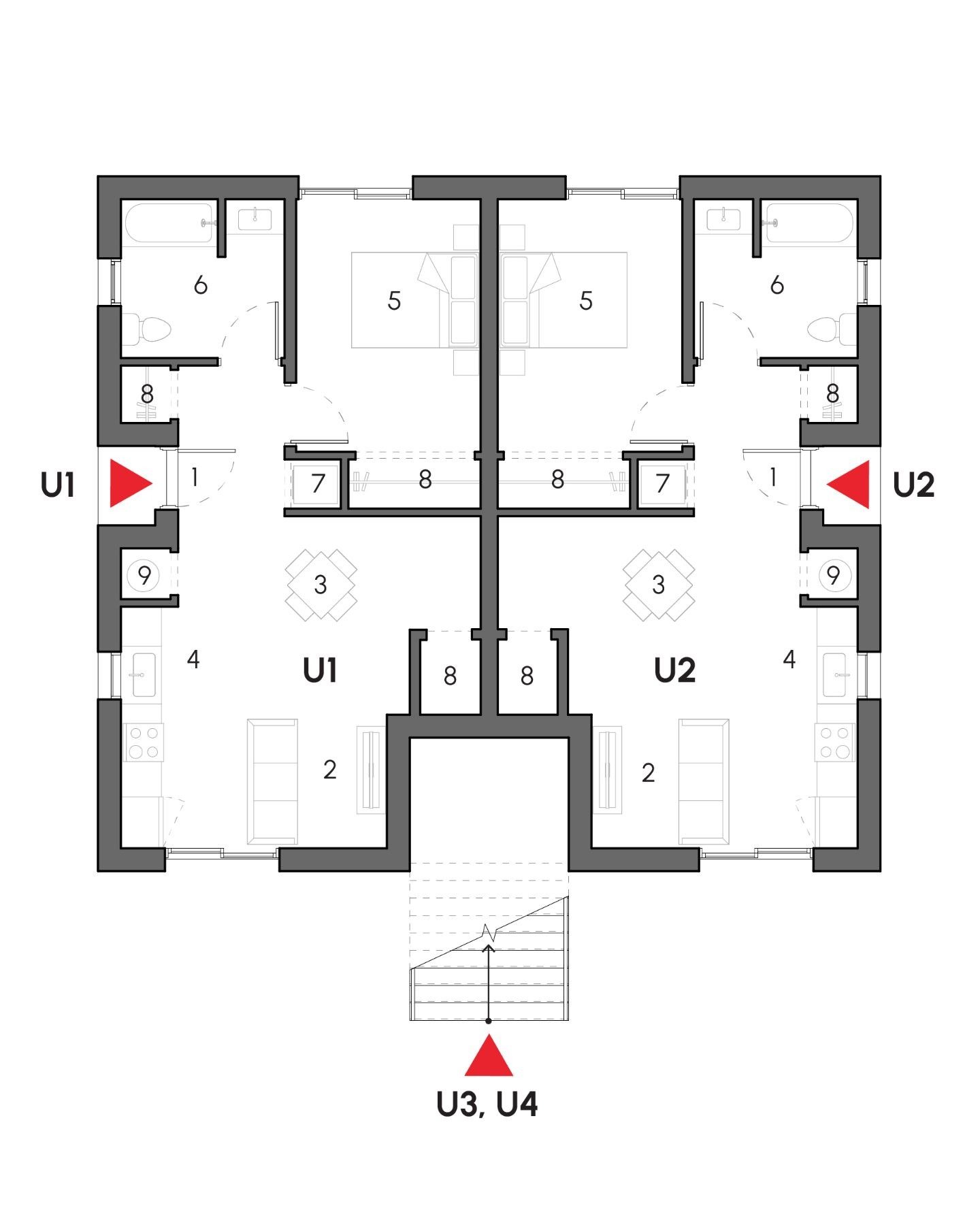
Courtyard Sixplex — Main Floor Plan
Images sourced from the BC Standardized Housing Designs Catalogue (gov.bc.ca). Designs created by Leckie Studio Architecture + Design and partner firms under contract to the Province of British Columbia.
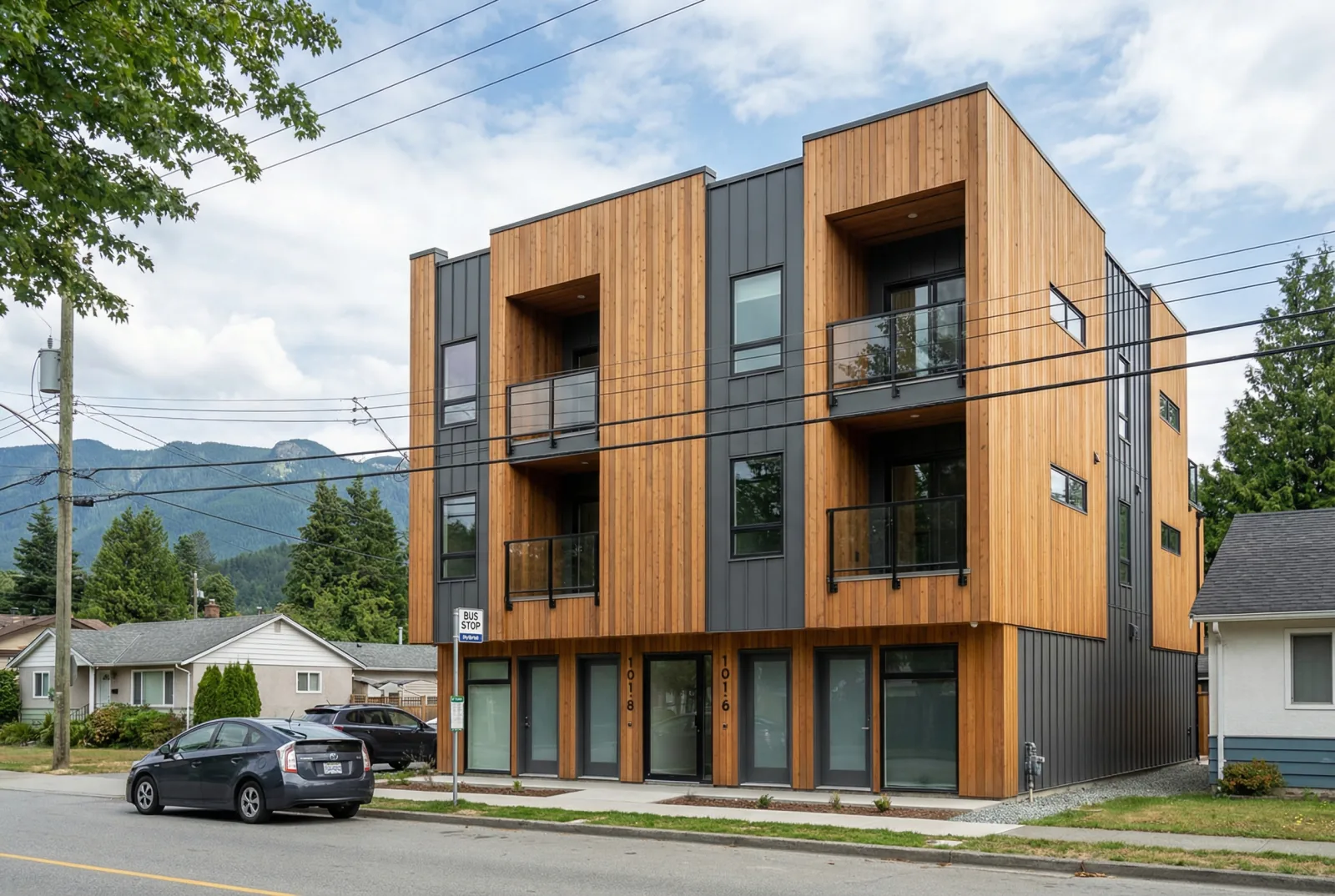
Townhouse 1 — Sixplex with stacked configuration
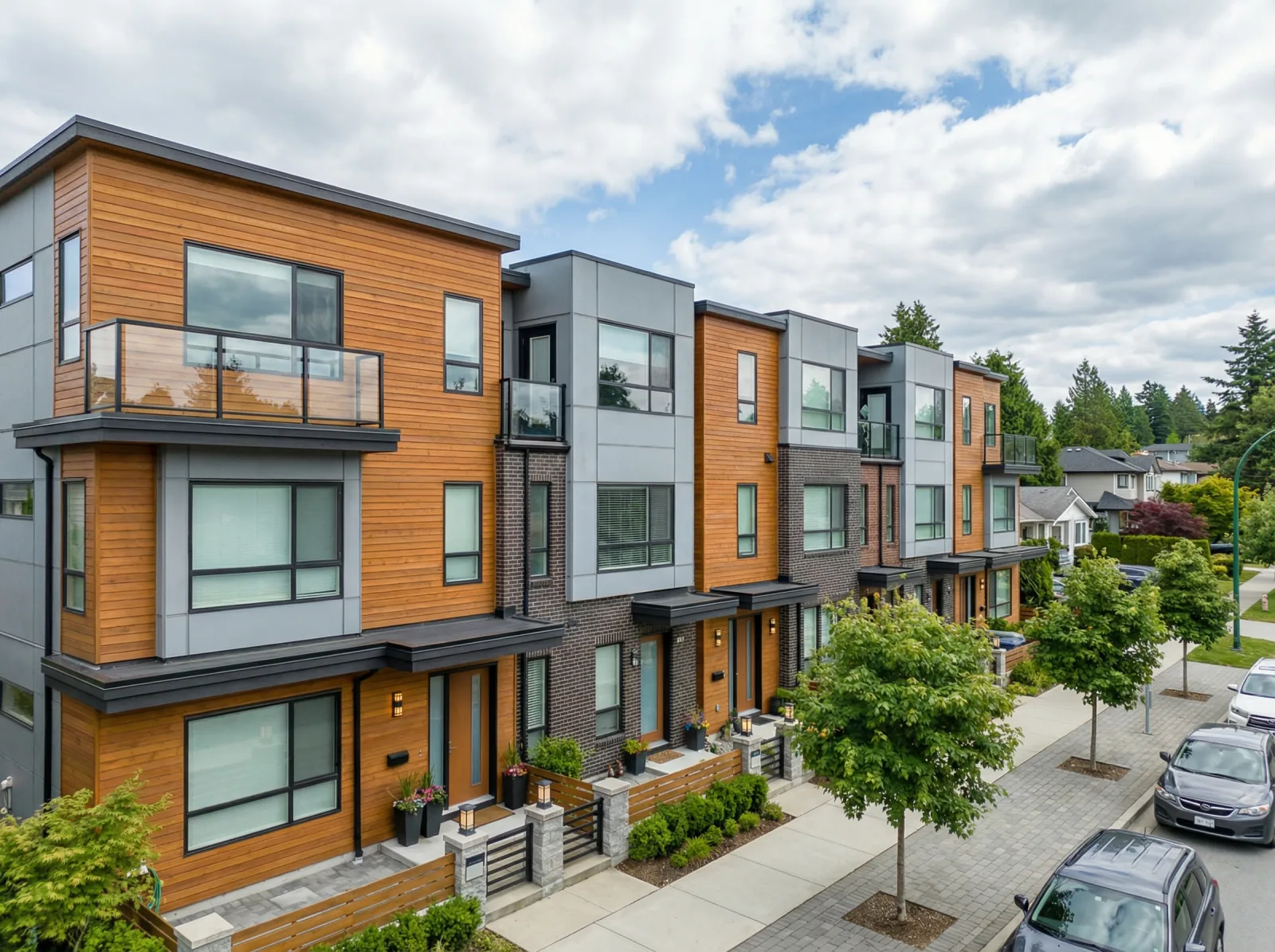
Townhouse 2 — Townhouse row with individual front doors
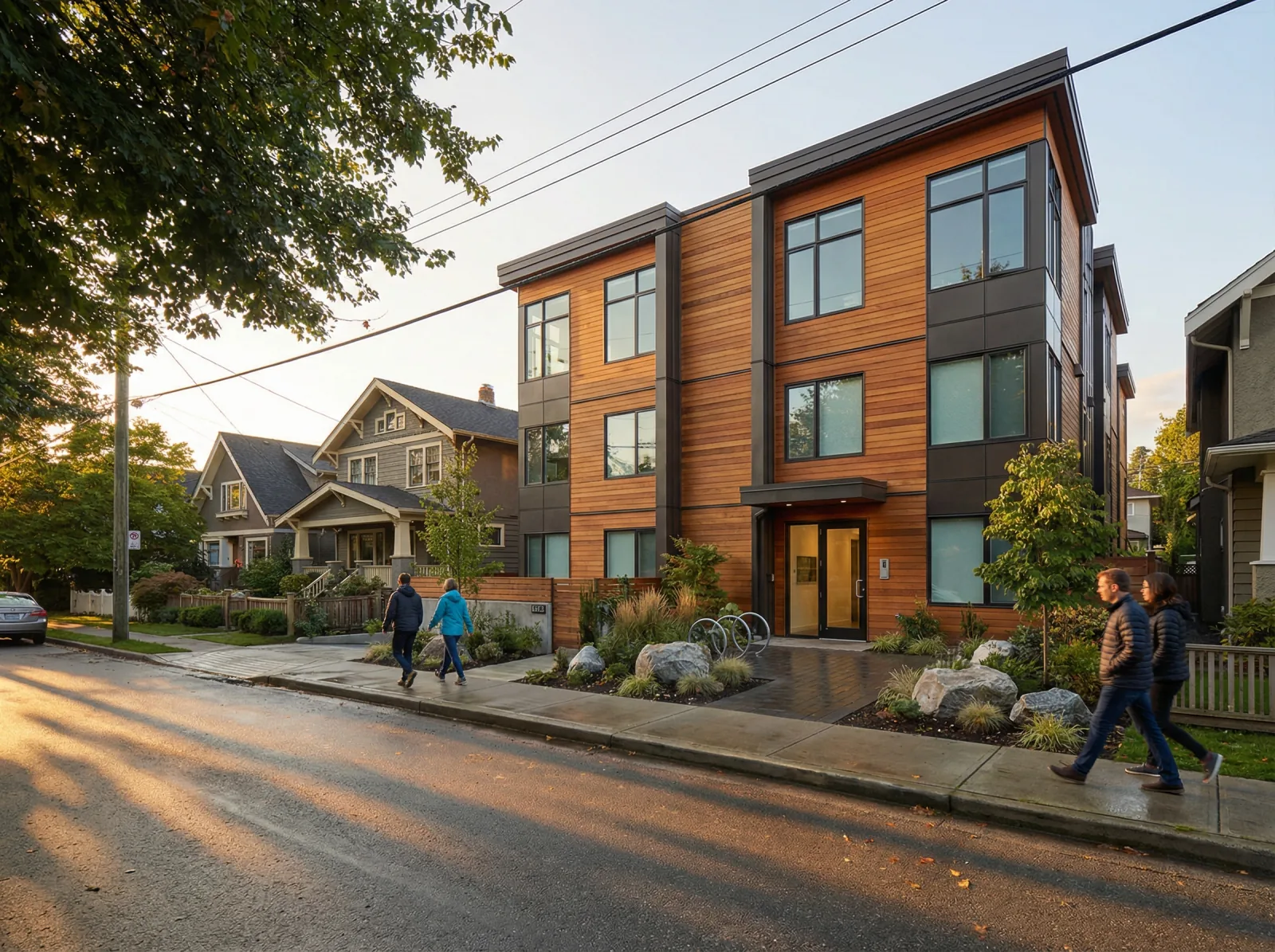
Street-level view showing neighbourhood-compatible design
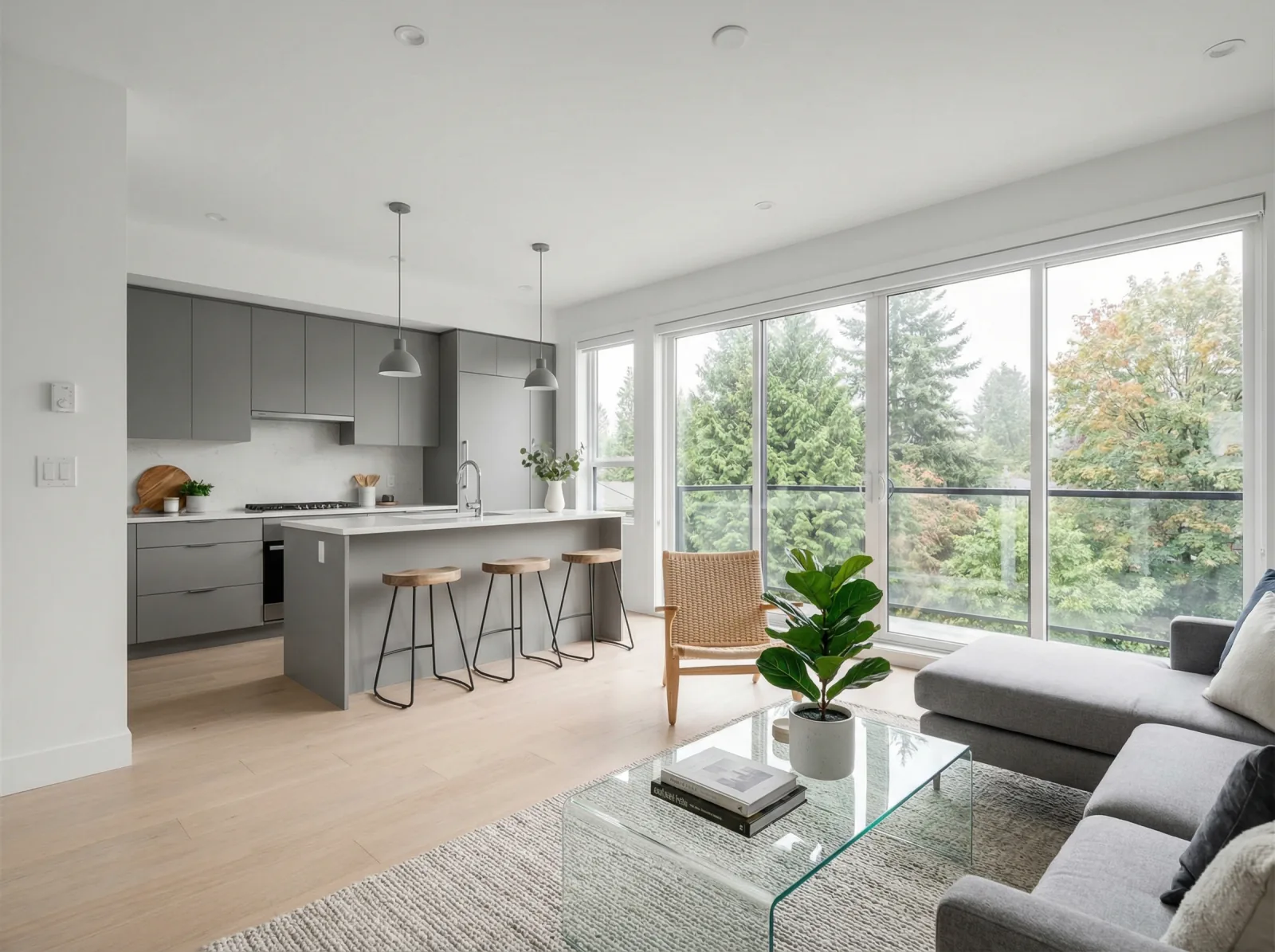
Typical unit interior with open-concept living
Lot Requirements
Six-unit projects require larger lots than fourplexes and must meet transit proximity criteria. The two concepts have different lot shape preferences.
| Specification | Sixplex (Townhouse 1) | Townhouse Row (Townhouse 2) |
|---|---|---|
| Minimum Frontage | 50 ft | 66 ft |
| Minimum Depth | 110 ft | 100 ft |
| Minimum Lot Area | 6,000 sq ft | 7,000 sq ft |
| Typical Zones | R1 (near transit) | R1 (near transit) |
| Max Height | 10.7 m (35 ft) | 10.7 m (35 ft) |
| Max FSR | 1.0 - 1.2 | 1.0 - 1.2 |
| Transit Proximity | Within 400 m | Within 400 m |
Townhouse 1 (Sixplex) vs. Townhouse 2 (Townhouse Row)
Townhouse 1 — Sixplex (50 ft lot)
Unit 5
Unit 6
Unit 3
Unit 4
Unit 1
Unit 2
3 storeys · 2 units per floor · Compact
Townhouse 2 — Townhouse Row (66 ft+ lot)
Unit 1
2-3 storey
Unit 2
2-3 storey
Unit 3
2-3 storey
Unit 4
2-3 storey
Unit 5
2-3 storey
Unit 6
2-3 storey
Row of 6 · Individual front doors · Wider lot
Illustrative configurations — actual layouts vary by design
Design Considerations
Accessibility
At least one unit must be fully accessible with a barrier-free path from the street. For sixplexes (Townhouse 1), this is typically a ground-floor unit with level entry. Townhouse rows (Townhouse 2) benefit from each unit having grade-level access, though the multi-storey nature means the upper floors may not be accessible without an elevator or lift.
Fire Separation
With six units, fire separation design becomes more complex. All inter-unit assemblies require 1-hour fire-resistance ratings. Sixplexes may need fire-rated corridors if units share internal circulation. Townhouse rows require fire-rated party walls between each unit. Sprinklers may be required depending on building area and municipal bylaws.
Sound Transmission
Assemblies must achieve STC 55 (airborne) and IIC 55 (impact) between all dwelling units. With six households, sound control is essential for livability. Consider exceeding minimum ratings to STC 60+ in sensitive areas. Pay particular attention to plumbing noise transmission, stairwell impact noise, and junction details where multiple assemblies meet.
Privacy
Townhouse rows inherently provide better privacy through individual front doors, private yards, and distinct unit massing. Sixplexes require more intentional design: offset windows, private balconies or patios, landscape buffering, and careful placement of shared areas like parking and waste storage.
Where Are Sixplexes Permitted in BC?
Six-unit projects are limited to lots near frequent transit. The availability depends on both lot size and transit proximity -- not all municipalities have qualifying areas.
| Notes | |||
|---|---|---|---|
| Vancouver | 6 | Adopted | Larger lots near transit; lots 50 ft+ within 400 m of frequent service |
| Burnaby | 6 | Adopted | Near SkyTrain stations and frequent bus routes; larger lot requirements |
| Surrey | 6 | Adopted | Transit-oriented areas; SkyTrain corridors and frequent bus routes |
| Coquitlam | 6 | Adopted | Near Evergreen Extension stations; lot size dependent |
| New Westminster | 6 | Adopted | Near SkyTrain; most of city qualifies due to transit coverage |
| North Vancouver (City) | 6 | Adopted | Near frequent transit corridors; select larger lots |
| Port Moody | 6 | Adopted | Near Evergreen Extension; limited qualifying lots |
| Richmond | 6 | Adopted | Near Canada Line stations; flood construction level applies |
Cost Breakdown
Six-unit projects benefit from the strongest economies of scale in the SSMUH category. The per-unit cost is lower than any smaller multiplex type, making these projects attractive for experienced developers.
Hard Costs
$370 - $460
per sq ft
Soft Costs
$150K - $200K
permits, design, fees
Total Project Cost
$1.8M - $3.0M
for all six units combined
Hard costs include foundation, framing, mechanical, electrical, plumbing, and finishes. Soft costs include architectural design, engineering, permits, surveys, legal, and project management. Larger projects may also include landscape architecture and traffic study fees.
Energy Requirements
All new sixplexes and townhouse rows must comply with BC Energy Step Code, typically Step 3 or higher. Six-unit buildings have excellent thermal performance potential due to the high ratio of shared walls to exposed surface area. Interior units achieve very low heating loads. Key considerations include centralized vs. individual mechanical systems (HRV, heating), shared vs. individual hot water systems, and solar-ready design for future PV installation on the larger roof area.
Run the Numbers for Your Property
Use the VanPlex proforma calculator to model sixplex or townhouse development scenarios on your specific lot -- including construction costs, financing, rental revenue, and return on equity.
Try the Proforma CalculatorFrequently Asked Questions
What is the difference between a sixplex and a townhouse row?
A sixplex (Townhouse 1) stacks six units across multiple storeys in a single building, similar to a small apartment. A townhouse row (Townhouse 2) arranges units side-by-side, each spanning 2-3 storeys with its own front door. The townhouse layout needs a wider lot (66 ft+) but feels more like individual homes, while the sixplex is more land-efficient on lots with 50 ft frontage.
Do I need to be near transit to build a sixplex?
Yes. Under SSMUH legislation, six-unit projects are only permitted on lots within 400 metres of a bus stop with frequent transit service (every 15 minutes or better during peak hours). Lots not meeting this criterion are generally limited to four units. Most SkyTrain-adjacent and major bus corridor properties qualify.
How do I handle parking for 6 units?
Municipalities cannot require more than 1 space per unit (6 total) under SSMUH. Since six-unit projects must be near transit, many cities reduce parking to 0.5 per unit or waive it entirely. Common solutions include tandem stalls, compact parking, carshare spaces, and enhanced bicycle parking. Some projects near rapid transit are built with zero vehicle parking.
Is a sixplex still classified as a Part 9 building?
It depends on total building area and unit sizes. If each unit is under 600 m² and the building is 3 storeys or less, it remains Part 9. Exceeding these thresholds triggers Part 3 classification, which involves more complex engineering, fire protection (sprinklers), and higher construction costs. The BC catalogue designs are sized to stay within Part 9 limits.
Related Design Guides
- Triplex designs and floor plans for smaller lots that cannot support six units.
- Fourplex designs and layouts for standard lots outside frequent transit areas.
- Duplex designs for narrow or constrained lots.
- Bare land vs building strata in BC before you commit to a six-unit strata plan.
- Vancouver zoning map to confirm your lot qualifies for six units.
Ready to Analyze Your Property?
Enter any BC address to get a free multiplex feasibility analysis with proforma projections.