Updated • April 2026 — Full Zoning Bylaw Rewrite Targeted Spring 2026
Burnaby R1 SSMUH: Gentle Density & Missing Middle Housing Guide
Burnaby's R1 Small-Scale Multi-Unit Housing (SSMUH) district enables gentle density development across all residential neighborhoods. Discover how Burnaby's missing middle housing regulations let you build duplexes, triplexes, and multiplexes under the new R1 zoning framework aligned with BC's Bill 44.
Source: City of Burnaby Planning and Development, R1 SSMUH District (August 2024), updated with December 2025 Council amendments. Current as of March 2026.
December 2025 council update: multiplex height cuts & reduced buildable area
In December 2025, Burnaby Council adopted final amendments that reduce the R1 SSMUH envelope to three storeys / 10 m for front buildings and two storeys / 7.5 m for rear buildings, remove rooftop patio height exemptions, cut lot coverage by 5% (with additional 10-15% reductions in certain conditions), reduce achievable floor area by 33-60%, and raise parking minimums to 0.67-1.0 spaces per unit. Provincial transit-oriented legislation limits enforcement of the new parking rules on approximately 57% of R1 lots. Burnaby also has a comprehensive Zoning Bylaw Rewrite project underway that will further reshape residential zoning.
Council decision
In December 2025, Council adopted final amendments reducing maximum height to three storeys / 10 m for front buildings and two storeys / 7.5 m for rear buildings. Rooftop patio height exemptions were removed. Lot coverage was cut by 5% across all housing types, with additional 10-15% reductions under certain conditions.
Floor-space impact
Achievable floor area is reduced 33-60% depending on housing type, unit count, and lot size. Single-building multiplexes see roughly 33% less floor area, while front-and-rear configurations on smaller lots can lose up to 60%.
Parking changes
Parking minimums increased from 0-0.5 to 0.67-1.0 spaces per unit depending on housing type and unit count. Provincial legislation prevents enforcement on FTNA lots, affecting roughly 57% of Burnaby's R1 properties.
Cost pressure
Vancouver Needs More Housing calculates the December 2025 height and density changes add roughly $100 per square foot to land costs for multiplex units.
If you secured permits under the August 2024 framework, confirm with Planning whether your project remains grandfathered. New feasibility requests should model the three-storey / 10 m front cap, two-storey / 7.5 m rear cap, reduced lot coverage, and updated parking requirements. For more on Burnaby's comprehensive Zoning Bylaw Rewrite project, see the City's Zoning Bylaw Rewrite page.
Background
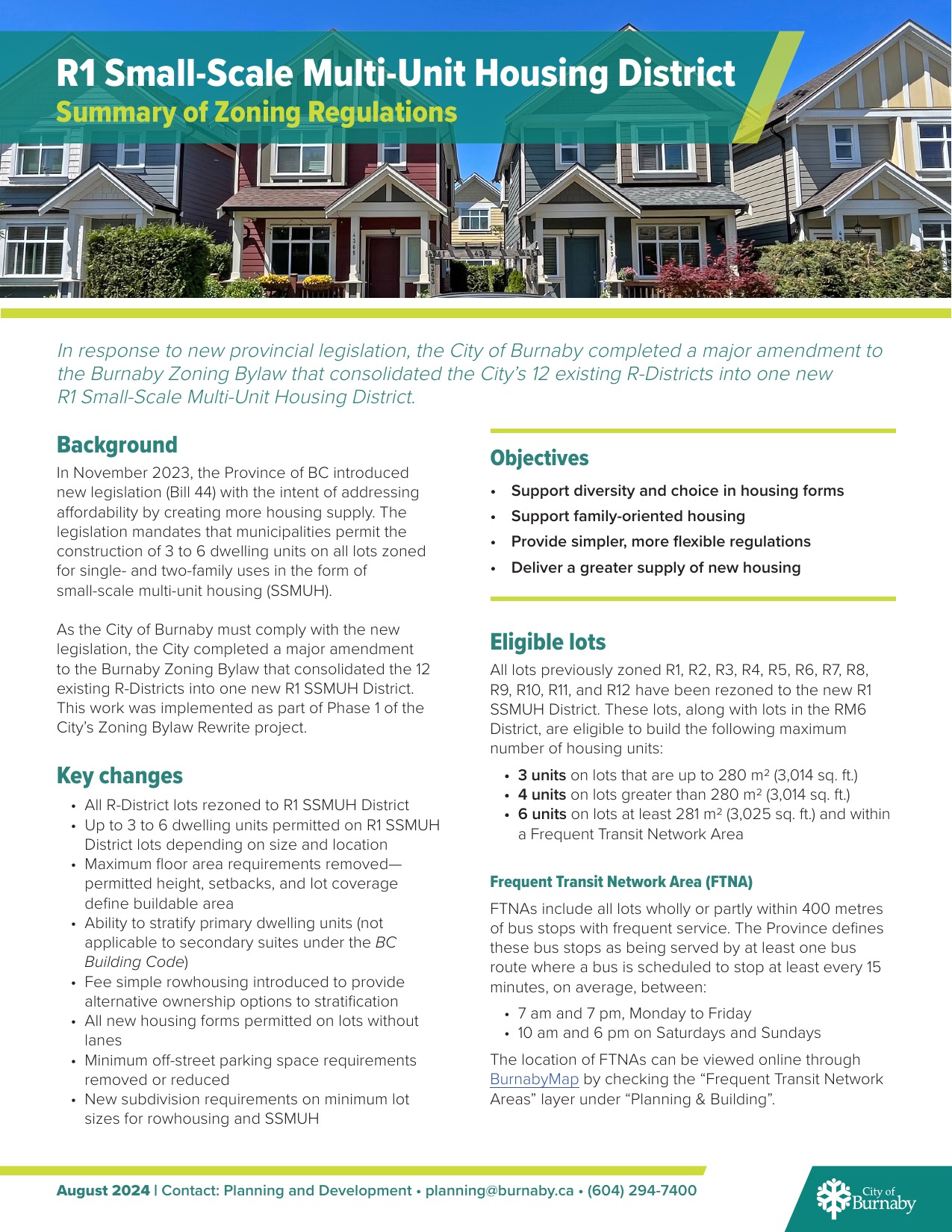
In November 2023 the Province of British Columbia introduced Bill 44 to expand gentle density. Burnaby responded by rewriting its zoning bylaw and merging twelve legacy R Districts into the new R1 Small-Scale Multi-Unit Housing District.
With Phase 1 of the Zoning Bylaw Rewrite complete and December 2025 amendments adopted, homeowners and builders now have a single playbook for multiplex projects. Burnaby's full Zoning Bylaw repeal-and-replace is targeted for adoption in spring 2026, with an effective date of July 1, 2026 — applicants timing a build around the transition should plan accordingly. The summary below captures the official guidance as amended through December 2025.
What is Gentle Density in Burnaby?
Gentle density refers to Burnaby's R1 SSMUH zoning approach that allows small-scale multi-unit housing—duplexes, triplexes, fourplexes, and small multiplexes—within traditional residential neighborhoods. This gradual increase in housing density maintains neighborhood character while creating more homes.
Understanding Missing Middle Housing in Burnaby
Missing middle housing fills the gap between single-family homes and high-rise apartments. In Burnaby, the R1 SSMUH district enables these housing types:
Duplexes & Triplexes
2-3 units offering gentle density transitions
Fourplexes & Multiplexes
4-6 units providing missing middle options
Row Housing
Fee simple alternative to strata ownership
Cottage Courts
Multiple detached units around shared space
Why Missing Middle Housing Matters
Burnaby's gentle density approach through R1 SSMUH creates more affordable housing options, increases neighborhood diversity, and allows homeowners to unlock property value through small-scale development—all while preserving the residential character that makes Burnaby neighborhoods desirable.
Key changes
- All R District lots rezoned into the new R1 Small-Scale Multi-Unit Housing (SSMUH) District.
- Up to 3 to 6 primary dwelling units permitted based on lot size and proximity to frequent transit.
- Maximum floor area limits removed. Height, setbacks, and lot coverage now define buildable volume.
- Stratification enabled for primary dwelling units while secondary suites remain tied to the principal title.
- Fee simple rowhousing introduced to provide an alternative to strata ownership.
- All new housing forms allowed on lots without lanes.
- Parking minimums set at 0.67 to 1.0 spaces per unit depending on housing type and unit count, though provincial rules limit enforcement on FTNA lots (about 57% of R1 properties).
- New subdivision rules set minimum lot sizes for rowhousing and SSMUH development.
Objectives
- Support diversity and choice in small-scale housing forms.
- Deliver family-oriented homes across Burnaby neighborhoods.
- Provide simpler, more flexible regulations for homeowners and builders.
- Increase the overall supply of new housing.
Eligible lots and unit counts
Every lot previously zoned R1 through R12 now falls under the R1 SSMUH District. Eligible RM6 lots are also captured. The number of primary dwelling units you can construct depends on the site area and whether the property sits inside a Frequent Transit Network Area (FTNA).
Lots up to 280 m2 (3,014 sq. ft.)
Up to 3 primary dwelling units
Applies to every former R District lot and eligible RM6 sites.
Lots larger than 280 m2 (over 3,014 sq. ft.)
Up to 4 primary dwelling units
Secondary suites count toward the total number of dwellings.
Lots at least 281 m2 within a Frequent Transit Network Area
Up to 6 primary dwelling units
Lot must be wholly or partly within 400 m of a frequent bus stop.
Frequent Transit Network Area (FTNA)
FTNAs include all lots that are wholly or partially within 400 meters of a bus stop with frequent service. A qualifying stop has at least one route where a bus arrives every 15 minutes on average between 7 am and 7 pm Monday to Friday, and between 10 am and 6 pm on weekends.
View FTNA boundaries on BurnabyMap by activating the "Frequent Transit Network Areas" layer within the Planning and Building section.
Housing forms you can build
The R1 SSMUH District promotes flexible housing forms to serve multiple household types. Combine configurations to balance revenue, livability, and financing goals.
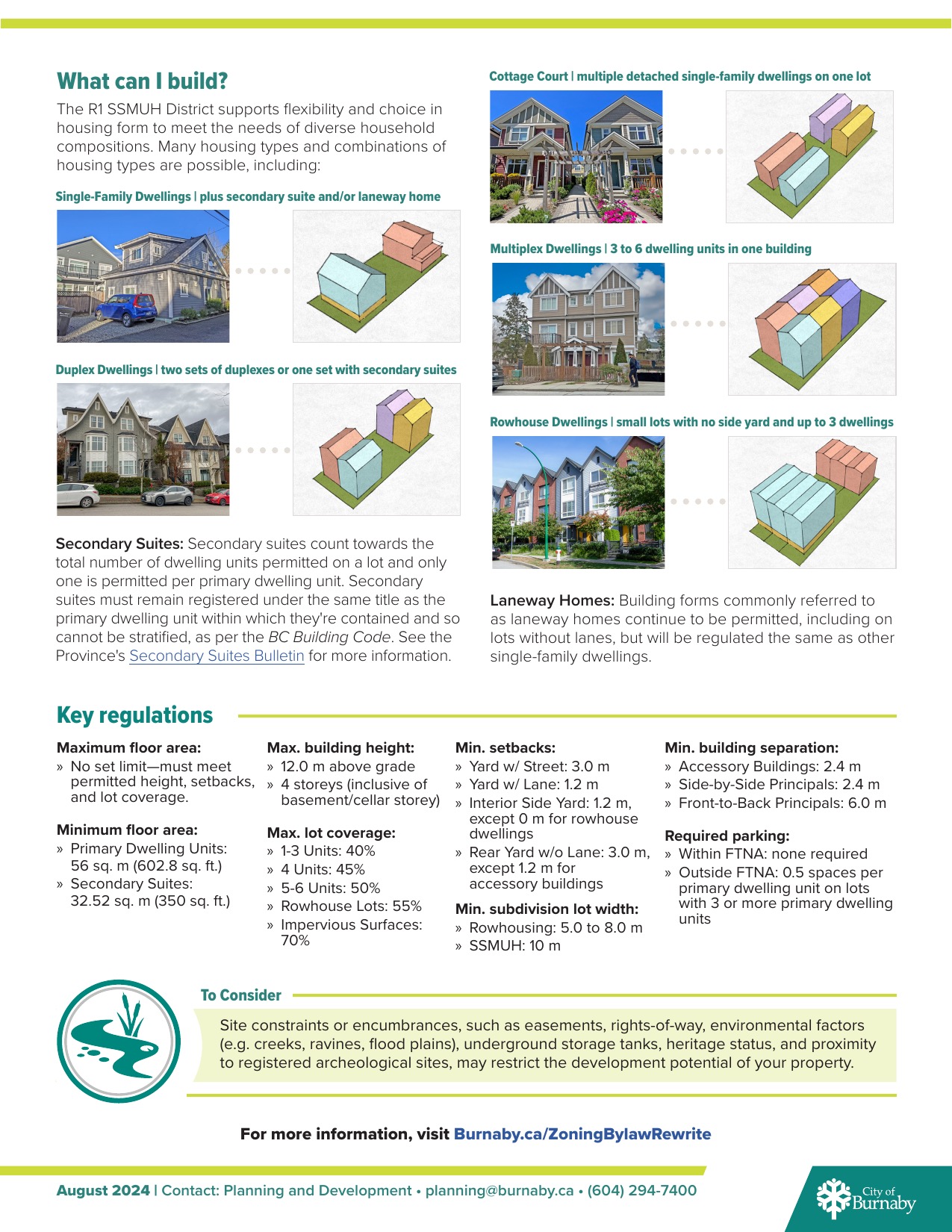
Single-family plus secondary suite and/or laneway home
Keep a principal home while adding rental income. Laneway homes remain permitted even on lots without lanes.
Duplex dwellings
Two principal units are permitted, with the ability to add secondary suites where space allows.
Multiplex dwellings (3 to 6 units)
Stacked or side-by-side configurations can deliver multiple front doors within one building envelope.
Fee simple rowhousing
Narrow fee simple lots with no side yards let owners avoid strata while meeting minimum frontage requirements.
Cottage court
Multiple detached dwellings around a shared open space provide family-oriented homes on a single lot.
Key regulations snapshot
These baseline standards guide envelope design before you dive into detailed site planning.
Maximum building height
In December 2025, Council adopted amendments reducing maximum building height from four storeys to three storeys / 10 m for front buildings. Rear principal buildings are limited to two storeys / 7.5 m. Height exemptions for rooftop patios have been removed. The original August 2024 framework had allowed 12.0 m (four storeys including basement).
Minimum floor areas
Primary dwelling units must be at least 56 m2 (603 sq. ft.); secondary suites must be at least 32.5 m2 (350 sq. ft.).
Building separations
Maintain 2.4 m between accessory buildings and side-by-side principal structures, and 6.0 m front-to-back.
Impervious surfaces
Total impervious area is capped at 70 percent of the lot.
Subdivision widths
Rowhousing lots must be 5.0 to 8.0 m wide. SSMUH subdivision lots must be at least 10 m wide.
Maximum lot coverage
- 1 to 3 primary units
- 30%
- 4 primary units
- 35%
- 5 to 6 primary units
- 40%
- Rowhousing lots
- 45%
December 2025 amendments reduced lot coverage by 5% across all housing types. Additional reductions of 10-15% may apply depending on housing type and lot conditions.
Minimum setbacks
- Yard with street frontage
- 3.0 m
- Yard with lane
- 1.2 m
- Interior side yard
- 1.2 m (0 m for rowhousing party walls)
- Rear yard without lane
- 3.0 m (1.2 m for accessory buildings)
Parking requirements
Council's December 2025 amendments increased parking minimums from 0-0.5 spaces per unit to 0.67-1.0 spaces per unit, depending on housing type and unit count. However, provincial legislation restricts Burnaby from enforcing these higher minimums on transit-oriented R1 lots within Frequent Transit Network Areas, which account for approximately 57% of all R1 properties in the city. Outside FTNAs, the new requirements of 0.67 to 1.0 spaces per unit apply in full.
Official summary visuals
Reference the original City of Burnaby summary pages alongside the digested guidance above when briefing consultants or meeting with planning staff.
How VanPlex helps you navigate the rules
Concept to permit support
We coordinate architect, engineering, and energy modeling teams to ensure your submission aligns with R1 SSMUH metrics before it reaches the City.
When a site is not viable
If the numbers do not pencil, leverage PlexRank to reallocate capital into multiplex infill projects that already meet our return thresholds.
Request your tailored multiplex feasibility
Share your Burnaby address to receive setbacks, servicing upgrades, timeline ranges, and pro forma budgets anchored in the new R1 SSMUH regulations.
Before you start
Burnaby highlights several site-specific factors that can still limit redevelopment even when zoning metrics are met. Address these early with your consultant team.
- Confirm easements, rights-of-way, and servicing constraints that could limit your proposed site plan.
- Review environmental considerations such as creeks, ravines, flood plains, or underground storage tanks.
- Check whether the property is listed on heritage registers or lies near registered archaeological sites.
Contact: Planning and Development, [email protected], (604) 294-7400.
Keep exploring
More multiplex support for Burnaby
Dive deeper into British Columbia's gentle density rollout with provincial guidance, statewide policy explainers, and practical tools that keep your Burnaby multiplex project on track.
Design Guidelines Hub
Explore BC's standardized multiplex designs, building code requirements, cost analysis, and permit process -- all in one place.
Browse design guidelines →BC SSMUH Guide
Understand provincial requirements, municipal adoption timelines, and VanPlex's delivery pillars for small-scale multi-unit housing.
Explore the guide →Gentle Density Playbook
Compare multiplex, rowhouse, and cottage court project strategies while you plan your Burnaby build-out.
View the playbook →All City Zoning Maps
Review zoning overlays, transit areas, and servicing considerations across Metro Vancouver, Tri-Cities, and Fraser Valley municipalities.
Browse maps →Multiplex & SSMUH Glossary
Decode Bill 44 terminology—FSR, stratification, gentle density, and more—so you can speak the same language as planners and lenders.
Learn the terms →